
LCMS
More information
WebinarsAbout usContact usTerms of use
LabRulez s.r.o. All rights reserved. Content available under a CC BY-SA 4.0 Attribution-ShareAlike
Author
Institute of Organic Chemistry and Biochemistry of the Czech Academy of Sciences
The Institute of Organic Chemistry and Biochemistry of the Czech Academy of Sciences (IOCB Prague) is a leading scientific institution in the Czech Republic, recognized internationally. Its primary mission is basic research in the fields of chemical biology and medicinal chemistry, organic and material oriented chemistry, chemistry of natural compounds, biochemistry and molecular biology, physical chemistry, theoretical chemistry, and analytical chemistry.
Tags
Article
Science and research
Video
LinkedIn Logo

Unique molecular CODE – Paramagnetic encoding of molecules
We, 3.1.2024
| Original article from: IOCB Prague
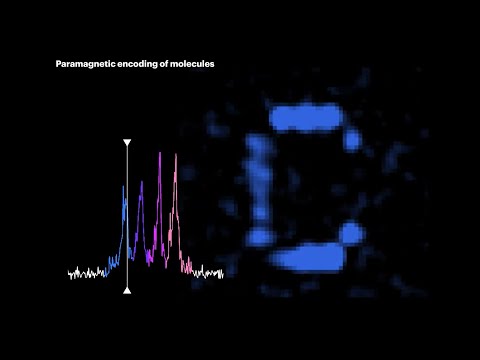
The principle of molecular coding created by Miloslav Polášek and his team at the IOCB Prague represents a new method on the border between the world of chemistry and modern technologies.
Video placeholder
  • Foto: IOCB Prague/Tomáš Belloň: Dr. Miloslav Polášek & Jan Kretschmer, Coordination Chemistry Group at IOCB Prague
  • Video: IOCB Prague/Miloslav Polášek, Tomáš Belloň: Paramagnetic encoding of molecules

Today we commonly encounter contactless RFID chips in a number of products, but can similar technology be implemented at the molecular level? The answer is yes. The principle of molecular encoding conceived by Miloslav Polášek and his team at IOCB Prague represents a novel method on the frontier of chemistry and modern technologies. Their paper on paramagnetic encoding of molecules was recently published in the journal Nature Communications.

Molecules as RFID chips

The new principle of molecular encoding and prototype of such a molecular system was initially only a sci-fi idea. After five years of development, the team succeeded in creating molecules with the right characteristics, the structure of which is suitable for the incorporation of ions of rare-earth metal elements, so-called lanthanides. These elements have special paramagnetic properties that allow tuning the response of the molecule in a magnetic field. The response can serve as a carrier of digital information and, analogically to RFID chips, it can be read in the radiofrequency spectrum by means of nuclear magnetic resonance. Moreover, these molecular constructions can be further linked and combined to create an increasingly complex yet still readable signal with a higher capacity for digital information.

IOCB Prague/Tomáš David: The researchers used a set of molecules containing two different lanthanides to encode the image of the word CODE, which they then read using magnetic resonance (artistic rendering)IOCB Prague/Tomáš David: The researchers used a set of molecules containing two different lanthanides to encode the image of the word CODE, which they then read using magnetic resonance (artistic rendering)

“With only six elements we could, for example, label all the euro banknotes currently in circulation with unique codes. Considering we can use twelve of these elements, we get a tool with immense potential.”

  • Miloslav Polášek, Head of the Coordination Chemistry Group at IOCB Prague.

“In our paper for Nature Communications, we introduced the simplest possible system of two linked molecules, into which we inserted various combinations of atoms of two selected lanthanides, dysprosium and holmium. We showed that even with a primitive system like that, it is possible to create four unique signals and use them to generate fifteen different digital codes,” says Miloslav Polášek, head of the Coordination Chemistry Group at the Institute of Organic Chemistry and Biochemistry of the Czech Academy of Sciences / IOCB Prague.

“That might not seem like much at first, but the number of codes grows dramatically as the number of elements is increased. Four elements provide 65,535 codes, and with only six we could, for example, label with unique codes all the euro banknotes currently in circulation. Considering that we can use twelve of these elements, we get a tool with immense potential.”

IOCB Prague/Tomáš Belloň: Dr. Miloslav Polášek & Jan Kretschmer, Coordination Chemistry Group at IOCB PragueIOCB Prague/Tomáš Belloň: Dr. Miloslav Polášek & Jan Kretschmer, Coordination Chemistry Group at IOCB Prague

Lanthanides in molecular cage

A molecular construction that allows incorporation of lanthanide atoms at precisely defined locations plays a key role. “Our group works with chelators, which are molecules that can form bonds with metal ions and enclose them in a structure that looks like a cage. We used an amino acid to link these metal-containing molecular cages, and we also linked another component to them that acts as a transmitter in the magnetic field and whose frequency depends on the type of the metal ions and their order,” explains Jan Kretschmer, a member of the team at IOCB Prague and a student at the Faculty of Science, Charles University.

Miloslav Polášek and his team are not the only ones interested in the use of molecules as information carriers; other researchers have primarily looked for ways inspired by biology, using for example DNA. The advantage of DNA is its ability to hold massive amounts of information in a single molecule. On the other hand, a big disadvantage is its complicated reading, which requires collection and manipulation of a sample, which moreover poses a risk of contamination with a different DNA from the surrounding environment. The fundamental advantage of paramagnetic molecular encoding is that the information can be read remotely. The reading process can be repeated indefinitely without any damage to the molecule or depletion. The information is stored permanently.

“When we submitted our paper to the journal the first time, one of the reviewers suggested that we provide a specific example of using the method. We took that as a challenge and performed two experiments. In the first one, we used our set of molecules to encode an image with the word ’CODE‘ inscribed in it, which we then read using magnetic resonance in collaboration with the team of Daniel Jirák of the Institute of Clinical and Experimental Medicine. In the second experiment, we used a slightly different method to encode the word ’Lanthanide‘ in the digital code,” adds Dr. Polášek.

IOCB Prague/Tomáš Belloň: Dr. Miloslav Polášek & Jan Kretschmer, Coordination Chemistry Group at IOCB PragueIOCB Prague/Tomáš Belloň: Dr. Miloslav Polášek & Jan Kretschmer, Coordination Chemistry Group at IOCB Prague

Future perspectives

The current molecular system uses four different lanthanides and is reliably capable of 16-bit encoding; however, an optimized system using also the remaining lanthanides could, in principle, allow 64-bit encoding or even higher, and that would provide opportunities for applications in many areas. In principle, it is possible to label microscopic objects, such as cells, as well as macroscopic objects like drugs or banknotes. Miloslav Polášek’s team is planning applications in the coming years not only for chemistry and pharmacy but also for telemedicine and other sectors focusing on development of innovative technologies.

In addition to the teams at IOCB Prague and the Faculty of Science, Charles University, scientists from the Institute of Clinical and Experimental Medicine and the University of Chemistry and Technology, Prague also contributed to the research. Financial support was provided by the Czech Science Foundation (project no. 17-22834Y).

IOCB Prague/Tomáš David, Tomáš Belloň: The word LANTHANIDE in molecular digital code created with four different lanthanidesIOCB Prague/Tomáš David, Tomáš Belloň: The word LANTHANIDE in molecular digital code created with four different lanthanides

Original article

Kretschmer, J.; David, T.; Dračínský, M.; Socha, O.; Jirak, D.; Vít, M.; Jurok, R.; Kuchař, M.; Císařová, I.; Polasek, M. Paramagnetic encoding of molecules. Nat Commun 2022, 13, 3179. https://doi.org/10.1038/s41467-022-30811-9

Miloslav Polášek, Ph.D. heads the Coordination Chemistry Group at IOCB Prague. In his research, he has long focused on compounds of so-called lanthanides, rare-earth elements, and their use in medicine and other industrial areas. In previous years, the team of Dr. Polášek succeeded in developing a new method for producing the radioactive isotope lutetium 177 to treat cancer. The patented method was licensed to the US company SHINE Technologies, which is using it to produce lutetium 177 on an industrial scale.

IOCB Prague/Tomáš Belloň: Miloslav Polášek's scientific group of Coordination ChemistryIOCB Prague/Tomáš Belloň: Miloslav Polášek's scientific group of Coordination Chemistry

Institute of Organic Chemistry and Biochemistry of the Czech Academy of Sciences
LinkedIn Logo
 

Related content

Overcoming Strong Solvent Effects in the Analysis of Vepdegestrant

Applications
| 2026 | Agilent Technologies
Instrumentation
HPLC
Manufacturer
Agilent Technologies
Industries
Pharma & Biopharma

Identification of Double Bond Positions and Relative Acyl Chain Positions in Egg Yolk Phosphatidylcholines Using OAD-TOF System

Applications
| 2026 | Shimadzu
Instrumentation
LC/MS, LC/MS/MS, LC/TOF, LC/HRMS
Manufacturer
Shimadzu
Industries
Food & Agriculture

High Molecular-Weight Polysaccharide Characterization by SEC-MALS Using GTxResolve™ 1000 and 2000 Å SEC Columns

Applications
| 2026 | Waters
Instrumentation
GPC/SEC, Consumables, LC columns
Manufacturer
Waters
Industries
Pharma & Biopharma, Food & Agriculture

Development and Optimization for a Comprehensive LC/MS/MS Method for the Detection of 74 PFAS Compounds

Applications
| 2026 | Agilent Technologies
Instrumentation
LC/MS, LC/MS/MS, LC/QQQ
Manufacturer
Agilent Technologies
Industries
Food & Agriculture

PFAS in Biota: Risk Context & Robust Analytical Solutions

Others
| 2026 | ALS Europe
Instrumentation
Laboratory analysis, LC/MS, LC/MS/MS
Manufacturer
Industries
Environmental
 

Related articles

Meeting EU Drinking Water Standards: The Critical Role of Sample Prep in Trace Contaminant Analysis
Article | Environment

Meeting EU Drinking Water Standards: The Critical Role of Sample Prep in Trace Contaminant Analysis

EU Drinking Water Directive 2020/2184 sets ultra-low limits for pesticides, PFAS, metals and endocrine disruptors. Learn how SPE and nitrogen evaporation enable LC-MS/MS compliance at ng/L levels.
Organomation
tag
share
more
Oligos Made Easy - Part 2: AEX
Article | Science and research

Oligos Made Easy - Part 2: AEX

Anion exchange chromatography (AEX) is a powerful tool for oligonucleotide analysis. Learn how charge-based separation reveals purity, length variants, and structural insights in modern LC workflows.
KNAUER
tag
share
more
Current sensors are not good enough. Scientists propose a new way to monitor plant health
Article | Science and research

Current sensors are not good enough. Scientists propose a new way to monitor plant health

Researchers present printable, low-cost sensor technologies using smart materials to enable real-time plant health monitoring and advance smart agriculture solutions.
CATRIN
tag
share
more
Unlocking Hemoglobin Variant Detection: LC-HR-MS Breakthrough with Ainslie Chen
Interview | Science and research

Unlocking Hemoglobin Variant Detection: LC-HR-MS Breakthrough with Ainslie Chen

Interview with Ainslie Chen on using LC-HRMS and C4 reversed-phase chromatography for precise hemoglobin variant detection and future clinical proteomics applications.
Organomation
tag
share
more
 

Related content

Overcoming Strong Solvent Effects in the Analysis of Vepdegestrant

Applications
| 2026 | Agilent Technologies
Instrumentation
HPLC
Manufacturer
Agilent Technologies
Industries
Pharma & Biopharma

Identification of Double Bond Positions and Relative Acyl Chain Positions in Egg Yolk Phosphatidylcholines Using OAD-TOF System

Applications
| 2026 | Shimadzu
Instrumentation
LC/MS, LC/MS/MS, LC/TOF, LC/HRMS
Manufacturer
Shimadzu
Industries
Food & Agriculture

High Molecular-Weight Polysaccharide Characterization by SEC-MALS Using GTxResolve™ 1000 and 2000 Å SEC Columns

Applications
| 2026 | Waters
Instrumentation
GPC/SEC, Consumables, LC columns
Manufacturer
Waters
Industries
Pharma & Biopharma, Food & Agriculture

Development and Optimization for a Comprehensive LC/MS/MS Method for the Detection of 74 PFAS Compounds

Applications
| 2026 | Agilent Technologies
Instrumentation
LC/MS, LC/MS/MS, LC/QQQ
Manufacturer
Agilent Technologies
Industries
Food & Agriculture

PFAS in Biota: Risk Context & Robust Analytical Solutions

Others
| 2026 | ALS Europe
Instrumentation
Laboratory analysis, LC/MS, LC/MS/MS
Manufacturer
Industries
Environmental
 

Related articles

Meeting EU Drinking Water Standards: The Critical Role of Sample Prep in Trace Contaminant Analysis
Article | Environment

Meeting EU Drinking Water Standards: The Critical Role of Sample Prep in Trace Contaminant Analysis

EU Drinking Water Directive 2020/2184 sets ultra-low limits for pesticides, PFAS, metals and endocrine disruptors. Learn how SPE and nitrogen evaporation enable LC-MS/MS compliance at ng/L levels.
Organomation
tag
share
more
Oligos Made Easy - Part 2: AEX
Article | Science and research

Oligos Made Easy - Part 2: AEX

Anion exchange chromatography (AEX) is a powerful tool for oligonucleotide analysis. Learn how charge-based separation reveals purity, length variants, and structural insights in modern LC workflows.
KNAUER
tag
share
more
Current sensors are not good enough. Scientists propose a new way to monitor plant health
Article | Science and research

Current sensors are not good enough. Scientists propose a new way to monitor plant health

Researchers present printable, low-cost sensor technologies using smart materials to enable real-time plant health monitoring and advance smart agriculture solutions.
CATRIN
tag
share
more
Unlocking Hemoglobin Variant Detection: LC-HR-MS Breakthrough with Ainslie Chen
Interview | Science and research

Unlocking Hemoglobin Variant Detection: LC-HR-MS Breakthrough with Ainslie Chen

Interview with Ainslie Chen on using LC-HRMS and C4 reversed-phase chromatography for precise hemoglobin variant detection and future clinical proteomics applications.
Organomation
tag
share
more
 

Related content

Overcoming Strong Solvent Effects in the Analysis of Vepdegestrant

Applications
| 2026 | Agilent Technologies
Instrumentation
HPLC
Manufacturer
Agilent Technologies
Industries
Pharma & Biopharma

Identification of Double Bond Positions and Relative Acyl Chain Positions in Egg Yolk Phosphatidylcholines Using OAD-TOF System

Applications
| 2026 | Shimadzu
Instrumentation
LC/MS, LC/MS/MS, LC/TOF, LC/HRMS
Manufacturer
Shimadzu
Industries
Food & Agriculture

High Molecular-Weight Polysaccharide Characterization by SEC-MALS Using GTxResolve™ 1000 and 2000 Å SEC Columns

Applications
| 2026 | Waters
Instrumentation
GPC/SEC, Consumables, LC columns
Manufacturer
Waters
Industries
Pharma & Biopharma, Food & Agriculture

Development and Optimization for a Comprehensive LC/MS/MS Method for the Detection of 74 PFAS Compounds

Applications
| 2026 | Agilent Technologies
Instrumentation
LC/MS, LC/MS/MS, LC/QQQ
Manufacturer
Agilent Technologies
Industries
Food & Agriculture

PFAS in Biota: Risk Context & Robust Analytical Solutions

Others
| 2026 | ALS Europe
Instrumentation
Laboratory analysis, LC/MS, LC/MS/MS
Manufacturer
Industries
Environmental
 

Related articles

Meeting EU Drinking Water Standards: The Critical Role of Sample Prep in Trace Contaminant Analysis
Article | Environment

Meeting EU Drinking Water Standards: The Critical Role of Sample Prep in Trace Contaminant Analysis

EU Drinking Water Directive 2020/2184 sets ultra-low limits for pesticides, PFAS, metals and endocrine disruptors. Learn how SPE and nitrogen evaporation enable LC-MS/MS compliance at ng/L levels.
Organomation
tag
share
more
Oligos Made Easy - Part 2: AEX
Article | Science and research

Oligos Made Easy - Part 2: AEX

Anion exchange chromatography (AEX) is a powerful tool for oligonucleotide analysis. Learn how charge-based separation reveals purity, length variants, and structural insights in modern LC workflows.
KNAUER
tag
share
more
Current sensors are not good enough. Scientists propose a new way to monitor plant health
Article | Science and research

Current sensors are not good enough. Scientists propose a new way to monitor plant health

Researchers present printable, low-cost sensor technologies using smart materials to enable real-time plant health monitoring and advance smart agriculture solutions.
CATRIN
tag
share
more
Unlocking Hemoglobin Variant Detection: LC-HR-MS Breakthrough with Ainslie Chen
Interview | Science and research

Unlocking Hemoglobin Variant Detection: LC-HR-MS Breakthrough with Ainslie Chen

Interview with Ainslie Chen on using LC-HRMS and C4 reversed-phase chromatography for precise hemoglobin variant detection and future clinical proteomics applications.
Organomation
tag
share
more
 

Related content

Overcoming Strong Solvent Effects in the Analysis of Vepdegestrant

Applications
| 2026 | Agilent Technologies
Instrumentation
HPLC
Manufacturer
Agilent Technologies
Industries
Pharma & Biopharma

Identification of Double Bond Positions and Relative Acyl Chain Positions in Egg Yolk Phosphatidylcholines Using OAD-TOF System

Applications
| 2026 | Shimadzu
Instrumentation
LC/MS, LC/MS/MS, LC/TOF, LC/HRMS
Manufacturer
Shimadzu
Industries
Food & Agriculture

High Molecular-Weight Polysaccharide Characterization by SEC-MALS Using GTxResolve™ 1000 and 2000 Å SEC Columns

Applications
| 2026 | Waters
Instrumentation
GPC/SEC, Consumables, LC columns
Manufacturer
Waters
Industries
Pharma & Biopharma, Food & Agriculture

Development and Optimization for a Comprehensive LC/MS/MS Method for the Detection of 74 PFAS Compounds

Applications
| 2026 | Agilent Technologies
Instrumentation
LC/MS, LC/MS/MS, LC/QQQ
Manufacturer
Agilent Technologies
Industries
Food & Agriculture

PFAS in Biota: Risk Context & Robust Analytical Solutions

Others
| 2026 | ALS Europe
Instrumentation
Laboratory analysis, LC/MS, LC/MS/MS
Manufacturer
Industries
Environmental
 

Related articles

Meeting EU Drinking Water Standards: The Critical Role of Sample Prep in Trace Contaminant Analysis
Article | Environment

Meeting EU Drinking Water Standards: The Critical Role of Sample Prep in Trace Contaminant Analysis

EU Drinking Water Directive 2020/2184 sets ultra-low limits for pesticides, PFAS, metals and endocrine disruptors. Learn how SPE and nitrogen evaporation enable LC-MS/MS compliance at ng/L levels.
Organomation
tag
share
more
Oligos Made Easy - Part 2: AEX
Article | Science and research

Oligos Made Easy - Part 2: AEX

Anion exchange chromatography (AEX) is a powerful tool for oligonucleotide analysis. Learn how charge-based separation reveals purity, length variants, and structural insights in modern LC workflows.
KNAUER
tag
share
more
Current sensors are not good enough. Scientists propose a new way to monitor plant health
Article | Science and research

Current sensors are not good enough. Scientists propose a new way to monitor plant health

Researchers present printable, low-cost sensor technologies using smart materials to enable real-time plant health monitoring and advance smart agriculture solutions.
CATRIN
tag
share
more
Unlocking Hemoglobin Variant Detection: LC-HR-MS Breakthrough with Ainslie Chen
Interview | Science and research

Unlocking Hemoglobin Variant Detection: LC-HR-MS Breakthrough with Ainslie Chen

Interview with Ainslie Chen on using LC-HRMS and C4 reversed-phase chromatography for precise hemoglobin variant detection and future clinical proteomics applications.
Organomation
tag
share
more
Other projects
GCMS
ICPMS
Follow us
More information
WebinarsAbout usContact usTerms of use
LabRulez s.r.o. All rights reserved. Content available under a CC BY-SA 4.0 Attribution-ShareAlike