LCMS
More information
WebinarsAbout usContact usTerms of use
LabRulez s.r.o. All rights reserved. Content available under a CC BY-SA 4.0 Attribution-ShareAlike
Author
Organomation
Organomation
Organomation, founded in 1959, designs and manufactures high-quality nitrogen evaporators and extraction systems. Known for innovation and durability, their lab instruments are used globally for efficient sample preparation with strong customer support.
Tags
Article
Product
Video
LinkedIn Logo

When is Evaporation Under Vacuum Helpful?

Th, 15.5.2025
| Original article from: Organomation / David Oliva
This article explores when and why evaporation under vacuum is helpful, highlighting its advantages, applications, and key considerations.
Video placeholder
  • Photo: Organomation: When is Evaporation Under Vacuum Helpful?
  • Video: Organomation: 8 Position S-EVAP-KD Solvent Evaporator Demonstration

Evaporation is a fundamental process in chemistry and laboratory settings, essential for concentrating solutions, purifying compounds, and drying samples. While traditional evaporation relies on heat to remove solvents, evaporation under vacuum offers a more efficient and versatile approach. By reducing the pressure, vacuum evaporation lowers the boiling point of solvents, allowing for faster and safer evaporation at lower temperatures. This article explores when and why evaporation under vacuum is helpful, highlighting its advantages, applications, and key considerations.

Understanding Evaporation Under Vacuum

Evaporation under vacuum, also known as vacuum evaporation, involves reducing the atmospheric pressure around a liquid, which decreases its boiling point. This allows the solvent to evaporate at a lower temperature than it would under normal atmospheric conditions. The process typically employs equipment like rotary evaporators and vacuum ovens, which create a controlled low-pressure environment to facilitate efficient solvent removal.

How It Works:

  • Pressure Reduction: A vacuum pump reduces the pressure in the system. 
  • Lower Boiling Point: The reduced pressure lowers the boiling point of the solvent. 
  • Evaporation: The solvent evaporates at the lower temperature, leaving behind the concentrated sample or dried product.

Advantages of Vacuum Evaporation  

Enhanced Efficiency and Speed 

Vacuum evaporation significantly speeds up the solvent removal process. The lower boiling point means that solvents evaporate more quickly, reducing the time required for concentration or drying.

Lower Temperatures

Evaporating at lower temperatures is crucial for preserving thermally sensitive compounds that might degrade under higher heat. This is particularly important in pharmaceutical and biochemical applications.

Improved Safety 

By avoiding high temperatures, vacuum evaporation reduces the risk of thermal decomposition and hazardous reactions. It also minimizes the potential for solvent vapors to become flammable or explosive.

Reduced Solvent Usage and Waste 

Vacuum evaporation often requires less solvent and generates less waste. This is beneficial for both cost savings and environmental sustainability. For example, Organomation large scale evaporators are capable of recollecting up to 97% of starting solvent.

Applications in Laboratory Settings 

Sample Concentration 

Vacuum evaporation is widely used to concentrate samples for analytical techniques such as high-performance liquid chromatography (HPLC) and gas chromatography-mass spectrometry (GC-MS). Concentrating the sample improves the detection limits and accuracy of these methods.

Drying Samples

It is also employed for drying samples before further analysis or storage. Removing moisture is crucial for accurate weight measurements and preventing degradation of sensitive compounds.

Preparation for Crystallization 

In crystallization studies, vacuum evaporation can be used to concentrate solutions to supersaturation, facilitating the formation of crystals.

Industrial Applications of Vacuum Evaporation 

Environmental Analysis 

In environmental labs, vacuum evaporation concentrates pollutants from large volume water samples, allowing for more accurate detection and quantification of contaminants

Chemical Manufacturing 

Vacuum evaporation is employed in chemical manufacturing for solvent recovery and recycling, reducing costs and environmental impact.

Pharmaceutical Industry 

In pharmaceutical manufacturing, vacuum evaporation is essential for purifying active pharmaceutical ingredients (APIs) by removing solvents and other impurities without degrading the product.

Food and Beverage Industry 

The food industry uses vacuum evaporation to concentrate flavors and extracts. This process enhances the intensity of flavors while preserving the quality of the ingredients.

Key Considerations for Vacuum Evaporation 

Equipment Selection

Choosing the right equipment is crucial for successful vacuum evaporation. The selection depends on the sample type, volume, and specific application requirements. Here are the main types of evaporators that integrate vacuum:

Rotary evaporators: Rotary evaporators, commonly referred to as "rotovaps," are widely used in laboratories for efficiently removing solvents from samples. They consist of a rotating flask, a condenser, and a vacuum system. The rotating motion increases the surface area for evaporation, and the vacuum reduces the boiling point of the solvent, making the process faster and more efficient.

Large Scale Parallel Evaporators: Organomation S-EVAP is a specialized evaporator designed for the efficient concentration of multiple samples simultaneously. The optional vacuum manifold system to reduce the boiling point of solvents, facilitating faster evaporation at lower temperatures. This system is ideal for laboratories needing to concentrate samples in Kuderna-Danish (KD) flasks, often used in environmental testing, food and beverage analysis, and pharmaceutical research. The S-EVAP provides precise control over temperature and vacuum levels, ensuring reproducibility and safety in sample processing.
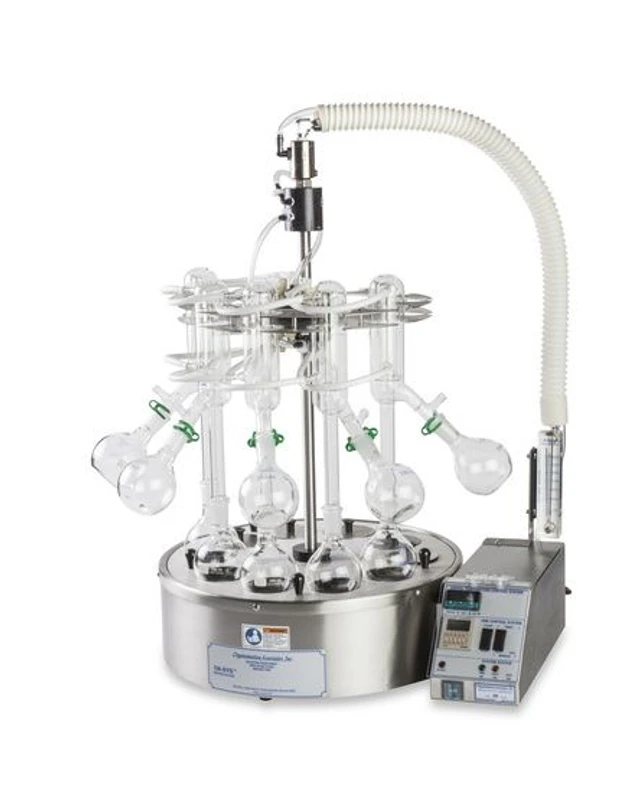
Organomation: When is Evaporation Under Vacuum Helpful?: Organomation S-EVAP-RB Solvent Evaporator - 10 position.Organomation: When is Evaporation Under Vacuum Helpful?: Organomation S-EVAP-RB Solvent Evaporator - 10 position.

Vacuum ovens: Vacuum ovens are used for drying samples that are sensitive to heat or require low-temperature evaporation. They provide a controlled environment where the pressure and temperature can be precisely adjusted. Vacuum ovens are ideal for drying solid and viscous samples, as well as for performing vacuum distillations.

Centrifugal evaporators: Centrifugal evaporators use a combination of vacuum, heat, and centrifugal force to evaporate solvents. They are particularly useful for high-throughput applications where multiple samples need to be processed simultaneously. These systems are commonly used in drug discovery and biochemical research.

Discover: When Nitrogen Blowdown is Preferable Over Centrifugal Evaporation

Falling film evaporators: Falling film evaporators are used for continuous evaporation processes, where the liquid flows down a heated surface in a thin film. The vacuum system reduces the boiling point, and the thin film facilitates rapid solvent evaporation. These evaporators are used in large-scale industrial applications, such as in the food and beverage industry.

Freeze dryers: Freeze dryers, or lyophilizers, integrate vacuum to sublimate frozen solvents directly from the solid to the gas phase. This technique is used for drying thermally sensitive materials, such as biological samples and pharmaceuticals, without damaging their structure or activity.

Discover: How Nitrogen Blow Down Compares to Lyophilization

Spray dryers: Spray dryers use a vacuum system in combination with a spray mechanism to evaporate solvents from liquid samples. The liquid is atomized into fine droplets, which are then exposed to a heated gas stream under vacuum, causing rapid solvent evaporation. This method is used for producing powders and granules from liquid solutions.

Solvent Properties

Understanding the properties of the solvents being used is essential. Different solvents behave differently under vacuum, and their boiling points, vapor pressures, and potential for forming azeotropes must be considered.

Vacuum evaporators excel in processing samples with naturally high boiling points, such as dimethyl sulfoxide (DMSO), N,N-dimethylformamide (DMF), and water. The reduced pressure lowers the boiling points, making the evaporation process more efficient and less thermally stressful for sensitive samples.

Understanding how solvents behave under reduced pressure, including potential azeotrope formation, is critical for effective evaporation.

Process Control 

Monitoring and controlling temperature and pressure are vital for optimizing the evaporation process. Precise control ensures efficient solvent removal while protecting the sample from degradation.

Safety Precautions

Proper handling of volatile and hazardous solvents is necessary to prevent accidents. This includes using appropriate containment, ventilation, and personal protective equipment.

Evaporation under vacuum is a powerful and versatile technique with numerous advantages over traditional evaporation methods. It offers enhanced efficiency, lower operating temperatures, and improved safety, making it invaluable in both laboratory and industrial settings. As technology advances and new applications arise, the role of vacuum evaporation will continue to expand, driving innovation and improving outcomes across various scientific and industrial fields.

To find out the best evaporation method for your needs, start a conversation with our experts at [email protected], or use our handy evaporation method recommendation tool.

Organomation
LinkedIn Logo
 

Related content

Overcoming Strong Solvent Effects in the Analysis of Vepdegestrant

Applications
| 2026 | Agilent Technologies
Instrumentation
HPLC
Manufacturer
Agilent Technologies
Industries
Pharma & Biopharma

Identification of Double Bond Positions and Relative Acyl Chain Positions in Egg Yolk Phosphatidylcholines Using OAD-TOF System

Applications
| 2026 | Shimadzu
Instrumentation
LC/MS, LC/MS/MS, LC/TOF, LC/HRMS
Manufacturer
Shimadzu
Industries
Food & Agriculture

High Molecular-Weight Polysaccharide Characterization by SEC-MALS Using GTxResolve™ 1000 and 2000 Å SEC Columns

Applications
| 2026 | Waters
Instrumentation
GPC/SEC, Consumables, LC columns
Manufacturer
Waters
Industries
Pharma & Biopharma, Food & Agriculture

Development and Optimization for a Comprehensive LC/MS/MS Method for the Detection of 74 PFAS Compounds

Applications
| 2026 | Agilent Technologies
Instrumentation
LC/MS, LC/MS/MS, LC/QQQ
Manufacturer
Agilent Technologies
Industries
Food & Agriculture

PFAS in Biota: Risk Context & Robust Analytical Solutions

Others
| 2026 | ALS Europe
Instrumentation
Laboratory analysis, LC/MS, LC/MS/MS
Manufacturer
Industries
Environmental
 

Related articles

JUNIOR STAR Grants at UCT Prague: Two talented women from abroad driving innovation in science
Article | Scientists

JUNIOR STAR Grants at UCT Prague: Two talented women from abroad driving innovation in science

Two outstanding early-career researchers at UCT Prague, Filipa Oliveira and Stella Gonsales, received prestigious GAČR JUNIOR STAR grants for innovative research in materials science and sustainable chemistry.
UCT Prague
tag
share
more
Research from IOCB Prague reveals a previously unknown mechanism of genetic transcription
Article | Science and research

Research from IOCB Prague reveals a previously unknown mechanism of genetic transcription

Scientists at IOCB Prague reveal a previously unknown mechanism that initiates gene transcription. Using cryo-EM, they uncover how alarmone molecules enable RNA synthesis under stress.
Institute of Organic Chemistry and Biochemistry of the Czech Academy of Sciences
tag
share
more
Food Adulteration and How It Is Revealed by Analytical Chemistry
Article | Food

Food Adulteration and How It Is Revealed by Analytical Chemistry

Food adulteration threatens quality and consumer trust. Discover how HPLC and modern chromatographic systems from Watrex Praha help identify oil, honey, and wine adulteration with high confidence.
Watrex Praha
tag
share
more
Affinity, Gel Filtration, Size Exclusion Chromatography: Repurposing Kinase Inhibitors for Malaria
Interview | Video

Affinity, Gel Filtration, Size Exclusion Chromatography: Repurposing Kinase Inhibitors for Malaria

This podcast explores how chromatography (FPLC/SEC) and mass spectrometry support malaria drug discovery, from protein purification and QC to interaction studies and complex sample preparation.
Organomation
tag
share
more
 

Related content

Overcoming Strong Solvent Effects in the Analysis of Vepdegestrant

Applications
| 2026 | Agilent Technologies
Instrumentation
HPLC
Manufacturer
Agilent Technologies
Industries
Pharma & Biopharma

Identification of Double Bond Positions and Relative Acyl Chain Positions in Egg Yolk Phosphatidylcholines Using OAD-TOF System

Applications
| 2026 | Shimadzu
Instrumentation
LC/MS, LC/MS/MS, LC/TOF, LC/HRMS
Manufacturer
Shimadzu
Industries
Food & Agriculture

High Molecular-Weight Polysaccharide Characterization by SEC-MALS Using GTxResolve™ 1000 and 2000 Å SEC Columns

Applications
| 2026 | Waters
Instrumentation
GPC/SEC, Consumables, LC columns
Manufacturer
Waters
Industries
Pharma & Biopharma, Food & Agriculture

Development and Optimization for a Comprehensive LC/MS/MS Method for the Detection of 74 PFAS Compounds

Applications
| 2026 | Agilent Technologies
Instrumentation
LC/MS, LC/MS/MS, LC/QQQ
Manufacturer
Agilent Technologies
Industries
Food & Agriculture

PFAS in Biota: Risk Context & Robust Analytical Solutions

Others
| 2026 | ALS Europe
Instrumentation
Laboratory analysis, LC/MS, LC/MS/MS
Manufacturer
Industries
Environmental
 

Related articles

JUNIOR STAR Grants at UCT Prague: Two talented women from abroad driving innovation in science
Article | Scientists

JUNIOR STAR Grants at UCT Prague: Two talented women from abroad driving innovation in science

Two outstanding early-career researchers at UCT Prague, Filipa Oliveira and Stella Gonsales, received prestigious GAČR JUNIOR STAR grants for innovative research in materials science and sustainable chemistry.
UCT Prague
tag
share
more
Research from IOCB Prague reveals a previously unknown mechanism of genetic transcription
Article | Science and research

Research from IOCB Prague reveals a previously unknown mechanism of genetic transcription

Scientists at IOCB Prague reveal a previously unknown mechanism that initiates gene transcription. Using cryo-EM, they uncover how alarmone molecules enable RNA synthesis under stress.
Institute of Organic Chemistry and Biochemistry of the Czech Academy of Sciences
tag
share
more
Food Adulteration and How It Is Revealed by Analytical Chemistry
Article | Food

Food Adulteration and How It Is Revealed by Analytical Chemistry

Food adulteration threatens quality and consumer trust. Discover how HPLC and modern chromatographic systems from Watrex Praha help identify oil, honey, and wine adulteration with high confidence.
Watrex Praha
tag
share
more
Affinity, Gel Filtration, Size Exclusion Chromatography: Repurposing Kinase Inhibitors for Malaria
Interview | Video

Affinity, Gel Filtration, Size Exclusion Chromatography: Repurposing Kinase Inhibitors for Malaria

This podcast explores how chromatography (FPLC/SEC) and mass spectrometry support malaria drug discovery, from protein purification and QC to interaction studies and complex sample preparation.
Organomation
tag
share
more
 

Related content

Overcoming Strong Solvent Effects in the Analysis of Vepdegestrant

Applications
| 2026 | Agilent Technologies
Instrumentation
HPLC
Manufacturer
Agilent Technologies
Industries
Pharma & Biopharma

Identification of Double Bond Positions and Relative Acyl Chain Positions in Egg Yolk Phosphatidylcholines Using OAD-TOF System

Applications
| 2026 | Shimadzu
Instrumentation
LC/MS, LC/MS/MS, LC/TOF, LC/HRMS
Manufacturer
Shimadzu
Industries
Food & Agriculture

High Molecular-Weight Polysaccharide Characterization by SEC-MALS Using GTxResolve™ 1000 and 2000 Å SEC Columns

Applications
| 2026 | Waters
Instrumentation
GPC/SEC, Consumables, LC columns
Manufacturer
Waters
Industries
Pharma & Biopharma, Food & Agriculture

Development and Optimization for a Comprehensive LC/MS/MS Method for the Detection of 74 PFAS Compounds

Applications
| 2026 | Agilent Technologies
Instrumentation
LC/MS, LC/MS/MS, LC/QQQ
Manufacturer
Agilent Technologies
Industries
Food & Agriculture

PFAS in Biota: Risk Context & Robust Analytical Solutions

Others
| 2026 | ALS Europe
Instrumentation
Laboratory analysis, LC/MS, LC/MS/MS
Manufacturer
Industries
Environmental
 

Related articles

JUNIOR STAR Grants at UCT Prague: Two talented women from abroad driving innovation in science
Article | Scientists

JUNIOR STAR Grants at UCT Prague: Two talented women from abroad driving innovation in science

Two outstanding early-career researchers at UCT Prague, Filipa Oliveira and Stella Gonsales, received prestigious GAČR JUNIOR STAR grants for innovative research in materials science and sustainable chemistry.
UCT Prague
tag
share
more
Research from IOCB Prague reveals a previously unknown mechanism of genetic transcription
Article | Science and research

Research from IOCB Prague reveals a previously unknown mechanism of genetic transcription

Scientists at IOCB Prague reveal a previously unknown mechanism that initiates gene transcription. Using cryo-EM, they uncover how alarmone molecules enable RNA synthesis under stress.
Institute of Organic Chemistry and Biochemistry of the Czech Academy of Sciences
tag
share
more
Food Adulteration and How It Is Revealed by Analytical Chemistry
Article | Food

Food Adulteration and How It Is Revealed by Analytical Chemistry

Food adulteration threatens quality and consumer trust. Discover how HPLC and modern chromatographic systems from Watrex Praha help identify oil, honey, and wine adulteration with high confidence.
Watrex Praha
tag
share
more
Affinity, Gel Filtration, Size Exclusion Chromatography: Repurposing Kinase Inhibitors for Malaria
Interview | Video

Affinity, Gel Filtration, Size Exclusion Chromatography: Repurposing Kinase Inhibitors for Malaria

This podcast explores how chromatography (FPLC/SEC) and mass spectrometry support malaria drug discovery, from protein purification and QC to interaction studies and complex sample preparation.
Organomation
tag
share
more
 

Related content

Overcoming Strong Solvent Effects in the Analysis of Vepdegestrant

Applications
| 2026 | Agilent Technologies
Instrumentation
HPLC
Manufacturer
Agilent Technologies
Industries
Pharma & Biopharma

Identification of Double Bond Positions and Relative Acyl Chain Positions in Egg Yolk Phosphatidylcholines Using OAD-TOF System

Applications
| 2026 | Shimadzu
Instrumentation
LC/MS, LC/MS/MS, LC/TOF, LC/HRMS
Manufacturer
Shimadzu
Industries
Food & Agriculture

High Molecular-Weight Polysaccharide Characterization by SEC-MALS Using GTxResolve™ 1000 and 2000 Å SEC Columns

Applications
| 2026 | Waters
Instrumentation
GPC/SEC, Consumables, LC columns
Manufacturer
Waters
Industries
Pharma & Biopharma, Food & Agriculture

Development and Optimization for a Comprehensive LC/MS/MS Method for the Detection of 74 PFAS Compounds

Applications
| 2026 | Agilent Technologies
Instrumentation
LC/MS, LC/MS/MS, LC/QQQ
Manufacturer
Agilent Technologies
Industries
Food & Agriculture

PFAS in Biota: Risk Context & Robust Analytical Solutions

Others
| 2026 | ALS Europe
Instrumentation
Laboratory analysis, LC/MS, LC/MS/MS
Manufacturer
Industries
Environmental
 

Related articles

JUNIOR STAR Grants at UCT Prague: Two talented women from abroad driving innovation in science
Article | Scientists

JUNIOR STAR Grants at UCT Prague: Two talented women from abroad driving innovation in science

Two outstanding early-career researchers at UCT Prague, Filipa Oliveira and Stella Gonsales, received prestigious GAČR JUNIOR STAR grants for innovative research in materials science and sustainable chemistry.
UCT Prague
tag
share
more
Research from IOCB Prague reveals a previously unknown mechanism of genetic transcription
Article | Science and research

Research from IOCB Prague reveals a previously unknown mechanism of genetic transcription

Scientists at IOCB Prague reveal a previously unknown mechanism that initiates gene transcription. Using cryo-EM, they uncover how alarmone molecules enable RNA synthesis under stress.
Institute of Organic Chemistry and Biochemistry of the Czech Academy of Sciences
tag
share
more
Food Adulteration and How It Is Revealed by Analytical Chemistry
Article | Food

Food Adulteration and How It Is Revealed by Analytical Chemistry

Food adulteration threatens quality and consumer trust. Discover how HPLC and modern chromatographic systems from Watrex Praha help identify oil, honey, and wine adulteration with high confidence.
Watrex Praha
tag
share
more
Affinity, Gel Filtration, Size Exclusion Chromatography: Repurposing Kinase Inhibitors for Malaria
Interview | Video

Affinity, Gel Filtration, Size Exclusion Chromatography: Repurposing Kinase Inhibitors for Malaria

This podcast explores how chromatography (FPLC/SEC) and mass spectrometry support malaria drug discovery, from protein purification and QC to interaction studies and complex sample preparation.
Organomation
tag
share
more
Other projects
GCMS
ICPMS
Follow us
More information
WebinarsAbout usContact usTerms of use
LabRulez s.r.o. All rights reserved. Content available under a CC BY-SA 4.0 Attribution-ShareAlike