Author
Phenomenex
Phenomenex
Phenomenex is a global technology leader committed to developing novel analytical chemistry solutions that solve the separation and purification challenges of researchers in industrial, government and academic laboratories.
Tags
Article
Academy
Video
LinkedIn Logo

Considerations when working with solid samples and SPE
We, 16.7.2025
| Original article from: Phenomenex
Solid phase extraction enables clean-up, pre-concentration, and solvent switching. Proper solvent choice and SPE mode are key for effective solid sample preparation.
Video placeholder
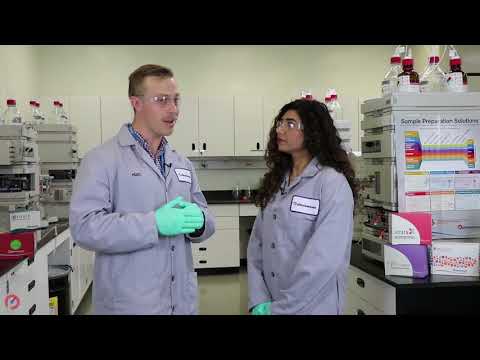
  • Photo: Phenomenex: Considerations when working with solid samples and SPE
  • Video: Phenomenex: Solid Phase Extraction (SPE) Tutorial 

Solid phase extraction is routinely selected as a sample preparation technique prior to HPLC and GC analysis. It provides:

  • Clean-up;
  • Analyte pre-concentration;
  • Solvent switching.

This works well for any homogeneous liquid samples, but clearly a solid sample cannot be applied directly to an SPE device. Here we will consider how best to approach the handling of solid samples prior to SPE.

The first stage of sample pre-treatment involves homogenising the solid sample with a suitable solvent. The solvent selected for this purpose will:

  • Be effective at solubilising the analyte.
  • Be effective at solubilising the sample matrix, although this is not necessary providing the sample is blended well with the solvent.
  • Ideally it will be a weak solvent when it comes to the SPE stage. This may not be possible, and it may be necessary to dry down and reconstitute the sample prior to loading on to the SPE cartridge.

Having formed a suspension of the sample in a suitable solvent the sample should be vortexed to promote thorough mixing, and then centrifuged to pellet the insoluble components of the matrix. The solvent should then be removed for further treatment.

At this point the SPE mechanism needs to be selected: 

Reversed Phase SPE Method

Mechanism / Weak Solvent / Strong Solvent

  • Reversed phase – Water/buffer – Acetonitrile/Methanol (hexane strongest)
  • Normal phase – Hexane/Heptane – Mid polar organic such as DCM, MTBE, IPA (strongest is water)
  • Ion exchange – Aqueous buffer at a pH which promotes ion exchange interactions between analyte and SPE sorbent – Organic solvent, typically methanol with pH adjustment to disrupt the ion exchange interactions.

Analyte properties and sample diluent both need to be considered at this point. Reversed phase extractions are effective for moderately polar to moderately hydrophobic analytes, but only if they are dissolved in a weak solvent such as water. If the sample is dissolved in a mid-polar solvent the sample will either need to be diluted, or alternatively dried down and reconstituted. The same is true for normal phase, where samples need to be dissolved in hexane/heptane for analytes to be successfully retained during sample loading onto the SPE device.

These examples will hopefully illustrate this concept.

The extraction of PCBs from soil.

PCBs are hydrophobic and will dissolve readily in a non-polar solvent. Soil can be dried, weighed and then extracted using hexane (or heptane). Once thoroughly mixed and centrifuged the resulting solution can be applied directed to a conditioned silica SPE tube allowing for a normal phase extraction to be conducted.

Tylosin from meat.

Tylosin is an antibiotic, with a log P of 1.0. Extracting from meat with a mixture of acetonitrile and water (80:20) will break any hydrophobic interactions releasing the tylosin. After centrifugation the resulting liquid sample will require further dilution with water to reduce the loading solvent strength prior to a reversed phase extraction.

Enilconazole from oranges.

Enilconazole is a fungicide widely used in agriculture and is often used with citrus fruits. It can readily be extracted from oranges using acetonitrile. As enilconazole is basic, the addition of HCl to the acetonitrile extract will promote protonation of the analyte, allowing for it to be directly retained on a strong cation exchange SPE material. This greatly simplifies the extraction process as no dilution of the sample is required (in contrast to reversed phase, or normal phase extraction where 100% acetonitrile would cause the analyte to be unretained during loading).

Phenomenex
LinkedIn Logo
 

Related content

Simultaneous Quantitation and Discovery analysis: Combining targeted and untargeted metabolomics on Orbitrap mass spectrometers

Applications
| 2026 | Thermo Fisher Scientific
Instrumentation
LC/MS, LC/MS/MS, LC/Orbitrap, LC/HRMS
Manufacturer
Thermo Fisher Scientific
Industries
Metabolomics

Analysis of Per- and Polyfluoroalkyl Substances (PFAS) in Wastewater

Applications
| 2026 | Agilent Technologies
Instrumentation
LC/MS, LC/MS/MS, LC/QQQ
Manufacturer
Agilent Technologies
Industries
Environmental

Non-Targeted Screening of Biosolids with the Xevo™ MRT Mass Spectrometer Reveals New Isoforms of PFAS

Applications
| 2026 | Waters
Instrumentation
LC/MS, LC/MS/MS, LC/TOF, LC/HRMS
Manufacturer
Waters
Industries
Environmental

High Resolution Characterization of Lipid Nanoparticles Using the Xevo™ Charge Detection Mass Spectrometry (CDMS) Instrument - Single Particle Mass Analysis of Intact LNP-mRNA Formulations

Applications
| 2026 | Waters
Instrumentation
LC/MS, LC/MS/MS, LC/HRMS, Particle characterization, LC/IT
Manufacturer
Waters
Industries
Lipidomics

Out-of-the-box workflow for PFAS quantitation using a fullscan high-resolution approach with the Orbitrap Exploris EFOX Mass Detector

Applications
| 2025 | Thermo Fisher Scientific
Instrumentation
LC/MS, LC/MS/MS, LC/Orbitrap, LC/HRMS
Manufacturer
Thermo Fisher Scientific
Industries
Environmental
 

Related articles

Generic SPE Method by Retention Mechanism
Article | Product

Generic SPE Method by Retention Mechanism

Explore solvent and pH conditions for Reversed Phase, Normal Phase, and Strong Ion-Exchange SPE. Guidelines cover analyte types, sample matrices, and key steps from conditioning to elution.
Phenomenex
tag
share
more
How is normal phase (NP) SPE different from reversed phase (RP) SPE? How do I decide which one to use?
Article | Academy

How is normal phase (NP) SPE different from reversed phase (RP) SPE? How do I decide which one to use?

How is normal phase (NP) SPE different from reversed phase (RP) SPE? How do I decide which one to use?
Phenomenex
tag
share
more
How is Normal Phase (NP) SPE Different from Reversed-Phase (RP) SPE?
Article | Academy

How is Normal Phase (NP) SPE Different from Reversed-Phase (RP) SPE?

A clear guide to Normal Phase SPE: when to use it, how polar interactions drive retention, and which solvents to choose in increasing polarity—plus a quick reference list for optimized sample preparation.
Phenomenex
tag
share
more
Troubleshooting SPE
Article | Academy

Troubleshooting SPE

A technical guide to troubleshooting low analyte recovery in SPE. Explains relative vs. absolute recovery and provides practical solutions for conditioning, loading, and sorbent selection.
Phenomenex
tag
share
more
 

Related content

Simultaneous Quantitation and Discovery analysis: Combining targeted and untargeted metabolomics on Orbitrap mass spectrometers

Applications
| 2026 | Thermo Fisher Scientific
Instrumentation
LC/MS, LC/MS/MS, LC/Orbitrap, LC/HRMS
Manufacturer
Thermo Fisher Scientific
Industries
Metabolomics

Analysis of Per- and Polyfluoroalkyl Substances (PFAS) in Wastewater

Applications
| 2026 | Agilent Technologies
Instrumentation
LC/MS, LC/MS/MS, LC/QQQ
Manufacturer
Agilent Technologies
Industries
Environmental

Non-Targeted Screening of Biosolids with the Xevo™ MRT Mass Spectrometer Reveals New Isoforms of PFAS

Applications
| 2026 | Waters
Instrumentation
LC/MS, LC/MS/MS, LC/TOF, LC/HRMS
Manufacturer
Waters
Industries
Environmental

High Resolution Characterization of Lipid Nanoparticles Using the Xevo™ Charge Detection Mass Spectrometry (CDMS) Instrument - Single Particle Mass Analysis of Intact LNP-mRNA Formulations

Applications
| 2026 | Waters
Instrumentation
LC/MS, LC/MS/MS, LC/HRMS, Particle characterization, LC/IT
Manufacturer
Waters
Industries
Lipidomics

Out-of-the-box workflow for PFAS quantitation using a fullscan high-resolution approach with the Orbitrap Exploris EFOX Mass Detector

Applications
| 2025 | Thermo Fisher Scientific
Instrumentation
LC/MS, LC/MS/MS, LC/Orbitrap, LC/HRMS
Manufacturer
Thermo Fisher Scientific
Industries
Environmental
 

Related articles

Generic SPE Method by Retention Mechanism
Article | Product

Generic SPE Method by Retention Mechanism

Explore solvent and pH conditions for Reversed Phase, Normal Phase, and Strong Ion-Exchange SPE. Guidelines cover analyte types, sample matrices, and key steps from conditioning to elution.
Phenomenex
tag
share
more
How is normal phase (NP) SPE different from reversed phase (RP) SPE? How do I decide which one to use?
Article | Academy

How is normal phase (NP) SPE different from reversed phase (RP) SPE? How do I decide which one to use?

How is normal phase (NP) SPE different from reversed phase (RP) SPE? How do I decide which one to use?
Phenomenex
tag
share
more
How is Normal Phase (NP) SPE Different from Reversed-Phase (RP) SPE?
Article | Academy

How is Normal Phase (NP) SPE Different from Reversed-Phase (RP) SPE?

A clear guide to Normal Phase SPE: when to use it, how polar interactions drive retention, and which solvents to choose in increasing polarity—plus a quick reference list for optimized sample preparation.
Phenomenex
tag
share
more
Troubleshooting SPE
Article | Academy

Troubleshooting SPE

A technical guide to troubleshooting low analyte recovery in SPE. Explains relative vs. absolute recovery and provides practical solutions for conditioning, loading, and sorbent selection.
Phenomenex
tag
share
more
 

Related content

Simultaneous Quantitation and Discovery analysis: Combining targeted and untargeted metabolomics on Orbitrap mass spectrometers

Applications
| 2026 | Thermo Fisher Scientific
Instrumentation
LC/MS, LC/MS/MS, LC/Orbitrap, LC/HRMS
Manufacturer
Thermo Fisher Scientific
Industries
Metabolomics

Analysis of Per- and Polyfluoroalkyl Substances (PFAS) in Wastewater

Applications
| 2026 | Agilent Technologies
Instrumentation
LC/MS, LC/MS/MS, LC/QQQ
Manufacturer
Agilent Technologies
Industries
Environmental

Non-Targeted Screening of Biosolids with the Xevo™ MRT Mass Spectrometer Reveals New Isoforms of PFAS

Applications
| 2026 | Waters
Instrumentation
LC/MS, LC/MS/MS, LC/TOF, LC/HRMS
Manufacturer
Waters
Industries
Environmental

High Resolution Characterization of Lipid Nanoparticles Using the Xevo™ Charge Detection Mass Spectrometry (CDMS) Instrument - Single Particle Mass Analysis of Intact LNP-mRNA Formulations

Applications
| 2026 | Waters
Instrumentation
LC/MS, LC/MS/MS, LC/HRMS, Particle characterization, LC/IT
Manufacturer
Waters
Industries
Lipidomics

Out-of-the-box workflow for PFAS quantitation using a fullscan high-resolution approach with the Orbitrap Exploris EFOX Mass Detector

Applications
| 2025 | Thermo Fisher Scientific
Instrumentation
LC/MS, LC/MS/MS, LC/Orbitrap, LC/HRMS
Manufacturer
Thermo Fisher Scientific
Industries
Environmental
 

Related articles

Generic SPE Method by Retention Mechanism
Article | Product

Generic SPE Method by Retention Mechanism

Explore solvent and pH conditions for Reversed Phase, Normal Phase, and Strong Ion-Exchange SPE. Guidelines cover analyte types, sample matrices, and key steps from conditioning to elution.
Phenomenex
tag
share
more
How is normal phase (NP) SPE different from reversed phase (RP) SPE? How do I decide which one to use?
Article | Academy

How is normal phase (NP) SPE different from reversed phase (RP) SPE? How do I decide which one to use?

How is normal phase (NP) SPE different from reversed phase (RP) SPE? How do I decide which one to use?
Phenomenex
tag
share
more
How is Normal Phase (NP) SPE Different from Reversed-Phase (RP) SPE?
Article | Academy

How is Normal Phase (NP) SPE Different from Reversed-Phase (RP) SPE?

A clear guide to Normal Phase SPE: when to use it, how polar interactions drive retention, and which solvents to choose in increasing polarity—plus a quick reference list for optimized sample preparation.
Phenomenex
tag
share
more
Troubleshooting SPE
Article | Academy

Troubleshooting SPE

A technical guide to troubleshooting low analyte recovery in SPE. Explains relative vs. absolute recovery and provides practical solutions for conditioning, loading, and sorbent selection.
Phenomenex
tag
share
more
 

Related content

Simultaneous Quantitation and Discovery analysis: Combining targeted and untargeted metabolomics on Orbitrap mass spectrometers

Applications
| 2026 | Thermo Fisher Scientific
Instrumentation
LC/MS, LC/MS/MS, LC/Orbitrap, LC/HRMS
Manufacturer
Thermo Fisher Scientific
Industries
Metabolomics

Analysis of Per- and Polyfluoroalkyl Substances (PFAS) in Wastewater

Applications
| 2026 | Agilent Technologies
Instrumentation
LC/MS, LC/MS/MS, LC/QQQ
Manufacturer
Agilent Technologies
Industries
Environmental

Non-Targeted Screening of Biosolids with the Xevo™ MRT Mass Spectrometer Reveals New Isoforms of PFAS

Applications
| 2026 | Waters
Instrumentation
LC/MS, LC/MS/MS, LC/TOF, LC/HRMS
Manufacturer
Waters
Industries
Environmental

High Resolution Characterization of Lipid Nanoparticles Using the Xevo™ Charge Detection Mass Spectrometry (CDMS) Instrument - Single Particle Mass Analysis of Intact LNP-mRNA Formulations

Applications
| 2026 | Waters
Instrumentation
LC/MS, LC/MS/MS, LC/HRMS, Particle characterization, LC/IT
Manufacturer
Waters
Industries
Lipidomics

Out-of-the-box workflow for PFAS quantitation using a fullscan high-resolution approach with the Orbitrap Exploris EFOX Mass Detector

Applications
| 2025 | Thermo Fisher Scientific
Instrumentation
LC/MS, LC/MS/MS, LC/Orbitrap, LC/HRMS
Manufacturer
Thermo Fisher Scientific
Industries
Environmental
 

Related articles

Generic SPE Method by Retention Mechanism
Article | Product

Generic SPE Method by Retention Mechanism

Explore solvent and pH conditions for Reversed Phase, Normal Phase, and Strong Ion-Exchange SPE. Guidelines cover analyte types, sample matrices, and key steps from conditioning to elution.
Phenomenex
tag
share
more
How is normal phase (NP) SPE different from reversed phase (RP) SPE? How do I decide which one to use?
Article | Academy

How is normal phase (NP) SPE different from reversed phase (RP) SPE? How do I decide which one to use?

How is normal phase (NP) SPE different from reversed phase (RP) SPE? How do I decide which one to use?
Phenomenex
tag
share
more
How is Normal Phase (NP) SPE Different from Reversed-Phase (RP) SPE?
Article | Academy

How is Normal Phase (NP) SPE Different from Reversed-Phase (RP) SPE?

A clear guide to Normal Phase SPE: when to use it, how polar interactions drive retention, and which solvents to choose in increasing polarity—plus a quick reference list for optimized sample preparation.
Phenomenex
tag
share
more
Troubleshooting SPE
Article | Academy

Troubleshooting SPE

A technical guide to troubleshooting low analyte recovery in SPE. Explains relative vs. absolute recovery and provides practical solutions for conditioning, loading, and sorbent selection.
Phenomenex
tag
share
more
Other projects
GCMS
ICPMS
Follow us
FacebookX (Twitter)LinkedInYouTube
More information
WebinarsAbout usContact usTerms of use
LabRulez s.r.o. All rights reserved. Content available under a CC BY-SA 4.0 Attribution-ShareAlike