LCMS
More information
WebinarsAbout usContact usTerms of use
LabRulez s.r.o. All rights reserved. Content available under a CC BY-SA 4.0 Attribution-ShareAlike
Author
Thermo Fisher Scientific
A unique company dedicated to serving science helping our customers drive productivity and accelerate results. Through our premier brands – Thermo Scientific, Applied Biosystems, Invitrogen, Fisher Scientific and Unity Lab Services.
Tags
Article
Science and research
Food
LinkedIn Logo

MOSH/MOAH Analysis: Technology, Regulation, and the Road Ahead
Tu, 28.10.2025
| Original article from: Thermo Fisher Scientific / Petra Gerhards
MOSH/MOAH testing is becoming a key topic in food safety and regulation. Discover how Thermo Fisher Scientific’s LC-GC-FID and GC×GC-MS workflows improve reliability, compliance, and source identification.
<p>Thermo Fisher Scientific: MOSH/MOAH Analysis: Technology, Regulation, and the Road Ahead</p>

Thermo Fisher Scientific: MOSH/MOAH Analysis: Technology, Regulation, and the Road Ahead

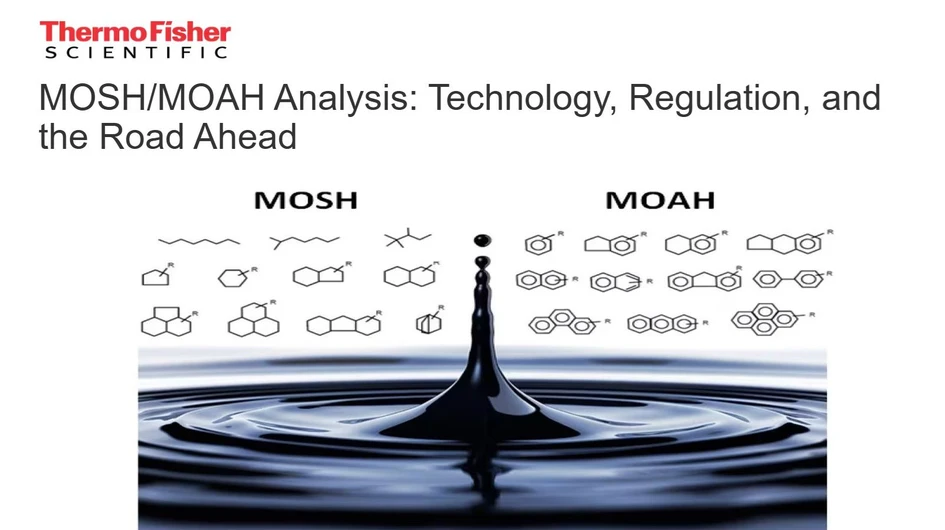
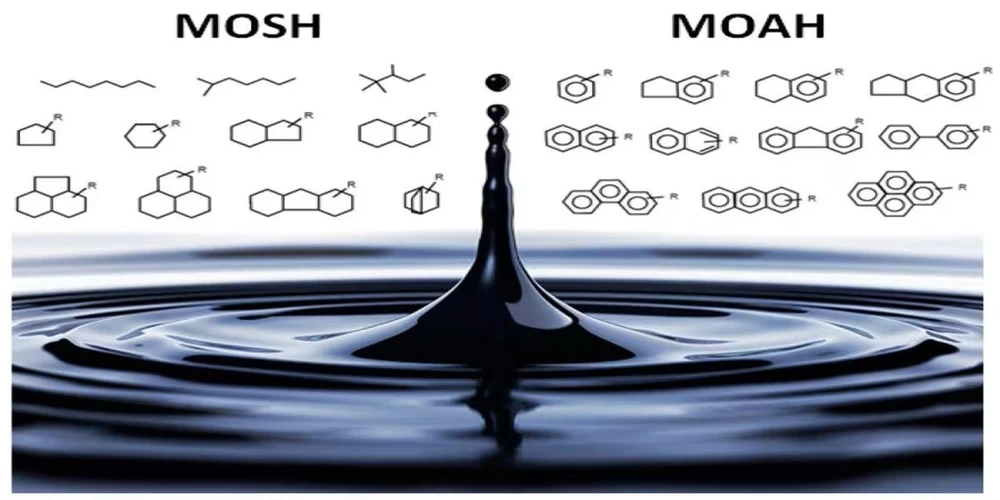
Mineral oil hydrocarbons (MOSH) and mineral oil aromatic hydrocarbons (MOAH) have moved from niche laboratory concerns to central topics in food safety, regulatory policy, and analytical science.
Thermo Fisher Scientific: MOSH/MOAH Analysis - Technology, Regulation, and the Road AheadThermo Fisher Scientific: MOSH/MOAH Analysis - Technology, Regulation, and the Road Ahead

These compounds—originating from sources such as environmental pollution, lubricants, processing aids, and migration from packaging materials—can enter the food chain and accumulate in both raw ingredients and finished products.

  • MOSH are saturated hydrocarbons, which can accumulate in human tissues but are generally considered of lower toxicological concern.
  • MOAH contain aromatic rings, including polycyclic structures; certain high-ring MOAH are suspected to have genotoxic and carcinogenic properties, making them a priority for regulatory control.

Growing public awareness, coupled with scientific research and legislative pressure, is pushing the food industry toward more robust monitoring and testing.

The evolving regulatory landscape

For years, MOSH/MOAH testing lacked consistent rules across jurisdictions. Different countries and organizations used their own limits and methods, creating confusion for global supply chains. Over the last decade, several important steps have brought the field closer to harmonization:

2017 – EN 16995 (CEN)
  • The first standardized method for quantifying MOSH and MOAH in foodstuffs using LC-GC-FID technology.
2023 – JRC Guidelines v2
  • Expanded scope to include food contact materials, with refinements in sample preparation and measurement.
2024 – ISO 20122:2024
  • A dedicated standard for fats and oils, integrating clean-up procedures alongside LC-GC-FID to improve accuracy.
Ongoing – EURL/ISO initiatives
  • Collaborative efforts including interlaboratory studies, method refinement, and the potential adoption of GC×GC–MS for enhanced selectivity and molecular insight.

A major development still in progress is the EU’s draft regulation for maximum residue limits for MOAH. Expected after 2024, it could introduce strict, enforceable thresholds across the single market, forcing a step-change in testing capacity and method validation.

Analytical challenges in MOSH/MOAH testing

Although standardized methods exist, MOSH/MOAH analysis is not a straightforward “plug-and-play” process. Laboratories face several persistent challenges:

Complex sample matrices
  • Edible oils, processed foods, and packaging extracts contain a mix of natural compounds such as carotenoids, terpenes, and squalene. These can overlap chromatographically with MOSH/MOAH peaks, making quantification more difficult.
False positives and overestimation
  • Non-MOSH/MOAH compounds can mimic the target analytes, especially in less selective detection modes, leading to inflated results.
Low detection limits
  • Many regulations demand quantification in the low mg/kg range. Achieving this requires both clean sample extracts and highly sensitive analytical instrumentation.
Reproducibility across labs
  • Differences in sample handling, clean-up techniques, and instrument tuning can lead to significant interlaboratory variation, complicating compliance and enforcement.

These challenges mean that achieving accuracy, repeatability, and regulatory compliance requires optimized workflows that combine precision sample preparation with advanced chromatographic techniques.

A modern workflow: from sample to result

State-of-the-art MOSH/MOAH workflows are typically built around an LC-GC-FID platform supported by automated sample preparation. This integration reduces human error, improves throughput, and delivers reproducible results.

Step 1: saponification

Fats can overwhelm LC columns, limiting injection volumes and obscuring MOSH/MOAH peaks. Saponification removes these fats, enabling:

  • Larger injection volumes.
  • Clearer chromatographic baselines.
  • Lower quantitation limits without compromising peak integrity.
Step 2: epoxidation

For MOAH analysis, carotenoids, terpenes, and other naturally occurring compounds must be removed. Epoxidation—now most commonly performed using PFA reagents—cleans up these interferences while maintaining the integrity of aromatic hydrocarbons.

Step 3: evaporation and concentration

By concentrating the hexane extract after saponification, laboratories can:

  • Achieve lower detection limits.
  • Improve recovery from challenging matrices such as palm stearates.
Step 4: alu oxide clean-up

Adding an alumina oxide clean-up step can substantially improve MOSH quantification in the presence of n-alkanes. This step is matrix-dependent and should be avoided if n-alkanes are absent to prevent bias.

Step 5: fraction collection for advanced analysis

When further identification is required—such as distinguishing between mineral oil hydrocarbons and plasticizers (POSH)—fraction collection followed by GC×GC-MS analysis can provide a deeper chemical fingerprint.

Beyond “how much”: the role of GC×GC-MS

Conventional LC-GC-FID answers the fundamental question: How much MOSH or MOAH is present in the sample?

But it cannot always explain the source or the chemical nature of the detected hydrocarbons.

This is where GC×GC-MS adds value:

  • Source tracing – Identifies whether contamination originates from packaging, processing equipment, or environmental exposure.
  • Structural characterization – Distinguishes low-ring MOAH (less concerning) from high-ring MOAH (more concerning toxicologically).
  • False positive elimination – Confirms the identity of suspect peaks, reducing the risk of misreporting.

By combining FID for precise quantification with MS for molecular identification, GC×GC-MS enables both regulatory compliance and investigative insight.

The role of chromeleon software in MOSH/MOAH analysis

Modern analytical systems rely heavily on software to ensure speed, traceability, and accuracy. Chromeleon software offers:

  • Unified control of LC, GC, and sample preparation hardware from a single interface.
  • Automated workflow setup – In just a few clicks, vial positions, injection types, and processing methods are assigned.
  • Integrated quality checks – Internal standard verification and retention time monitoring are built-in.
  • Customizable, regulatory-ready reports – Exportable in PDF, CSV, XML, and other formats without external spreadsheets.

The result is streamlined operation, reduced analyst intervention, and consistent compliance with good laboratory practice (GLP) requirements.

Looking ahead

With upcoming EU regulations likely to set strict MOAH limits, and with continued scientific scrutiny of MOSH accumulation, the demand for high-quality testing will only increase.

Key trends shaping the future of MOSH/MOAH analysis include:

  • Wider adoption of GC×GC-MS for confirmation and source identification.
  • Greater automation in sample preparation to increase throughput and reproducibility.
  • Regulatory harmonization, which will help reduce discrepancies between international markets.
  • Lower detection thresholds, requiring even more sensitive and selective methods.

For laboratories, the challenge is twofold: staying ahead of compliance requirements while building capacity for high-volume, high-accuracy testing. Those that invest in robust, automated, and harmonized workflows now will be better positioned to meet both current and future demands.

Acknowledgement: Jorn Hofsteenge, SampleQ, Breda, The Netherlands

Thermo Fisher Scientific
LinkedIn Logo
 

Related content

Overcoming Strong Solvent Effects in the Analysis of Vepdegestrant

Applications
| 2026 | Agilent Technologies
Instrumentation
HPLC
Manufacturer
Agilent Technologies
Industries
Pharma & Biopharma

Identification of Double Bond Positions and Relative Acyl Chain Positions in Egg Yolk Phosphatidylcholines Using OAD-TOF System

Applications
| 2026 | Shimadzu
Instrumentation
LC/MS, LC/MS/MS, LC/TOF, LC/HRMS
Manufacturer
Shimadzu
Industries
Food & Agriculture

High Molecular-Weight Polysaccharide Characterization by SEC-MALS Using GTxResolve™ 1000 and 2000 Å SEC Columns

Applications
| 2026 | Waters
Instrumentation
GPC/SEC, Consumables, LC columns
Manufacturer
Waters
Industries
Pharma & Biopharma, Food & Agriculture

Development and Optimization for a Comprehensive LC/MS/MS Method for the Detection of 74 PFAS Compounds

Applications
| 2026 | Agilent Technologies
Instrumentation
LC/MS, LC/MS/MS, LC/QQQ
Manufacturer
Agilent Technologies
Industries
Food & Agriculture

PFAS in Biota: Risk Context & Robust Analytical Solutions

Others
| 2026 | ALS Europe
Instrumentation
Laboratory analysis, LC/MS, LC/MS/MS
Manufacturer
Industries
Environmental
 

Related articles

ISC 2026 Short Course 3 - Interpretation of Mass Spectra: Basic Introduction for Chromatographers
Article | Events

ISC 2026 Short Course 3 - Interpretation of Mass Spectra: Basic Introduction for Chromatographers

Short Course 3 at ISC 2026 offers a practical introduction to LC–MS spectral interpretation for chromatographers, covering ESI, APCI, APPI, adducts, isotope patterns, and MS/MS fundamentals.
International Symposium on Chromatography - (ISC)
tag
share
more
New Study Reveals How Agricultural Plastics Impact Soil Health In Real Conditions
Article | Environment

New Study Reveals How Agricultural Plastics Impact Soil Health In Real Conditions

Agricultural mulching films degrade into microplastics that affect soil properties, microbial life, and nitrogen cycling. A new European field study reveals real risks to soil health.
RECETOX - Centrum pro výzkum toxických látek v prostředí
tag
share
more
Oligos Made Easy - Part 2: AEX
Article | Science and research

Oligos Made Easy - Part 2: AEX

Anion exchange chromatography (AEX) is a powerful tool for oligonucleotide analysis. Learn how charge-based separation reveals purity, length variants, and structural insights in modern LC workflows.
KNAUER
tag
share
more
News from LabRulezLCMS Library - Week 07, 2026
Article | Application

News from LabRulezLCMS Library - Week 07, 2026

This week we bring you application notes by Agilent Technologies, KNAUER, Shimadzu and Waters Corporation and poster by Thermo Fisher Scientific / MSACL!
LabRulez
tag
share
more
 

Related content

Overcoming Strong Solvent Effects in the Analysis of Vepdegestrant

Applications
| 2026 | Agilent Technologies
Instrumentation
HPLC
Manufacturer
Agilent Technologies
Industries
Pharma & Biopharma

Identification of Double Bond Positions and Relative Acyl Chain Positions in Egg Yolk Phosphatidylcholines Using OAD-TOF System

Applications
| 2026 | Shimadzu
Instrumentation
LC/MS, LC/MS/MS, LC/TOF, LC/HRMS
Manufacturer
Shimadzu
Industries
Food & Agriculture

High Molecular-Weight Polysaccharide Characterization by SEC-MALS Using GTxResolve™ 1000 and 2000 Å SEC Columns

Applications
| 2026 | Waters
Instrumentation
GPC/SEC, Consumables, LC columns
Manufacturer
Waters
Industries
Pharma & Biopharma, Food & Agriculture

Development and Optimization for a Comprehensive LC/MS/MS Method for the Detection of 74 PFAS Compounds

Applications
| 2026 | Agilent Technologies
Instrumentation
LC/MS, LC/MS/MS, LC/QQQ
Manufacturer
Agilent Technologies
Industries
Food & Agriculture

PFAS in Biota: Risk Context & Robust Analytical Solutions

Others
| 2026 | ALS Europe
Instrumentation
Laboratory analysis, LC/MS, LC/MS/MS
Manufacturer
Industries
Environmental
 

Related articles

ISC 2026 Short Course 3 - Interpretation of Mass Spectra: Basic Introduction for Chromatographers
Article | Events

ISC 2026 Short Course 3 - Interpretation of Mass Spectra: Basic Introduction for Chromatographers

Short Course 3 at ISC 2026 offers a practical introduction to LC–MS spectral interpretation for chromatographers, covering ESI, APCI, APPI, adducts, isotope patterns, and MS/MS fundamentals.
International Symposium on Chromatography - (ISC)
tag
share
more
New Study Reveals How Agricultural Plastics Impact Soil Health In Real Conditions
Article | Environment

New Study Reveals How Agricultural Plastics Impact Soil Health In Real Conditions

Agricultural mulching films degrade into microplastics that affect soil properties, microbial life, and nitrogen cycling. A new European field study reveals real risks to soil health.
RECETOX - Centrum pro výzkum toxických látek v prostředí
tag
share
more
Oligos Made Easy - Part 2: AEX
Article | Science and research

Oligos Made Easy - Part 2: AEX

Anion exchange chromatography (AEX) is a powerful tool for oligonucleotide analysis. Learn how charge-based separation reveals purity, length variants, and structural insights in modern LC workflows.
KNAUER
tag
share
more
News from LabRulezLCMS Library - Week 07, 2026
Article | Application

News from LabRulezLCMS Library - Week 07, 2026

This week we bring you application notes by Agilent Technologies, KNAUER, Shimadzu and Waters Corporation and poster by Thermo Fisher Scientific / MSACL!
LabRulez
tag
share
more
 

Related content

Overcoming Strong Solvent Effects in the Analysis of Vepdegestrant

Applications
| 2026 | Agilent Technologies
Instrumentation
HPLC
Manufacturer
Agilent Technologies
Industries
Pharma & Biopharma

Identification of Double Bond Positions and Relative Acyl Chain Positions in Egg Yolk Phosphatidylcholines Using OAD-TOF System

Applications
| 2026 | Shimadzu
Instrumentation
LC/MS, LC/MS/MS, LC/TOF, LC/HRMS
Manufacturer
Shimadzu
Industries
Food & Agriculture

High Molecular-Weight Polysaccharide Characterization by SEC-MALS Using GTxResolve™ 1000 and 2000 Å SEC Columns

Applications
| 2026 | Waters
Instrumentation
GPC/SEC, Consumables, LC columns
Manufacturer
Waters
Industries
Pharma & Biopharma, Food & Agriculture

Development and Optimization for a Comprehensive LC/MS/MS Method for the Detection of 74 PFAS Compounds

Applications
| 2026 | Agilent Technologies
Instrumentation
LC/MS, LC/MS/MS, LC/QQQ
Manufacturer
Agilent Technologies
Industries
Food & Agriculture

PFAS in Biota: Risk Context & Robust Analytical Solutions

Others
| 2026 | ALS Europe
Instrumentation
Laboratory analysis, LC/MS, LC/MS/MS
Manufacturer
Industries
Environmental
 

Related articles

ISC 2026 Short Course 3 - Interpretation of Mass Spectra: Basic Introduction for Chromatographers
Article | Events

ISC 2026 Short Course 3 - Interpretation of Mass Spectra: Basic Introduction for Chromatographers

Short Course 3 at ISC 2026 offers a practical introduction to LC–MS spectral interpretation for chromatographers, covering ESI, APCI, APPI, adducts, isotope patterns, and MS/MS fundamentals.
International Symposium on Chromatography - (ISC)
tag
share
more
New Study Reveals How Agricultural Plastics Impact Soil Health In Real Conditions
Article | Environment

New Study Reveals How Agricultural Plastics Impact Soil Health In Real Conditions

Agricultural mulching films degrade into microplastics that affect soil properties, microbial life, and nitrogen cycling. A new European field study reveals real risks to soil health.
RECETOX - Centrum pro výzkum toxických látek v prostředí
tag
share
more
Oligos Made Easy - Part 2: AEX
Article | Science and research

Oligos Made Easy - Part 2: AEX

Anion exchange chromatography (AEX) is a powerful tool for oligonucleotide analysis. Learn how charge-based separation reveals purity, length variants, and structural insights in modern LC workflows.
KNAUER
tag
share
more
News from LabRulezLCMS Library - Week 07, 2026
Article | Application

News from LabRulezLCMS Library - Week 07, 2026

This week we bring you application notes by Agilent Technologies, KNAUER, Shimadzu and Waters Corporation and poster by Thermo Fisher Scientific / MSACL!
LabRulez
tag
share
more
 

Related content

Overcoming Strong Solvent Effects in the Analysis of Vepdegestrant

Applications
| 2026 | Agilent Technologies
Instrumentation
HPLC
Manufacturer
Agilent Technologies
Industries
Pharma & Biopharma

Identification of Double Bond Positions and Relative Acyl Chain Positions in Egg Yolk Phosphatidylcholines Using OAD-TOF System

Applications
| 2026 | Shimadzu
Instrumentation
LC/MS, LC/MS/MS, LC/TOF, LC/HRMS
Manufacturer
Shimadzu
Industries
Food & Agriculture

High Molecular-Weight Polysaccharide Characterization by SEC-MALS Using GTxResolve™ 1000 and 2000 Å SEC Columns

Applications
| 2026 | Waters
Instrumentation
GPC/SEC, Consumables, LC columns
Manufacturer
Waters
Industries
Pharma & Biopharma, Food & Agriculture

Development and Optimization for a Comprehensive LC/MS/MS Method for the Detection of 74 PFAS Compounds

Applications
| 2026 | Agilent Technologies
Instrumentation
LC/MS, LC/MS/MS, LC/QQQ
Manufacturer
Agilent Technologies
Industries
Food & Agriculture

PFAS in Biota: Risk Context & Robust Analytical Solutions

Others
| 2026 | ALS Europe
Instrumentation
Laboratory analysis, LC/MS, LC/MS/MS
Manufacturer
Industries
Environmental
 

Related articles

ISC 2026 Short Course 3 - Interpretation of Mass Spectra: Basic Introduction for Chromatographers
Article | Events

ISC 2026 Short Course 3 - Interpretation of Mass Spectra: Basic Introduction for Chromatographers

Short Course 3 at ISC 2026 offers a practical introduction to LC–MS spectral interpretation for chromatographers, covering ESI, APCI, APPI, adducts, isotope patterns, and MS/MS fundamentals.
International Symposium on Chromatography - (ISC)
tag
share
more
New Study Reveals How Agricultural Plastics Impact Soil Health In Real Conditions
Article | Environment

New Study Reveals How Agricultural Plastics Impact Soil Health In Real Conditions

Agricultural mulching films degrade into microplastics that affect soil properties, microbial life, and nitrogen cycling. A new European field study reveals real risks to soil health.
RECETOX - Centrum pro výzkum toxických látek v prostředí
tag
share
more
Oligos Made Easy - Part 2: AEX
Article | Science and research

Oligos Made Easy - Part 2: AEX

Anion exchange chromatography (AEX) is a powerful tool for oligonucleotide analysis. Learn how charge-based separation reveals purity, length variants, and structural insights in modern LC workflows.
KNAUER
tag
share
more
News from LabRulezLCMS Library - Week 07, 2026
Article | Application

News from LabRulezLCMS Library - Week 07, 2026

This week we bring you application notes by Agilent Technologies, KNAUER, Shimadzu and Waters Corporation and poster by Thermo Fisher Scientific / MSACL!
LabRulez
tag
share
more
Other projects
GCMS
ICPMS
Follow us
More information
WebinarsAbout usContact usTerms of use
LabRulez s.r.o. All rights reserved. Content available under a CC BY-SA 4.0 Attribution-ShareAlike