Proficiency testing schemes and other interlaboratory comparisons

Eurachem: Proficiency testing schemes and other interlaboratory comparisons
Types of comparisons
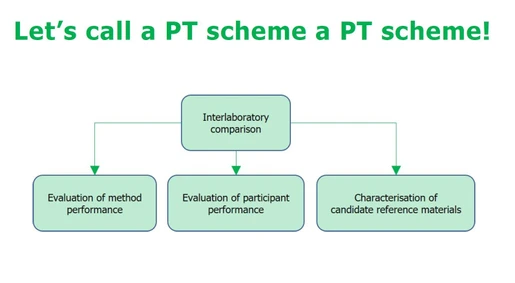
Interlaboratory comparisons mean organisation, performance and evaluation of measurements and tests on the same or similar items by two or more laboratories in accordance with predetermined conditions. Comparisons are organised at all scientific levels, but the objectives, protocols and participants vary. In certification trials, the measurements are used to assign values to reference materials. In method validation studies (collaborative trials), the performance, e.g. trueness and precision of methods, is evaluated. The most accurate measurements are compared world-wide in ’key comparisons’.
Proficiency testing (PT) schemes – also known as ‘external quality assessment (EQA) schemes’ or ‘laboratory performance studies’ – are one means of assessing the quality of routine measurements. PT schemes are the most common, and perhaps the most important, type of interlaboratory comparisons.
Advantages of PT
Participation in PT enables you to compare your results with those from other laboratories. It can also provide you with:
- Regular, objective and independent assessment of the quality of your routine analyses;
- Feedback that stimulates improvement of the technical work;
- Comparative information about method and instrument performance;
- An overview of the quality of specific analyses in a sector, country or region.
Limitations of PT
Ideally, PT samples are similar in nature to routine samples, and sufficiently homogeneous and stable not to influence the evaluation of participants’ performance. Due to practical aspects, PT samples are sometimes processed, e.g. stabilised and/or freeze-dried. Participants should be aware of this.
PT schemes can be organised and evaluated in many different ways. There is no perfect protocol! For laboratories and their customers, and for accreditation and regulatory bodies, it can be important to know if the same result is judged differently by different PT providers.
Appropriate PT schemes
The huge number of analytes, and the large variety in the way tests are performed, means that it is not always possible to find a scheme that meets a laboratory’s exact requirements. Before signing up for a scheme, carefully check that the test materials, and the analytes and their levels fit your routine measurement procedures. Is the frequency appropriate and does the provider’s report give you sufficient information?
Role of PT in measurement quality
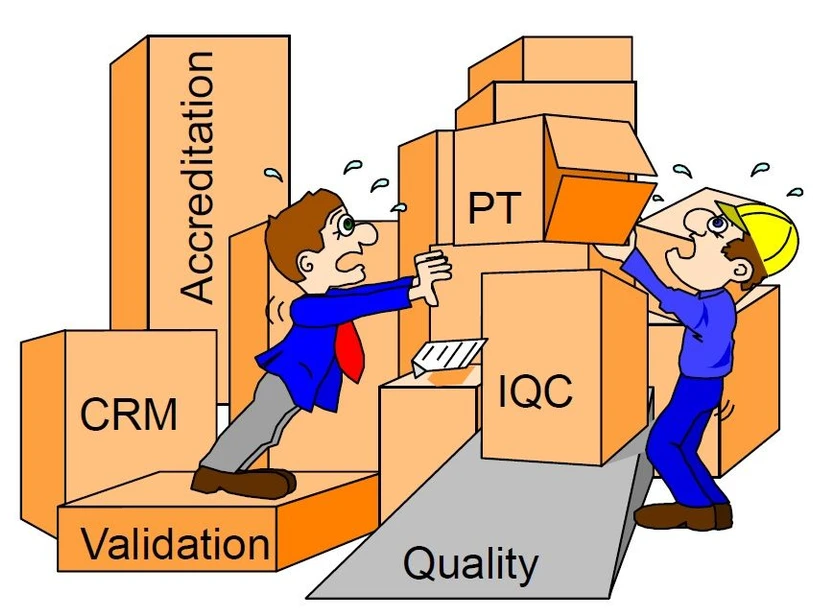
Correct measurements require both internal and external ‘tools’. During the validation step, the performance of the method is established. Subsequent use of control charts will show if the measurements are under statistical control. Many laboratories choose to accredit their services, thereby agreeing to implement a quality management system and accepting regular external audits of their work. Participating in PT is an effective external means to check that the procedures are fit for purpose!
 Eurachem: Proficiency testing schemes and other interlaboratory comparisons
Educational aspects
PT offers opportunities for education and training. Many providers have regular user meetings to discuss results and problem areas. Virtual PT schemes, using digital images of the samples, enable an unlimited number of participants, immediate feedback and repeated assessments.
Accreditation of PT providers
Some providers choose to accredit their PT schemes. The work with organising and evaluating the results will then be assessed according to international guidelines, similar to calibration and testing laboratories.
Use of PT results
Because PT schemes provide an overview of the analytical quality for specific applications, the results are increasingly used by laboratories’ customers, and by accreditation and regulatory bodies. PT helps identify measurement problems, which have a direct impact on trade, environmental monitoring, and health and safety.
More information / further reading
Information about PT providers and schemes can be obtained from your national accreditation body, from the EPTIS website or from other national or international organisations.