
Author
Institute of Organic Chemistry and Biochemistry of the Czech Academy of Sciences
The Institute of Organic Chemistry and Biochemistry of the Czech Academy of Sciences (IOCB Prague) is a leading scientific institution in the Czech Republic, recognized internationally. Its primary mission is basic research in the fields of chemical biology and medicinal chemistry, organic and material oriented chemistry, chemistry of natural compounds, biochemistry and molecular biology, physical chemistry, theoretical chemistry, and analytical chemistry.
Tags
Article
Science and research
LinkedIn Logo

Deoxyribozymes, tools for precision sensing and machine learning-guided discoveries
Th, 11.6.2026
| Original article from: IOCB Prague
Researchers at IOCB Prague developed deoxyribozyme-based sensors that detect DNA-editing enzymes faster and cheaper, while machine learning helps design new catalytic DNA tools.
<p><strong>IOCB Prague: </strong>Deoxyribozymes, tools for precision sensing and machine learning-guided discoveries</p>

IOCB Prague: Deoxyribozymes, tools for precision sensing and machine learning-guided discoveries

Deoxyribozymes represent a new frontier in biotechnology. They show that DNA is much more than a storage molecule for genetic information: it can also function as a catalytic machine. Unlike traditional enzymes made of proteins, such DNA-based tools are stable, easy to produce in large quantities, and can be evolved in a lab to perform different chemical tasks we need. Their potential is vast, ranging from low-cost diagnostic kits to high-speed screening tools that can facilitate drug discovery. As our ability to understand and predict their behavior continues to improve, these versatile molecules are becoming a cornerstone for future personalized medicine and environmental monitoring.

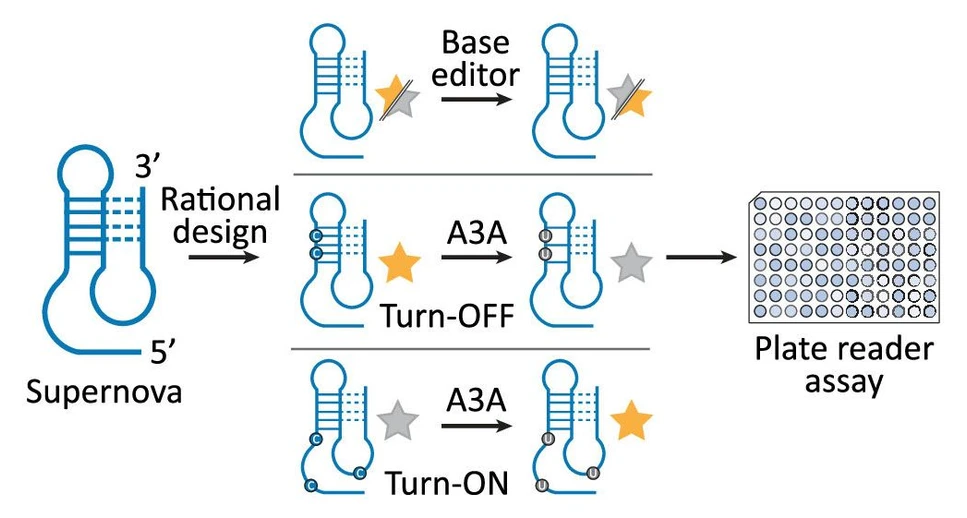
IOCB Prague: Deoxyribozymes, tools for precision sensing and machine learning-guided discoveries: Researchers described a new assay for DNA-editing enzymes in which the substrate in the reaction is a chemiluminescent deoxyribozyme called Supernova. ACS Chem. Biol. 2026, 21, 5, 941-950IOCB Prague: Deoxyribozymes, tools for precision sensing and machine learning-guided discoveries: Researchers described a new assay for DNA-editing enzymes in which the substrate in the reaction is a chemiluminescent deoxyribozyme called Supernova. ACS Chem. Biol. 2026, 21, 5, 941-950

Researchers led by Edward Curtis from IOCB Prague have developed a remarkable DNA molecule called Supernova that acts as a tiny biological flashlight, glowing blue during a specific chemical reaction. By tweaking its sequence, scientists transformed Supernova into a sensor capable of detecting DNA-editing enzymes, which are proteins that alter the sequence of DNA and are often linked to the development of cancer. These new sensors represent a step forward because they are roughly three times faster and over five times cheaper than standard assays. Depending on how they are designed, these sensors can be either "turned off" or "turned on" by a DNA-editing enzyme in a sample. Such sensors will make characterization of DNA-editing enzymes easier, and could also help scientists to find new inhibitors.
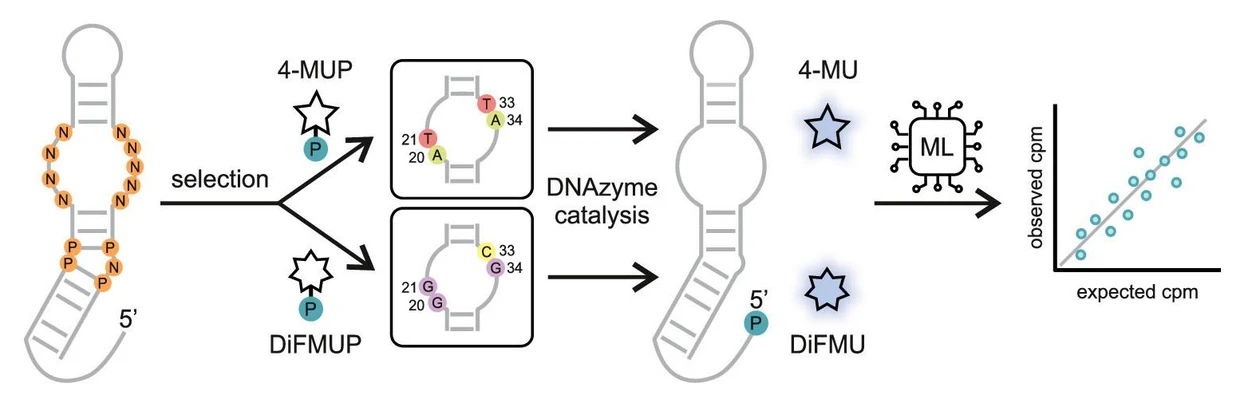
IOCB Prague: Deoxyribozymes, tools for precision sensing and machine learning-guided discoveries: Researchers also systematically investigated the specificities of self-phosphorylating deoxyribozymes that convert the coumarin substrate 4-MUP into a fluorescent product using biochemical assays, single-step selections, and machine learning. ACS Chem. Biol. 2026, 21, 5, 951-959IOCB Prague: Deoxyribozymes, tools for precision sensing and machine learning-guided discoveries: Researchers also systematically investigated the specificities of self-phosphorylating deoxyribozymes that convert the coumarin substrate 4-MUP into a fluorescent product using biochemical assays, single-step selections, and machine learning. ACS Chem. Biol. 2026, 21, 5, 951-959

In another advance, researchers in the Curtis Group used a fluorescent deoxyribozyme named Aurora to explore how these molecular tools can be taught to recognize specific chemical targets. Using a combination of artificial evolution and machine learning, the team successfully identified specific mutations that change Aurora’s preference for one substrate over another. Machine learning is particularly powerful here because it allows researchers to predict how millions of different DNA variants will behave without having to test each one individually in a lab. This approach helps us understand the fundamental rules of how DNA molecules interact with the world, which is essential for designing more precise medicines and diagnostic tools.

These results are described in two recent publications:

Chemiluminescent Deoxyribozyme Sensors for DNA-Editing Enzymes

Jakubec, M.; Svoboda, M.; Kurfürst, J.; Svehlova, K.; Veverka, V.; Curtis, E. A.  

ACS Chem. Biol. 2026

http://doi.org/10.1021/acschembio.5c00927

licensed under CC-BY 4.0

Abstract

DNA-editing enzymes such as those in the APOBEC family of cytidine deaminases play important roles in both normal and pathogenic function, while engineered enzymes offer exciting new possibilities for genome editing. Despite their importance, widely used assays for DNA-editing enzymes are time-consuming and expensive. Here, we describe a new assay for DNA-editing enzymes in which the substrate in the reaction is a chemiluminescent deoxyribozyme called Supernova. Editing alters the sequence of Supernova, which results in a change in catalytic activity and light production. By analyzing a data set of Supernova variants previously identified by selection and high-throughput sequencing, it was possible to generate sensors with a wide range of specificities. Sensors were also developed for APOBEC3A, a cytidine deaminase which converts C to U in single-stranded DNA and RNA. These include a turn-off sensor that produces light 14-fold slower after incubation with recombinant APOBEC3A than in its absence, and a turn-on sensor that generates light 10-fold faster after incubation with APOBEC3A than in its absence. Assays that use these sensors are faster and less expensive than existing ones, and should be particularly useful for applications such as high-throughput screening.

Probing the Specificity of Fluorescent Deoxyribozymes Using Single-Step Selections and Machine Learning

Král’ová, Z.; Isler, L.; Volek, M.; Jandová, M.; Kurfürst, J.; Curtis, E. A. 

ACS Chem. Biol. 2026 

http://doi.org/10.1021/acschembio.5c00969

licensed under CC-BY 4.0

Abstract

The ability of proteins and nucleic acids to form specific binding sites for ligands is critical for biological function, and methods to modulate biochemical specificity are important for fields such as enzyme engineering and drug design. Here, we systematically investigated the specificities of self-phosphorylating deoxyribozymes that convert the coumarin substrate 4-MUP into a fluorescent product using biochemical assays, single-step selections, and machine learning. Activity assays using a panel of 20 catalytic motifs and 10 substrates that generate different types of signals when they are dephosphorylated revealed that these deoxyribozymes are extremely specific for 4-MUP. To identify mutations that change specificity, we constructed a library based on a self-phosphorylating fluorescent deoxyribozyme called Aurora. A series of single-step selections yielded variants that react with 4-MUP and the structurally similar substrate diFMUP, but not with the more distinct substrates pNPP and ELF. Pairwise analysis of sequences in the 4-MUP and diFMUP data sets revealed four mutations that modulate Aurora specificity. The effects of these mutations were confirmed using biochemical assays and could be predicted using models developed by machine learning. Taken together, our results show how single-step selections can be used to identify mutations that change the specificity of a deoxyribozyme. They also highlight how machine learning can be used to model complex data sets from in vitro selection experiments.

Institute of Organic Chemistry and Biochemistry of the Czech Academy of Sciences
LinkedIn Logo
 

Related content

Large-Volume Dilute-and-Shoot Analysis of PFAS in Drinking Water Using the Altura PFAS Column

Applications
| 2026 | Agilent Technologies
Instrumentation
Consumables, LC columns, LC/MS, LC/MS/MS, LC/QQQ
Manufacturer
Agilent Technologies
Industries
Environmental

Hey, ho, oliGO – Comparison of ion-pairing systems for oligonucleotide analysis with HPLC-UV

Applications
| 2026 | KNAUER
Instrumentation
Consumables, LC columns, HPLC
Manufacturer
KNAUER
Industries
Pharma & Biopharma

Suppressed Cation Analysis of Wastewater Using Ion Chromatograph Nexera IC, Conforming to ASTM D6919-17

Applications
| 2026 | Shimadzu
Instrumentation
Ion chromatography
Manufacturer
Shimadzu
Industries
Environmental, Food & Agriculture

Comprehensive and Robust Analysis of Ultrashort- to Long-Chain PFAS, PAE, OPE, and PAH

Applications
| 2026 | Agilent Technologies
Instrumentation
LC/MS, LC/MS/MS, LC/TOF, LC/HRMS
Manufacturer
Agilent Technologies, Plasmion
Industries
Environmental

UPLC™ Separation of Fifteen Bisphenols Using a Waters Acquity™ Biphenyl RP Column with MaxPeak™ Premier Technology and UV Detection

Applications
| 2026 | Waters
Instrumentation
Consumables, LC columns, HPLC
Manufacturer
Waters
Industries
Pharma & Biopharma
 

Related articles

Scientists at IOCB Prague are developing a new generation of DNA tests for a wide range of applications
Article | Video

Scientists at IOCB Prague are developing a new generation of DNA tests for a wide range of applications

A research group led by Dr. Edward Curtis has developed two new types of catalytic DNA molecules (deoxyribozymes) that can reveal the presence of target molecules through fluorescence or color.
Institute of Organic Chemistry and Biochemistry of the Czech Academy of Sciences
tag
share
more
Protein scientist Jan Velecký: Machine learning can shine where human imagination falls short
Article | Science and research

Protein scientist Jan Velecký: Machine learning can shine where human imagination falls short

Jan Velecký - explains what protein engineering is about, why it is important to study protein solubility, and how machine learning can be crucial for human knowledge.
RECETOX - Centrum pro výzkum toxických látek v prostředí
tag
share
more
Alcohol causes cancer. A study from IOCB Prague confirms damage to DNA and shows how cells defend against it
Article | Science and research

Alcohol causes cancer. A study from IOCB Prague confirms damage to DNA and shows how cells defend against it

Alcohol consumption produces acetaldehyde, a toxic compound that damages DNA. Scientists from IOCB Prague reveal how cells repair this damage, shedding light on the link between alcohol and cancer.
Institute of Organic Chemistry and Biochemistry of the Czech Academy of Sciences
tag
share
more
Exploring sequence space beyond random mutagenesis
Article | Science and research

Exploring sequence space beyond random mutagenesis

Structure-guided libraries and machine learning enable faster discovery of active nucleic acid sequences beyond random mutagenesis.
Institute of Organic Chemistry and Biochemistry of the Czech Academy of Sciences
tag
share
more
 

Related content

Large-Volume Dilute-and-Shoot Analysis of PFAS in Drinking Water Using the Altura PFAS Column

Applications
| 2026 | Agilent Technologies
Instrumentation
Consumables, LC columns, LC/MS, LC/MS/MS, LC/QQQ
Manufacturer
Agilent Technologies
Industries
Environmental

Hey, ho, oliGO – Comparison of ion-pairing systems for oligonucleotide analysis with HPLC-UV

Applications
| 2026 | KNAUER
Instrumentation
Consumables, LC columns, HPLC
Manufacturer
KNAUER
Industries
Pharma & Biopharma

Suppressed Cation Analysis of Wastewater Using Ion Chromatograph Nexera IC, Conforming to ASTM D6919-17

Applications
| 2026 | Shimadzu
Instrumentation
Ion chromatography
Manufacturer
Shimadzu
Industries
Environmental, Food & Agriculture

Comprehensive and Robust Analysis of Ultrashort- to Long-Chain PFAS, PAE, OPE, and PAH

Applications
| 2026 | Agilent Technologies
Instrumentation
LC/MS, LC/MS/MS, LC/TOF, LC/HRMS
Manufacturer
Agilent Technologies, Plasmion
Industries
Environmental

UPLC™ Separation of Fifteen Bisphenols Using a Waters Acquity™ Biphenyl RP Column with MaxPeak™ Premier Technology and UV Detection

Applications
| 2026 | Waters
Instrumentation
Consumables, LC columns, HPLC
Manufacturer
Waters
Industries
Pharma & Biopharma
 

Related articles

Scientists at IOCB Prague are developing a new generation of DNA tests for a wide range of applications
Article | Video

Scientists at IOCB Prague are developing a new generation of DNA tests for a wide range of applications

A research group led by Dr. Edward Curtis has developed two new types of catalytic DNA molecules (deoxyribozymes) that can reveal the presence of target molecules through fluorescence or color.
Institute of Organic Chemistry and Biochemistry of the Czech Academy of Sciences
tag
share
more
Protein scientist Jan Velecký: Machine learning can shine where human imagination falls short
Article | Science and research

Protein scientist Jan Velecký: Machine learning can shine where human imagination falls short

Jan Velecký - explains what protein engineering is about, why it is important to study protein solubility, and how machine learning can be crucial for human knowledge.
RECETOX - Centrum pro výzkum toxických látek v prostředí
tag
share
more
Alcohol causes cancer. A study from IOCB Prague confirms damage to DNA and shows how cells defend against it
Article | Science and research

Alcohol causes cancer. A study from IOCB Prague confirms damage to DNA and shows how cells defend against it

Alcohol consumption produces acetaldehyde, a toxic compound that damages DNA. Scientists from IOCB Prague reveal how cells repair this damage, shedding light on the link between alcohol and cancer.
Institute of Organic Chemistry and Biochemistry of the Czech Academy of Sciences
tag
share
more
Exploring sequence space beyond random mutagenesis
Article | Science and research

Exploring sequence space beyond random mutagenesis

Structure-guided libraries and machine learning enable faster discovery of active nucleic acid sequences beyond random mutagenesis.
Institute of Organic Chemistry and Biochemistry of the Czech Academy of Sciences
tag
share
more
 

Related content

Large-Volume Dilute-and-Shoot Analysis of PFAS in Drinking Water Using the Altura PFAS Column

Applications
| 2026 | Agilent Technologies
Instrumentation
Consumables, LC columns, LC/MS, LC/MS/MS, LC/QQQ
Manufacturer
Agilent Technologies
Industries
Environmental

Hey, ho, oliGO – Comparison of ion-pairing systems for oligonucleotide analysis with HPLC-UV

Applications
| 2026 | KNAUER
Instrumentation
Consumables, LC columns, HPLC
Manufacturer
KNAUER
Industries
Pharma & Biopharma

Suppressed Cation Analysis of Wastewater Using Ion Chromatograph Nexera IC, Conforming to ASTM D6919-17

Applications
| 2026 | Shimadzu
Instrumentation
Ion chromatography
Manufacturer
Shimadzu
Industries
Environmental, Food & Agriculture

Comprehensive and Robust Analysis of Ultrashort- to Long-Chain PFAS, PAE, OPE, and PAH

Applications
| 2026 | Agilent Technologies
Instrumentation
LC/MS, LC/MS/MS, LC/TOF, LC/HRMS
Manufacturer
Agilent Technologies, Plasmion
Industries
Environmental

UPLC™ Separation of Fifteen Bisphenols Using a Waters Acquity™ Biphenyl RP Column with MaxPeak™ Premier Technology and UV Detection

Applications
| 2026 | Waters
Instrumentation
Consumables, LC columns, HPLC
Manufacturer
Waters
Industries
Pharma & Biopharma
 

Related articles

Scientists at IOCB Prague are developing a new generation of DNA tests for a wide range of applications
Article | Video

Scientists at IOCB Prague are developing a new generation of DNA tests for a wide range of applications

A research group led by Dr. Edward Curtis has developed two new types of catalytic DNA molecules (deoxyribozymes) that can reveal the presence of target molecules through fluorescence or color.
Institute of Organic Chemistry and Biochemistry of the Czech Academy of Sciences
tag
share
more
Protein scientist Jan Velecký: Machine learning can shine where human imagination falls short
Article | Science and research

Protein scientist Jan Velecký: Machine learning can shine where human imagination falls short

Jan Velecký - explains what protein engineering is about, why it is important to study protein solubility, and how machine learning can be crucial for human knowledge.
RECETOX - Centrum pro výzkum toxických látek v prostředí
tag
share
more
Alcohol causes cancer. A study from IOCB Prague confirms damage to DNA and shows how cells defend against it
Article | Science and research

Alcohol causes cancer. A study from IOCB Prague confirms damage to DNA and shows how cells defend against it

Alcohol consumption produces acetaldehyde, a toxic compound that damages DNA. Scientists from IOCB Prague reveal how cells repair this damage, shedding light on the link between alcohol and cancer.
Institute of Organic Chemistry and Biochemistry of the Czech Academy of Sciences
tag
share
more
Exploring sequence space beyond random mutagenesis
Article | Science and research

Exploring sequence space beyond random mutagenesis

Structure-guided libraries and machine learning enable faster discovery of active nucleic acid sequences beyond random mutagenesis.
Institute of Organic Chemistry and Biochemistry of the Czech Academy of Sciences
tag
share
more
 

Related content

Large-Volume Dilute-and-Shoot Analysis of PFAS in Drinking Water Using the Altura PFAS Column

Applications
| 2026 | Agilent Technologies
Instrumentation
Consumables, LC columns, LC/MS, LC/MS/MS, LC/QQQ
Manufacturer
Agilent Technologies
Industries
Environmental

Hey, ho, oliGO – Comparison of ion-pairing systems for oligonucleotide analysis with HPLC-UV

Applications
| 2026 | KNAUER
Instrumentation
Consumables, LC columns, HPLC
Manufacturer
KNAUER
Industries
Pharma & Biopharma

Suppressed Cation Analysis of Wastewater Using Ion Chromatograph Nexera IC, Conforming to ASTM D6919-17

Applications
| 2026 | Shimadzu
Instrumentation
Ion chromatography
Manufacturer
Shimadzu
Industries
Environmental, Food & Agriculture

Comprehensive and Robust Analysis of Ultrashort- to Long-Chain PFAS, PAE, OPE, and PAH

Applications
| 2026 | Agilent Technologies
Instrumentation
LC/MS, LC/MS/MS, LC/TOF, LC/HRMS
Manufacturer
Agilent Technologies, Plasmion
Industries
Environmental

UPLC™ Separation of Fifteen Bisphenols Using a Waters Acquity™ Biphenyl RP Column with MaxPeak™ Premier Technology and UV Detection

Applications
| 2026 | Waters
Instrumentation
Consumables, LC columns, HPLC
Manufacturer
Waters
Industries
Pharma & Biopharma
 

Related articles

Scientists at IOCB Prague are developing a new generation of DNA tests for a wide range of applications
Article | Video

Scientists at IOCB Prague are developing a new generation of DNA tests for a wide range of applications

A research group led by Dr. Edward Curtis has developed two new types of catalytic DNA molecules (deoxyribozymes) that can reveal the presence of target molecules through fluorescence or color.
Institute of Organic Chemistry and Biochemistry of the Czech Academy of Sciences
tag
share
more
Protein scientist Jan Velecký: Machine learning can shine where human imagination falls short
Article | Science and research

Protein scientist Jan Velecký: Machine learning can shine where human imagination falls short

Jan Velecký - explains what protein engineering is about, why it is important to study protein solubility, and how machine learning can be crucial for human knowledge.
RECETOX - Centrum pro výzkum toxických látek v prostředí
tag
share
more
Alcohol causes cancer. A study from IOCB Prague confirms damage to DNA and shows how cells defend against it
Article | Science and research

Alcohol causes cancer. A study from IOCB Prague confirms damage to DNA and shows how cells defend against it

Alcohol consumption produces acetaldehyde, a toxic compound that damages DNA. Scientists from IOCB Prague reveal how cells repair this damage, shedding light on the link between alcohol and cancer.
Institute of Organic Chemistry and Biochemistry of the Czech Academy of Sciences
tag
share
more
Exploring sequence space beyond random mutagenesis
Article | Science and research

Exploring sequence space beyond random mutagenesis

Structure-guided libraries and machine learning enable faster discovery of active nucleic acid sequences beyond random mutagenesis.
Institute of Organic Chemistry and Biochemistry of the Czech Academy of Sciences
tag
share
more
Other projects
GCMS
ICPMS
Follow us
FacebookX (Twitter)LinkedInYouTube
More information
WebinarsAbout usContact usTerms of use
LabRulez s.r.o. All rights reserved. Content available under a CC BY-SA 4.0 Attribution-ShareAlike