ISC 2026 Program
International Symposium on Chromatography (ISC): ISC 2026 Program
ISC 2026
The International Symposium on Chromatography (ISC) represents the oldest conference series on separation science. ISC symposia have been organised since 1956 in each even year. ISC is one of the premier meetings series for discussion of all modes of chromatography and separation science with a broad coverage of techniques and applications.
The major focus of the symposium will be on the impact of chromatography and separation science to meet the needs of the pharmaceutical, environmental, food and health industry, as well as science and medicine. The symposium programme will reflect these themes and highlight new challenges and emerging opportunities for the science and marketing of separation and detection systems and methods.
As an integral part of the scientific programme of lectures and poster sessions, an international exhibition and vendor seminars on instrumentation and services for chromatography, separation science and mass spectrometry will be organised. ISC 2026 will provide the perfect forum for attendees from academia, industry and government research institutions for scientific exchange and networking.
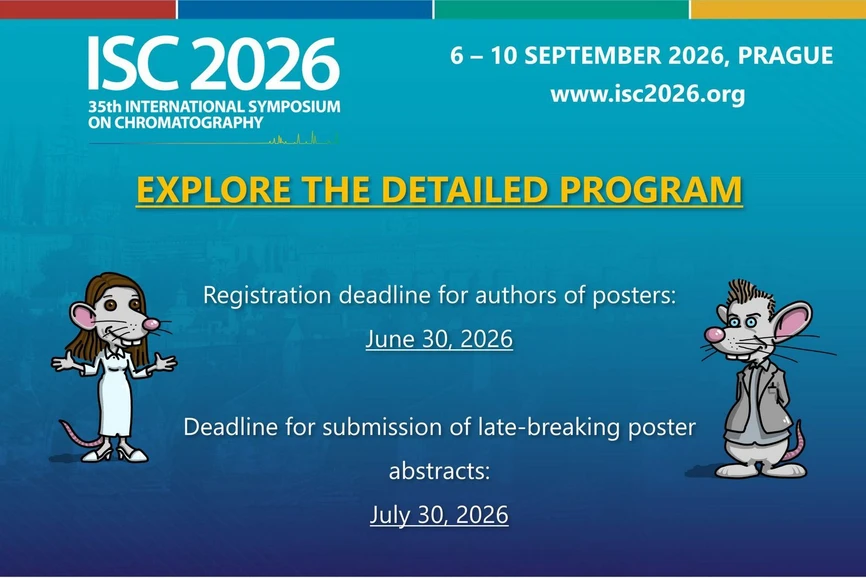
35th International Symposium on Chromatography
📆6. - 10. September 2026
📍Prague, Czech Republic
REGISTRATION
ABSTRACT SUBMISSION
SCIENTIFIC PROGRAM
Detailed program in PDF will be published closer to the dates of the ISC 2026 Symposium
Sunday, September 6th
8:30–11:45 Short Course 3: The Analytical Procedure Lifecycle Approach: From Procedure Design to Performance Assessment using AQbD Principles
08:30–11:45 Short Course 4: Interpretation of Mass Spectra: Basic Introduction for Chromatographers
08:30–11:45 Short Course 5: Hydrophilic Interaction Liquid Chromatography
10:00–10:30 Coffee Break
11:45–12:30 Lunch Break
12:30–15:45 Short Course 6: Oligonucleotides and Other Biopharmaceuticals
12:30–15:45 Short Course 7: Statistical Analysis and Visualization of Quantitative LC/MS Data in R
12:30–15:45 Short Course 8: Supercritical Fluids in Chromatography and Extraction
14:00–14:30 Coffee Break
16:00–16:30 Opening Ceremony
- Michal Holčapek, Czech Republic
- Lucie Nováková, Czech Republic
16:30–17:00 Award Ceremony
- Martin Medal, Jubilee Medal, J.F.K. Huber Medal
- Introduction of the Pavel Jandera Award and the Best Poster Award
17:00 - 17:30 Spintronics: A new paradigm in digital bits
- Tomáš Jungwirth, Czech Republic
17:30 - 18:00 Single cell proteomics requires robust LC-MS: Unexpected findings bring new biological understanding
- Jennifer Van Eyk, USA
18:00 - 18:30 Rapid evaporative ionisation mass spectrometry: From MSI to LC-MS
- Zoltan Takats, United Kingdom
18:30–19:30 Welcome Reception
Monday, September 7th
08:30–10:00 FUN 01: Advances in Column Technology
08:30 - 09:00 An outlook on the future directions in chromatography column technology
- Gert Desmet, Vrije Universiteit Brussel, Chemical Engineering, Brussels, Belgium
On the curvature of the van Deemter curve
- B. Huygens, Vrije Universiteit Brussel, Department of Chemical Engineering, Brussels, Belgium
To separate the inseparable: The magic of Repetto peak recycle technology in analytical an preparative HPLC
- Marek Minarik, Watrex Praha- s.r.o., HPLC laboratory, Prague, Czech Republic.
Opportunities and constraints of sub-1 μm packing materials for next-generation chromatography columns
- Hanrong Wen, Vrije Universiteit Brussel, Department of Chemical Engineering CHIS-IR, Brusslels, Belgium.
08:30–10:00 BIO 01: Proteomics
08:30 - 09:00 Keynote Speaker
- John Yates, USA
Ensuring robustness in label-free quantitation: System suitability and quality control strategies for ultra-deep proteomics
- Angelo Lopez, VUB, Chemical Engineering, Brussel, Belgium
From chromatography to proteomics: Characterization of microflow LC columns for bottom-up proteomics
- Jiří Urban, Masaryk University, Department of Chemistry, Brno, Czech Republic.
Propionic acid boosts sensitivity in analytical and microflow LC–MS of peptides
- Juraj Lenčo, Charles University Prague- Faculty of Pharmacy in Hradec Králové, Department of Analytical Chemistry, Hradec Králové, Czech Republic.
08:30–10:00 HYP 01: SFC/MS
08:30 - 09:00 Toward next-generation lipidomics: Comprehensive and quantitative lipidome analysis based on supercritical fluid chromatography/mass spectrometry
- Takeshi Bamba, The University of Osaka, Graduate School of Medicine, Suita, Japan.
Analysis of total fatty acids by SFC/MS: Separation of omega-3 and omega-6, branched and hydroxy fatty acids
- Michaela Chocholouskova, DUKE-NUS Medical School, Signature Research Program in Cardiovascular & Metabolic Disorders, Singapore, Singapore, National University of Singapore, SLING - Singapore Lipidomics Incubator- Department of Biochemistry- YLL School of Medicine, Singapore, Singapore.
Miniaturised solid phase extraction - supercritical fluid chromatography tandem mass spectrometry workflow for high-throughput acidic phytohormone profiling
- Jitka Široká, Institute of Experimental Botany of the Czech Academy of Sciences and Faculty of Science of Palacký University Olomouc, Laboratory of Growth Regulators, Olomouc, Czech Republic.
Comprehensive lipidomic analysis of human plasma by UHPSFC/MS using bioinert column: Dysregulation in pancreatic cancer
- Petra Peroutková, University of Pardubice, Department of Analytical Chemistry, Pardubice, Czech Republic.
10:00–10:30 Coffee Break
10:30–12:00 FUN 02: Retention Mechanisms of Large Biomolecules
10:30 - 11:00 On the investigation of mass transfer phenomena of oligonucleotides: Challenges and novel approaches
- Deirdre Cabooter, KU Leuven, Pharmaceutical and Pharmacological Sciences, Leuven, Belgium.
Hybridization-based diastereomer separation of therapeutic small interfering RNA oligonucleotides using anion exchange chromatography under non-denaturing conditions
- Luca Tutiš, Vrije Universiteit Amsterdam, Department of Chemistry and Pharmaceutical Sciences- Division of BioAnalytical Chemistry, Amsterdam, Netherlands.
Advancing liquid chromatography approaches for siRNA diastereomer analysis: From method development to application
- Lucy Durham, AstraZeneca, Pharmaceutical Sciences, Macclesfield, United Kingdom.
Analysis of N-acetylgalactosamine conjugated oligonucleotide therapeutics using 2D LC-MS
- J. Dale, University of Sheffield, School of Chemical- Materials and Biological Engineering, Sheffield, United Kingdom.
10:30–12:00 BIO 02: Green Chemistry and Environmental Analysis
10:30 - 11:00 Facilitating miniaturization and integration toward sustainable analytical chemistry
- Janusz Pawliszyn, University of Waterloo, chemistry, Waterloo, Canada.
11:00 - 11:20 Unmasking hazardous compounds: Fastest, greenest, and most orthogonally hyphenated
- Gertrud Morlock, Justus Liebig University Giessen, Food Sciences, Giessen, Germany.
Sensitivity and performance evaluation of online two-dimensional liquid chromatography modes for the analysis of organic micropollutants in the environment
- Marie Pardon, KU Leuven, Pharmaceutical and Pharmacological Sciences, Leuven, Belgium.
Application of green solvents in RP LC in the search for sustainability, improved performance, and orthogonal selectivity
- Oktawia Kalisz, Nicolaus Copernicus University in Toruń, Department of Environmental Chemistry and Bioanalysis- Faculty of Chemistry, Toruń, Poland.
10:30–12:00 HYP 02: Electro-Driven Separations Coupled with MS
10:30 - 11:00 Comprehensive nanoLCxCE-MS for the analysis of proteoform families
- Christian Neusüß, Aalen University, Chemistry, Aalen, Germany.
Capillary electrophoresis for quantitative analysis of proteins in pharmaceutical and biomedical samples
- K. Maráková, Faculty of Pharmacy- Comenius University Bratislava, Department of Pharmaceutical Analysis and Nuclear Pharmacy, Bratislava, Slovakia.
Analysis of nanoobjects by CE-ICP-MS and CE-ESI-MS
- Jan Petr, Palacky University in Olomouc, Department of Analytical Chemistry, Olomouc, Czech Republic.
3D printed gel electrophoresis coupling with ICP-MS for metallomics research
- Ligang Hu, Research Center for Eco-Environmental Sciences- Chinese Academy of Sciences, State Key Laboratory of Environmental Chemistry and Toxicology, Beijing, China.
12:00–14:30 Lunch – Exhibition – Posters
14:30–16:00 FUN 03: Multi-Dimensional Separations
14:30 - 15:00 Recent advances in 2D-LC separations: Instrumentation, oligonucleotides, and surfactants
- Dwight Stoll, Gustavus Adolphus College, Chemisry, Saint Peter, USA.
Two-dimensional AEX – IP-RPLC: New insights on mRNA integrity and encapsulation efficiency of mRNA-lipid nanoparticle formulations
- Megane Aebischer, University of Geneva, School of Pharmaceutical Sciences, Geneva, Switzerland; University of Geneva, Institute of Pharmaceutical Sciences of Western Switzerland, Geneva, Switzerland.
A robust multi-criteria framework for the rational selection of orthogonal separation conditions in comprehensive two-dimensional liquid chromatography
- S. Chapel, CNRS, Carmen Institute- University Rouen-Normandy, Mont-Saint-Aignan, France.
A new approach to numerical optimization of gradient separation conditions in comprehensive two-dimensional liquid chromatography
- Petr Česla, University of Pardubice, Department of Analytical Chemistry, Pardubice, Czech Republic.
14:30–16:00 BIO 03: Processing of LC/MS Data in Omics
14:30 - 15:00 Keynote Speaker
- Tomáš Pluskal, Czech Republic
From raw LC‑HRMS data to biomarkers: Workflow and critical steps for untargeted metabolomics profiling
- Luisa Barreiros, LAQV- REQUIMTE- Department of Chemical Sciences- Faculty of Pharmacy- University of Porto, Rua Jorge Viterbo Ferreira 228, Porto, Portugal; ESS- Polytechnic of Porto, R. Dr. António Bernardino de Almeida 400, Porto, Portugal.
Metabolomics-guided discovery of bioactive metabolites from environmental and human-associated Streptomyces
- Taťána Gazárková, Institute of Microbiology of the Czech Academy of Sciences, Laboratory of Antibiotic Resistance and Microbial Metabolomics, Prague 4, Czech Republic; First Faculty of Medicine and General University Hospital in Prague- Charles University, Institute of Medical Microbiology, Prague 2, Czech Republic.
Overcoming current limitations in industrial citrus debittering: Non‑thermal processing of cloudy orange juice validated by Orbitrap metabolomics and molecular networking
- Araceli Rivera-Pérez, University of Almeria-University of Granada, Department of Chemistry and Physics-Department of Analytical Chemistry, Almeria-Granada, Spain.
14:30–16:00 HYP 03: Ionization Techniques in GC/MS and LC/MS
14:30 - 15:00 Coupling LCxLC and GC with SLIM-qTOF-MS for a powerful orthogonal two-dimensional separation of complex samples
- Oliver Schmitz, University of Duisburg-Essen, Applied Analytical Chemistry, Essen, Germany.
GC×GC-MS with modern ionisation techniques for the analysis of sustainable aviation fuels
- Sebastian Löbbecke, Universität Duisburg-Essen, Applied Analytical Chemistry, Essen, Germany.
Usage of the Century Mix for the comparison of GC-EI-HRMS versus GC-SICRIT-HRMS
- Clément De Saint Jores, Université d'Orléans, UMR 7311 ICOA - Institut de Chimie Organique et Analytique, Orléans, France.
Complementary ionization strategies in LC–MS: A comparative study of ESI and DBDI in complex biological samples
- Christina Brenner, University of Vienna, Department of Analytical Chemistry, Vienna, Austria.
16:00–16:30 Coffee Break
16:30–18:00 FUN TY 1: Chromatographic Columns and Stationary Phases
16:30 - 17:15 Modern stationary phases and column technologies for liquid chromatography
- Tutorial speaker: Michael Lämmerhofer, Germany
Enhanced liquid chromatography utilizing acoustic streaming-induced lateral flow
- Elahe Naghdi, Vrije Universiteit Brussel, µFlow group- Department of Chemical Engineering, Brussels, Belgium.
Identification of mobile and stationary phase contributions to the plate height in randomly packed chromatographic media
- Ali Moussa, Vrije Universiteit Brussel, Department of Chemical Engineering, Brussels, Belgium.
Morphology tuning of polymer monolith columns for biomolecules: Considerations and guidelines
- Daniel Papp, Vrije Universiteit Brussel, Department of Chemical Engineering, Brussels, Belgium.
16:30–18:00 BIO TY 01: Biopharmaceuticals
16:30 - 17:15 Bioinert LC separations
- Martin Gilar, Waters Corp., R&D, Milford, USA.
17:15 - 17:30 Advancing drug discovery of covalent kinase inhibitors with liquid chromatography and electron-activated-dissociation mass spectrometry
- Benedikt Masberg, Institute of Pharmaceutical Sciences, Pharmaceutical Bioanalysis, Tübingen, Germany.
17:30 - 17:45 Hydrophobic interaction chromatography developments for ADCs: Tunable selectivity and MS‑friendly methods
- Andrea Krumm, Tosoh Bioscience GmbH, Product Management, Griesheim, Germany.
17:45 - 18:00 From clinical studies to commercial products: Universal chromatographic solutions and global regulatory requirements for excipient analytics in protein and CGT biotherapeutics
- Jeroen De Keijzer, Johnson & Johnson Innovative Medicine, DPDS-TDS-Analytical Development, Leiden, Netherlands.
16:30–18:00 HYP TY 1: LC/MS of Small Molecules
16:30 - 17:15 LC-MS tutorial: Which analytes are in my samples and what are their amounts?
- Gérard Hopfgartner, University of Geneva, CHIAM, Geneva 4, Switzerland.
17:15 - 17:30 A unified theory and framework for diagnosing and mitigating matrix effects in quantitative LC–MS
- Ivan Petrik, Palacky University in Olomouc and IEB ASCR, Laboratory of Growth Regulators, Olomouc, Czech Republic.
17:30 - 17:45 High-throughput RP-UHPLC/MS/MS profiling of derivatized free sterol and tocopherols in statin therapy
- Yasmin Kadyrbekova, University of Pardubice, Analytical Chemistry, Pardubice, Czech Republic.
17:45 - 18:00 Assessment of occupational pesticide exposure using dermal washing and biomonitoring approaches utilizing LC-MS/MS
- Summaiya Alam Lari, ICMR - National Institute of Nutrition, Nutrition Information- Communication & Health Education NICHE Division, Hyderabad, India.
Tuesday, September 8th
08:30–10:00 FUN 04: Advances in Stationary Phases
08:30 - 09:00 Non-porous nanoparticle columns for ultra-high-performance LC
- Ken Broeckhoven, Vrije Universiteit Brussel, Chemical Engineering CHIS, Brussels, Belgium.
MOF-based liquid chromatography: A new platform for polymer separation and purification
- Nobuhiko Hosono, The University of Tokyo, Department of Applied Chemistry- School of Engineering, Tokyo, Japan.
Governing selectivity in HILIC and mixed-mode column technology
- Alla Chernobrovkina, Lomonosov Moscow State University, Chemistry Department, Moscow, Russian Federation.
Boosting polar resolution: Zwitterionic HILIC meets superficially porous particles
- Petra Lewits, Merck Life Sciences KGaA, Analytical Chemistry, Darmstadt, Germany.
08:30–10:00 BIO 04: Analysis of Food and Natural Products
08:30 - 09:00 Comprehensive chemical characterization and neuroprotective evaluation of green extracts obtained from different natural matrices
- Alejandro Cifuentes, CSIC, Foodomics Lab- CIAL, Madrid, Spain.
09:00 - 09:20 Liquid chromatography strategies for metabolomic profiling and preparative purification of metabolites from complex plant matrices
- Martina Catani, University of Ferrara, Department of Chemical Pharmaceutical and Agricultural Sciences, Ferrara, Italy.
Chemical fingerprinting of shea kernels: Quality, antioxidants and health benefits
- Nikoline Juul Nielsen, University of Copenhagen, Dept. Plant and Environmental Sciences, Frederiksberg C, Denmark.
From rapid to high-resolution separation of carbohydrates
- Jean-Pierre Chervet, Antec Scientific, Research, Alphen a/d Rijn, Netherlands.
08:30–10:00 HYP 04: Ion Mobility and Multidimensional Separation Approaches
08:30 - 09:00 Rapid high-dimensional phenomics using LC-ion mobility-MS
- John McLean, Vanderbilt University, Department of Chemistry, Nashville, USA.
Unravelling tannin complexity using 2D-LC, ion mobility spectrometry and high resolution MS
- André de Villiers, Stellenbosch University, Department of Chemistry and Polymer Science, Stellenbosch, South Africa.
Design and optimization the interface of gas chromatography and photoionization ion mobility spectrometry aided by multi-physics field dynamic convolution
- Haiyang Li, Dalian Institute of Chemical Physics- CAS, Center for Advanced Mass Spectrometry, Dalian, China.
Multidimensional chromatography and LC-HRMS for non-target screening of environmental contaminants: Strategies for quantification, prioritization, and identification
- Jan H Christensen, University of Copenhagen, Plant and Environmental Sciences, Copenhagen- Capital Region of Denmark, Denmark.
10:00–10:30 Coffee Break
10:30–12:00 FUN 05: Separations with Supercritical and Subcritical Fluids
10:30 - 11:00 One fluid, many molecules: Expanding SFC across the chemical space of natural products
- Caroline West, University of Orleans, Institute of Organic and Analytical Chemistry, Orléans, France.
From molecular structure to SFC Selectivity: AI-guided mapping of Retention mechanisms
- Jean Christophe Garrigues, CNRS - Toulouse University, SOFTMAT laboratory, Toulouse, France.
Comprehensive SFC and NPLC chiral screening and optimization of tacrine‑based metabolites: A step toward a safe, highly active drug
- Ondrej Horacek, Farmaceutická fakulta v Hradci Králové UK, Department of Pharmaceutical Chemistry and Pharmaceutical analysis, Hradec Králové, Czech Republic.
Accelerating forensic analysis: A rapid SFC–MS workflow for novel regioisomeric fluorofentanyl derivatives and related compounds
- Jennifer Field, Shimadzu UK, Technical, Milton Keynes, United Kingdom.
10:30–12:00 BIO 05: Metabolomics
10:30 - 11:00 From metabolomics to exposomics: Examining health from small molecules based on liquid chromatography-mass spectrometry
- Guowang Xu, Dalian Institute of Chemical Physics- Chinese Academy of Sciences, Division of Biotechnology, Dalian, China.
Exploring targeted polar metabolomics by Porous Graphitic Carbon (PGC)-based LC-HRMS: A class-focused comparison with HILIC and C18 approaches
- Danila La Gioia, University of Salerno, Department of Pharmacy, Fisciano- Salerno, Italy.
Towards plant pan-metabolome: Metabolic diversity of 3000 plant species
- Markéta Macho, Max Planck Institute of Molecular Plant Physiology, Laboratory of Central Metabolism, Potsdam, Germany.
Tracing microbial rosmarinic acid metabolism in a colon model applying a validated UHPLC-qTOF method and 13C-labelling
- Laura Falk, University of Bonn, Institute of Nutritional and Food Sciences, Bonn, Germany.
10:30–12:00 HYP 05: Clinical Analysis
Enantioselective and multi-dimensional HPLC analysis of amino acids and related compounds for the screening of novel biomarkers and functional molecules
- K. Hamase, Kyushu University, Graduate School of Pharmaceutical Sciences, Fukuoka, Japan.
From organoids to exposure markers: LC-MS approaches for PFAS-related health effects
- Hanne Røberg-Larsen, University of Oslo, Department of Chemistry, Oslo, Norway.
Comprehensive plasma lipidomics by RP-UHPLC-MS/MS reveals lipid alterations in paediatric cancers
- Laiyu Zhao, University of Pardubice, Department of Analytical Chemistry, Pardubice, Czech Republic.
Gut microbiota-mediated transformation of bisphenol pollutants and associated metabolic disruptions
- Guangbo Qu, Research Center for Eco-Environmental Sciences- Chinese Academy of Sciences, State Key Laborotary of Envrionmental Chemistry and Environmental Toxicology, Beijing, China.
12:00–14:30 Lunch – Exhibition – Poster Sessions
14:30–16:00 FUN 06: Chiral Separations
14:30 - 15:00 Enantiomers and other isomers in bioanalytical applications: Still an analytical challenge?
- Michael Lämmerhofer, University of Tuebingen-, Institute of Pharmaceutical Sciences, Tuebingen, Germany.
Elucidating molecular interactions governing enantiorecognition in polysaccharide-based chiral HPLC using descriptor-guided AI analysis
- Carlos Pardo-Cortina, Universitat de València, Química Analítica, Valencia, Spain.
Revealing the chirality of boron clusters: New chemical entities in drug development
- Radim Kucera, Charles University- Faculty of Pharmacy, Pharmaceutical Chemistry and Pharmaceutical Analysis, Hradec Králové, Czech Republic.
Combining per-aqueous and chiral reversed-phase separation modes towards a comprehensive two-dimensional LC platform for amino acid analysis
- José Meneses, Ghent University, Organic and Macromolecular Chemistry, Ghent, Belgium.
14:30–16:00 BIO 06: Lipidomics
14:30–16:00 HYP 06: Microfluidic and Chip-Based Separations in MS
14:30 - 15:00 Best of both worlds: Modular microfluidics for micro-separation–mass spectrometry coupling
- Detlev Belder, Leipzig University, Analytical Chemistry, Leipzig, Germany.
Study of the analytical performance of ultra-miniaturized preconcentrators based on MEMS technology for the analysis of planetary samples
- Lylia Skander, LATMOS- IPSL- UVSQ Université Paris-Saclay- CNRS- Guyancourt- France, Solar System, Guyancourt, France.
Bridging mass spectrometry and SERS via microfluidics: A step toward integrated peptide characterization
- Jakub Novotny, Institute of Analytical Chemistry of the Czech Academy of Sciences- v.v.i., Department of Bioanalytical Instrumentation, Brno, Czech Republic.
Application of 3D printing in environmental analysis
- Dingyi Wang, Research Center for Eco-Environmental Sciences- Chinese Academy of Sciences, State Key Laboratory of Environmental Chemistry and Ecotoxicology, Beijing, China.
16:00–16:30 Coffee Break
16:30–18:00 FUN TY 2: Technological Innovations in Chromatography
16:30 - 17:15 The great (separation) power of two-dimensional liquid chromatography
- Peter Schoenmakers, University of Amsterdam, HIMS, Amsterdam, Netherlands.
17:15 - 17:30 Towards LC with integrated sample preparation under 2kg
- David Jaime Cocovi Solberg, PalmChrom, Product development, Vienna, Austria.
17:30 - 17:45 MEMS column for space missions: Design optimization of fluidic interface and column inlet-outlet geometry to combine test reliability and maximum efficiency
- Malak Bigourd, LATMOS/IPSL- UVSQ Université Paris-Saclay- Sorbonne Université- CNRS- Guyancourt- France, Solar System, Guyancourt, France.
17:45 - 18:00 In silico optimization of two-dimensional liquid chromatography in proteomics
- Kateřina Hrůzová, Masaryk University, Department of Chemistry, Brno, Czech Republic.
16:30–18:00 BIO TY 02: Chromatographic Methods in Bioanalysis
16:30 - 17:15 Enantioseparations in high-performance liquid chromatography
- Bezhan Chankvetadze, Iv. Javakhishvili Tbilisi State University, Chemistry, Tbilisi, Georgia.
17:15 - 17:30 Ion-pair-free HILIC-HRMS/MS for multi-level characterization of intact modified oligonucleotides
- Khaoula Adouairi, University of Lyon- Institute of Analytical Sciences, Rhône 69, Villeurbanne, France.
17:30 - 17:45 Green solvent alternatives for RP-HPLC–PDA–MS analysis of polyphenols in natural products
- Carmelo Coppolino, Foundation Prof. Antonio Imbesi, University of Messina, Messina, Italy; Messina Institute of Technology, Department of Chemical- Biological- Pharmaceutical and Environmental Sciences- University of Messina, Messina, Italy.
17:45 - 18:00 HPLC-based assessment of PFAS removal by activated biochars produced from agricultural residues
- Águeda María Sánchez Martín, Instituto de Recursos Naturales y Agrobiología de Sevilla IRNAS-CSIC, Biogeoquímica y Microbiomas, Seville, Spain.
16:30–18:00 HYP TY 2: Hyphenated Techniques
16:30 - 17:15 Bridging the gap: Interfacing electro-driven and microfluidic separations with mass spectrometry
- Jorg P. Kutter, University of Copenhagen, Dept. of Pharmacy, Copenhagen, Denmark.
17:15 - 17:30 Seeing more in TLC: How multichannel detection improves complex mixture analysis
- Lukasz Pieszczek, University of Silesia in Katowice, Faculty of Science and Technology, Katowice, Poland.
17:30 - 17:45 A multicomponent MAE–SPE–HPLC–MS/MS workflow for the analysis of contaminants in sediments and microplastics
- Janina Heim, KNAUER wissenschaftliche Geräte GmbH, Application and Academy, Berlin, Germany.
17:45 - 18:00 Towards circular wind energy: Sample preparation strategies in combination with GC×GC-TOFMS for the characterization of wind turbine blade recycling products
- Giulia Giacoppo, University of Ferrara, Department of Chemical- Pharmaceutical- and Agricultural Sciences, Ferrara, Italy.
18:30–19:30 ISC Tube and Quiz
Wednesday, September 9th
08:30–10:00 FUN 07: Separation Mechanisms and Structural Effects
08:30 - 09:00 Opportunities and possibilities of slalom chromatography in cell and gene therapy
- Fabrice Gritti, Waters Corporation, Core Research, Milford, USA.
From peak shape distortions to integration errors: Mechanisms, limits of manual integration, and a new path for QC
- Torgny Fornstedt, Karlstad University, Department of Engineering and Chemical Sciences, Karlstad, Sweden.
Effect of buffer salt and pH in mobile phases, column nature, and residual silanol on retention and selectivity on HILIC characterization scheme
- Tohru Ikegami, Kyoto Institute of Technology, Faculty of Molecular Chemistry and Engineering, Kyoto, Japan.
Separation of structurally related bioactive phenolic acids from blackcurrant leaf extract using human serum albumin biomimetic chromatography
- Vladimir Vlatković, Institute of Physics, Laboratory of Biomimetics, Belgrade, Serbia.
08:30–10:00 BIO 07: (Bio)Pharmaceuticals
08:30 - 09:00 Next-generation chromatographic approaches for oligonucleotide analysis
- Davy Guillarme, University of Geneva, School of pharmaceutical sciences, Geneva, Switzerland.
Towards a smart toolbox for PROTACs separations: Learnings from pharmaceutical development experience
- Astrid Buica, AstraZeneca, BioPharma R&D, Gothenburg, Sweden.
Detailed analytical characterization of lipids in mRNA lipid nanoparticles using advanced chromatographic strategies
- Jonathan Maurer, Institute of Pharmaceutical Sciences of Western Switzerland, University of Geneva, Geneva, Switzerland.
Comprehensive LC×LC with skin-mimicking stationary phases for dermal permeability assessment of pharmaceutical and toxicologically relevant compounds
- Giacomo Russo, Edinburgh Napier University, Centre for Biomedicine and Global Health- School of Applied Sciences, Edinburgh, United Kingdom.
08:30–10:00 HYP 07: Separation Coupled with High-Resolution MS
08:30 - 09:00 Separation with High-Resolution MS for Proteomics
- Roman Zubarev, Karolinska Institutet, MBB, Solna, Sweden.
09:00 - 09:20 Multidimensional mass spectrometric and liquid separation approaches for the general screening of low molecular weight compounds and lipids
- Gérard Hopfgartner, University of Geneva, CHIAM, Geneva 4, Switzerland.
Online chemical labeling for functional group discovery in complex mixtures
- Christian Geibel, University of Tuebingen, Department of Microbial Bioactive Compounds- Interfaculty Institute of Microbiology and Infection Medicine IMIT, Tuebingen, Germany.
Development of an LC-HRMS based workflow for characterizing leachates from polymer auxiliary components in fuel cells
- Louis Genain, Laboratory of Analytical and Bioanalytical Sciences and Miniaturization- UMR 8231 Chemistry- Biology and Innovation- CNRS, ESPCI Paris - PSL, Paris, France.
10:00–10:30 Coffee Break
10:30–12:00 FUN 08: Separation Modes
10:30 - 11:00 The power of modeling to understand retention and selectivity in HPLC
- Attila Felinger, University of Pécs, Analytical and Environmental Chemistrty, Pécs, Hungary.
Investigation of the applicability of dimethyl carbonate as a green solvent in liquid chromatography
- Rebecca Gibkes, Vrije Universiteit Brussel, Chemical Engineering, Brussel, Belgium.
A flexible gradient score approach for targeted LC–MS/MS method optimization
- Michal Kašpar, University of Pardubice, Department of Analytical Chemistry, Pardubice, Czech Republic.
Perfusion chromatography enables highly efficient separation of oligonucleotide biotherapeutics at ultra-high velocities
- Daniel Meston, Agilent Technologies, ACG Chem and Supplies, Church Stretton, United Kingdom
10:30–12:00 BIO 08: Sample Preparation and Automation
10:30 - 11:00 Optimising the extraction process of oligonucleotides by SPE
- Tony Edge, The Chromatographic Society, Separations, Salisbury, United Kingdom.
11:00 - 11:20 The microbiome as a source of information about environmental and biological samples
- Boguslaw Buszewski, Kujawsko-Pomorskie Centrum Naukowo-Technologiczne im. prof. Jana Czochralskiego, Prezes Zarządu, Toruń, Poland.
Design of a portable sensor event-driven open-column chromatogrphic sample preparation system
- Jong-Kwang Lee, Korea Atomic Energy Research Institute, Advanced Fuel Cycle Technology Division, Daejeon, Korea Republic of.
The silica-based sorbents for the mixed-mode extraction of risdiplam and its metabolite from serum samples
- Natalia Balińska, Nicolaus Copernicus University, Chair of Environmental Chemistry and Bioanalytics- Faculty of Chemistry, Toruń, Poland.
10:30–12:00 HYP 08: Separation–MS of Large Biomolecules
10:30 - 11:00 Advanced Hyphenated and Multidimensional Techniques in Biopharmaceutical Analysis
- Koen Sandra, RIC group, na, Kortrijk, Belgium.
New developments in RP- and HILIC-HRMS for intact hCG glycoform characterization
- Nathalie Delaunay, ESPCI, Laboratory of Analytical and Bioanalytical Sciences and Miniaturization, Paris, France.
Analytical tools addressing heterogeneity challenges in therapeutic polyclonal antibodies
- Caterina Temporini, University of Pavia, Department of Drug Sciences, Pavia, Italy.
Practical aspects and advantages of coupling ion exchange chromatography to mass spectrometry for biotherapeutic analysis
- Ken Cook,Thermo Fisher Scientific, Application support, Hemel Hempstead, United Kingdom.
12:00–14:30 Lunch – Exhibition – Poster Sessions
14:30–16:00 FUN 09: Electromigration Techniques
14:30 - 15:00 Exploring liposomes and lipid vesicles for use in capillary electromigration techniques
- Susanne Wiedmer, University of Helsinki, Department of Chemistry, Helsinki, Finland.
Epitachophoresis: From concept to commercialization
- František Foret, Czech Academy of Sciences- Institute of Analytical Chemistry, Bioanalytical Instrumentation, Brno, Czech Republic.
Towards reliable pH control in LC: Determining pKa scales in methanol–water and acetonitrile–water by Internal Standard Capillary Electrophoresis
- Marti Roses, University of Barcelona, Department of Analytical Chemistry, Barcelona, Spain.
Generic capillary electrophoresis methodology for quality control of histidine epimerization in therapeutic peptides
- Quentin Lorenzi, IBMM - Univ Montpellier, F12 sab, Montpellier, France.
14:30–16:00 BIO 09: Nucleic Acids and Oligonucleotides
14:30 - 15:00 Separation matters: Advanced chromatographic approaches for impurity profiling of emerging oligonucleotide
- Sebastiaan Eeltink, Vrije Universiteit Brussel, Department of Chemical Engineering, Brussels, Belgium.
Capillary electrophoresis for separation and characterization of protein-DNA assemblies and condensates
- Hailin Wang, Research Center for Eco-Environmental Sciences- Chinese Academy of Sciences, State Key Laboratory of Environmental Chemistry and Ecotoxicology, Beijing, China.
Expanding the analytical toolbox: Denaturing ion-pair HILIC and RP approaches for impurity characterization of fatty acid-conjugated siRNAs
- Martina Lioi, Novartis Pharma AG, Technical Research and Development- Analytical Research and Development ARD, Basel, Switzerland.
Development of sample preparation methods for the extraction of therapeutic oligonucleotides from plasma and cerebrospinal fluid
- Sylwia Studzińska, Nicolaus Copernicus University in Torun, Faculty of Chemistry- Chair of Environmental Chemistry and Bioanalytics, Toruń, Poland.
14:30–16:00 HYP 09: Novel Hyphenation Techniques
14:30 - 15:00 Keynote Speaker: Frederic Lynen, Belgium
The evolution of HPLC-XRF: From early concept to latest developments and future potential
- Gaëlle Spileers, Ghent University, Separation Science Group- Department of Organic and Macromolecular Chemistry, Ghent, Belgium.
An application of flow programming to enable useful detection regimes in hyphenation of low-field NMR to 1-D HPLC
- Michael Pollard, Karlsruhe Institute of Technology, Institute of Polymer Chemistry and Technical Chemistry, Karlsruhe, Germany.
Analysis of fatty acids in polysorbate 80 using High-Performance Liquid Chromatography (HPLC) with Charged Aerosol Detection (CAD)
- Margaret Maziarz, Waters Corporation, LC Portfolio, Milford, USA.
16:00–16:30 Coffee Break
16:30–18:00 FUN TY 3: Method Development and Optimization in Chromatography
16:30 - 17:15 Monolithic columns: Why, how, and for what?
- František Švec, Faculty of Pharmacy- Charles University, Department of Analytical Chemistry, Hradec Králové, Czech Republic.
17:15 - 17:30 Lowering the experimental burden: Improving the data efficiency of Bayesian optimization for unsupervised automated chromatography method development
- Gerben Van Henten, University of Amsterdam, Van 't Hoff Institute for Molecular Sciences- Analytical Chemistry group, Amsterdam, Netherlands.
17:30 - 17:45 A computational framework for accelerating LC–MS method development through simulation and retention scoring
- Sanne Boot, University of Amsterdam, Van 't Hoff Institute for Molecular Sciences, Amsterdam, Netherlands.
17:45 - 18:00 Data-driven selection of liquid chromatography stationary phases for the separation of isomeric environmental contaminants in non-target screening
- Ruchun Chen, Stockholm University, Department of Chemistry, Stockholm, Sweden.
16:30–18:00 BIO TY 03: Analysis of Proteins and Nucleotides
16:30 - 17:15 Separation, analysis and characterization of peptides and proteins by capillary electromigration methods
- Václav Kašička, Institute of Organic Chemistry and Biochemistry of the Czech Academy of Sciences, Electromigration methods, Prague, Czech Republic.
17:15 - 17:30 Data‑independent acquisition‑based proteome and phosphoproteome profiling for the analytical investigation of Hypericum perforatum extract effects in melanoma cells
- Davide Barboni, University of Ferrara, Department of Chemical- Pharmaceutical and Agricultural Sciences, Ferrara, Italy.
17:30 - 17:45 A novel LC column enables low-input proteomics
- Saša Vatić, Institute of Microbiology of the Academy of Sciences of the Czech Republic, Laboratory of Structural Biology and Cell Signaling - BioCeV, Vestec- Prague, Czech Republic.
Impact of ion-paring reagent on the behaviour of crosslinked peptides during LC-MS
- Andrew Michael, Czech Academy of Sciences, Insitute of Microbiology, Prague, Czech Republic.
16:30–18:00 HYP TY 3: Ion Mobility and High-Resolution MS
16:30 - 17:15 Tutorial speaker: John McLean, USA
From relative to absolute: Quantitative cancer metabolomics using bioinert HILIC and mixed-mode chromatography
- Alena Langová, University of Pardubice, Analytical chemistry, Pardubice, Czech Republic.
Green stability-indicating LC method for etrasimod: BBD optimization and HRMS identification of novel degradation products
- Saniye Özcan, Anadolu University, Analytical Chemistry, Eskisehir, Turkey.
Advancements towards higher-throughput tissue sample preparation: Microsampling versus chemical biopsy using high-resolution mass spectrometry in porcine muscle tissue
- Helena Kim, University of Vienna, Department of Analytical Chemistry, Vienna, Austria.
19:00–23:30 Gala Dinner
Thursday, September 10th
09:00–10:30 FUN 10: Artificial Intelligence and Machine Learning
09:00 - 09:30 No regrets? Entropy-driven bayesian optimization for chromatography-informed 2D-LC method development
- Bob W.J. Pirok, University of Amsterdam, Chemometrics & Advanced Separations Technology Group, Amsterdam, Netherlands.
Machine learning-assisted liquid chromatography-mass spectrometry analysis for the identification of new pollutants with toxic effects
- Guibin Jiang, Chinese Academy of Sciences, Research Center for Eco-Environmental Science, Beijing, China.
Uncertainty-driven model-based search methods for method development in liquid chromatography
- Leon Niezen, Vrije Universiteit Brussel, Department of Chemical Engineering, Brussel, Belgium.
Accelerating siRNA diastereomer method development: Automated chromatography with Bayesian optimisation
- Edward Ahearne, AstraZeneca, Pharmaceutical Sciences - Early Chemical Development, Macclesfield, United Kingdom.
09:00–10:30 BIO 10: Forensics, Doping Control, and Toxicology
09:00 - 09:30 Analytical approaches for the detection of emerging therapeutics and non-approved drugs in human sports drug testing
- Mario Thevis, German Sport University Cologne, Institute of Biochemistry, Cologne, Germany.
GC×GC-MS/TOF analysis of the human scent on cartridge cases
- Ulrika Malá, University of Chemistry and Technology Prague, Department of Analytical Chemistry, Prague, Czech Republic.
Chromatography as the gold standard in chemical warfare agents analysis: Operational experience, proficiency testing, and analytical challenges
- Jakub Milczarek, Organisation for the Prohibition of Chemical Weapons, Centre for Chemistry and Technology, The Hague, Netherlands.
Targeted HILIC-MS/MS for glutathione profiling: Method optimization and toxicological applications
- Miroslav Kubát, University of Pardubice, Department of Analytical Chemistry, Pardubice, Czech Republic.
09:00–10:30 HYP 10: LC/MS in Bioanalysis
09:00 - 09:30 Liquid chromatography, organoids and organ-on-a-chip: An update
- Steven R. H. Wilson, University of Oslo, Department of Chemistry, Oslo, Norway.
09:30 - 09:50 Aptamer-based affinity sorbents for the selective extraction of target molecules and ions from complex samples
- Valérie Pichon, ESPCI Paris, UMR CBI / Lab of Analytical- Bionalytical Science and Miniaturization, Paris, France; Sorbonne Université, UFR Chimie, Paris, France.
Capillary-LC/ICP-MS for selective detection and quantification of fluorinated drugs and their metabolites
- Sam Wouters, Johnson & Johnson, Preclinical Sciences & Translational Safety, Beerse, Belgium.
DoE-Optimized Green MEPS-UHPLC-MS/MS platform with data-driven internal standard selection for targeted intact peptide profiling in saliva
- Mariano De Cristofaro, University of Pisa, Department Chemistry and Industrial Chemistry, Pisa, Italy.
10:30–11:00 Coffee Break
11:00–12:30 FUN 11: 3D Printing and Miniaturization
11:00 - 11:30 Microfluidic solid-phase extraction using 3D printed chromatography columns
- Adam T. Woolley, Brigham Young University, Chemistry and Biochemistry, Provo, USA.
Contrasting high-end and low-cost 3D printing strategies for miniaturized HPLC
- T. Werres, Institut für Umwelt & Energie- Technik & Analytik e. V. IUTA, Forschungsanalytik & Miniaturisierung, Duisburg, Germany.
The impact of minimal surfaces and transversal transport on gas chromatography performance
- Valentina Biagioni, Sapienza University of Rome, Department of Chemical Engineering- Materials- Environment, Rome, Italy.
Adapting 3D printed polymers and surfaces for separation science
- Sinéad Currivan-Macdonald, Technological University Dublin, School of Chemical and BioPharmaceutical Sciences, Dublin, Ireland; Technological University Dublin, Health- Engineering- and Materials Research Hub, Dublin, Ireland.
11:00–12:30 BIO 11: Glycoproteomics and Glycolipidomics
11:00 - 11:30 Glycoproteomics of single proteins using HPLC-MS profiling: How many glycoforms are there?
- Christian G. Huber, University of Salzburg, Department of Biosciences and Medical Biology, Salzburg, Austria.
Extraction and platform-dependent bias reshape the observed liver glycolipidome: Implications for lipidomics harmonization - A case study
- Constanza Fernández Hernández, Universidad San Pablo CEU, CEMBIO- Centro de Metabolómica y Bioanálisis, Madrid, Spain.
Simultaneous mapping of peptides and released N-glycans by HILIC-FLD-MS for quality control of protein biopharmaceuticals
- Mykyta Starovoit, Charles University- Faculty of Pharmacy, Department of Analytical Chemistry, Hradec Králové, Czech Republic.
Multidimensional HILIC–Ion mobility–mass spectrometry for glycosphingolipid profiling in biological samples
- Veronika Subrtova, University of Pardubice, Department of Analytical Chemistry, Pardubice, Czech Republic.
11:00–12:30 HYP 11: GC/MS and GC×GC/MS
11:00 - 11:30 Advancing food analysis through comprehensive two-dimensional gas chromatography
- Giorgia Purcaro, University of Liège, Gembloux Agro-Bio Tech- Analytical Chemistry Lab, Gembloux, Belgium.
Combining GC-HRMS and GC×GC-HRMS for comprehensive analysis of breast skin volatiles during pregnancy
- Serena Reale, University of Pisa, Department of Chemistry and Industrial Chemistry, Pisa, Italy.
GC-MS/MS in action: Unravelling hazardous substances within complex mixtures of waste-derived polymers
- Claudia Marchán-Moreno, Université de Normandie, Institute CARMeN UMR CNRS 6064, Evreux, France.
Optimisation and comparative performance of sorptive headspace sampling systems for comprehensive VOC profiling in complex natural matrices by GC–MS
- Natasha Damiana Spadafora, University of Ferrara, Department of Environmental Science and Prevention, Ferrara, Italy.
12:30–13:00 Lunch Break
13:00–13:30 Analytical approaches in chemical exposomics: From food safety to human biomonitoring
- Plenary Speaker: Ana M. Garcia-Campaña, Spain
13:30–14:00 Award Ceremony
- Pavel Jandera Award
- Best Poster Award
14:00–14:30 Closing Ceremony