

ABCA7 deficiency exacerbates glutamate excitotoxicity in Alzheimer’s disease mice – A new pharmacological target for Glu-related neurotoxicity
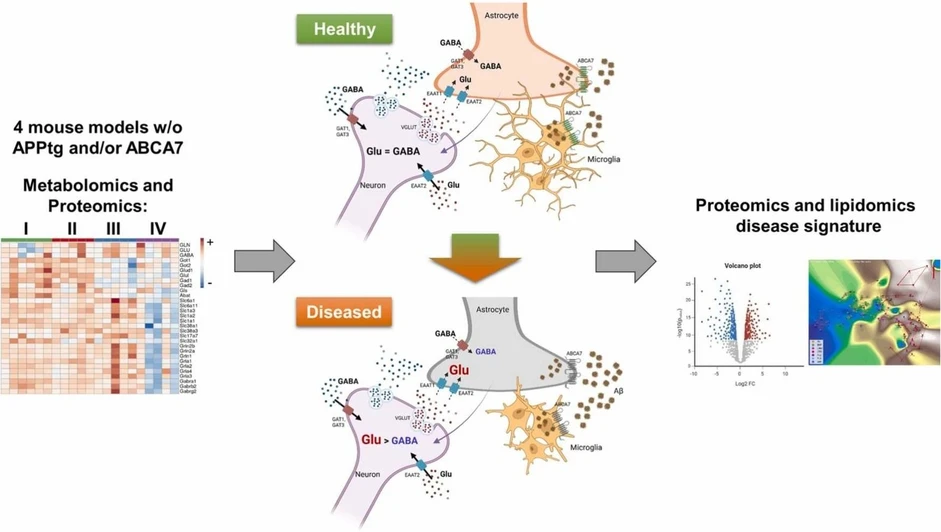
Prog Neurobiol. 2026 Apr:259:102891: Graphical abstract
This study investigates the role of the Alzheimer's disease risk gene ABCA7 in regulating glutamate and GABA neurotransmission. Using multi-omics analyses across four mouse models, the researchers found that amyloid-β deposition enhances glutamatergic signaling, while loss of ABCA7 further aggravates excitotoxic neuronal damage by altering neurotransmitter metabolism, transport, and receptor expression.
The findings identify ABCA7 as a key modulator of glutamate-driven neurotoxicity and suggest it as a promising pharmacological target for slowing neurodegeneration. The work provides new mechanistic insight into Alzheimer's disease and other neurological disorders involving disrupted glutamate–GABA homeostasis.
The original article
ABCA7 deficiency exacerbates glutamate excitotoxicity in Alzheimer’s disease mice – A new pharmacological target for Glu-related neurotoxicity
Anna Maria Górska, Irene Santos-García, Aleš Kvasnička, Dana Dobešová, David Friedecký, Jacob Gildenblat, Jens Pahnke
Prog Neurobiol. 2026 Apr:259:102891
https://doi.org/10.1016/j.pneurobio.2026.102891
licensed under CC-BY 4.0
Selected sections from the article follow. Formats and hyperlinks were adapted from the original.
Alzheimer’s disease (AD) ranks as the fifth leading cause of mortality among individuals aged 65 years and older and holds the position of the sixth leading cause of death for the adult population at large (Alzheimer's Association, 2024). In 2019, over 55 million individuals globally were affected by AD and other forms of dementia. According to estimations of the World Health Organization (WHO), this number is anticipated to escalate to approximately 140 million by the year 2050 (Alzheimer's Association, 2024). AD is characterized by the deposition of amyloid-β (Aβ) plaques and tau neurofibrillary tangles within the neocortex. However, the biochemical and cellular alterations occurring within the brain remain only partially elucidated (Gulisano et al., 2018, Perl, 2010). The most profound symptoms of AD include memory loss and disorientation, which are associated with a reduction in neuronal count within the hippocampus, a brain region fundamental to learning and memory (Ball et al., 1985). The entorhinal cortex, the interface between the hippocampus and the neocortex, is essential for forming spatial memory and is the initial region impacted by AD pathology (Knierim, 2015).
In recent years, the significant correlation between the imbalance of amino acid neurotransmitters, specifically glutamate (Glu) and γ-aminobutyric acid (GABA), and the pathogenesis of AD has garnered considerable attention (Sun et al., 2009). Notably, the overstimulation of Glu coupled with insufficient inhibition by GABA is associated with progressive deposition of Aβ (Zott et al., 2019, Avila et al., 2025).
Glu, recognized as the predominant excitatory neurotransmitter within the mammalian central nervous system (CNS) and a precursor to GABA (Patel et al., 2005), is essential to processes such as memory, neuronal development, and synaptic plasticity. Its distribution is widespread throughout the CNS, predominantly localized within cortical and hippocampal pyramidal neurons that are integral to cognitive function (Bird and Burgess, 2008). Most glutamatergic neurotransmission in the mammalian CNS is facilitated by ionotropic glutamate receptors (iGluRs) – specifically, NMDA and AMPA receptors. These receptors are pivotal in modulating synaptic plasticity and strength, thereby elucidating the molecular mechanisms underpinning learning and memory, which positions iGluRs as significant targets for therapeutic interventions (Hansen et al., 2021, Platt and Micheau, 2003). As of now, the only used drug mitigating the excessive stimulation of the glutamatergic system is memantine, a low-affinity antagonist of NMDA receptors that inhibits Glu-related neurotoxicity without disrupting the physiological functions of Glu that are necessary for memory and learning (Danysz et al., 2000). The gradual decline in glutamatergic terminals may elucidate why memantine exhibits diminished efficacy in AD patients after several years of treatment. Consequently, exploring potential new therapeutic strategies utilizing existing pharmacological agents that can counteract the progressive neurodegeneration and memory impairments associated with Glu overstimulation may provide substantial benefits to affected individuals.
In this work, we elucidated the disruption of Glu-GABA equilibrium in a murine AD model through the application of multi-omics analyses, emphasizing the significant role of ABCA7 in modulating Glu-mediated neurotoxicity associated with AD. Furthermore, by employing advanced methodologies using MS/MSI and new computational approaches (Gildenblat and Pahnke, 2026, Gildenblat et al., 2025b), we are the first to identify lipids that appear specific to the pathology of AD concerning ABCA7 deficiency.
2. Materials and methods
2.5. Proteomics analyses
2.5.2. LC-MS/MS proteomics analysis of brain tissue samples
Liquid chromatography with tandem mass spectrometry (LC-MS/MS) analysis was performed using an EVOSEP one LC system coupled with a timsTOF pro2™ mass spectrometer and a CaptiveSpray nanoelectrospray ion source (Bruker Daltonics GmbH, Bremen, Germany). 200 ng of the digested peptides were loaded onto a capillary C18 column (15 cm length, 150 μm inner diameter, 1.5 μm particle size, EVOSEP, Odense, Denmark). Peptides were separated at 50 °C using EVOSEP's standard 30 sample/day method. The timsTOF pro2™ mass spectrometer operated in data-dependent Parallel Accumulation-Serial Fragmentation (PASEF®) mode (Skowronek and Meier, 2022). Mass spectra for MS and MS/MS scans were recorded in the m/z range of 100–1700 Da. Ion mobility resolution was set between 0.85 and 1.40 V·s/cm over a ramp time of 100 ms. Data-dependent acquisition was conducted using four PASEF MS/MS scans per cycle with a nearly 100 % duty cycle. A polygon filter was applied in the m/z and ion mobility space to filter out low m/z, singly charged ions from PASEF precursor selection. An active exclusion time of 0.4 min was applied to precursors that reached 20,000 intensity units. The collisional energy was ramped stepwise as a function of ion mobility.
2.6. Metabolomics analyses
2.6.2. LC-MS/MS metabolomics analysis
Targeted metabolomics analysis was conducted using an ExionLC ultra-high-performance liquid chromatograph coupled with a QTrap 6500 + mass spectrometer (Sciex, Foster City, CA, USA). The setup was controlled using Analyst software (v1.6.2). A HILIC column (Luna 3 μm NH2, 2 × 100 mm, Phenomenex) was employed to separate metabolites. Mobile phase A consisted of 20 mM ammonium acetate (pH=9.75), while mobile phase B was acetonitrile. The column temperature was set at 35 °C, with a 0.3 mL/min flow rate. The gradient settings were as follows: 0 min: 95 % B; 7 min: 10 % B; 13 min: 10 % B; 13.5 min: 95 % B; and 17 min: 95 % B. The total runtime was 17 min. Polarity switching allowed for the acquisition of metabolites in both positive and negative ionization modes. Optimal declustering potentials and collision energies were established using reference standards. Detailed methodology for detecting 352 metabolites in biological samples has been reported previously (Karlikova et al., 2016).
2.7.2. LC-MS/MS lipidomics analysis
Lipidomic profiling was performed using an ExionLC ultra-high-performance liquid chromatograph interfaced with a QTrap 6500 + mass spectrometer (Sciex, Concord, CA, USA) as previously described (Kvasnicka et al., 2023). Lipids were separated on a BEH C8 reversed-phase column (2.1 mm × 100 mm, 1.7 µm, Waters), tempered at 55 °C with a flow rate of 0.35 mL/min. The mobile phase A (MPA) was acetonitrile/water (3:2, v/v), and the mobile phase B (MPB) was isopropanol/acetonitrile (9:1, v/v), both containing 10 mM ammonium acetate. The elution gradient was: 0–1.5 min: 32 % MPB; 1.5–15.5 min: increase to 85 % MPB; 15.6–18 min: 97 % MPB; 18.1–20 min: return to 32 % MPB. Polarity switching allowed the simultaneous detection of lipids in positive and negative modes. QC samples were analyzed every sixth injection to ensure system stability.
3. Results
3.3. Dysregulation of Glu and GABA metabolism at the astrocytic and neuronal levels is induced by Aβ deposition and lack of ABCA7
The balance between the metabolism of Glu and GABA is maintained by mutual communication between astrocytes and neurons. Here, astrocytes remove excessive Glu and GABA from the synaptic cleft and then supply neurons with glutamine (Gln) for Glu and GABA synthesis (Norenberg and Martinez-Hernandez, 1979). Gln is transported to neurons by SNAT1 and SNAT3 (Qureshi et al., 2019, Mackenzie et al., 2003, Reimer et al., 2000) and then metabolized into Glu in glutamatergic neurons and GABA in GABAergic neurons via glutaminase (GLS) (Kvamme et al., 2001, Schousboe, 2003, Bak et al., 2006), and glutamate decarboxylase (GAD), respectively (Fig. 2). After the release of neurotransmitters into the synaptic cleft, the excess of Glu and GABA is captured by neighboring astrocytes using specific transporters, excitatory amino acid transporters (EAAT1 and 2) and sodium- and chloride-dependent GABA transporters (GAT-1 and −2). Highly toxic Glu is immediately broken down via glutamine synthetase (GLUL) into Gln (Norenberg and Martinez-Hernandez, 1979). At the same time, GABA is metabolized by GABA transaminase (GABA-T, ABAT) to succinic semi-aldehyde (SSA), followed by succinate, which is incorporated into the tricarboxylic acid (TCA) cycle (Bak et al., 2006) (Fig. 2).
An imbalance between inhibitory and excitatory neurotransmission is an essential feature of AD (Andersen et al., 2022). Here, the level of Glu and GABA is measured in the whole brain, meaning the pool which is released into the synaptic cleft and stored inside the neuronal vesicles. Thus, changes in the level of degrading enzymes may also be affected by neurotransmitter pools inside the neurons and the efficiency of reuptake transporters. In physiological conditions, Glu and GABA are mainly metabolized by astrocytes instead of being taken up into neurons and packed again into vesicles.
Our results showed that in AD mice the lack of ABCA7 results in decreased levels of the enzymes (AAT/GOT1 and GLUD1) responsible for converting Glu into α-ketoglutarate (α-KG). Simultaneously, the stable GLUL levels suggest a reduction in Glu metabolism at the astrocytic level. Furthermore, the increased activity of EAAT2 drives Glu into astrocytes, where impaired Glu metabolism may lead to higher astrocytic toxicity and excess Glu in the synaptic cleft. In pathological conditions, Glu-related toxicity is intensified by impaired Aβ plaque clearance via ABCA7. Interestingly, the lack of ABCA7 in control animals (A7ko) impaired Glu and GABA metabolism at the astrocytic and neuronal levels without changing the neurotransmitter levels, suggesting that already-synthesized Glu and GABA are stored inside the vesicles.
GOT1 (AAT) and GLUD1 are reverse enzymes that convert αKG to Glu and Glu back into αKG (Fig. 3). These enzymes are expressed in both neurons and astrocytes, with higher activity observed in astrocytes, making them the primary cell type responsible for Glu metabolism. In APPtg animals, a decrease in GLUD1 was seen in 50- and 100-day-old animals (Fig. 4B), while no differences were found in GLUL activity (Fig. 4D). The changes in enzyme levels were accompanied by an increase in Glu (Fig. 5C) with no changes in Gln levels (Fig. 4F), suggesting that neuronal metabolism is favored in APPtg mice compared to astrocytes. This is supported by decreased GLS activity, which is specifically expressed in neurons. Additionally, impairment of Glu metabolism at the astrocytic level may also lead to a persistent excess of Glu in the synaptic cleft. In the GABAergic system, an increase in GAD2 (GAD65) (Fig. 4H) was observed in 50-day-old animals, with no changes in GAD1 (GAD67) (Fig. 4G), followed by no difference in GABA levels and a decrease in ABAT (Fig. 4I and J).
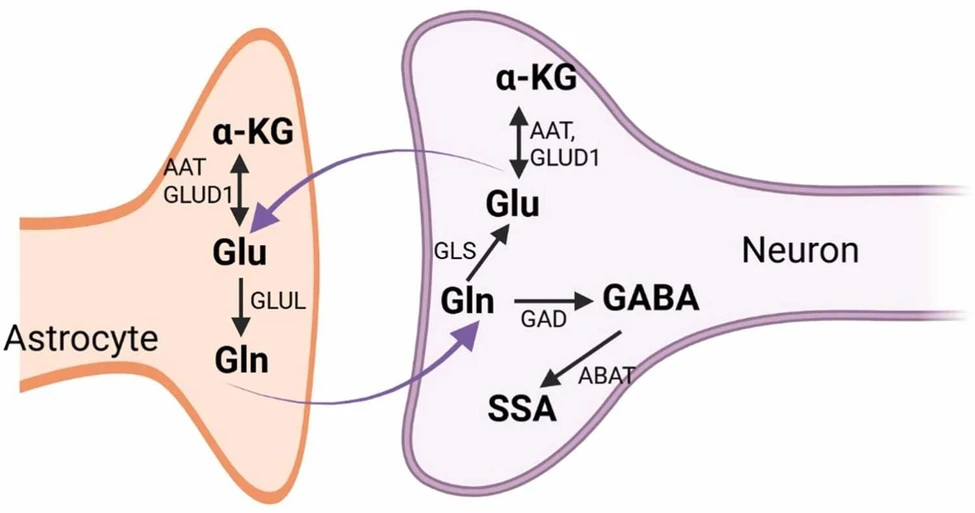 Prog Neurobiol. 2026 Apr:259:102891: Fig. 3. Astrocyte – neuron cycle of Glu-Gln-GABA synthesis and metabolism. Astrocytes provide neurons with Gln, a precursor for synthesizing Glu and GABA. Astrocytes absorb excess Glu to complete the cycle, which is then metabolized back into Gln.
 Prog Neurobiol. 2026 Apr:259:102891: Fig. 4. AD pathology favors neuronal reuptake, which persists Glu longer in the synaptic cleft. Lack of functional ABCA7 transporters in healthy/control animals inhibits Glu and GABA turnover in astrocytes and neurons. Diagram present the combined metabolomics (C) Glu, (F) Gln and (I) GABA (in black rectangular) and proteomics data for degrading enzymes: (A) GOT1, (B) GLUD, (D) GLUL, (E) GLS, (G) GAD1, (H) GAD2 and (J) ABAT. After a normality check, statistical analyses were performed with a two-tailed unpaired Student’s t-test. p < 0.05 was considered to be significant, * vs APPtg; ^ vs APP-A7ko; # vs WT. Data are presented as the mean ± SD.
3.6. Virtual lipid landscape analysis using MSI-ATLAS
The recently described the MiCS/LMC (Gildenblat and Pahnke, 2026), MSI-VISUAL (Gildenblat and Pahnke, 2025a), and MSI-ATLAS (Gildenblat et al., 2025b) methods and frameworks which provide new dimensionality reduction, computational, and machine learning tools to visualize and analyze the region-specific lipid composition of the brain based on high-dimensional MSI data.
Using spatial brain lipidomics data, followed by a highly detailed brain segmentation model, a Computational Brain Lipid Atlas (CBLA) and Virtual Landscape Visualizations (VLV) of the lipid composition across different brain regions and their anatomical connections were generated (Gildenblat et al., 2025b). Through VLV, we present regions with the highest accumulation of lipids based on their mass-to-charge ratio (m/z). The resulting landscape color maps represent lipid levels corresponding to the MSI signal intensity, ranging from 0 (blue) through green, yellow, and brown to white (maximum 255, indicating high accumulation). Exemplarily, we present the localization of m/z 502.2890 (potentially LPE(20:3)) in the AD mouse brain with or without ABCA7, a lipid which is specifically increased in white matter regions of APP-A7ko animals (Fig. 9).
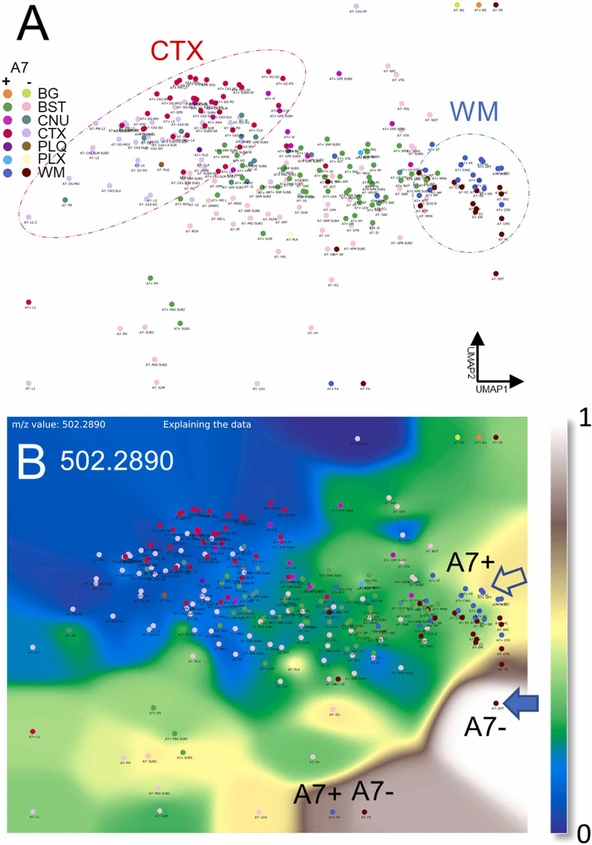 Prog Neurobiol. 2026 Apr:259:102891: Fig. 9. Cerebral brain lipid atlas (CBLA) and a Virtual Landscape Visualization (VLV) of a differentially detected m/z generated with MSI-ATLAS (Gildenblat et al., 2025b). (A) shown is the UMAP 2D dimensionality reduction graph (CBLA, only nodes, no edges) of 123 brain regions highlighting the cortex (CTX) and white matter (WM) region clusters. A7ko mice show a slight shift in their general lipid profile towards top/right. (B) VLV of m/z 502.2890 showing increased levels in AD-A7ko mice (A7single bond) in specific white matter regions (e.g., OPT – filled arrow). No expression is detected in the cortex regions (blue). The landscape color map represents the normalized MSI signal intensity, ranging from 0 (dark blue) through green, yellow, brown, to bright white (maximum 255)(Matplotlib, color map: terrain). The brain region nomenclature is based on the Allen Mouse Brain Atlas (Sunkin et al., 2013).
In human post-mortem tissue from AD individuals with PSEN1 mutation, for example, PE(22:6) (m/z 524.247) was observed in the Aβ plaques amongst many others. However, despite the enrichment, this species was not significantly increased in Aβ plaques on a group level (2 out of 5 patients) (Michno et al., 2024).
4.6. Conclusions and future directions
The results of this study emphasize the importance of ABCA7 dysfunction in the development of AD, especially in relation to the regulation of glutamatergic and GABAergic neurotransmission.
Specifically, the deposition of Aβ impaired the glutamatergic system. Notably, the absence of ABCA7 in APPtg mice led to more severe alterations characterized by an overdrive of excitatory neurotransmission and reduced inhibitory signaling.
As a lipid transporter, ABCA7 may influence the lipid content of neuronal membranes, thereby impacting neurotransmission at both presynaptic and postsynaptic levels, affecting the release of vesicles and the docking of receptors into the membrane. However, the specific mechanisms by which ABCA7 mediates these effects need further investigation.
Our lipid analysis hypothesize LPC(O-16:0), LPE(22:6), and LPE(20:3) as promising indicators of disease progression and potential treatment targets, emphasizing their specific localization in pathological contexts.
The findings also raise the question of whether existing drugs that modify glutamatergic neurotransmission in other neurological conditions could be repurposed for patients with AD. To date, the only drug primarily targeting Glu-related toxicity is memantine. This NMDAR antagonist has been used since 1986 and is considered safe and helpful for symptomatic treatment in AD (Grossberg et al., 2009). However, memantine is ineffective for all patients, with an efficacy rate of about 70 % (Tampi and van Dyck, 2007). Additionally, there are concerns regarding its diminishing effectiveness over time, as some patients may find that it becomes less effective or eventually stops working altogether.
Our study links the sole absence of ABCA7 (without any disease) to reduced glutamatergic and GABAergic neurotransmission. These results prompt further investigation into how ABCA7 mutations influence the development and severity of other neurological disorders characterized by altered glutamatergic neurotransmission, such as epilepsy, depression, schizophrenia, Parkinson’s disease, and Huntington’s disease. Significantly, they raise the question of how these mutations might affect the efficacy of treatments for the latter conditions.


