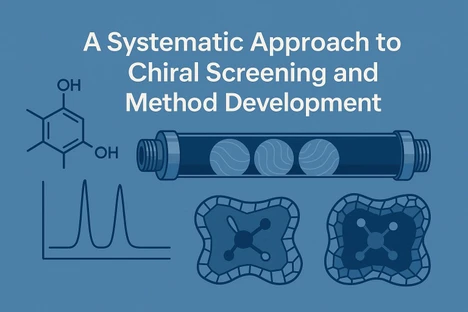
A Systematic Approach to Chiral Screening and Method Development
Article | Academy

A Systematic Approach to Chiral Screening and Method Development

Chiral separations require careful screening of stationary phases. Learn how a systematic approach with polysaccharide-based columns streamlines method development.
We, 20.8.2025
Phenomenex
tag
share
more
A Systematic Approach to Chiral Screening and Method Development
Peptide Mapping Sample Preparation - Good Practices for Tryptic Digests
Article | Academy

Peptide Mapping Sample Preparation - Good Practices for Tryptic Digests

Best practices for sample preparation in peptide mapping with trypsin, covering denaturation, alkylation, buffer exchange, and protease selection for complete sequence coverage.
We, 13.8.2025
Phenomenex
tag
share
more
Peptide Mapping Sample Preparation - Good Practices for Tryptic Digests
Basic analytes and the benefits of modified silica supports in reversed-phase liquid chromatography
Article | Academy

Basic analytes and the benefits of modified silica supports in reversed-phase liquid chromatography

C18 columns with residual positive charge improve peak shape of basic analytes at low pH by reducing silanol interactions and enabling 100% aqueous mobile phases.
We, 6.8.2025
Phenomenex
tag
share
more
Basic analytes and the benefits of modified silica supports in reversed-phase liquid chromatography
Sample Pre-treatment Procedures for Bioanalytical Samples
Article | Academy

Sample Pre-treatment Procedures for Bioanalytical Samples

Bioanalytical samples often need pretreatment before SPE. Each matrix presents challenges like protein removal, red blood cell lysis, glucuronide hydrolysis, or tissue homogenization.
We, 30.7.2025
Phenomenex
tag
share
more
Sample Pre-treatment Procedures for Bioanalytical Samples
Overcoming Peak Tailing of Basic Analytes in Silica Type A Stationary Phases in RP
Article | Academy

Overcoming Peak Tailing of Basic Analytes in Silica Type A Stationary Phases in RP

Struggling with peak tailing of basic compounds in RP-LC using type A silica columns? Discover how low-pH buffers and silanol suppressors can improve peak shape—plus why type B silica is a better choice.
We, 23.7.2025
Phenomenex
tag
share
more
Overcoming Peak Tailing of Basic Analytes in Silica Type A Stationary Phases in RP
Considerations when working with solid samples and SPE
Article | Academy

Considerations when working with solid samples and SPE

Solid phase extraction enables clean-up, pre-concentration, and solvent switching. Proper solvent choice and SPE mode are key for effective solid sample preparation.
We, 16.7.2025
Phenomenex
tag
share
more
Considerations when working with solid samples and SPE
The Role of End-Capping in RP
Article | Academy

The Role of End-Capping in RP

New end-capping technologies can significantly improve the analysis of compounds that were once considered challenging.
We, 9.7.2025
Phenomenex
tag
share
more
The Role of End-Capping in RP
How much sample can I load onto my SPE device? Is it linked to the concentration of my analyte of interest?
Article | Academy

How much sample can I load onto my SPE device? Is it linked to the concentration of my analyte of interest?

How much sample can I load onto my SPE device? Is it linked to the concentration of my analyte of interest?
We, 2.7.2025
Phenomenex
tag
share
more
How much sample can I load onto my SPE device? Is it linked to the concentration of my analyte of interest?
How can capacity factors drive method robustness?
Article | Academy

How can capacity factors drive method robustness?

How can capacity factors drive method robustness?
We, 25.6.2025
Phenomenex
tag
share
more
How can capacity factors drive method robustness?
How is normal phase (NP) SPE different from reversed phase (RP) SPE? How do I decide which one to use?
Article | Academy

How is normal phase (NP) SPE different from reversed phase (RP) SPE? How do I decide which one to use?

How is normal phase (NP) SPE different from reversed phase (RP) SPE? How do I decide which one to use?
We, 18.6.2025
Phenomenex
tag
share
more
How is normal phase (NP) SPE different from reversed phase (RP) SPE? How do I decide which one to use?
Other projects
GCMS
ICPMS
Follow us
FacebookX (Twitter)LinkedInYouTube
More information
WebinarsAbout usContact usTerms of use
LabRulez s.r.o. All rights reserved. Content available under a CC BY-SA 4.0 Attribution-ShareAlike