


The Institute for Nanomaterials, Advanced Technologies and Innovations of the Technical University of Liberec, also known as CXI TUL, was founded in 2009. Our mission is to support TUL's long-term vision of collaboration with industry and innovation. Our experts use state-of-the-art equipment and cutting-edge technology to deliver science at the highest level. We focus on three main research areas: nanomaterials in life sciences, competitive engineering and systems integration.
CXI TUL prides itself on its applied research, which often takes place in close collaboration with industrial partners. These collaborations account for more than 20% of our annual turnover. Our team includes more than 160 specialists working on approximately 70 scientific projects, with nearly one-sixth of our staff coming from all over the world.
We have been successful in winning major European grants such as Horizon Europe, Digital Europe, MSCA, Life+ and Twinning. We publish more than 100 impactful scientific publications per year. In our existence, we can boast, for example, 66 patents or 59 proven technologies.
We also focus on creating a pleasant and inspiring working environment. In 2020, we received the HR Excellence in Research award, which confirms our care for our employees and our compliance with European standards in this area. Half of our team is female. We believe that diversity is the path to success.
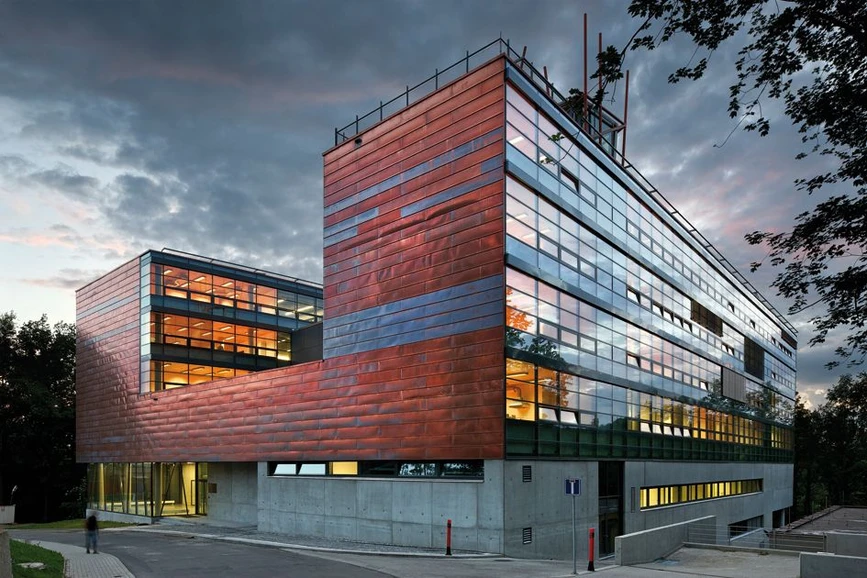 CXI TUL: The Institute for Nanomaterials, Advanced Technologies and Innovations of the Technical University of Liberec.
Science and research
Our Institute is oriented in three directions:
- The first is the Nanomaterials in Life Sciences research stream, which combines basic and applied research with advanced technologies, including hi-tech analysis of environmental pollutants. A key focus is on the synthesis, testing and validation of nanomaterials in practical applications, particularly in water treatment and remediation. We offer specialised services in microbial safety, nanomaterial development for medicine and cosmetics, and bioremediation, including analysis of the impact of remediation interventions on microbial communities. We provide accredited sampling and analysis of drinking and bathing water, chemical and microbiological testing, laboratory and semi-operational testing of chemical oxidation methods, including GC/MS and LC/MS. We deal with the synthesis and functionalization of organic and inorganic compounds, prepare nanoparticles and offer chemistry consultation. We are involved in advanced water treatment technologies, membrane bioreactors, biomass carriers, groundwater remediation and nanomaterials in biotechnology, including nanofiber filters for water and air.
- The second research thrust, Competitive Engineering, focuses on R&D for the manufacturing and automotive industries with high application potential. We support industrial activities not only in adjacent regions, focusing on new technologies and processes to increase innovation in industrial production.
- The third research area, System Integration, focuses on the development of modern software solutions, system solutions for data processing and integration between systems. Key areas are robotics, collaborative robots and visualisation of measured data using augmented and mixed reality.
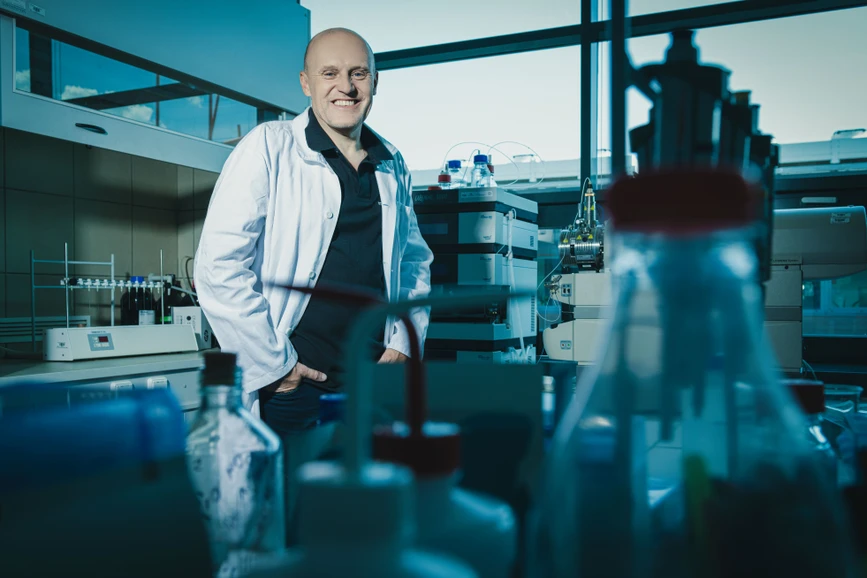 CXI TUL: The Institute for Nanomaterials, Advanced Technologies and Innovations of the Technical University of Liberec.
News




Related content
Benefits of Agilent Altura Ultra Inert HPLC Column Hardware
Vinylene carbonate water determination via coulometric Karl Fischer titration
An Isocratic Separation of B Vitamins Using Waters XBridge Biphenyl RP Column with MaxPeak Premier Technology


