19th International Symposium on Hyphenated Techniques in Chromatograph and Separation Technology (HTC-19)
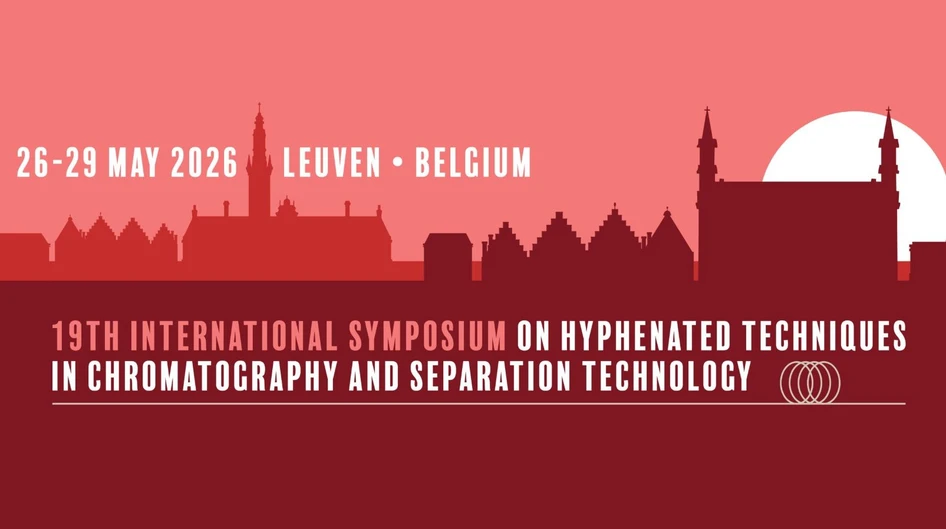
It is our great pleasure to invite you to attend and contribute to the 19th International Symposium on Hyphenated Techniques in Chromatograph and Separation Technology (HTC-19), which will take place from May 26 to 29 in Leuven, Belgium.
The HTC symposium series started in 1990 and is the ideal meeting place for scientists and practitioners from academia and industry and vendors to discuss and gather new insights in emerging technologies, instrumentation, workflows, and applications. Organized under the auspices of the Vrije Universiteit Brussel (VUB), the Catholic University of Leuven (KU Leuven), Ghent University (UGhent), and the Separation Science Group of the Royal Society of Chemistry (RSC), HTC-19 is expected to gather over 300 participants.
We look forward to warmly welcoming you to HTC-19 in the historic city of Leuven!
Deirdre Cabooter, Ken Broeckhoven, Frederic Lynen and Sebastiaan Eeltink
Timeline
- Opening abstract submissions: Monday 1 September 2025
- Opening registrations: Wednesday 1 October 2025
- Extended submission deadline oral presentations: Thursday 15 January 2026
- Poster submission deadline: Thursday 15 January 2026
- Late breaking poster submission deadline: Friday 27 February 2026
- Notification letters: Friday 27 February 2026
- Presenting author registration deadline: Friday 13 March 2026
- Early bird registration deadline: Friday 13 March 2026
Registration
Registration Fee
Early bird (until 13 March 2026)
- Industry / Academic: € 675
- Student: € 325
Regular (From 14 March 2026)
- Industry / Academic: € 775
- Student: € 425
Conference dinner
- Participants: € 95
- Accompanying persons: € 110
Tasting event
- Participants: € 50
- Accompanying persons: € 60
Short courses (CE, GC and GCxGC, NANOLC-MS, 2D-LC)
- Academic: € 500
- Industry: € 500
- Students: € 350
Short course (AI MD Development)
- Academic: € 250
- Industry: € 250
- Students: € 125
All registration fees are VAT exempt based on article 44 § 2, 4° of the Belgian VAT directive.
Registration fees are to be paid in Euros (€) by bank transfer, online payment or invoice.
Abstract Submission
Topics
The HTC-19 Scientific Committee will welcome the submission of high quality abstracts focusing on a wide variety of topics:
HYPHENATED TECHNIQUES
- Multi-dimensional LC, GC, and SFC
- LC-MS
- GC-MS
HIGHLIGHTED TECHNOLOGIES
- Automated sample preparation
- On-line analyzers and sensors
- Electro-driven separations
FEATURED APPLICATIONS
- Modulation approaches
- Coupling to detectors
SUBMISSION GUIDELINES
- You can submit an abstract for an oral presentation and/or poster presentation.
- Abstracts are to be written in English and should be submitted electronically using the Conftool abstract management system.
- All abstracts must be relevant to the conference topics.
- To assist with the review process and the creation of the conference program itself, you will be asked to select max. 3 themes from the topic list that best suit your submission.
- The abstract body text is limited to 3000 words, but typically one page.
- Do not include keywords or images/photos/figures in the abstract body.
- In case of poster presentation, authors have the option to select whether they would like to be considered for the best poster award.
Programme
The conference program will comprise six plenary lectures, twenty keynote lectures by renowned experts in the field of hyphenated separation and detection techniques. Sixty oral presentation slots are foreseen for the open abstract submission. The oral and Keynote presentation sessions will include, among others, the following sessions:
- Current state of the art in Gas Chromatography (GC)
- Dedicated session on Supercritical Fluid Chromatography (SFC)
- Novel fundamental chromatographic research (LC, GC)
- Novel LC, GC, and SFC column technology
- Novel detector technology (LC, GC)
- The power of the Hyphen (RSC session)
- Predicting the Future (RSC session)
- Protein-based bio-therapeutics: innovative separation and detection approaches
- State-of-the-art in bio-therapeutics analysis: oligonucleotides
- Exploiting AI & modelling in separations and detection
- Innovations in LC, GC and HRMS based non-targeted analysis
- Implementing next-level hyphenated techniques for ultra-sensitive metabolomics
- Advances in hyphenated (green) sample preparation (EuChemS-DAC session)
- State-of-the-art in 2D-LC and 2D-GC
- Advances in natural product and food analysis
- Data mining and curation of hyphenated chromatographic data
Plenary Spekares
Under pressure: bringing supercritical fluids to multi-dimensional analysis systems
- Caroline West, Université d’Orléans, France
Open Science Cheminformatics Resources Supporting Hyphenated Non-target Screening Efforts
- Emma Schymanski, University of Luxembourg, Luxembourg
The challenges of scale for meaningful environmental research
- Leon Barron, Imperial College London, United Kingdom
Hyphenated methods in chromatography: Innovations realised and challenges remaining
- Hans-Gerd Janssen, Unilever, The Netherlands
Delicious Science: A Chemical Journey Through the Kitchen
- Peter Van Broeck, WM-Lightning B.V., Belgium
Shaken, not stirred – James Bond in the spotlight of physics
- Metin Tolan, Faculty of Physics, TU Dortmund University, Germany
Short Courses
Hands-on 2D-LC Short Course
- By Stephan Buckenmaier (Agilent Technologies) and Marie Pardon (KU Leuven)
- Location: Leuven
Two-dimensional liquid chromatography (2D-LC) offers powerful solutions for difficult separation problems. This short course is designed to introduce attendees to the fundamental principles of 2D-LC and explain the rationale behind using this advanced technique. Application examples will focus on multiple heart-cutting (MHC) 2D-LC, an operation mode that allows each dimension to operate independently under optimal conditions, which significantly enhances the overall performance. Through practical demonstrations, attendees will gain hands-on experience with MHC 2D-LC, including data acquisition and evaluation workflows, making the concepts tangible and applicable to real-world scenarios.
Hands-on nanolc-ms short course
- By Sebastiaan Eeltink (VUB)
- Location: Brussels
This short course provides a practical introduction to nano-scale liquid chromatography–mass spectrometry (nanoLC-MS) targeting proteomics profiling. Short, focused lectures cover nanoLC instrumentation, column selection and LC method development, and MS workflows, while hands-on sessions guide participants through system setup, optimization, and high-sensitivity data acquisition and processing. Designed for researchers and technicians, the training emphasizes troubleshooting, routine maintenance, and best practices to ensure robust proteomic profiling.
Hands-on GC and GC x GC short course
- By Pierre-Hugues Stefanuto (U Liege) and Katelynn Perrault (William & Mary University)
- Location: Liege
In this hand-on short course we introduce the basic principles of gas chromatography (GC) and its hyphenation with different type of injectors and detectors, with a special focus on mass spectrometry hyphenation. Participants will become familiar with the different injection mode for liquid samples and acquire basic knowledge on volatile molecules sampling using SPME and trap tubes. Moreover, best practices (modulators, optimization of key parameters, and method development) of heart-cutting and comprehensive GCxGC-MS separations, including data processing will be covered.
Hands-on CE short course
- By Frederic Lynen (UGhent)
- Location: Ghent
Join us for an interactive, half-day course exploring the fundamentals and practical applications of capillary electrophoresis (CE). Participants will gain a solid understanding of CE theory and hands-on experience analyzing charged and neutral organic and inorganic molecules, as well as proteins. Learn how to optimize separations (CZE, MEKC), choose appropriate buffer and capillary conditions, interpret electropherograms, and appreciate the versatility of this powerful analytical technique. This short, practical introduction to CE is ideal for students, researchers, and laboratory professionals looking to deepen their skills and confidence in this rapidly growing family of separation techniques.
AI MD development short course
- By Bob Pirok (University of Amsterdam)
- Location: Leuven
Introduction to Artificial Intelligence for Hyphenated Separations
Artificial intelligence (AI) is undeniably reshaping both science and society. From accelerating molecular discovery to the rapid evolution of language models, AI’s capacity to drive innovation at an extraordinary pace is remarkable. Its impact is far-reaching, altering the way we work, learn, and interact. It is therefore natural that researchers in analytical separation science are also seeking to harness its potential.
This course offers an introduction to AI. Much like chromatography, AI is a broad field that encompasses a wide range of techniques. We will highlight the most important ones and explore their relevance. It is worth noting that AI is not new, its history spans more than fifty years. Over that time, the field has seen setbacks, including two “AI winters,” with the second beginning around 1984, when the technology again fell short of its ambitious promises. Even today, AI faces significant limitations, and part of this course is dedicated to understanding these challenges, including those that cannot easily be overcome.
We will then turn to a critical discussion of applications of AI in chromatography and data analysis, examining both successes and failures, and reflecting on likely future developments. Finally, the course will close with a hands-on demonstration of selected machine learning techniques, complemented by exercises that will examine which machine-learning techniques are useful to solve practical problems. Participants will also be encouraged to contribute their own case studies for discussion.
SPONSORS & EXHIBITORS
Interested in becoming a sponsor or exhibitor during HTC-19 in Leuven, Belgium?
Do not hesitate to reach out to discuss the possibilities!
GOLD
- Johnson&Johnson
- RIC group
SILVER
- GL Sciences
- MERCK
- Phenomenex
- Shimadzu
- YMC Europe GmbH
- HALO
- Agilent Technologies
- Thermo Fisher Scientific
- labbuddy
- cmc Instruments GmbH
- LECO
BRONZE
Venue
Social Sciences Campus
- Parkstraat 45, 3000 Leuven
The Faculty of Social Sciences is one of the campuses located in the heart of Leuven, close to Sint-Donatuspark. This vibrant faculty serves as a center for high-quality research in the field of social sciences in Europe and around the world. Additionally, it is home to many anthropologists, communication scientists, sociologists, and political scientists.
Opening lectures & welcome reception (26 MAY): University hall
- Naamsestraat 22, 3000 Leuven
The opening lectures will be held in the Promotion Hall, which hosts up to 385 places. This oak paneled hall, lined with the portraits of former rectors, is the location where the university convenes for its most prestigious activities: the celebration of honorary doctorates, graduations, conferences, etc.
Jubilee Hall (Jubileumzaal) at KU Leuven is a distinguished ceremonial space located in the historic heart of the university. Known for its elegant neoclassical architecture, high ceilings, and stately decor, the hall is often used for academic ceremonies, lectures, and official events. It reflects the long-standing academic tradition and prestige of KU Leuven, one of Europe’s oldest and most renowned universities.
Conference dinner (28 MAY): Faculty club
- Groot Begijnhof 14, 3000 Leuven
Join us for the conference dinner at the Faculty Club in Leuven, a historic venue nestled within the beautifully restored Grand Beguinage, a UNESCO World Heritage site. Enjoy a refined evening of Belgian cuisine and networking in an inspiring setting that blends tradition and hospitality.