
LCMS
More information
WebinarsAbout usContact usTerms of use
LabRulez s.r.o. All rights reserved. Content available under a CC BY-SA 4.0 Attribution-ShareAlike
Organizer
Agilent Technologies
Analytical scientists and clinical researchers worldwide rely on Agilent to help fulfill their most complex laboratory demands. Our instruments, software, services and consumables address the full range of scientific and laboratory management needs.
Tags
Consumables
Columns
Tips & Tricks
HPLC
LinkedIn Logo

Too Polar for Reverse Phase: What Do You Do?
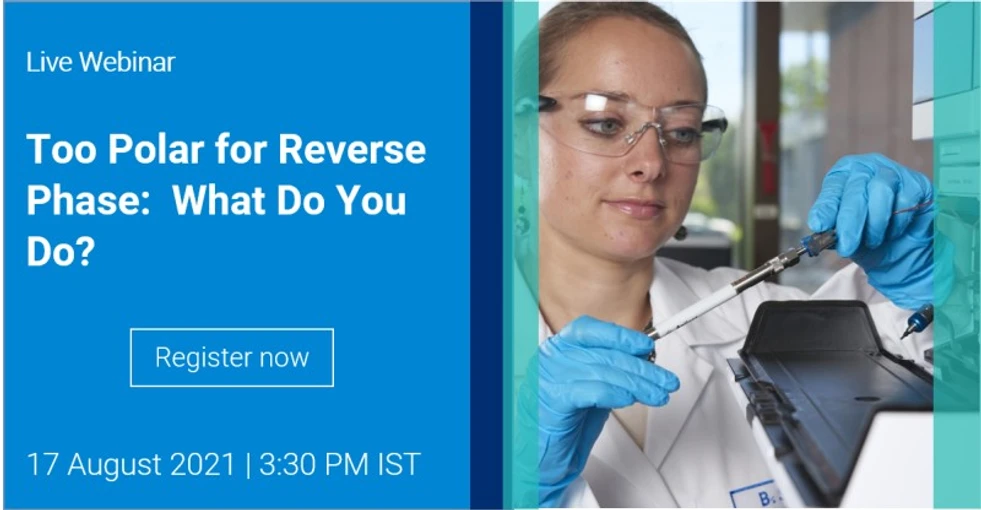
RECORD | Already taken place Tu, 17.8.2021
We will try to present general guidelines on how to choose the right separation mode (HILIC or RP). Working down a checklist, we will discuss aspects that have to be taken into consideration.
Go to the webinar
Agilent Technologies: Too Polar for Reverse Phase: What Do You Do?

Analyzing polar molecules presents a unique challenge for chromatographers. These molecules span the gamut of varying markets: from Polar pesticides in food to Non-steroidal anti-inflammatory drugs to highly polar sugars and amino acids. Conventional HPLC stationary phases like C18 often do not provide adequate retention and separation of such highly polar compounds.

Consequently, chromatographers are forced to step outside of their comfort zone and start exploring polar chemistries. Both Reverse phase polar columns as well as hydrophilic stationary phases are utilized for solving this problem.

This webinar will not focus on specific applications, but we will try to present general guidelines on how to choose the right separation mode (HILIC or RP). Working down a checklist, we will discuss aspects that have to be taken into consideration when developing new polar molecule separations.

In this webinar, we will discuss how to:

  • Find the best column to retain and separate polar analytes, focusing on HILIC and polar RP
  • Choose between RP and HILIC based on analyte solubility and sample solvent
  • How the right separation mode can ensure reliable detection of your sample

Presenter: Sunil B Lakhmapure (Technical Support Specialist Consumables, Agilent Technologies Debesh)

Holds 18 year plus experience in the analytical field with major exposure to LC/GC with Single quad , Triple Quad and High resolution (QToF) mass spectroscopy.

Started career in Pharma R&D as a scientist with hands on experience on high end instruments like LCMS, XRD & NMR .

Developed & published application notes using Chromatographic techniques on real world samples/issues at various levels.

Agilent Technologies
LinkedIn Logo
 

Related content

Overcoming Strong Solvent Effects in the Analysis of Vepdegestrant

Applications
| 2026 | Agilent Technologies
Instrumentation
HPLC
Manufacturer
Agilent Technologies
Industries
Pharma & Biopharma

Identification of Double Bond Positions and Relative Acyl Chain Positions in Egg Yolk Phosphatidylcholines Using OAD-TOF System

Applications
| 2026 | Shimadzu
Instrumentation
LC/MS, LC/MS/MS, LC/TOF, LC/HRMS
Manufacturer
Shimadzu
Industries
Food & Agriculture

High Molecular-Weight Polysaccharide Characterization by SEC-MALS Using GTxResolve™ 1000 and 2000 Å SEC Columns

Applications
| 2026 | Waters
Instrumentation
GPC/SEC, Consumables, LC columns
Manufacturer
Waters
Industries
Pharma & Biopharma, Food & Agriculture

Development and Optimization for a Comprehensive LC/MS/MS Method for the Detection of 74 PFAS Compounds

Applications
| 2026 | Agilent Technologies
Instrumentation
LC/MS, LC/MS/MS, LC/QQQ
Manufacturer
Agilent Technologies
Industries
Food & Agriculture

PFAS in Biota: Risk Context & Robust Analytical Solutions

Others
| 2026 | ALS Europe
Instrumentation
Laboratory analysis, LC/MS, LC/MS/MS
Manufacturer
Industries
Environmental
Other projects
GCMS
ICPMS
Follow us
More information
WebinarsAbout usContact usTerms of use
LabRulez s.r.o. All rights reserved. Content available under a CC BY-SA 4.0 Attribution-ShareAlike