
Organizer
Thermo Fisher Scientific
A unique company dedicated to serving science helping our customers drive productivity and accelerate results. Through our premier brands – Thermo Scientific, Applied Biosystems, Invitrogen, Fisher Scientific and Unity Lab Services.
Tags
HPLC
Tips & Tricks
LinkedIn Logo

Back to basics: Revealing the strength of HPLC-CAD methods
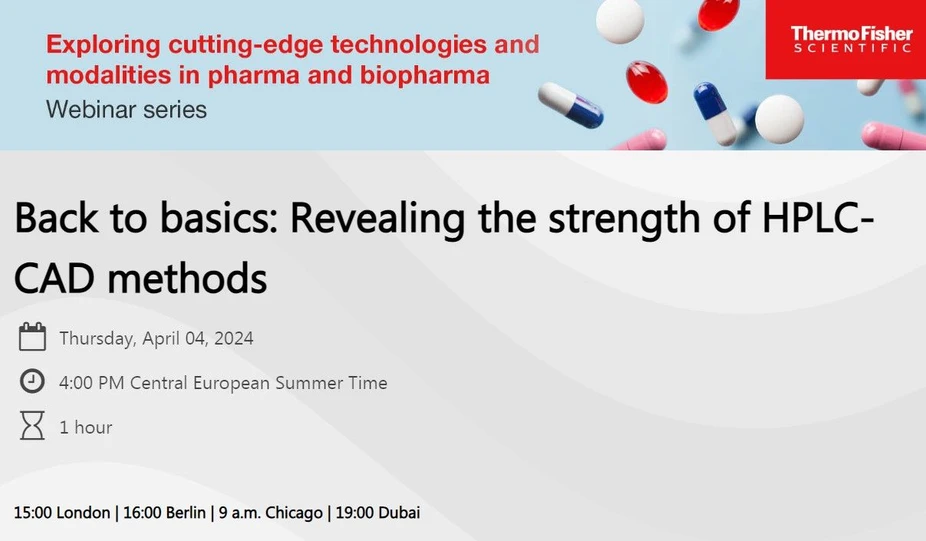
RECORD | Already taken place Th, 4.4.2024
In this live webinar, we will highlight some distinctions between CAD and other UV-absorbance detection, such as the non-linear response to analyte concentration, and sensitivity to mobile phase impurities.
Go to the webinar
ThermoFisher Scientific: Back to basics: Revealing the strength of HPLC-CAD methods

In recent years, the use of quantitative liquid chromatography (LC) coupled charged aerosol detection (CAD) for poor UV absorbing analytes in multicomponent mixtures has grown exponentially across industrial sectors.

In this live webinar, we will highlight some distinctions between CAD and other UV-absorbance detection, such as the non-linear response to analyte concentration, and sensitivity to mobile phase impurities. However, careful optimization of CAD parameters can lead to successful development and transfer of analytical methods, nearly on par with that of conventional UV absorbance detectors. Through careful tuning CAD parameters, we have developed quantitative LC-CAD assays which are sensitive, precise, accurate and robust across early and late-stage pharmaceutical development. Examples of LC-CAD methods across various stages of drug development spanning from discovery to commercialization will be shared during the presentation.

Learning points:

  • Optimization: Optimizing non-linear detection response
  • Troubleshooting: Tips and tricks to maintain a CAD detector
  • Transfer: Examples of HPLC-CAD successfully developed and transferred (nearly on par with conventional HPLC-UV)
  • Implementation of HPLC-MS-CAD for post µg-purification analysis

Who should attend:

  • Analytical chemists: Professionals who specialize in analytical techniques, especially those involved in liquid chromatography and detection methods
  • Pharmaceutical scientists: Researchers and scientists working in the pharmaceutical industry, particularly those involved in drug development and quality control
  • Quality control and assurance professionals: Individuals responsible for ensuring the quality and reliability of analytical methods used in various industries, including pharmaceuticals

Presenter: Imad Haidar Ahmad, PhD (Research Director, Amgen)

Presenter: Wes Barnhart (Principal Scientist, Amgen)
Thermo Fisher Scientific
LinkedIn Logo
 

Related content

Comprehensive and Robust Analysis of Ultrashort- to Long-Chain PFAS, PAE, OPE, and PAH

Applications
| 2026 | Agilent Technologies
Instrumentation
LC/MS, LC/MS/MS, LC/TOF, LC/HRMS
Manufacturer
Agilent Technologies, Plasmion
Industries
Environmental

UPLC™ Separation of Fifteen Bisphenols Using a Waters Acquity™ Biphenyl RP Column with MaxPeak™ Premier Technology and UV Detection

Applications
| 2026 | Waters
Instrumentation
Consumables, LC columns, HPLC
Manufacturer
Waters
Industries
Pharma & Biopharma

Achieving Low‑ppb Bisphenol Quantitation with the Agilent InfinityLab Pro iQ Mass Detector

Applications
| 2026 | Agilent Technologies
Instrumentation
LC/MS, LC/SQ
Manufacturer
Agilent Technologies
Industries
Materials Testing

ECL detection of fentanyl

Applications
| 2026 | Metrohm
Instrumentation
Electrochemistry
Manufacturer
Metrohm
Industries
Forensics

Early-stage drug metabolite quantitation without radiolabels

Applications
| 2026 | Thermo Fisher Scientific
Instrumentation
HPLC, LC/MS, LC/SQ
Manufacturer
Thermo Fisher Scientific
Industries
Pharma & Biopharma, Metabolomics
Other projects
GCMS
ICPMS
Follow us
FacebookX (Twitter)LinkedInYouTube
More information
WebinarsAbout usContact usTerms of use
LabRulez s.r.o. All rights reserved. Content available under a CC BY-SA 4.0 Attribution-ShareAlike