ASO RNA impurity analysis
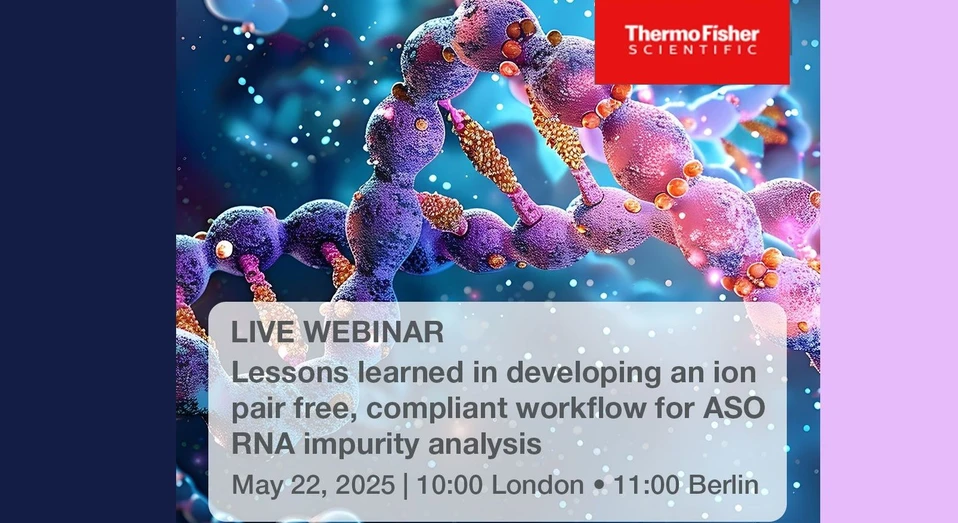
Lessons learned in developing an ion pair free, compliant workflow for ASO RNA impurity analysis
Join this live webinar with Dr. Ken Cook and discover innovative techniques for oligonucleotide impurity quantitation, automation, and data handling to enhance your laboratory's efficiency and compliance.
Topics:
- Ion pair free separation mechanisms
- Reasons for choosing the best path for quantitative methods.
- Removing problems of adducts and in-source induced impurities
- Preventing accurate quantitation of real impurities.
- Choice of the best charge states to use for quantitation
- Deconvolution and XIC Component Tables in Thermo Scientific Chromeleon Software
- Compliant data handling and complementary techniques.
- Automation of Annotation, Integration, and Compliant Reporting
- UV and MS data handling to remove bottlenecks in developing and running new quantitative methods for oligonucleotide impurity analysis
After the presentation, we planned time to answer your questions.
Who should attend?
- Laboratory managers or analysts
- developing methods for new synthetic therapeutic oligonucleotides
- implementing methods for existing modalities
- Laboratories
- involved in clinical trial analysis
- aiming to avoid ion pair contamination in their LC-MS systems
- Oligonucleotide analysts in R&D or QC departments
- Analysts looking for green oligonucleotide chemistry
You cannot attend the live broadcast on May 22? Please register to automatically receive an email with the link to the recording.
Presenter: Dr. Ken Cook (Applications Scientists Manager, Thermo Fisher Scientific)
Moved to industry from a University lectureship in Biochemistry, University of Newcastle upon Tyne, following 7 years’ experience in academia. Now with over 35 years’ experience with Thermo Fisher Scientific using a wide range of analytical equipment and software. Publications range from metabolomics, proteomics to large biopharmaceutical drug analysis. Current job title is the European manager for the BioPharma expert support group. This involves the support of Bio-Pharmaceutical applications to characterise protein and oligonucleotide based bio-therapeutics. This involves ongoing collaborations with the Biopharmaceutical industry and academia. Characterization methods of Bio-therapeutics include, monoclonal antibodies, peptides, AAV analytical development, small and large RNA analysis including sequence mapping of mRNA by LC/HRMS.