(Young Scholars Workshop) Metric Tools for the Evaluation of Chromatographic Methods
Welcome from the Chair
5th Separations Webinar
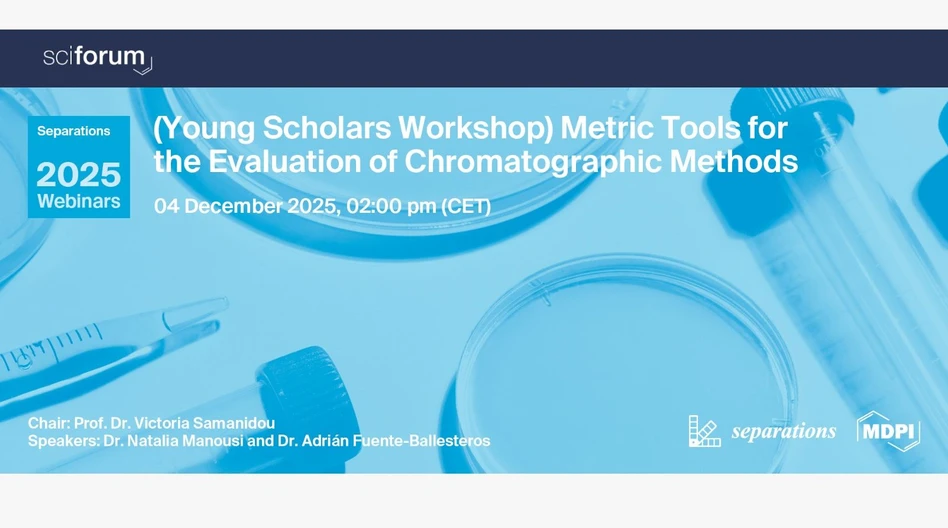
(Young Scholars Workshop) Metric Tools for the Evaluation of Chromatographic Methods
In 1998, Paul Anastas and John Warner were the pioneers who coined the term “Green Chemistry”, as a result of high concern for human health and the protection of the environment from exposure to hazardous chemicals. Since then, many metric tools have been proposed to evaluate the green character of an analytical method. However, soon after, analytical chemists realised that greenness is not the only criterion to be taken into consideration when selecting an analytical method. The consideration of other parameters, such as the type of analysis, the number of compounds that can be determined in one run, the analytical technique and required instrumentation, the throughput, the commercial availability of reagents, the automation degree, the need for pre-concentration to meet legislation criteria, etc., is also essential. Therefore, the practicality and applicability of these approaches are also to be taken into account. Moreover, the analytical performance and innovation grade should, in the meantime, be evaluated using metric tools. The principles and the relevant indices will be described in the webinar, while the software and its application will be demonstrated.
Registration
This is a FREE webinar. After registering, you will receive a confirmation email containing information on how to join the webinar. Registrations with academic institutional email addresses will be prioritized.
Certificates of attendance will be delivered to those who attend the live webinar.
Program
2:00 – 2:10 pm Chair Introduction
- Prof. Dr. Victoria Samanidou
2:10 – 2:30 pm Complementing Greenness Evaluation in White Analytical Chemistry: The Roles of the Blue Applicability Grade Index for practicality evaluation
- Dr. Natalia Manousi
2:30 – 2:50 pm Meet “VIGI”: A New Survey-Based Metric to Assess Innovation in Analytical Chemistry Methods
- Dr. Adrián Fuente-Ballesteros
2:50 – 3:10 pm How Red Analytical Performance Index can be used to assess methods in terms of analytical performance: Theory and Applications
- Dr. Natalia Manousi
3:10 – 3:30 pm Introducing “GLANCE”: A Graphical Layout Tool for Analytical Chemistry Evaluation
- Dr. Adrián Fuente-Ballesteros
3:30 – 4:00 pm Q&A
4:00 – 4:10 pm Closing of Webinar
- Prof. Dr. Victoria Samanidou
Event Chair: Prof. Dr. Victoria Samanidou (Laboratory of Analytical Chemistry, School of Chemistry, Aristotle University of Thessaloniki, Thessaloniki, Greece)
Keynote speaker: Dr. Natalia Manousi (Institute of Chemical Technologies and Analytics, TU Wien, Vienna, Austria)
Keynote speaker: Dr. Adrián Fuente-Ballesteros (Analytical Chemistry Group (TESEA), I. U. CINQUIMA, Faculty of Sciences, University of Valladolid, Valladolid, Spain)