From experts to applications: Screening protein-drug interactions with HT-PELSA
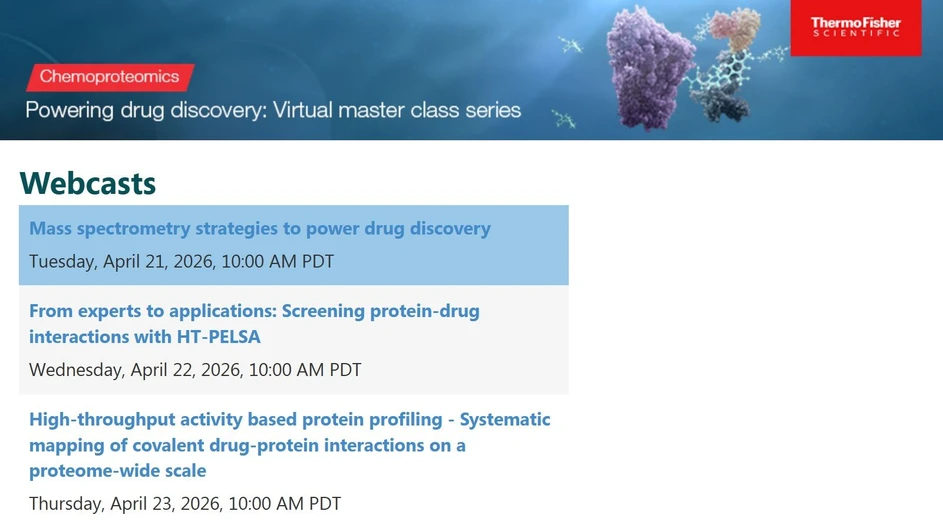
In Part 2 of our three-part Chemoproteomics Master Class Series, we move beyond foundational strategies to explore real-world applications led by experts actively advancing the field. Dr. Mikhail Savitski will highlight the development and use of high-throughput peptide centric local stability assay (HT-PELSA) to map ligand binding sites and interactions. This screening strategy can provide insight to drug targets and specificity with peptide level resolution. Mikhail will give examples to show where this can be most effective in a drug discovery pipeline, and uncover new biology.
Why Attend
- Gain insight into HT-PELSA, a cutting-edge assay paired with the Thermo Scientific™ Orbitrap™ Astral™ Mass Spectrometer to pinpoint ligand binding sites with peptide-level precision.
- Learn how this method can enhance target discovery and specificity in your drug development pipelines.
- See real-world examples of HT-PELSA uncovering new biology and accelerating chemoproteomic workflows.
Presenter: Mikhail Savitski (Team Leader, Head of Proteomics Facility, and Senior Scientist, European Molecular Biology Laboratory (EMBL))
Mikhail Savitski, Ph.D., heads Functional Proteomics and the Proteomics Core Facility at EMBL Heidelberg. He is recognized for pioneering Thermal Proteome Profiling (TPP), enabling proteome-wide drug target discovery and protein stability studies. In 2024, he received the HUPO Discovery Award for his impact on proteomics research.
Moderator: Brett Larsen (Sr. Marketing Specialist Proteomics, Thermo Fisher Scientific)
Brett Larsen is a leader in chemoproteomics and post-translational modification analysis at Thermo Fisher Scientific. With over 25 years of mass spectrometry experience, he has led proteomics at LTRI Toronto and advanced applications at MDS Proteomics. Brett brings practical expertise in translating complex workflows into real-world discovery.