
Organizer
Wiley
Wiley
For over 200 years we have been helping people and organizations develop the skills and knowledge they need to succeed. We develop digital education, learning, assessment, and certification solutions to help universities, businesses, and individuals move between education and employment and achieve their ambitions.
Tags
LC/MS
OMICS
LinkedIn Logo

Lipidomics from Structure to Function
RECORD | Already taken place We, 21.4.2021
Part I: Lipidomics from Structure to Function
Go to the webinar
Wiley Analytical Science: Lipidomics from Structure to Function

Even with a lipid content of over 10% in the human body, lipids were not in the central scientific focus during the last decade. However, more and more evidence is provided that non-genetically determined biomolecules such as metabolites and lipids are the key to biomolecular regulation.

Today it is obvious that lipids are not only important for energy homeostasis and as an environmental-cellular barrier, but also represent a central part of our signal transduction machinery. Disruptions of the sensitive lipid metabolism are highly correlated with different types of diseases including thrombocytopenia, metabolic syndrome, diabetes, obesity and hyperlipidemia. This is especially true for the latter ones, which are also reaching pandemic levels, causing a larger annual health burden than infectious diseases.

Therefore, lipid metabolism is again becoming an emerging scientific field and is a central part of pharmacological research today (statins, cyclooxygenase inhibitors). Therefore, the mission of the Lipidomics group in Vienna is to understand lipids in context with their proteins (enzymes) and building blocks (metabolites) in a true systems biology way.

Who should attend:

Anybody with a basic analytical knowledge.

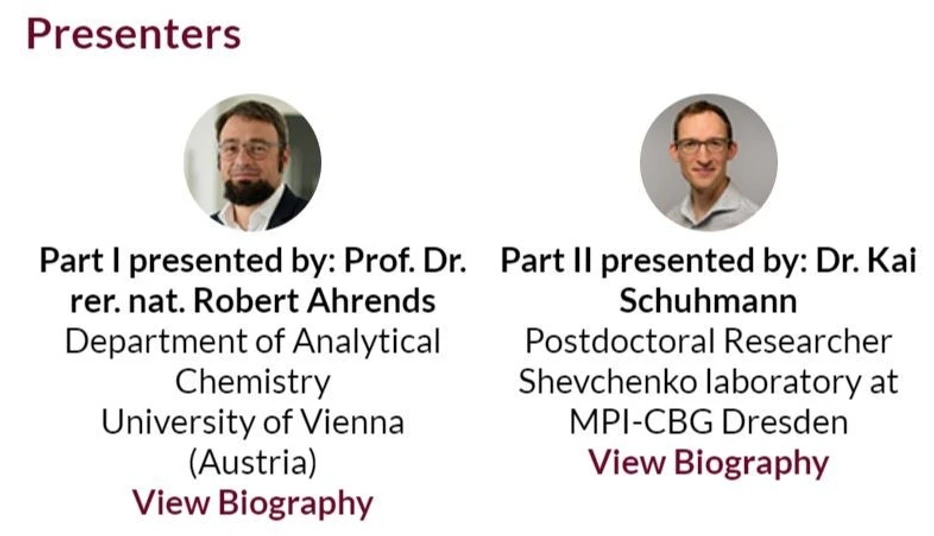
Presenter: Prof. Dr. rer. nat. Robert Ahrends (Department of Analytical Chemistry, University of Vienna (Austria))

Robert Ahrends is Professor of Analytical Chemistry at the University of Vienna (Austria), Robert founding member of the International Lipidomics Society and Member of the Lipid Standard Initiative. He obtained his Dr. rer. nat. at the Humboldt University zu Berlin and spend his postdoctoral time at Stanford Medical School in the Department of Chemical& Systems Biology. His lab’s research focus on lipid research by developing omics tools to analyze lipids and their metabolizing enzymes in a cardiovascular context.

Wiley
LinkedIn Logo
 

Related content

Simultaneous Quantitation and Discovery analysis: Combining targeted and untargeted metabolomics on Orbitrap mass spectrometers

Applications
| 2026 | Thermo Fisher Scientific
Instrumentation
LC/MS, LC/MS/MS, LC/Orbitrap, LC/HRMS
Manufacturer
Thermo Fisher Scientific
Industries
Metabolomics

Analysis of Per- and Polyfluoroalkyl Substances (PFAS) in Wastewater

Applications
| 2026 | Agilent Technologies
Instrumentation
LC/MS, LC/MS/MS, LC/QQQ
Manufacturer
Agilent Technologies
Industries
Environmental

Non-Targeted Screening of Biosolids with the Xevo™ MRT Mass Spectrometer Reveals New Isoforms of PFAS

Applications
| 2026 | Waters
Instrumentation
LC/MS, LC/MS/MS, LC/TOF, LC/HRMS
Manufacturer
Waters
Industries
Environmental

High Resolution Characterization of Lipid Nanoparticles Using the Xevo™ Charge Detection Mass Spectrometry (CDMS) Instrument - Single Particle Mass Analysis of Intact LNP-mRNA Formulations

Applications
| 2026 | Waters
Instrumentation
LC/MS, LC/MS/MS, LC/HRMS, Particle characterization, LC/IT
Manufacturer
Waters
Industries
Lipidomics

Out-of-the-box workflow for PFAS quantitation using a fullscan high-resolution approach with the Orbitrap Exploris EFOX Mass Detector

Applications
| 2025 | Thermo Fisher Scientific
Instrumentation
LC/MS, LC/MS/MS, LC/Orbitrap, LC/HRMS
Manufacturer
Thermo Fisher Scientific
Industries
Environmental
Other projects
GCMS
ICPMS
Follow us
FacebookX (Twitter)LinkedInYouTube
More information
WebinarsAbout usContact usTerms of use
LabRulez s.r.o. All rights reserved. Content available under a CC BY-SA 4.0 Attribution-ShareAlike