
Author
University of Amsterdam
The University of Amsterdam is one of the largest comprehensive universities in Europe. With some 40,000 students, 6,000 staff, 3,000 PhD candidates, and an annual budget of more than 850 million euros, it is also one of Amsterdam’s biggest employers. There is an inseparable link between the university and its host city. The freedom and creativity with which Amsterdam has long been associated have worked their way into the fabric of the university. This is a place where individuality, authenticity and diversity are celebrated as sources of stimulation, inspiration and innovation. Professional and personal development, challenges and collaboration are undertaken in a versatile and multidimensional (inter)national ecosystem with leading stakeholders. Staff at the UvA make a meaningful contribution to uncovering solutions to some of the world’s most significant problems and to developing the next generation of talent.
Tags
Article
Scientific article
Health
Environment
LinkedIn Logo

Finding evidence in plants for the use of chemical weapons

Analytical Scientists at the University of Amsterdam’s together with colleagues from TNO have demonstrated that chemical warfare agents react with plant proteins to form stable protein adducts.
Video placeholder
  • Photo: University of Amsterdam / HIMS / Analytical Methods: Graphical abstract.
  • Video: University of Amsterdam: 3MT pitch Mirjam de Bruin-Hoegee, Revealing the origin of drugs and chemical weapons, UvA Science

Analytical Scientists at the University of Amsterdam’s Van ‘t Hoff institute for Molecular Sciences together with colleagues from TNO have demonstrated for the first time that chemical warfare agents react with plant proteins to form stable protein adducts. These ‘biomarkers’ could still be detected in the living plants, as well as in dried leaves, up to three months after the actual exposure. This enables forensic reconstructions of the use of chemical weapons, which can assist investigations into alleged use in conflict areas.

University of Amsterdam / HIMS: Photo of leaves of selected plants. (A) Bay laurel leaf (Laurus nobilis), (B) Basil (Ocimum basilicum), (C) Stinging nettle (Urtica dioica). Image taken from the paper.University of Amsterdam / HIMS: Photo of leaves of selected plants. (A) Bay laurel leaf (Laurus nobilis), (B) Basil (Ocimum basilicum), (C) Stinging nettle (Urtica dioica). Image taken from the paper.

The research was recently published as a ‘hot article’ in the scientific journal Analytical Methods and features on the cover. First author is Mirjam de Bruin-Hoegée who performed the research as part of her PhD study under supervision of Arian van Asten, professor of Forensic Analytical Chemistry and On Scene Chemical Analysis at the University of Amsterdam and one of the directors of the Amsterdam Center for Forensic Science and Medicine (CLHC). De Bruin-Hoegée cooperated with researchers at TNO Defence, Safety and Security in Rijswijk, and with scientists of various member states of the Organisation for the Prohibition of Chemical Weapons (OPCW) as part of its “Plant Biomarker Challenge”. The OPCW was awarded the Nobel Peace Prize in 2013 for its comprehensive efforts to eliminate chemical weapons.

Abstract of the paper

The continuing threats of military conflicts and terrorism may involve the misuse of chemical weapons. The present study aims to use environmental samples to find evidence of the release of such agents at an incident scene. A novel approach was developed for identifying protein adducts in plants.

Basil (Ocimum basilicum), bay laurel leaf (Laurus nobilis) and stinging nettle (Urtica dioica) were exposed to 2.5 to 150 mg m−3 sulfur mustard, 2.5 to 250 mg m−3 sarin, and 0.5 to 25 g m−3 chlorine gas. The vapors of the selected chemicals were generated under controlled conditions in a dedicated set-up. After sample preparation and digestion, the samples were analyzed by liquid chromatography tandem mass spectrometry (LC-MS/MS) and liquid chromatography high resolution tandem mass spectrometry (LC-HRMS/MS), respectively.

University of Amsterdam / HIMS / Analytical Methods: Graphical abstract.University of Amsterdam / HIMS / Analytical Methods: Graphical abstract.

In the case of chlorine exposure, it was found that 3-chloro- and 3,5-dichlorotyrosine adducts were formed. As a result of sarin exposure, the o-isopropyl methylphosphonic acid adduct to tyrosine could be analyzed, and after sulfur mustard exposure the N1- and N3-HETE-histidine adducts were identified. The lowest vapor exposure levels for which these plant adducts could be detected, were 2.5 mg m−3 for sarin, 50 mg m−3 for chlorine and 12.5 mg m−3 for sulfur mustard. Additionally, protein adducts following a liquid exposure of only 2 nmol Novichock A-234, 0.4 nmol sarin and 0.2 nmol sulfur mustard could still be observed. For both vapor and liquid exposure, the amount of adduct formed increased with the level of exposure. In all cases synthetic reference standards were used for unambiguous identification.

The window of opportunity for investigation of agent exposure through the analysis of plant material was found to be remarkably long. Even three months after the actual exposure, the biomarkers could still be detected in the living plants, as well as in dried leaves. An important benefit of the current method is that a relatively simple and generic sample work-up procedure can be applied for all agents studied.

In conclusion, the presented work clearly demonstrates the possibility of analyzing chemical warfare agent biomarkers in plants, which is useful for forensic reconstructions, including the investigation into alleged use in conflict areas.
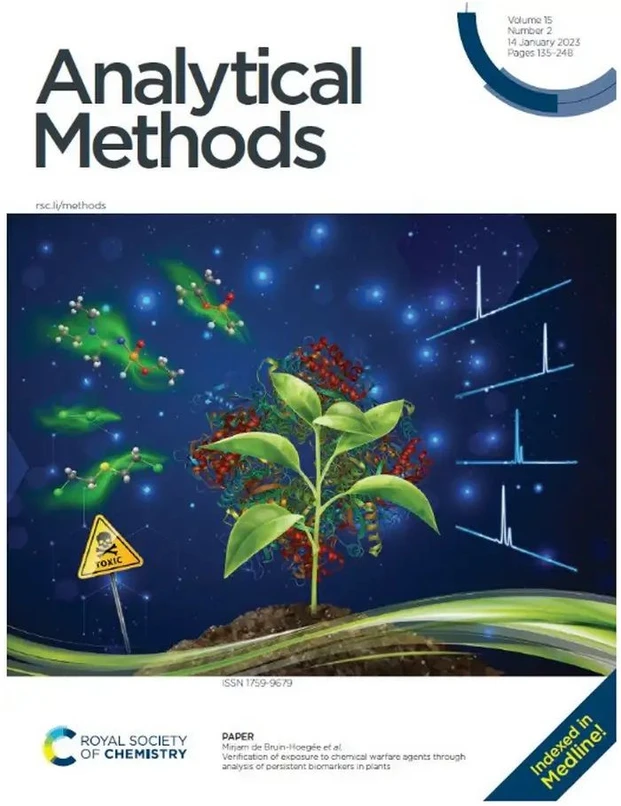
University of Amsterdam / HIMS / Analytical Methods: Finding evidence in plants for the use of chemical weapons.University of Amsterdam / HIMS / Analytical Methods: Finding evidence in plants for the use of chemical weapons.

Resources
  • Mirjam de Bruin-Hoegée, Latifa Lamriti, René C. M. Olivier, Lai Fun Chau, Marcel J. van der Schans, Daan Noort and Arian C. van Asten: Verification of exposure to chemical warfare agents through analysis of persistent biomarkers in plants. Anal. Methods, 2023, 15, 142-153.  DOI: 10.1039/D2AY01650H
University of Amsterdam
LinkedIn Logo
 

Related content

Oligonucleotide Analysis Using the Agilent InfinityLab Pro iQ and Altura Oligo HPH-C18 Column

Applications
| 2026 | Agilent Technologies
Instrumentation
LC/MS, LC/SQ, Consumables, LC columns
Manufacturer
Agilent Technologies
Industries
Pharma & Biopharma

Simultaneous Quantitation and Discovery analysis: Combining targeted and untargeted metabolomics on Orbitrap mass spectrometers

Applications
| 2026 | Thermo Fisher Scientific
Instrumentation
LC/MS, LC/MS/MS, LC/Orbitrap, LC/HRMS
Manufacturer
Thermo Fisher Scientific
Industries
Metabolomics

Analysis of Per- and Polyfluoroalkyl Substances (PFAS) in Wastewater

Applications
| 2026 | Agilent Technologies
Instrumentation
LC/MS, LC/MS/MS, LC/QQQ
Manufacturer
Agilent Technologies
Industries
Environmental

Non-Targeted Screening of Biosolids with the Xevo™ MRT Mass Spectrometer Reveals New Isoforms of PFAS

Applications
| 2026 | Waters
Instrumentation
LC/MS, LC/MS/MS, LC/TOF, LC/HRMS
Manufacturer
Waters
Industries
Environmental

High Resolution Characterization of Lipid Nanoparticles Using the Xevo™ Charge Detection Mass Spectrometry (CDMS) Instrument - Single Particle Mass Analysis of Intact LNP-mRNA Formulations

Applications
| 2026 | Waters
Instrumentation
LC/MS, LC/MS/MS, LC/HRMS, Particle characterization, LC/IT
Manufacturer
Waters
Industries
Lipidomics
 

Related articles

Detecting nerve agent biomarkers in dried blood spots
Scientific article | Video

Detecting nerve agent biomarkers in dried blood spots

In a paper in Forensic Chemistry, Mirjam de Bruin - Hoegée and co-workers present research on the use of dried blood spots for portable detection and laboratory verification of organophosphate poisoning.
University of Amsterdam
tag
share
more
16th MDCW 2025 (Day 2)
Article | Events

16th MDCW 2025 (Day 2)

On the second day of MDCW 2025 we saw 10 scientific presentations, 9 flash talks, a poster session and a guided discussion.
The Multidimensional Chromatography Workshop
tag
share
more
Low-Cost Heating Modalities Allow the Detection of Biomarkers for Plant Infection Using Rapid Evaporative Ionization Mass Spectrometry (REIMS) That Are Pathogen Specific
Scientific article | Science and research

Low-Cost Heating Modalities Allow the Detection of Biomarkers for Plant Infection Using Rapid Evaporative Ionization Mass Spectrometry (REIMS) That Are Pathogen Specific

Using low-cost REIMS with a 450 nm laser, researchers detected pathogen-specific biomarkers in tomato plants, distinguishing infections from Meloidogyne incognita and Pseudomonas syringae.
LabRulez
tag
share
more
Metabolomic Changes in Rice (Oryza sativa L.) Subjected to Herbicide Application through HPLC-HRMS and Chemometrics Approaches
Scientific article | Science and research

Metabolomic Changes in Rice (Oryza sativa L.) Subjected to Herbicide Application through HPLC-HRMS and Chemometrics Approaches

HPLC-HRMS with chemometrics showed clear metabolomic changes in herbicide-treated rice, including reduced sugars, lower flavonoids, and disrupted phenylpropanoid pathways.
LabRulez
tag
share
more
 

Related content

Oligonucleotide Analysis Using the Agilent InfinityLab Pro iQ and Altura Oligo HPH-C18 Column

Applications
| 2026 | Agilent Technologies
Instrumentation
LC/MS, LC/SQ, Consumables, LC columns
Manufacturer
Agilent Technologies
Industries
Pharma & Biopharma

Simultaneous Quantitation and Discovery analysis: Combining targeted and untargeted metabolomics on Orbitrap mass spectrometers

Applications
| 2026 | Thermo Fisher Scientific
Instrumentation
LC/MS, LC/MS/MS, LC/Orbitrap, LC/HRMS
Manufacturer
Thermo Fisher Scientific
Industries
Metabolomics

Analysis of Per- and Polyfluoroalkyl Substances (PFAS) in Wastewater

Applications
| 2026 | Agilent Technologies
Instrumentation
LC/MS, LC/MS/MS, LC/QQQ
Manufacturer
Agilent Technologies
Industries
Environmental

Non-Targeted Screening of Biosolids with the Xevo™ MRT Mass Spectrometer Reveals New Isoforms of PFAS

Applications
| 2026 | Waters
Instrumentation
LC/MS, LC/MS/MS, LC/TOF, LC/HRMS
Manufacturer
Waters
Industries
Environmental

High Resolution Characterization of Lipid Nanoparticles Using the Xevo™ Charge Detection Mass Spectrometry (CDMS) Instrument - Single Particle Mass Analysis of Intact LNP-mRNA Formulations

Applications
| 2026 | Waters
Instrumentation
LC/MS, LC/MS/MS, LC/HRMS, Particle characterization, LC/IT
Manufacturer
Waters
Industries
Lipidomics
 

Related articles

Detecting nerve agent biomarkers in dried blood spots
Scientific article | Video

Detecting nerve agent biomarkers in dried blood spots

In a paper in Forensic Chemistry, Mirjam de Bruin - Hoegée and co-workers present research on the use of dried blood spots for portable detection and laboratory verification of organophosphate poisoning.
University of Amsterdam
tag
share
more
16th MDCW 2025 (Day 2)
Article | Events

16th MDCW 2025 (Day 2)

On the second day of MDCW 2025 we saw 10 scientific presentations, 9 flash talks, a poster session and a guided discussion.
The Multidimensional Chromatography Workshop
tag
share
more
Low-Cost Heating Modalities Allow the Detection of Biomarkers for Plant Infection Using Rapid Evaporative Ionization Mass Spectrometry (REIMS) That Are Pathogen Specific
Scientific article | Science and research

Low-Cost Heating Modalities Allow the Detection of Biomarkers for Plant Infection Using Rapid Evaporative Ionization Mass Spectrometry (REIMS) That Are Pathogen Specific

Using low-cost REIMS with a 450 nm laser, researchers detected pathogen-specific biomarkers in tomato plants, distinguishing infections from Meloidogyne incognita and Pseudomonas syringae.
LabRulez
tag
share
more
Metabolomic Changes in Rice (Oryza sativa L.) Subjected to Herbicide Application through HPLC-HRMS and Chemometrics Approaches
Scientific article | Science and research

Metabolomic Changes in Rice (Oryza sativa L.) Subjected to Herbicide Application through HPLC-HRMS and Chemometrics Approaches

HPLC-HRMS with chemometrics showed clear metabolomic changes in herbicide-treated rice, including reduced sugars, lower flavonoids, and disrupted phenylpropanoid pathways.
LabRulez
tag
share
more
 

Related content

Oligonucleotide Analysis Using the Agilent InfinityLab Pro iQ and Altura Oligo HPH-C18 Column

Applications
| 2026 | Agilent Technologies
Instrumentation
LC/MS, LC/SQ, Consumables, LC columns
Manufacturer
Agilent Technologies
Industries
Pharma & Biopharma

Simultaneous Quantitation and Discovery analysis: Combining targeted and untargeted metabolomics on Orbitrap mass spectrometers

Applications
| 2026 | Thermo Fisher Scientific
Instrumentation
LC/MS, LC/MS/MS, LC/Orbitrap, LC/HRMS
Manufacturer
Thermo Fisher Scientific
Industries
Metabolomics

Analysis of Per- and Polyfluoroalkyl Substances (PFAS) in Wastewater

Applications
| 2026 | Agilent Technologies
Instrumentation
LC/MS, LC/MS/MS, LC/QQQ
Manufacturer
Agilent Technologies
Industries
Environmental

Non-Targeted Screening of Biosolids with the Xevo™ MRT Mass Spectrometer Reveals New Isoforms of PFAS

Applications
| 2026 | Waters
Instrumentation
LC/MS, LC/MS/MS, LC/TOF, LC/HRMS
Manufacturer
Waters
Industries
Environmental

High Resolution Characterization of Lipid Nanoparticles Using the Xevo™ Charge Detection Mass Spectrometry (CDMS) Instrument - Single Particle Mass Analysis of Intact LNP-mRNA Formulations

Applications
| 2026 | Waters
Instrumentation
LC/MS, LC/MS/MS, LC/HRMS, Particle characterization, LC/IT
Manufacturer
Waters
Industries
Lipidomics
 

Related articles

Detecting nerve agent biomarkers in dried blood spots
Scientific article | Video

Detecting nerve agent biomarkers in dried blood spots

In a paper in Forensic Chemistry, Mirjam de Bruin - Hoegée and co-workers present research on the use of dried blood spots for portable detection and laboratory verification of organophosphate poisoning.
University of Amsterdam
tag
share
more
16th MDCW 2025 (Day 2)
Article | Events

16th MDCW 2025 (Day 2)

On the second day of MDCW 2025 we saw 10 scientific presentations, 9 flash talks, a poster session and a guided discussion.
The Multidimensional Chromatography Workshop
tag
share
more
Low-Cost Heating Modalities Allow the Detection of Biomarkers for Plant Infection Using Rapid Evaporative Ionization Mass Spectrometry (REIMS) That Are Pathogen Specific
Scientific article | Science and research

Low-Cost Heating Modalities Allow the Detection of Biomarkers for Plant Infection Using Rapid Evaporative Ionization Mass Spectrometry (REIMS) That Are Pathogen Specific

Using low-cost REIMS with a 450 nm laser, researchers detected pathogen-specific biomarkers in tomato plants, distinguishing infections from Meloidogyne incognita and Pseudomonas syringae.
LabRulez
tag
share
more
Metabolomic Changes in Rice (Oryza sativa L.) Subjected to Herbicide Application through HPLC-HRMS and Chemometrics Approaches
Scientific article | Science and research

Metabolomic Changes in Rice (Oryza sativa L.) Subjected to Herbicide Application through HPLC-HRMS and Chemometrics Approaches

HPLC-HRMS with chemometrics showed clear metabolomic changes in herbicide-treated rice, including reduced sugars, lower flavonoids, and disrupted phenylpropanoid pathways.
LabRulez
tag
share
more
 

Related content

Oligonucleotide Analysis Using the Agilent InfinityLab Pro iQ and Altura Oligo HPH-C18 Column

Applications
| 2026 | Agilent Technologies
Instrumentation
LC/MS, LC/SQ, Consumables, LC columns
Manufacturer
Agilent Technologies
Industries
Pharma & Biopharma

Simultaneous Quantitation and Discovery analysis: Combining targeted and untargeted metabolomics on Orbitrap mass spectrometers

Applications
| 2026 | Thermo Fisher Scientific
Instrumentation
LC/MS, LC/MS/MS, LC/Orbitrap, LC/HRMS
Manufacturer
Thermo Fisher Scientific
Industries
Metabolomics

Analysis of Per- and Polyfluoroalkyl Substances (PFAS) in Wastewater

Applications
| 2026 | Agilent Technologies
Instrumentation
LC/MS, LC/MS/MS, LC/QQQ
Manufacturer
Agilent Technologies
Industries
Environmental

Non-Targeted Screening of Biosolids with the Xevo™ MRT Mass Spectrometer Reveals New Isoforms of PFAS

Applications
| 2026 | Waters
Instrumentation
LC/MS, LC/MS/MS, LC/TOF, LC/HRMS
Manufacturer
Waters
Industries
Environmental

High Resolution Characterization of Lipid Nanoparticles Using the Xevo™ Charge Detection Mass Spectrometry (CDMS) Instrument - Single Particle Mass Analysis of Intact LNP-mRNA Formulations

Applications
| 2026 | Waters
Instrumentation
LC/MS, LC/MS/MS, LC/HRMS, Particle characterization, LC/IT
Manufacturer
Waters
Industries
Lipidomics
 

Related articles

Detecting nerve agent biomarkers in dried blood spots
Scientific article | Video

Detecting nerve agent biomarkers in dried blood spots

In a paper in Forensic Chemistry, Mirjam de Bruin - Hoegée and co-workers present research on the use of dried blood spots for portable detection and laboratory verification of organophosphate poisoning.
University of Amsterdam
tag
share
more
16th MDCW 2025 (Day 2)
Article | Events

16th MDCW 2025 (Day 2)

On the second day of MDCW 2025 we saw 10 scientific presentations, 9 flash talks, a poster session and a guided discussion.
The Multidimensional Chromatography Workshop
tag
share
more
Low-Cost Heating Modalities Allow the Detection of Biomarkers for Plant Infection Using Rapid Evaporative Ionization Mass Spectrometry (REIMS) That Are Pathogen Specific
Scientific article | Science and research

Low-Cost Heating Modalities Allow the Detection of Biomarkers for Plant Infection Using Rapid Evaporative Ionization Mass Spectrometry (REIMS) That Are Pathogen Specific

Using low-cost REIMS with a 450 nm laser, researchers detected pathogen-specific biomarkers in tomato plants, distinguishing infections from Meloidogyne incognita and Pseudomonas syringae.
LabRulez
tag
share
more
Metabolomic Changes in Rice (Oryza sativa L.) Subjected to Herbicide Application through HPLC-HRMS and Chemometrics Approaches
Scientific article | Science and research

Metabolomic Changes in Rice (Oryza sativa L.) Subjected to Herbicide Application through HPLC-HRMS and Chemometrics Approaches

HPLC-HRMS with chemometrics showed clear metabolomic changes in herbicide-treated rice, including reduced sugars, lower flavonoids, and disrupted phenylpropanoid pathways.
LabRulez
tag
share
more
Other projects
GCMS
ICPMS
Follow us
FacebookX (Twitter)LinkedInYouTube
More information
WebinarsAbout usContact usTerms of use
LabRulez s.r.o. All rights reserved. Content available under a CC BY-SA 4.0 Attribution-ShareAlike