

Mechanisms of aroma compound formation during the drying of Dendrobium nobile stems (Shihu)
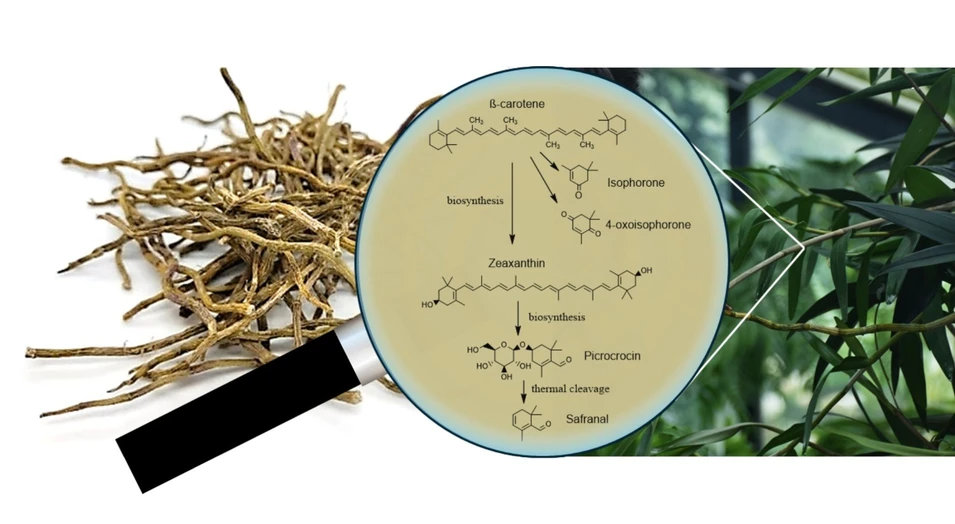
- Photo: Food Chemistry, Volume 464, Part 3, 2025, 141888: Graphical abstract
In the study published in the Food Chemistry journal, researchers from the University of Nottingham, UK, The University of Adelaide, Australia, Golden Keys High-Tech Materials Co., Ltd, China, and the University of Warwick, UK explored the mechanisms of aroma formation during the drying of Dendrobium nobile stems (Shihu), valued in Chinese cuisine and traditional medicine.
Stems were dried in a convection oven at 70 °C for 48 hours, and carotenoids, amino acids, monosaccharides, and volatile compounds were analyzed using advanced techniques like HPLC-DAD, LC-MS/MS, HPAEC-PAD, and GC–MS. Key aroma compounds, such as β-ionone, 4-oxoisophorone, and dihydroactinidiolide, were formed through carotenoid degradation, while safranal and β-damascenone were unique to thermal drying. Methional and 3-methylbutanal were produced via Strecker degradation during the Maillard reaction, with a concurrent reduction in methionine, leucine, and glucose levels. These findings provide detailed insights into the flavor-forming mechanisms of Shihu, offering strategies to enhance flavor quality in similar food ingredients.
The original article
Mechanisms of aroma compound formation during the drying of Dendrobium nobile stems (Shihu)
Aidan Kirkwood, Ian Fisk, Yingjian Xu, Joshua Reid, Ni Yang
Food Chemistry, Volume 464, Part 3, 2025, 141888
https://doi.org/10.1016/j.foodchem.2024.141888
licensed under CC-BY 4.0
Selected sections from the article follow. Formats and hyperlinks were adapted from the original.
Highlights
- Identified carotenoid degradation and Maillard reaction formation pathways.
- β-ionone, 4-oxoisophorone and dihydroactinidiolide formed through β-carotene.
- Safranal and β-damascenone formed only during the later stages of oven drying.
- Methional and 3-methylbutanal are likely formed through Strecker degradation.
Abstract
To ensure the aroma and flavour quality of dried herbs, it is essential to understand flavour reactions that occur during complex drying mechanisms. This study investigated aroma formation in dried Dendrobium nobile stems (Shihu), valued in Chinese cuisine and traditional medicine. Stems were dried in a convection oven over 48 h (70 °C). Carotenoids, amino acids, monosaccharides, and the resultant volatile compounds were quantified using HPLC-DAD, LC-MS/MS, HPAEC-PAD and GC–MS, respectively. β-ionone, 4-oxoisophorone and dihydroactinidiolide were formed through carotenoid degradation (supported by the concomitant loss of the precursor β-carotene). Safranal and β-damascenone were formed only through thermal drying. Methional and 3-methylbutanal were formed through Strecker degradation as part of the Maillard reaction, flavour precursors methionine and leucine, in addition to glucose, levels also reduced. This study provides quantified evidence revealing the mechanisms of flavour formation in Shihu during the drying process. This offers scientific strategies to enhance the flavour quality of other comparable food ingredients.
2. Materials and methods
2.2. Volatile analysis
2.2.1. Chemicals
3-heptanone (purity 98 %) and alkane standard solution C7-C30 (in hexane) were purchased from Sigma-Aldrich (Poole, UK). Methanol (≥ 99.9 % CHROMASOLV™ for HPLC) was purchased from Fisher Scientific (Honeywell, Fisher Scientific, Rugby, UK). 3-heptanone was diluted to 0.001 % - 0.0001 % v/v in methanol and used as an internal standard (ISTD). Alkane standard was diluted to 100 ppm in methanol and run on the same GC–MS method as the samples. Analytical standards 4-oxoisophorone (98 %), β-ionone (96 %), β-damascenone (1.1–1.4 %), safranal (≥90 %), 3-methylbutanal (≥97 % FG) were purchased Sigma Aldrich (Poole, UK). Methional (97 %) was purchased from Alfa Aesar (Thermo Fisher Scientific, Hemel Hempstead, UK). Analytical standards were diluted between 0.01 and 0.1 % in methanol, run separately on the same GC–MS method as the samples.
2.2.2. Sample preparation
Each sample (in triplicate or quadruplicate; dependent on sample availability), 0.12 g of dried Shihu (± 0.01 g), was weighed into plastic weighing boats, and added to GC headspace vials (amber glass, 20 mL, 22.5 mm × 75.5 mm, Sigma-Aldrich, UK). Ultrapure water (Milli-Q, MQ), 120 μl, was then added to the vials by pipette. Then, 20 μl of 0.0001 % 3-heptanone was added to the vials, and crimp sealed with PTFE-lined silicone septa.
2.2.3. Extraction method
Volatiles were extracted from sample headspaces using automated Solid-Phase Microextraction (SPME), with a 50/30 μm DVB/CAR/PDMS fibre (Supelco, Sigma Aldrich, UK). Samples were extracted at 50 °C (40 °C during the β-carotene incubation experiment) for 30 mins (5 mins for analytical standards) using SPME. After extraction, the SPME fibre was injected into the GC–MS inlet and desorbed at 250 °C for a splitless time of 0.15 min.
2.2.4. Gas chromatography-mass spectrometry
Samples were analysed using a Gas Chromatography-Mass Spectrometry (GC–MS) instrument (ISQ™ Series Single-Quadrupole, Thermo Fisher Scientific, Hemel Hempstead, UK). Installed for chromatographic separation was a ZB-WAX column (30 m × 0.25 mm inner diameter × 1 μm film thickness, Phenomenex Inc., Macclesfield, UK) fitted with a guard column. Chromatographic separation: 40 °C for 2 min before increasing to 240 °C at 6 °C/min, and holding at the top temperature for 5 min. Carrier gas was helium (5.0 mL/min) on constant pressure mode at 18 psi. Transfer line set to 250 °C, energy voltage set to 70 eV, with a mass scanning range of 35–300 m/z (0.2 dwell/scan time) and an ion source temperature of 200 °C. Samples were analysed in triplicate (Fig. 1), randomised, with blank vials for background subtraction.
2.3. Beta-carotene analysis
2.4.3. LC-MS/MS
Targeted AA analysis was performed using a Vanquish Ultra High-Performance Liquid Chromatograph with an Altis Triple Quadrupole Mass Spectrometer (MS/MS) with heated electrospray ionisation (Thermo Scientific). Separation was achieved using an Acclaim™ Trinity P1 HPLC column (150 mm × 2.1 mm, 3 μm, Thermo Scientific) with a gradient of mobile phase A (20 mM ammonium formate in water) and B (100 mM ammonium formate in water and acetonitrile (80:2, v/v). 1 μl of sample and standards was detected using multiple reaction monitoring (MRM) mode with positive electrospray ionisation. More details are found elsewhere by Muleya et al. (2023).
Source conditions: spray volatile 3500 V, spray current 63.4 μA, ion transfer tube temperature 325 °C, vapouriser temperature 370 °C, sheath gas 5.58 L/min, auxiliary gas 7.97 l/min, ion transfer tube DC 15 V, RF Lens Amplitude 47 V. Nitrogen gas was produced using a nitrogen generator (Genius NM32LA, Peak Scientific Instruments Ltd., Inchinnan, Scotland). Quantification ions displayed in Table 2 were used to generate chromatographic peaks.
2.4. Amino acids analysis
2.4.2. Sample preparation
Oxidation: dried Dendrobium powder was weighed out in 20 ml crimp top vials (Agilent, UK) according to Appendix Table 2. Vials were cooled in a refrigerator for one hour before adding 2.5 ml of chilled oxidation solution. Samples were then incubated in a fridge (5 °C) for 16–18 h (for cystine and methionine derivatisation). Acid hydrolysis was conducted according to Muleya et al. (2023). Hydrolysed samples were transferred to 50 ml falcon tubes and adjusted to pH 2.75 using 4 M ammonium formate and formic acid. To the tubes, 20 mM ammonium formate buffer (pH 2.75) according to Appendix Table 2. Samples were centrifuged at 3000 rpm for 10 min before passing through a 0.22 μm syringe filter into an eppendorf tube. Samples were then prepared in 1.5 ml HPLC vials according to Appendix Table 2.
2.4.3. LC-MS/MS
Targeted AA analysis was performed using a Vanquish Ultra High-Performance Liquid Chromatograph with an Altis Triple Quadrupole Mass Spectrometer (MS/MS) with heated electrospray ionisation (Thermo Scientific). Separation was achieved using an Acclaim™ Trinity P1 HPLC column (150 mm × 2.1 mm, 3 μm, Thermo Scientific) with a gradient of mobile phase A (20 mM ammonium formate in water) and B (100 mM ammonium formate in water and acetonitrile (80:2, v/v). 1 μl of sample and standards was detected using multiple reaction monitoring (MRM) mode with positive electrospray ionisation. More details are found elsewhere by Muleya et al. (2023).
Source conditions: spray volatile 3500 V, spray current 63.4 μA, ion transfer tube temperature 325 °C, vapouriser temperature 370 °C, sheath gas 5.58 L/min, auxiliary gas 7.97 l/min, ion transfer tube DC 15 V, RF Lens Amplitude 47 V. Nitrogen gas was produced using a nitrogen generator (Genius NM32LA, Peak Scientific Instruments Ltd., Inchinnan, Scotland). Quantification ions displayed in Table 2 were used to generate chromatographic peaks.
2.5. Monosaccharide analysis
The concentration of monosaccharides (glucose and mannose) in Shihu extracts were quantified using High-performance Anion-Exchange Chromatography-Pulsed Amperometric Detection (HPAEC-PAD).
2.5.2. Sample preparation and extraction
Shihu powders were weighed (0.30 g ± 0.01 g) into 50 ml Duran bottles and 30 ml of Milli-Q water was added. The bottles were shaken before extracting in a hot water bath for 1 h at 90 °C (see Fig. 1 for replicates). Extracted samples were cooled and transferred to 50 ml centrifuge and frozen at −18 °C before analysis. Samples (including the calibration series) were thawed and then centrifuged at 4000 G for 10 mins. The supernatant was diluted by a factor of 2000 (v/v) in 10 mM NaOH and syringe filtered using 0.45 μm PES syringe filters. Afterwards, 2 ml of sample was transferred into a HPLC vials with PTFE split septum cap and placed into the autosampler of the Dionex instrument, equilibrated to 4 °C. As blanks, 10 mM NaOH was used injected into the system, and duplicate injections were performed for each sample.
2.5.3. HPAEC-PAD analysis
The instrument used was a Dionex ICS 6000, installed with a CarboPac PA210 (250 × 4 mm) and guard column (50 × 4 mm) (Thermo Scientific, UK). The mobile phase was composed of three eluents at varying ratios and were all prepared using ultrapure water which had been degassed under vacuum and with a sonicating water bath. The eluents were a) 100 % H2O, b) 100 mM NaOH and c) 200 mM NaOH. The column temperature was set to 30 °C. A sample loop of 25 μl was used with push full injection mode. The chromatography method, summarising flow rate, buffer composition and time duration, is summarised in Appendix Table 4. Elutes were detected using a gold electrode PAD and triple-pulsed amperometry calibrated for carbohydrate analysis.
2.5.4. HPAEC-PAD data analysis
Data analysis was conducted using Chromeleon 7.2 software (Thermo Fisher Scientific, UK). Integration was performed manually, and peak areas were exported to Excel. Concentrations were calculated using calibration curves. Results were averaged and dilution factors were accounted for, and moisture content to report concentration in mg/g, dry weight.
4. Conclusion
Dried Dendrobium stems (Shihu) have been recognised over the course of history for its use not only as a traditional medicinal herb but also as a modern ingredient in Chinese cooking and commercial products such as nutraceutical drinks. This article delved into mechanisms involved in the formation of previously found key aroma-active compounds in Shihu and aimed to advance the knowledge related to the aroma of Shihu. We proposed main mechanisms are carotenoid degradation and Maillard reaction as confirmed by changes in derived volatile compounds and their precursors, and we have mapped this out for the first time in Shihu. Oven drying of Shihu was found to significantly affect aroma compounds such as β-ionone and dihydroactinidiolide, which was occurring while β-carotene levels were reducing. We were able to identify aroma compounds such as safranal and β-damascenone that were specific to drying. There was a general trend in decreasing levels over the drying process for 16 out of 17 amino acids. Neither glucose nor amino acid precursors to aroma-active compounds were significant after 48 h of drying, indicating that the Maillard reaction is only minor component in Shihu's flavour development with the drying conditions employed (70 °C for 48 h). The results found in this study were conclusions based on the limited sample data set used in this study, larger sample sets should be further evaluated to account for variation in metabolites as a result of pre-harvest conditions in future studies. This study fills a gap in the understanding of flavour mechanisms at play in the drying of Shihu and is the first to report on changes in volatile aroma and non-volatile compounds through processing of Shihu. We found that the primary mechanism, carotenoid degradation may be following a similar pathway to that in tea leaves. Further work is necessary to determine the impact of storage conditions of Shihu flavour quality. This work helps to implement the knowledge in processing and exploiting mechanisms to enhance flavours in Shihu and other herbal products. This study hopes to provide insights for the plant product manufacturing industry to select drying parameters to maximise retention of flavour and beneficial bioactive compounds.
- Mechanisms of aroma compound formation during the drying of Dendrobium nobile stems (Shihu). Aidan Kirkwood, Ian Fisk, Yingjian Xu, Joshua Reid, Ni Yang. Food Chemistry, Volume 464, Part 3, 2025, 141888. https://doi.org/10.1016/j.foodchem.2024.141888.


