News from LabRulezLCMS Library - Week 9, 2025
LabRulez: News from LabRulezLCMS Library - Week 9, 2025
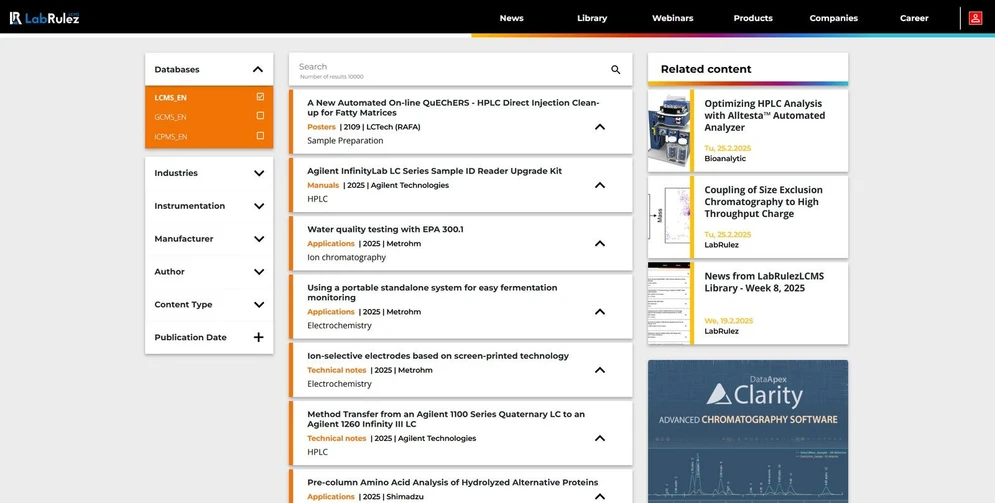
Our Library never stops expanding. What are the most recent contributions to LabRulezLCMS Library in the week of 24th February 2025? Check out new documents from the field of liquid phase, especially HPLC and LC/MS techniques!
👉 SEARCH THE LARGEST REPOSITORY OF DOCUMENTS ABOUT LCMS AND RELATED TECHNIQUES
👉 Need info about different analytical techniques? Peek into LabRulezGCMS or LabRulezICPMS libraries.
This week we bring you technical note by Agilent Technologies, brochure by Metrohm, application notes by Knauer, Shimadzu, Thermo Fisher Scientific and Waters Corporation!
1. Agilent Technologies: Method Transfer from an Agilent 1100 Series Quaternary LC to an Agilent 1260 Infinity III LC
Proof of equivalency for the transfer of conventional LC methods
- Technical Overview
- Full PDF for download
Method transfer from legacy equipment to new instruments, such as the Agilent 1260 Infinity III LC, is an important topic for all laboratories throughout different industries. Seamless method transfer ensures that the same methods can still be used, which ensures business continuity and reduced regulatory and financial risks.
This technical overview demonstrates method transfer from an Agilent 1100 Series Quaternary LC to an Agilent 1260 Infinity III LC for conventional LC methods covering diverse gradient conditions. Equivalent results are obtained, which proves that seamless method transfer can be expected for typical, robust, conventional LC methods. In terms of retention time precision, the 1260 Infinity III LC outperforms the 1100 LC, leading to higher trust in the data.
Experimental
Equipment
The Agilent 1100 Series LC System comprised the following modules:
- Agilent 1100 Series quaternary pump (G1311A) with active inlet valve (AIV)
- Agilent 1100 Series degasser (G1322A)
- Agilent 1100 Series standard autosampler (G1313A)
- Agilent 1100 Series thermostatted column compartment (G1316A)
- Agilent 1100 Series diode array detector (G1315B) with standard flow cell, 10 mm, (G1315-60022)
The Agilent 1260 Infinity III LC System comprised the following modules:
- Agilent 1260 Infinity III quaternary pump (G7111B) with active inlet valve (AIV)
- Agilent 1260 Infinity III vialsampler (G7129C)
- Agilent 1260 Infinity III multicolumn thermostat (G7116A)
- Agilent 1260 Infinity III diode array detector WR (G7115A) with standard flow cell, 10 mm, (G1315-60022)
Software
- Agilent OpenLab CDS, version 2.7.
Columns
- Agilent ZORBAX Eclipse Plus C18, 4.6 × 150 mm, 5 µm (part number 959993-902)
- Agilent ZORBAX Eclipse Plus C18, 4.6 × 50 mm, 3.5 µm (part number 959943-902)
- Agilent ZORBAX SB-C18, 4.6 × 150 mm, 5 µm (part number 883975-902)
Conclusion
The transfer of conventional LC methods covering diverse gradient conditions from an Agilent 1100 Series Quaternary LC to an Agilent 1260 Infinity III LC leads to equivalent results, thereby proving that seamless method transfer can be expected for typical, robust, conventional LC methods. In terms of retention time precision, the 1260 Infinity III LC outperforms the 1100 LC, leading to a higher trust in the data.
2. Knauer: Size exclusion chromatography of polylactic acid in three different solvents
- Application Note
- Full PDF for download
PLA is one of the most promising sustainable plastics. It can be produced on an industrial scale using simple, bacteria-driven, bio-based synthesis whilst also being biodegradable, meaning it could help solve problems such as long-term pollution of the environment by nondegradable plastics.(1) In addition, PLA can be used in a wide range of applications such as medical applications, as packaging material, for disposable tableware or in horticulture. Work is currently underway to make PLA more widely applicable and more recyclable through fibre reinforcement.(2) The macroscopic properties of a polymer, such as melting point, hardness and elasticity, are mainly determined by the number average molar mass (Mn), the weight average molar mass (Mw) and the polydispersity. The method of choice to determine these parameters is GPC. In this application, three methods are presented to determine the molecular weight of three different PLA standards. For this purpose, two calibrations in three different solvents, THF, CHCl3 and EtOAc, were investigated/recorded. In addition, two real samples were analysed: PLA filaments for 3D-printing and a PLA disposable drinking bottle.
Conclusion
Considering the relatively high uncertainty of the universal calibration, it could be shown that a low molecular weight PLA standard can be analyzed in three different solvents using two different calibrations. Due to interactions with the stationary phase, polystyrene in EtOAc is not suitable when using a polystyrene GPC column. This could be shown due to systematic deviations of several PS standards. The analysis of two PLA filaments with a KNAUER HPLC system in combination with a GPC column has shown that real samples can be analyzed quickly and easily using this suggested method. When using a DiodeArray Detector (DAD), additional information about the sample composition can be obtained. Particularly noteworthy is the possibility of analyzing PLA in EtOAc, as EtOAc is significantly more environmentally friendly when compared to CHCl3 and THF.
3. Metrohm: Continuous Ion Chromatography Module
Enjoy the benefits of automatic generation of high-purity eluents
- Brochure
- Full PDF for download
Empowering your IC analysis with a sustainable solution
Manual preparation of hydroxide eluents costs valuable laboratory time, consumes substantial amounts of chemicals, and is prone to human error. The Continuous IC Module is the solution to these issues.
It is sustainable and cost-efficient, as it helps to reduce the consumption of chemicals and the equipment can be used multiple times. Moreover, automated hydroxide eluent generation with the Continuous IC Module provides for safe handling of hydroxide eluents while improving reproducibility and accuracy of results.
Ideal for optimizing workflows in environmental, industrial, and research laboratories
The short reaction time and fast equilibration provide for high flexibility for isocratic and gradient elution methods, which is ideal for method development or routine analyses with changing methods. Highthroughput labs profit especially from automatic and almost reagent-free eluent production as this saves time and money and enables 24/7 analysis.
Applications range from isocratic methods for the determination of major anions to convenient gradient methods for the determination of oxyhalides. Also, more complex applications using hyphenated systems with ion chromatography and mass spectrometry such as the determination of haloacetic acids are easily feasible and benefit from high purity, accuracy, and ease-of-use.
HIGHLIGHTS
- High purity eluent generation
- For isocratic and easy gradient elution
- Elimination of manual eluent preparation procedures
- Substainable solution with low running costs due to multiple use of the eluent producer cartridge (EPC) and free choice of chemicals
- Extremely low baseline, outstanding linearity and signal-to-noise ratio
- Upgradable for all Metrohm IC systems, small footprint, and easy to install
- Large portfolio of hydroxide suitable ion chromatography columns
4. Shimadzu: HPLC Analysis for Rebamipide in Accordance with Japanese Pharmacopoeia
- Application Note
- Full PDF for download
User Benefits:
- Purity test for Rebamipide (related substances) can be performed in accordance with Japanese Pharmacopoeia.
- Shim-pack GIST C18 provides good separation for rebamipide and related substances.
Rebamipide has been used as a therapeutic drug for gastric ulcers for a long time. It promotes production of prostaglandins to mucosa that protects the stomach wall, resulting in suppression of inflammation. This article presents an analysis conducted in accordance with Japanese Pharmacopoeia using HPLC LC-2050 3D, an integrated HPLC.
Analysis Conditions (in accordance with Japanese Pharmacopoeia)
In accordance with purity test of rebamipide (related substances) described in 18th Revised Japanese Pharmacopoeia, it is required to confirm three items as system suitability: confirmation of detection, system performance, and system repeatability. These items were confirmed as follows,
Purity (4) Related substances:
In “test for required detectability”, the standard solution and the detectability confirming solution were analyzed to be compared with peak areas. In “system performance”, the system performance confirming solution was measured to confirm the peak resolution. In “system repeatability”, the standard solution was analyzed six times repeatedly to confirm the relative standard deviation of peak areas. The analytical conditions for the purity test of rebamipide (related substances) are shown in Table 1. Shim-pack GIST C18 was used in this study since the stationary phase of the analytical column is specified as octadecylsilylated silica gel (ODS).
Conclusion
In this article, HPLC analyses were conducted using integrated HPLC LC-2050 3D in accordance with the system suitability test for the purity test of rebamipide (related substance) listed in Japanese Pharmacopoeia, 18th Revised Edition. As a result, it was confirmed that test for required detectability, system performance, and system reproducibility all met the criteria of Japanese Pharmacopoeia.
5. Thermo Fisher Scientific: Orbitrap Astral mass spectrometer allows comprehensive proteome coverage at the single-cell level
- Application Note
- Full PDF for download
Highlights
- The automatic single cell sorting pretreatment method is efficient, flexible, and stable.
- With a total gradient of 14 min, up to 80 single cell samples can be analyzed per day.
- Up to 7,200 protein groups can be identified from only 250 pg of HeLa digest using a
library-based DIA approach. - Up to 6,500 protein groups are identified from real single cells.
- The correlation between different single cells ranges from R=0.93–0.98, indicating good reproducibility.
- The dynamic range is more than five orders of magnitude, satisfying the need for
protein quantitation.
Chromatography plays a crucial role in single cell analysis, and advancements in chromatography, such as ultra-highperformance liquid chromatography (UHPLC) and columns, have greatly improved the sensitivity and throughput of LC-MSbased single cell proteomics. An excellent example is the Thermo Scientific™ Vanquish™ Neo UHPLC System, which offers exceptional retention time precision spanning from 100 nL/min to 100 µL/min at pressures of up to 1,500 bar. When used in conjunction with narrow bore HPLC/UHPLC columns, the highpressure capability of the system enables rapid loading, washing, and equilibration procedures. Moreover, the wide flow range of the system allows for lower flow rates, thereby enhancing sensitivity in single cell proteomics.
Mass spectrometry (MS)-based SCP employs labeled (multiplexed, e.g., TMT)16-17 or label-free methods9-13, using either data-dependent acquisition (DDA) or data-independent acquisition (DIA) approaches. These methods face challenges due to the complexity of the proteome and low protein content within individual cells.6 Hence, high-sensitivity and highresolution mass spectrometers are crucial for SCP to achieve comprehensive coverage and enable the extraction of quantitative information from cells.
Thermo Fisher Scientific has recently introduced the Thermo Scientific™ Orbitrap™ Astral™ mass spectrometer, an advanced instrument that combines Thermo Scientific™ Orbitrap mass analyzer with an asymmetric track lossless (Astral) analyzer. This state-of-the-art device offers features such as >200 Hz MS/MS scanning speed, high resolving power, sensitivity, and low-ppm mass accuracy. It ensures nearly lossless ion transmission efficiency and a wide dynamic range. Leveraging this innovative mass spectrometer, we have developed a complete workflow solution for SCP that delivers exceptional sensitivity and throughput. Our automated workflow involves utilizing a proteoCHIP EVO 96 chip from Cellenion and standard 96- and 384-well plates for single cell sorting and sample pretreatment. Separation is carried out using an Aurora™ TS column from IonOpticks, in conjunction with the Vanquish Neo UHPLC system. The column is coupled with an Orbitrap Astral MS equipped with a Thermo Scientific™ FAIMS Pro Duo interface. The Orbitrap Astral MS operates in a data-independent acquisition (DIA) mode, and the resulting raw files are analyzed using Thermo Scientific™ Proteome Discoverer™ software with CHIMERYS™ intelligent search algorithm or Spectronaut™ 18 software for protein identification and quantitation.
Conclusion
In this study, a comprehensive workflow was developed for SCP analysis. The workflow incorporates the use of the CellenONE system, which enables automatic cell sorting, lysis, and digestion, as well as the Vanquish Neo UHPLC system, which provides precise flow rates and high-pressure capabilities for efficient sample loading and increased method development flexibility. The Orbitrap Astral MS, coupled with the FAIMS Pro Duo interface, was employed for SCP analysis, offering high resolution, sensitivity, and dynamic range.
The workflow was evaluated in two steps. First, a HeLa dilution series ranging from 50 to 10,000 pg was analyzed using DIA mode. With a library-free analysis, more than 4,200 protein groups were identified from a 50 pg HeLa digest. Increasing the sample amount to 250 pg resulted in the identification of over 5,500 protein groups. Processing the same raw files with a 1,269 2,358 5,616 0 1,000 2,000 3,000 4,000 5,000 6,000 Identified protein groups of single cell (n=3) Membrane protein (%) in single cell Plasma membrane (23%) Other membranes (42%) library-based method further increased the number of identified protein groups to over 6,180 and 7,270 for the 50 pg and 250 pg samples, respectively. The median coefficient of variation (CV) for protein groups in both DIA approaches was less than 10%.
In the second step, a total of 222 single cells, along with a few wells containing 10 or 20 cells, were analyzed. These cells were prepared on three different plates using two sample pretreatment conditions. Based on the plate type and number of single cells analyzed, an average of 5,977, 4,589, and 6,556 protein groups were identified from the 384-well plate, proteoCHIP Evo 96, and 96-well plate, respectively. Furthermore, the protein abundance exhibited a wide dynamic range spanning more than five orders of magnitude. These results highlight the impressive sensitivity and depth of coverage achievable with the Orbitrap Astral MS in both HeLa dilution series and single-cell analyses.
6. Waters Corporation: Targeted and Untargeted Screening of ‘eliquids’ Using the High Resolution ACQUITY™ RDa™ Mass Detector
- Application Note
- Full PDF for download
Electronic nicotine delivery systems (ENDS), also known as ‘vapes’ or e-cigarettes’ are marketed as a healthier alternative to conventional tobacco smoking to reduce health risks and to aid with smoking cessation.1 These products use an ‘e-liquid’ which contains varying levels of nicotine derived from tobacco commonly ranging between 0–20 mg/mL dissolved in a combination of propylene glycol and vegetable glycerin. Flavorings are also added to increase the palatability of the e-liquid. The e-liquid is then heated to create an aerosol which is inhaled.
With the ACQUITY RDa Mass Detector and the UNIFI™ screening platform utilizing in-built libraries, routine screening and compound characterization is achievable without the need for HRMS (High Resolution Mass Spectrometry) expertise.
Within this application note, focusing on the bulk matrix of the product, a commercially available nicotine-free eliquid was screened against the Waters™ extractables and leachables (E and L) library. The samples were analyzed by liquid chromatography coupled to the ACQUITY RDa Time-of-flight Mass Spectrometer. The acquisition was carried out in both positive and negative electrospray ionization mode. The simultaneous acquisition of high and low energy, Full Scan with Fragmentation, enabled the use of acquired fragment information which increased compound identification confidence.
Major components were identified by mass accuracy measurement <5 ppm. The identification was confirmed by precursor accurate mass and fragments generated in the high energy scan. For unidentified compounds, the Elucidation Toolset feature in UNIFI was used. Hedione is putatively present in the samples. Hedione is a common fragrance/flavoring agent with a well understood safety profile for these applications, but no safety data exists for inhalation.
Benefits
- Routine access to sub 5 ppm mass accuracy HRMS (High Resolution Mass Spectrometry) screening for eliquid analysis
- Use of in-source fragmentation source generate pseudo MSE spectra
- Use of simultaneous high and low energy acquisition providing component fragment data for additional characterization confidence
- Compliant ready UNIFI HRMS software as part of the waters_connect™ Software Solution
- In built screening workflows for automatic acquiring, processing, and reporting of results
- Use of screening libraries for automatic data interpretation and visualization
- Access to online libraries to investigate unknowns
Conclusion
With concerns around the quality control and potential health impact of ‘e-liquids’, there is an increasing need for manufacturers and laboratory services to get the necessary instrumentation in place to provide high quality characterization of these products.
The ACQUITY RDa coupled to the ACQUITY I-Class PLUS has demonstrated the ability to provide fit for purpose information for screening and discovery workflows in an easy to use format for deployment in routine analytical labs.
In positive electrospray mode thirty three compounds were identified from the E and L screening libraries, with nineteen of those compounds identified containing a carbonyl group which can then be monitored for potential toxicity. This raises concerns about the contents of ‘e-liquids’ due to the potential toxicity of inhaled carbonyl compounds. In negative electrospray mode five compounds were detected with four containing a carbonyl group negative mode.
The discovery workflow pointed out the presence of assignment of ‘hedione’. Hedione is used in cosmetics or food flavoring, not present in the E and L library. Screening online libraries was essential for the assignment of unknown compounds. A comparison of the m/z, retention time, and fragmentation of hedione with a synthetic standard if required for full identification. Combined with the compliant-ready UNIFI HRMS screening software as part of waters_connect, the ACQUITY RDa provides a simple solution to acquiring high quality data for a wide range of analytical expertise for e-liquids in a regulated environment