LCMS
More information
WebinarsAbout usContact usTerms of use
LabRulez s.r.o. All rights reserved. Content available under a CC BY-SA 4.0 Attribution-ShareAlike
Author
Thermo Fisher Scientific
A unique company dedicated to serving science helping our customers drive productivity and accelerate results. Through our premier brands – Thermo Scientific, Applied Biosystems, Invitrogen, Fisher Scientific and Unity Lab Services.
Tags
Article
Academy
Video
Product
LinkedIn Logo

Automated LC-MS Sample Cleanup Using Turbulent Flow Chromatography

Tu, 25.3.2025
| Original article from: Thermo Fisher Scientific / Dan Kalu Appulage
Too much interfering matrix? Discover how to streamline your daily LC-MS analysis with turbulent flow chromatography.
Video placeholder
  • Photo: Thermo Fisher Scientific: Automated LC-MS Sample Cleanup Using Turbulent Flow Chromatography
  • Video: Chromatography & Mass Spectrometry Solutions: Thermo Scientific Vanquish Duo HPLC and UHPLC systems 

Too much interfering matrix? Discover how to streamline your daily LC-MS analysis with turbulent flow chromatography.

Sample preparation is a critical step in liquid chromatography-mass spectrometry (LC-MS) analysis to achieve quantitative accuracy and precision. Directly injecting crude samples into your instrument without prior cleanup to remove interfering compounds can clog the flow path, damage your detector, and negatively impact your analyses through a “matrix effect.”

Thermo Fisher Scientific: Automated LC-MS Sample Cleanup Using Turbulent Flow Chromatography.Thermo Fisher Scientific: Automated LC-MS Sample Cleanup Using Turbulent Flow Chromatography.

Common approaches to clean up samples and suppress the matrix effect include simple dilution and centrifugation to extensive extraction techniques. The common scope of all these procedures is to minimize the possible contamination of your LC-MS system but, more importantly, to reduce to a minimum the interference of unrelated sample components on the detection and quantification of your analytes of interest.

A point to note is the preparation method you choose often depends on the complexity of your sample. For instance, samples for clinical research applications or toxicology tend to have high levels of interfering matrix and require a more sophisticated clean-up approach.  Let’s dive into what a matrix effect is, the impacts on your LC-MS data, and an effective method called turbulent flow chromatography you can use to clean complex samples.1

What exactly is matrix effect?

Any chemical entity in your sample capable of coeluting or interacting with analytes of interest can generate matrix effect, ultimately impacting the integrity of your data.

Interfering matrix compounds come from endogenous and exogenous sources, but biological samples like blood or serum, and food and environmental extracts inherently have higher levels of interfering compounds.

Some examples of interfering matrix compounds include ion-suppressing salts, proteins, lipids, compounds capable of ion-pairing interactions, and polymers.

How does matrix effect impact your LC-MS data?

Because matrix compounds interfere with the detection and quantitation of your target analytes, the effects ultimately lead to an under- or overestimation in analyte quantification.

In the case of LC-MS, the matrix effect triggers ion suppression2, which happens when compounds from the sample matrix inhibit charge transfer from the ion source to your target analytes – a prime example is electrospray ionization, where the detection relies on efficient charge transfer to analytes.

Analytes and matrix components will naturally compete for the available charge from the MS ion source. And when compounds of your sample matrix are present in higher concentrations than your analytes, these unwanted molecules can capture more of the charge, leaving fewer ions available for charge transfer to your analytes.

Hence suppression of charge transfer to your analytes leads to poor accuracy and limits of detection and quantitation.

Sample preparation methods to remove interfering matrix

Using the example of ion suppression, you can see how eliminating the competition for charge transfer between matrix components and analytes through proper sample cleaning is essential to developing a method with quantitative accuracy.

Solid-Phase Extraction (SPE) and Liquid-Liquid Extraction (LLE) are techniques used to clean samples before LC-MS analysis. 3,4

  • In SPE, a liquid sample is loaded onto a column packed with a solid adsorbent material. The analytes of interest are retained on the adsorbent material while unwanted matrix components are washed away. The retained analytes are then eluted using a solvent. This approach is typically developed on a specific panel of target analytes.
  • LLE is based on the differential solubility of analytes between two immiscible solvents; once a partition equilibrium is reached, the enriched solvent is separated and, usually, evaporated to dryness and reconstituted in a solvent compatible with LC-MS.

Regardless of the sample preparation approach you decide to use, these manual procedures are imprecise, time-consuming, and labor-intensive—even a quick and easy cleanup is subject to human errors like improper pipetting or sample mix-up.

Automated online sample cleanup for efficient sample preparations

To overcome the bottlenecks and risks of manual approaches, automated sample cleanup is gaining popularity, thanks to much less human intervention combined with better speed and analytical reproducibility.

Online SPE is an improvement over manual ones, where the extraction process integrates directly with your LC system. The sample is automatically injected onto an extraction cartridge, cleanup occurs, and your extracted sample transfers directly to the MS instrument (flow injection analysis) or to an analytical column for further separation and detection.

Turbulent flow chromatography (TurboFlow) is a more advanced online sample cleanup approach combining the aspects of the chemical affinity of SPE with size exclusion chromatography (SEC).5

How does turbulent flow chromatography work?

TurboFlow separates low molecular weight molecules from high molecular weight matrix components using a specialized sample extraction column on LC systems (Figure 2).

Here’s a detailed look at how TurboFlow works:

  1. Your sample is directly injected into a TurboFlow column (typically large > 50 µm particle size with macropores).
  2. The sample flows through the column at high linear velocities, creating turbulence to enhance the interaction between the sample components and the stationary phase.
  3. Low molecular weight molecules diffuse into the pores faster than high molecular weight components and quickly flush to waste. Only the small molecules with an affinity for the particle chemistry bind to the internal pore surfaces.
  4. A change in mobile phase composition elutes the small molecules bound by the TurboFlow column for further separation and detection.
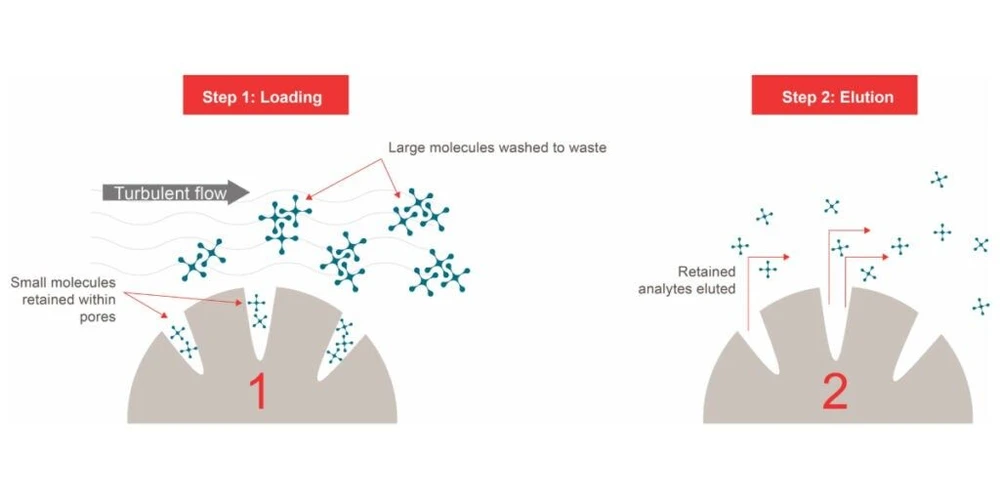
Thermo Fisher Scientific: Figure 1. Illustration showing how turbulent flow chromatography works.Thermo Fisher Scientific: Figure 1. Illustration showing how turbulent flow chromatography works.

Benefits of turbulent flow chromatography for sample preparation over SPE

While both TurboFlow and online SPE streamline and automate the sample preparation process, TurboFlow has key differences and advantages to consider (Figure 2).
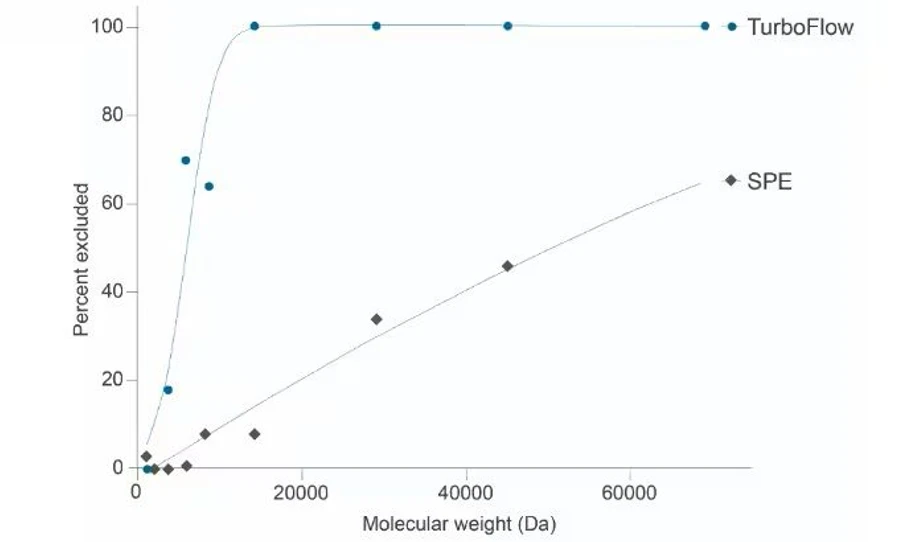
Thermo Fisher Scientific: Figure 2. TurboFlow vs. SPE for sample cleanup.Thermo Fisher Scientific: Figure 2. TurboFlow vs. SPE for sample cleanup.

  1. TurboFlow provides a cleaner sample compared to SPE
    • The more efficient dual mode of action (chemical affinity plus SEC)
    • The elution performed by a strong solvent plug potentially reduces the transfer of residual matrix components to your MS
  2. A cleaner sample means
    • Reduced ion suppression, leading to increased sensitivity
    • Less mass spectrometer contamination
    • Extended analytical column lifespan
    • Faster analytical gradients

Moreover, the opportunity to modulate the strength of the mobile phase reaching the analytical column allows for better analyte focusing on the head of the column, significantly improving your chromatography.

Streamline your daily LC-MS analysis with TurboFlow technology

Automated sample cleanup using online TurboFlow technology is a rapid and efficient sample preparation approach that considerably improves method accuracy, reliability, and sensitivity.

Adopting this technology can even enhance the competitiveness of your laboratory by allowing faster results, lower costs per sample, and improved reproducibility and MS sensitivity.

Thermo Fisher Scientific: Figure 3. Transcend TLX TurboFlow UHPLC System.Thermo Fisher Scientific: Figure 3. Transcend TLX TurboFlow UHPLC System.

Learn how TurboFlow can ease your lab’s daily LC-MS analysis of complex matrices today.

Visit us on LinkedIn: #TurbulentflowChromatography #lcms #IonSuppression

Dan Kalu Appulage

Dr. Dan Kalu Appulage is a Product Management Specialist in the HPCS business unit at Thermo Fisher Scientific. He holds a Ph.D. in Analytical Chemistry, an M.A., and B.S. in Chemistry. His professional background includes expertise in product management, LCMS method development, and teaching. Dan is passionate about education and loves sharing his knowledge and experiences with others. Outside of work, Dan enjoys playing volleyball and traveling with his family.

Thermo Fisher Scientific
LinkedIn Logo
 

Related content

Overcoming Strong Solvent Effects in the Analysis of Vepdegestrant

Applications
| 2026 | Agilent Technologies
Instrumentation
HPLC
Manufacturer
Agilent Technologies
Industries
Pharma & Biopharma

Identification of Double Bond Positions and Relative Acyl Chain Positions in Egg Yolk Phosphatidylcholines Using OAD-TOF System

Applications
| 2026 | Shimadzu
Instrumentation
LC/MS, LC/MS/MS, LC/TOF, LC/HRMS
Manufacturer
Shimadzu
Industries
Food & Agriculture

High Molecular-Weight Polysaccharide Characterization by SEC-MALS Using GTxResolve™ 1000 and 2000 Å SEC Columns

Applications
| 2026 | Waters
Instrumentation
GPC/SEC, Consumables, LC columns
Manufacturer
Waters
Industries
Pharma & Biopharma, Food & Agriculture

Development and Optimization for a Comprehensive LC/MS/MS Method for the Detection of 74 PFAS Compounds

Applications
| 2026 | Agilent Technologies
Instrumentation
LC/MS, LC/MS/MS, LC/QQQ
Manufacturer
Agilent Technologies
Industries
Food & Agriculture

PFAS in Biota: Risk Context & Robust Analytical Solutions

Others
| 2026 | ALS Europe
Instrumentation
Laboratory analysis, LC/MS, LC/MS/MS
Manufacturer
Industries
Environmental
 

Related articles

Research from IOCB Prague reveals a previously unknown mechanism of genetic transcription
Article | Science and research

Research from IOCB Prague reveals a previously unknown mechanism of genetic transcription

Scientists at IOCB Prague reveal a previously unknown mechanism that initiates gene transcription. Using cryo-EM, they uncover how alarmone molecules enable RNA synthesis under stress.
Institute of Organic Chemistry and Biochemistry of the Czech Academy of Sciences
tag
share
more
Affinity, Gel Filtration, Size Exclusion Chromatography: Repurposing Kinase Inhibitors for Malaria
Interview | Video

Affinity, Gel Filtration, Size Exclusion Chromatography: Repurposing Kinase Inhibitors for Malaria

This podcast explores how chromatography (FPLC/SEC) and mass spectrometry support malaria drug discovery, from protein purification and QC to interaction studies and complex sample preparation.
Organomation
tag
share
more
Webinars LabRulezLCMS Week 07/2026
Article | Webinars

Webinars LabRulezLCMS Week 07/2026

11 webinars: accurate mass, antibody stability, autosampler QC, bioprocess PAT, fermentation analytics, GLP-1, LC method transfer, Orbitrap, PFAS food testing, preparative HPLC
LabRulez
tag
share
more
Dissecting Heterogeneous Populations of Protein-Complex Samples Using Direct Mass Technology
Scientific article | Science and research

Dissecting Heterogeneous Populations of Protein-Complex Samples Using Direct Mass Technology

This study demonstrates Orbitrap-based CDMS/Direct Mass Technology as a quantitative tool for resolving and analyzing heterogeneous protein complexes below 100 kDa.
LabRulez
tag
share
more
 

Related content

Overcoming Strong Solvent Effects in the Analysis of Vepdegestrant

Applications
| 2026 | Agilent Technologies
Instrumentation
HPLC
Manufacturer
Agilent Technologies
Industries
Pharma & Biopharma

Identification of Double Bond Positions and Relative Acyl Chain Positions in Egg Yolk Phosphatidylcholines Using OAD-TOF System

Applications
| 2026 | Shimadzu
Instrumentation
LC/MS, LC/MS/MS, LC/TOF, LC/HRMS
Manufacturer
Shimadzu
Industries
Food & Agriculture

High Molecular-Weight Polysaccharide Characterization by SEC-MALS Using GTxResolve™ 1000 and 2000 Å SEC Columns

Applications
| 2026 | Waters
Instrumentation
GPC/SEC, Consumables, LC columns
Manufacturer
Waters
Industries
Pharma & Biopharma, Food & Agriculture

Development and Optimization for a Comprehensive LC/MS/MS Method for the Detection of 74 PFAS Compounds

Applications
| 2026 | Agilent Technologies
Instrumentation
LC/MS, LC/MS/MS, LC/QQQ
Manufacturer
Agilent Technologies
Industries
Food & Agriculture

PFAS in Biota: Risk Context & Robust Analytical Solutions

Others
| 2026 | ALS Europe
Instrumentation
Laboratory analysis, LC/MS, LC/MS/MS
Manufacturer
Industries
Environmental
 

Related articles

Research from IOCB Prague reveals a previously unknown mechanism of genetic transcription
Article | Science and research

Research from IOCB Prague reveals a previously unknown mechanism of genetic transcription

Scientists at IOCB Prague reveal a previously unknown mechanism that initiates gene transcription. Using cryo-EM, they uncover how alarmone molecules enable RNA synthesis under stress.
Institute of Organic Chemistry and Biochemistry of the Czech Academy of Sciences
tag
share
more
Affinity, Gel Filtration, Size Exclusion Chromatography: Repurposing Kinase Inhibitors for Malaria
Interview | Video

Affinity, Gel Filtration, Size Exclusion Chromatography: Repurposing Kinase Inhibitors for Malaria

This podcast explores how chromatography (FPLC/SEC) and mass spectrometry support malaria drug discovery, from protein purification and QC to interaction studies and complex sample preparation.
Organomation
tag
share
more
Webinars LabRulezLCMS Week 07/2026
Article | Webinars

Webinars LabRulezLCMS Week 07/2026

11 webinars: accurate mass, antibody stability, autosampler QC, bioprocess PAT, fermentation analytics, GLP-1, LC method transfer, Orbitrap, PFAS food testing, preparative HPLC
LabRulez
tag
share
more
Dissecting Heterogeneous Populations of Protein-Complex Samples Using Direct Mass Technology
Scientific article | Science and research

Dissecting Heterogeneous Populations of Protein-Complex Samples Using Direct Mass Technology

This study demonstrates Orbitrap-based CDMS/Direct Mass Technology as a quantitative tool for resolving and analyzing heterogeneous protein complexes below 100 kDa.
LabRulez
tag
share
more
 

Related content

Overcoming Strong Solvent Effects in the Analysis of Vepdegestrant

Applications
| 2026 | Agilent Technologies
Instrumentation
HPLC
Manufacturer
Agilent Technologies
Industries
Pharma & Biopharma

Identification of Double Bond Positions and Relative Acyl Chain Positions in Egg Yolk Phosphatidylcholines Using OAD-TOF System

Applications
| 2026 | Shimadzu
Instrumentation
LC/MS, LC/MS/MS, LC/TOF, LC/HRMS
Manufacturer
Shimadzu
Industries
Food & Agriculture

High Molecular-Weight Polysaccharide Characterization by SEC-MALS Using GTxResolve™ 1000 and 2000 Å SEC Columns

Applications
| 2026 | Waters
Instrumentation
GPC/SEC, Consumables, LC columns
Manufacturer
Waters
Industries
Pharma & Biopharma, Food & Agriculture

Development and Optimization for a Comprehensive LC/MS/MS Method for the Detection of 74 PFAS Compounds

Applications
| 2026 | Agilent Technologies
Instrumentation
LC/MS, LC/MS/MS, LC/QQQ
Manufacturer
Agilent Technologies
Industries
Food & Agriculture

PFAS in Biota: Risk Context & Robust Analytical Solutions

Others
| 2026 | ALS Europe
Instrumentation
Laboratory analysis, LC/MS, LC/MS/MS
Manufacturer
Industries
Environmental
 

Related articles

Research from IOCB Prague reveals a previously unknown mechanism of genetic transcription
Article | Science and research

Research from IOCB Prague reveals a previously unknown mechanism of genetic transcription

Scientists at IOCB Prague reveal a previously unknown mechanism that initiates gene transcription. Using cryo-EM, they uncover how alarmone molecules enable RNA synthesis under stress.
Institute of Organic Chemistry and Biochemistry of the Czech Academy of Sciences
tag
share
more
Affinity, Gel Filtration, Size Exclusion Chromatography: Repurposing Kinase Inhibitors for Malaria
Interview | Video

Affinity, Gel Filtration, Size Exclusion Chromatography: Repurposing Kinase Inhibitors for Malaria

This podcast explores how chromatography (FPLC/SEC) and mass spectrometry support malaria drug discovery, from protein purification and QC to interaction studies and complex sample preparation.
Organomation
tag
share
more
Webinars LabRulezLCMS Week 07/2026
Article | Webinars

Webinars LabRulezLCMS Week 07/2026

11 webinars: accurate mass, antibody stability, autosampler QC, bioprocess PAT, fermentation analytics, GLP-1, LC method transfer, Orbitrap, PFAS food testing, preparative HPLC
LabRulez
tag
share
more
Dissecting Heterogeneous Populations of Protein-Complex Samples Using Direct Mass Technology
Scientific article | Science and research

Dissecting Heterogeneous Populations of Protein-Complex Samples Using Direct Mass Technology

This study demonstrates Orbitrap-based CDMS/Direct Mass Technology as a quantitative tool for resolving and analyzing heterogeneous protein complexes below 100 kDa.
LabRulez
tag
share
more
 

Related content

Overcoming Strong Solvent Effects in the Analysis of Vepdegestrant

Applications
| 2026 | Agilent Technologies
Instrumentation
HPLC
Manufacturer
Agilent Technologies
Industries
Pharma & Biopharma

Identification of Double Bond Positions and Relative Acyl Chain Positions in Egg Yolk Phosphatidylcholines Using OAD-TOF System

Applications
| 2026 | Shimadzu
Instrumentation
LC/MS, LC/MS/MS, LC/TOF, LC/HRMS
Manufacturer
Shimadzu
Industries
Food & Agriculture

High Molecular-Weight Polysaccharide Characterization by SEC-MALS Using GTxResolve™ 1000 and 2000 Å SEC Columns

Applications
| 2026 | Waters
Instrumentation
GPC/SEC, Consumables, LC columns
Manufacturer
Waters
Industries
Pharma & Biopharma, Food & Agriculture

Development and Optimization for a Comprehensive LC/MS/MS Method for the Detection of 74 PFAS Compounds

Applications
| 2026 | Agilent Technologies
Instrumentation
LC/MS, LC/MS/MS, LC/QQQ
Manufacturer
Agilent Technologies
Industries
Food & Agriculture

PFAS in Biota: Risk Context & Robust Analytical Solutions

Others
| 2026 | ALS Europe
Instrumentation
Laboratory analysis, LC/MS, LC/MS/MS
Manufacturer
Industries
Environmental
 

Related articles

Research from IOCB Prague reveals a previously unknown mechanism of genetic transcription
Article | Science and research

Research from IOCB Prague reveals a previously unknown mechanism of genetic transcription

Scientists at IOCB Prague reveal a previously unknown mechanism that initiates gene transcription. Using cryo-EM, they uncover how alarmone molecules enable RNA synthesis under stress.
Institute of Organic Chemistry and Biochemistry of the Czech Academy of Sciences
tag
share
more
Affinity, Gel Filtration, Size Exclusion Chromatography: Repurposing Kinase Inhibitors for Malaria
Interview | Video

Affinity, Gel Filtration, Size Exclusion Chromatography: Repurposing Kinase Inhibitors for Malaria

This podcast explores how chromatography (FPLC/SEC) and mass spectrometry support malaria drug discovery, from protein purification and QC to interaction studies and complex sample preparation.
Organomation
tag
share
more
Webinars LabRulezLCMS Week 07/2026
Article | Webinars

Webinars LabRulezLCMS Week 07/2026

11 webinars: accurate mass, antibody stability, autosampler QC, bioprocess PAT, fermentation analytics, GLP-1, LC method transfer, Orbitrap, PFAS food testing, preparative HPLC
LabRulez
tag
share
more
Dissecting Heterogeneous Populations of Protein-Complex Samples Using Direct Mass Technology
Scientific article | Science and research

Dissecting Heterogeneous Populations of Protein-Complex Samples Using Direct Mass Technology

This study demonstrates Orbitrap-based CDMS/Direct Mass Technology as a quantitative tool for resolving and analyzing heterogeneous protein complexes below 100 kDa.
LabRulez
tag
share
more
Other projects
GCMS
ICPMS
Follow us
More information
WebinarsAbout usContact usTerms of use
LabRulez s.r.o. All rights reserved. Content available under a CC BY-SA 4.0 Attribution-ShareAlike