News from LabRulezLCMS Library - Week 14, 2025
LabRulez: News from LabRulezLCMS Library - Week 14, 2025
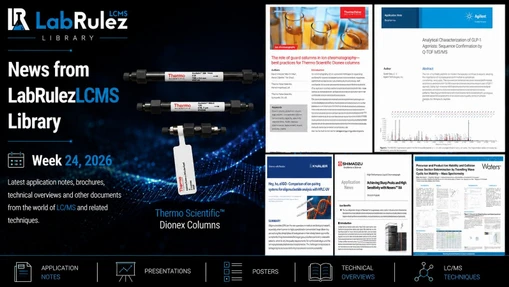
Our Library never stops expanding. What are the most recent contributions to LabRulezLCMS Library in the week of 31thMarch 2025? Check out new documents from the field of liquid phase, especially HPLC and LC/MS techniques!
👉 SEARCH THE LARGEST REPOSITORY OF DOCUMENTS ABOUT LCMS AND RELATED TECHNIQUES
👉 Need info about different analytical techniques? Peek into LabRulezGCMS or LabRulezICPMS libraries.
This week we bring you application notes by Agilent Technologies, Mestrelab Research, Shimadzu and Waters Corporation, poster by GC Image / MDCW and technical note by Thermo Fisher Scientific!
1. Agilent Technologies: Evaluating HILIC Stationary Phases for Oligonucleotide Separation by LC/MS
- Application note
- Full PDF for download
IP-RPLC coupled with MS represents the most common analytical method for oligonucleotide analysis.1-3 However, alternative separation methods are needed because alkylamine ion-pair reagents require dedicated instruments. While ion-exchange chromatography (IEX) represents a viable alternative technique due to excellent selectivity for oligonucleotides based on their length, it is not preferred due to mobile phase incompatibility with MS detection. HILIC is a valuable alternative to both IP-RPLC and IEX as HILIC mobile phases are compatible with MS and offer flexibility in instrument use. This work highlights the utility of HILIC for oligonucleotide analysis and the critical parameters that need to be considered to optimize LC/MS performance.
Experimental
HILIC columns Five HILIC columns from Agilent were evaluated in this study: InfinityLab Poroshell 120 HILIC (P120 HILIC), InfinityLab Poroshell 120 HILIC-OH5, InfinityLab Poroshell 120 HILIC-Z, AdvanceBio Amide HILIC, and AdvanceBio Glycan Mapping. The Glycan Mapping column features a neutral amide stationary phase, while the Amide HILIC column has a mixed-mode HILIC stationary phase with both amide and ion-exchange functionalities. All columns contain 2.7 μm superficially porous particles, except for the Amide HILIC column, which has 1.8 μm fully porous particles. A summary of the columns used is provided in Table 1.
Instrumentation
LC/MS analysis was performed using an Agilent 1290 Infinity II LC system coupled to an Agilent 6545XT AdvanceBio LC/Q-TOF with an Agilent Jet Stream Electrospray source. The LC consisted of:
- Agilent 1290 Infinity II high-speed pump (G7120A)
- Agilent 1290 Infinity II multisampler with thermostat (G7167B)
- Agilent 1290 Infinity II multicolumn thermostat (MCT) (G7116B)
- Agilent 1290 Infinity II diode array detector (DAD) (G7117A)
Dynamic mass axis correction was achieved by continuous infusion of a reference mass solution. Tables 3 and 4 summarize the optimized LC and the MS conditions. Data acquisition and analysis was done using the Agilent MassHunter software suite.
Conclusion
This study systematically evaluated five different HILIC stationary phases with varying mobile phase pH levels to determine the optimal conditions for chromatographic peak shape, resolution, and MS signal for oligonucleotides. It was found that different mobile phase pH conditions can impact the charge state distribution of the analyte, which is important to consider when working with longer oligonucleotides. The developed methods ultimately facilitated the LC/MS analysis of a heavily modified ASO, with the potential for sequence confirmation analysis through tandem MS. This work confirms that HILIC chromatography can be an attractive alternative to IP RP for the analytical characterization of oligonucleotides. These methods could be applied to other emerging oligonucleotide modalities, including siRNA, aptamers, single-stranded guide RNA (sgRNA), and mRNA sequencing in the future.
2. GC Image / MDCW: Interactive Ion Peak Analysis and Differencing for Comparing Multidimensional Chromatography Data
- Poster
- Full PDF for download
Comprehensive two-dimensional chromatography offers superior separation capabilities for complex mixtures, but the resulting data complexity necessitates advanced comparative analysis methods. A common scenario involves comparing two samples to identify similarities and differences. We demonstrate our methods through two applications including performing new peak detection (NPD) [1] for LC-MS data of peptide samples, and identifying and comparing common and unique compounds from pairs of GCxGC-MS chromatograms.
Approach 1: Targeted Ion Peak Detection
- Targeted detection with 5ppm ion m/z tolerance
- A fold change of >5 was used to perform new peak detection (NPD) [1]
- 2D visualizations generated using a RT x MS data view
Data Set
- LC-MS data of the NISTmAb RM 8671 from the Multi-Attribute Method (MAM) Consortium Interlaboratory Study [4]
- From the data set, we focused on data from a single participant (participant 16)
Spiked vs Reference:
- Comparing the spiked reference to the original reference sample
- Successfully found all 15 expected calibrants as new peak detections in spiked
- Found 3 decreased peaks and 1 additional new peak
pH vs Reference:
- Comparing reference subjected to pH stress to original reference sample
- Found all NPD reported by >50% of study participants
- Found total of 173 new peak and 53 missing peak candidates
3. Mestrelab Research: Scoring of LC separation procedures for ezetimibe and its degradants using Mgears Chrom Best Method
- Application note
- Full PDF for download
Screening sample sets are common tasks in industries with discovery departments, and purification and scaling fabrication processes for high added value chemicals. In all these fields, preparative chromatography is often the preferred way to obtain material with sufficient purity. The efficient purification methodology involves screening a few chromatography methods using mass and/or UV detectors and testing different columns and/or mobile phase compositions.
Frequently, these sample sets consider chiral compounds, and the objective is not only the separation of the target species such that it is as pure as possible, but also the separation of enantiomers and/or diasteroisomeric impurities. From this screen, critical decisions are taken (e.g., a synthetic route is preferred; a preparative method is chosen; alternative separation methods are tested; ...). Frequently, a busy discovery and/or purification lab receives many such requests and reviewing the results of screens manually is time-consuming and tedious. A tool which automates the task, gathering the required data, scoring the methods for suitability, and reporting the results, is therefore highly desirable.
Mgears Chrom Best Method has been developed as a tool to hierarchically organize the results of screening experiments according to flexible, convenient, automated, and user-selectable scoring criteria. In this short note, we will consider, as a case study, the selection of LC procedures to isolate ezetimibe (C24 H21 F2NO3; CAS: 163222-33-1, MW: 409.433 g/mol) from several of its degradants.
Degradation processes of ezetimibe have been extensively described in the literature1,2 . The sample mixture was prepared departing from an ezetimibe standard (Acesys Pharmatech, Cat No. 1242-111-21, Fairfield, NJ, USA). This standard was submitted to alkaline and acidic degradation processes, then mixed and spiked with the pure standard to provide a mixture where both the API and several of its degradants can be accurately detected. This mixture was diluted and used for all screening runs described, which were arranged according to a simple factorial experimental design (Table 1).
The column was a Cortecs C8 3 x 50 mm, 2.7 um (Waters® PN.186008369). The instrumental system used was a Waters® Acquity HClass LC system furnished with an Acquity DAD-UV detector and a Xevo TQD detector and was operated via the Masslynx software. MSD scan mode signal in the 100-700 m/z range was registered in negative polarity. The DAD wavelength range was 220-400 nm. The mobile phase flowrate was 0.2 mL/min in all experiments. The pH of the mobile phases was varied between 3 and 8, developing elutions with acetonitrile as modifier, at column temperatures of between 35 and 55 ºC.
Chrom Best Method Scoring Criteria
Chrom Best Method provides a highly flexible scoring system that can be adapted to the needs of any chromatographic separation aimed at selecting the optimal purification method. Factors such as the target resolution, purity, symmetry, and retention time can be evaluated by means of desirability functions and combined into an overall measure, allowing the selection of the best separation among those provided in the experiment.
Desirability functions for scoring criteria use logistic functions (Figure 1) that represent situations that range from highly undesirable (score = 0) to highly desirable (score = 1). These functions are defined by assigning a value for the 50% score point and a slope (k). Moreover, a weight coefficient can be assigned to reflect the relative importance of each scoring criterion to the user.
4. Shimadzu: Analysis of Amino Acids in Foods Using Automatic Pretreatment Function of Integrated HPLC
- Application note
- Full PDF for download
User Benefits
- Automatic pre-column derivatization method enables highly selective amino acid analysis with high sensitivity.
- Proteinogenic amino acids can be analyzed within 20 minutes.
- Generally used HPLC can cover all procedures for pre-column derivatized amino acid
Foods contain many amino acidsincluding glutamic acid, which is known to provide umami flavor. Measuring the content of each amino acid is recently used for the research activity on functional components as well as the evaluation of the nutritional value and the taste.
Application News L529A described automatic amino acid analysis using pre-column derivatization with the integrated HPLC that has pre-treatment function. This article introduces the amino acid analysis and real sample pretreatment protocols of 14 types of real food samples using the same method asin L529A.
Pre-Column Derivatization
The process flow for automatic pre-column derivatization using LC-2050C is shown in Fig. 1. Settings are entered in the autosampler pretreatment program setting windows. The setting window image is shown in Fig. 2. The MPA/OPA reagent is set as Vial 1 on Tray 3, the FMOC reagent as Vial 2, and aqueous phosphate solution as Vial 3.
Analysis of Real Samples
The system was used to analyze four hydrochloric acid hydrolyzed products (brown rice, soybean extract, boiled tuna, and chicken eggs) and ten samples for free amino acids (soybean extract, scallop, boiled tuna, amino acid supplement, mushroom, matcha, tomato juice, green vegetable juice, barbeque sauce, and coconut milk). Corresponding chromatograms and pretreatment protocols are shown in Fig. 4 to Fig. 31.
In pre-column derivatization, the reaction might be influenced by the sample matrix due to direct addition of the derivatizing reagent to the samples. Therefore, an ultrafiltration cartridge (with molecular weight cut-off 3000) was used for deproteinization and 10 mmol/L hydrochloric acid was used as diluent for all the pretreatment protocols, to make the equal sample matrices before derivatization as much as possible.
5. Thermo Fisher Scientific: Quantification of steroids in human serum by TurboFlow online sample cleanup using a Transcend VTLX-1 UHPLC system
- Technical note
- Full PDF for download
Application benefits
- Utilization of a new, compact, and cost-effective fully Vanquish-based Transcend UHPLC system for rapid online sample cleanup
- Simplified pre-injection sample preparation
- Quantification of eight steroids in five minutes
- Improved chromatographic performance with optimized Vanquish fluidics
Liquid chromatography (LC) coupled with triple quadrupole tandem mass spectrometry (MS/MS) has become the preferred technology for quantifying steroid hormones in biological matrices. Its superior specificity compared to immunoassays and its sensitivity when using low sample volumes have been major contributors to its success. However, as LC-MS/MS technology continues to proliferate, laboratory space and budget constraints often pose significant hurdles to adoption.
To address these needs, we have evolved our Transcend TLX-1 UHPLC system into the new Transcend VTLX-1 UHPLC system, which has a smaller footprint while maintaining the same functionalities as its predecessor (Figure 1). The Transcend VTLX-1 system can perform TurboFlow online sample cleanup or online solid phase extraction (SPE) (Figure 2a), as well as UHPLC applications that do not require online purification (Figure 2b). Additionally, replacing the Thermo Scientific™ TriPlus™ RSI autosampler with a stackable Thermo Scientific™ Vanquish™ Dual Split sampler dramatically reduces the system’s footprint, alleviating space constraints in the laboratory.
In this technical note, we analyzed the same samples on both a Transcend VTLX-1 system and a Transcend TLX-1 system, Figure 1. (a) Transcend TLX-1 and (b) Transcend VTLX-1 systems alternately coupled to the same TSQ Altis triple quadrupole mass spectrometer. Serum samples were extracted by offline protein precipitation with concurrent internal standard addition. Extracted samples were injected onto both Transcend UHPLC systems. Detection was performed in Selected Reaction Monitoring (SRM) acquisition mode using a TSQ Altis mass spectrometer with a heated electrospray ionization (HESI-II) source operated in positive ionization mode. Method performance was evaluated using calibrators, controls, and internal standards from the ClinMass™ Complete Kit for Steroids in Serum/Plasma from RECIPE Chemicals + Instruments GmbH (Munich, Germany) in terms of chromatography, linearity of response within the calibration ranges, accuracy, and intra-assay precision for each analyte.
Experimental
Liquid chromatography
A Transcend VTLX-1 UHPLC system (P/N 60500-60301) and a Transcend TLX-1 UHPLC system (P/N 60500-60201) were coupled on two different days to a TSQ Altis triple quadrupole mass spectrometer to evaluate the chromatographic performance of the two front ends. The same analytical method, including TurboFlow online sample cleanup, was used on the two systems (Figure 3). Sample cleanup was performed using Fisher Chemical™ Optima™ LC/MS water (P/N W6-1) and methanol (P/N A456-1) on a Thermo Scientific™ Cyclone-P 0.5 × 50 mm TurboFlow column (P/N CH-953289). Chromatographic separation was achieved on a Thermo Scientific™ Accucore™ Biphenyl 50 × 2.1 mm, 2.6 µm column (P/N 17826-052130) using Optima LC/MS water and methanol with 0.2 mM ammonium fluoride (P/N 393190500). Total runtime was 5.0 minutes.
Mass spectrometry
Analytes and internal standards were detected in SRM acquisition mode on a TSQ Altis mass spectrometer with heated electrospray ionization operated in positive ion mode. A summary of the MS conditions is reported in Table 4. A comprehensive list of SRM parameters used to acquire analytes and internal standards are reported in Table 5.
Conclusions
An analytical performance comparison between the new Transcend VTLX-1 UHPLC system and the Transcend TLX-1 version was performed using the quantification of a panel of eight steroids in human serum as a reference application. The two Transcend systems were alternatively coupled to the same TSQ Altis triple quadrupole mass spectrometer for detection. Calibrators, controls, and internal standards from RECIPE were used on a home-made TurboFlow method; the total runtime was 5.0 minutes. The method incorporates simple offline protein precipitation with concurrent addition of the internal standards.
It was not possible to obtain acceptable chromatography for DHEAS using the Transcend TLX-1 system, where the considerable delay volume due to long stainless-steel tubing would have required extensive method optimization.
For the remaining analytes, the new Transcend VTLX-1 system showed significantly improved chromatographic peak sharpness and symmetry, especially for the early eluting compounds, thanks to the optimized fluidics based on Thermo Scientific™ Viper™ fittings that reduce the delay volume to a minimum. This hardware enhancement also facilitates the development of analytical methods requiring online sample cleanup, minimizing analyte dispersion during the transfer from the extraction cartridge to the analytical column.
The two Transcend systems also demonstrated equivalent analytical performance in terms of linearity of response within the covered calibration range, with overlapping linear calibration curves for each analyte (except for DHEAS on the Transcend TLX-1 system) and correlation factors always above 0.9995. Similar excellent performance was also obtained in terms of accuracy and intra-assay precision, with a percentage bias within ±6.7% and a percentage CV always below 2.3%.
The obtained results demonstrate the ability of the new Transcend VTLX-1 UHPLC system to provide higher quality analytical results when compared to the Transcend TLX-1 version in the quantification of steroids in human serum, meeting research laboratory requirements in terms of linearity of response, accuracy, and precision.
6. Waters Corporation: Illustrating the Use of Cyclic Ion Mobility to Enhance Specificity for branched-PFAS Isomer Analysis
- Application note
- Full PDF for download
Benefits
- CCS values provide additional specificity to distinguish PFAS isomers
- LC-cIM-MS is a routine and robust non-targeted screening approach that provides enhanced peak capacity, using a combination of chromatographic, m/z and ion mobility resolution. The combined resolution enables differentiation of isobaric and isomeric analytes, including PFHxS, PFOS, and PFOA isomers
- Multipass cyclic IMS enhances peak capacity, allowing for the resolution of chromatographically coeluting isomers. This improvement enables single component fragment ion spectra to be obtained, providing greater certainty in the structural elucidation of both known and unknown isomeric polyfluoroalkyl substances
- Comparing Travelling wave ion mobility (TWIM) CCS values to drift tube and trapped ion CCS measurements (Δ CCS <0.7%), confirms CCS values can be used to reliably perform transferable PFAS analysis research
Products incorporating PFAS, have evolved and are used extensively within society because of the unique properties imparted by the fluoroalkyl moiety. Adverse health conditions resulting from environmental exposure to PFAS have previously been described.1,2 Stringent guidelines and legislation have been introduced because of the associated toxicity resulting from PFAS exposure.3-7 Environmental fate and impact of alternative PFAS are being assessed, several studies indicate that new alternative PFAS have similar toxicity to banned PFAS.8
Although PFOA and PFOS are banned, production continues in developing countries. Electrochemical fluorination (ECF) and telomerization are the major manufacturing processes for PFOA. Rearrangement and breakage of the carbon chain takes place in the ECF process, leading to the production of approximately 78% linear and 22% branched isomers.9 Primarily PFOS is has been manufactured by ECF, with 70% linear and 30% branched isomers resulting. Over the past two decades there has been prevalent focus upon multiple PFAS in aquatic environments, comparatively, branched-PFAS (br-PFAS) isomers have received little attention, due to the incumbent analytical challenge, and low abundance as the root cause.10
The number of known and unknown emerging PFAS, PFAS precursors and transformation products are increasing. As a result, the use of non-targeted high resolution mass spectrometry (HRMS) strategies will continue to increase (~1000 unknown PFAS identified).12 These strategies will be employed alongside targeted analysis strategies. Non-targeted ultra-high performance liquid chromatography cyclic ion mobility (UHPLC-cIM) is a particularly amenable because of its ability to resolve and differentiate isomeric species, as well as providing enhanced resolution of thousands of analytes in a single acquisition.12
The ability to resolve isomers is of notable importance, it has previously been proposed that LC-cIM-MS is an analytical strategy that can be used to potentially cross correlate PFOS isomer structure and toxicity.13 The need to exploit the benefits if LC-cIM-MS to improve understanding of the environmental impact of PFAS exposure resulting from isomeric distribution, is emphasised, given that L-PFAS and br-PFAS have been shown to have specific detrimental health association and infant burden during pregnancy.14,15
Herein we describe LC-cIM-MS analyses performed using a SELECT SERIES Cyclic IMS system (see Figure 1), where enhanced peak capacity Pc, and increased peak-to-peak resolution RsP-P is obtained. Chromatographically coeluting PFOS isomers are resolved and structural elucidation performed to identify brPFOS byproducts, based on the single component isomeric fragmentation spectra obtained.
Experimental
LC Conditions
- LC system: ACQUITY™ Premier System modified with PFAS Kit and Atlantis™ Premier BEH™ C18 AX Isolator
- Column, 2.1 x 50 mm, 5 µm (p/n: 186010926).16
- Column: ACQUITY UPLC™ BEH™ C18 Column (100 mm x 2.1 mm, 1.8 µm)
Results and Discussion
In the case of L-PFOS and P1MHpS equivalent retention times are observed, however the isomers are differentiated by their CCS values (>3 Å2 ) and observed ion mobility product ion spectra. The L-PFOS anion fragmentation pathway produces both a SO3 - m/z 80 and SO3F - m/z 99 fragment ions of approximate equal abundance. In Figure 6 (I), L-PFOS and P1MHpS are presented, the fragment ion spectrum of L-PFOS is comprised of fragment ions resulting from fragmentation pathway a and b, whereas P1MHpS fragment ions are produced solely from fragmentation pathway b. For P1MHpS the m/z 99 forms the base peak of the of the product ion spectrum and m/z 80 is approximately 1%. br-PFOS isomer fragmentation spectra have been acquired using a fixed collision energy (Figure 6 (II)), characteristic isomer fragmentation spectra are comprised of major and minor isomeric fragment ions. Using ion mobility spectral clean up aids visualisation of critical fragmentation information to facilitate isomer structural elucidation. Although illustrated for standards, the benefits of this approach can be adopted for identification of both known and unknown PFAS.13
Conclusion
The implementation of HRMS for PFAS analysis has led to the identification of previously unknown PFAS. However, the focus has primarily been on linear PFAS forms, neglecting their br-PFAS isomer byproducts. LCIM-MS offers a solution by enabling non-targeted screening to detect and identify known, unknown, and emerging PFAS, including transformation products, and crucially, differentiate br-PFAS byproducts. This technique combines three dimensions of resolution—retention time, m/z, and CCS specificity.
Characteristic CCS values for br-PFOS, br-PFOA, and br-PFHxS isomers have been determined and shown to be independent of IM technology (Δ CCS <0.7%). LC-IM-MS has resolved chromatographically coeluting br-PFOS isomers, generating single-component characteristic isomeric product ion spectra for confident structural elucidation. Even at low analyte concentrations when the absence of product ion spectra is problematic, L-PFAS and br-PFAS CCS fingerprints can be correlated with PFAS product-specific fingerprints to facilitate environmental source tracking.
With growing global concerns about environmental exposure to PFAS, the demand for PFAS sample analyses will continue to grow. This study demonstrates that LC-cIM-MS can play a critical role in analytical strategies, particularly in correlating the genotoxicity and environmental fate of br-PFAS.