News from LabRulezLCMS Library - Week 10, 2025
LabRulez: News from LabRulezLCMS Library - Week 10, 2025
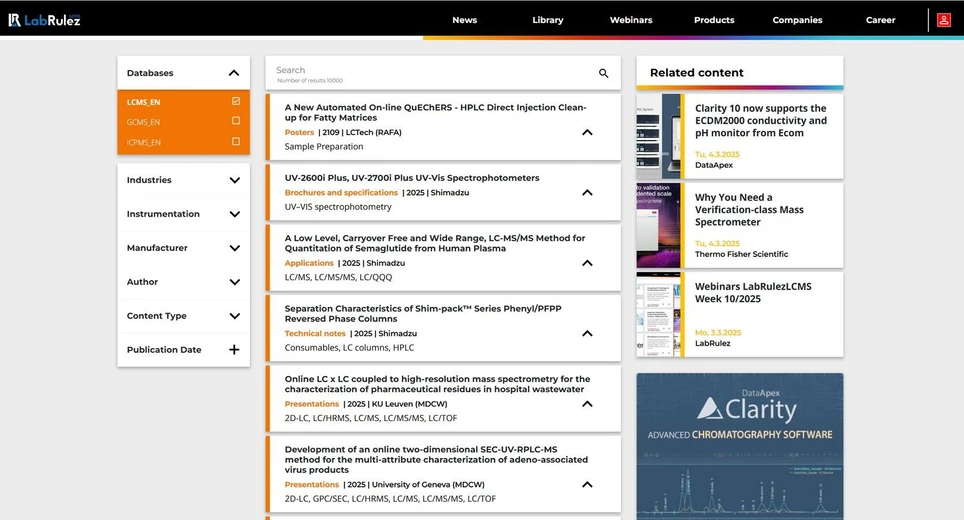
Our Library never stops expanding. What are the most recent contributions to LabRulezLCMS Library in the week of 3rd March 2025? Check out new documents from the field of liquid phase, especially HPLC and LC/MS techniques!
👉 SEARCH THE LARGEST REPOSITORY OF DOCUMENTS ABOUT LCMS AND RELATED TECHNIQUES
👉 Need info about different analytical techniques? Peek into LabRulezGCMS or LabRulezICPMS libraries.
This week we bring you application notes and other documents by Agilent Technologies, Knauer, Mestrelab, Shimadzu, Thermo Fisher Scientific and Waters Corporation!
1. Agilent Technologies: A Fully Automated Workflow for PFAS Analysis in Seafood for Regulatory Screening
PFAS quantitation using CTC PAL3 with 6495D LC/TQ
- Application note
- Full PDF for download
PFAS are synthetic chemicals that are widely used in various industrial and consumer products due to their resistance to heat, water, and oil. These properties contribute to their persistence in the environment, where they can accumulate in aquatic ecosystems and contaminate marine life. Seafood, such as fish and shellfish, can therefore absorb PFAS, leading to potential human exposure through consumption. Studies have detected PFAS in various seafood items, including clams, cod, crab, pollock, salmon, shrimp, tilapia, and tuna.1 Surveys by the FDA have found detectable levels of PFAS in a significant percentage of seafood samples.
The U.S. FDA, the European Food Safety Authority (EFSA), EURL POPs, and AOAC are actively involved in discovering the extent of PFAS contamination in seafood to establish guidelines to protect public health.2-6 For instance, EU 2022/1431, EURL POPs, and AOAC have set the required or recommended limits of quantitation (LOQs) at 0.3 µg/kg for four individual PFAS (PFOS, PFOA, PFNA, and PFHxS) in seafood matrices.4-6 The U.S. FDA has also published validation data for MDLs at the parts per trillion (ppt) level for all 28 regulated PFAS in seafood.2
Detecting trace levels of PFAS in food, particularly seafood, poses significant challenges due to the complexity of the matrices. PFAS analysis typically involves QuEChERS (Quick, Easy, Cheap, Effective, Rugged, and Safe) extraction followed by solid-phase extraction (SPE) cleanup. SPE is a widely used protocol due to its efficiency in extracting a broad range of analytes from food matrices.2,7 However, these manual steps can be labor-intensive and prone to errors, impacting the accuracy and reliability of results. Skilled analysts are required to perform these tedious extractions and operate the instruments. Variation in skill level can also lead to inconsistent results, reducing the reliability and repeatability of PFAS analysis, especially when high precision at trace levels is needed.
This study discusses a fully automated workflow for the quantitative analysis of PFAS in seafood using a PAL3 Series 2 RTC autosampler and 6495D LC/TQ. Solvent extraction followed by QuEChERS salting-out and micro-SPE cartridge cleanup was automatically performed by the PAL3 platform, while data analysis was conducted on the LC/TQ in parallel mode. The method performance was thoroughly evaluated based on EU 2023/915, EU 2022/1431, EURL POPs, the U.S. FDA, and AOAC SMPR 2023.003.
Experimental
Consumables
Consumables are crucial for trace-level analysis of PFAS, as their composition can greatly impact background levels and contribute to false positive high results for the targets. All consumables used in this work were therefore tested and verified for their suitability in PFAS analysis to deliver ultralow background.8
The following consumables were used:
- Agilent QuEChERS extraction salt packets, EN 15662 method (part number 5982-6650)
- Agilent micro-SPE cartridges (part number G6074-67013)
- Agilent ZORBAX Rapid Resolution High Definition
- Eclipse Plus C18 column (2.1 × 100 mm, 1.8 μm, part number 959758-902)
Instrumentation
An integrated PAL3 Series 2 RTC autosampler coupled with a 6495D LC/TQ (Figure 1) was used for the fully automated workflow of PFAS quantitation from seafood matrix in this study.
A 160 cm PAL3 Series 2 RTC autosampler was used as an automated liquid handling platform for preparing calibration standards, sample extraction, and for performing injections onto the LC/TQ system. The PAL3 platform was equipped with various tools and modules, providing the necessary capabilities to achieve its designated functions. The following tools and modules were used in this study:
- Two PAL Park Stations with three Liquid Syringe Tools, Dilutor Tool, micro-SPE Tool, and LC/MS Tool
- Vortex Mixer
- Centrifuge
- Dilutor Multi
- Tray Cooler (for 2/10/20 mL vials)
- Tray Holders with Rack R60 (for 10/20 mL vials)
- Micro-SPE Tray (for 2 mL vials and micro-SPE cartridges)
- Solvent Module and Fast Wash Module
- LC Injection Valve
The LC Injection Valve was configured on the PAL3 platform, and all liquid syringes were cleaned using a Fast Wash Module. All solvent tubing used in the PAL3 platform was PFAS-free. Extra modules and tools can be added to meet specific sample preparation needs.
Chromatographic separation was achieved using a ZORBAX RRHD Eclipse Plus C18 column (2.1 × 100 mm, 1.8 μm) installed on an Agilent 1290 Infinity II UHPLC system. This system consisted of the following two modules (Figure 1):
- Agilent 1290 Infinity II high-speed pump (part number G7120A)
- Agilent 1290 Infinity II multicolumn thermostat (part number G7116B)
An Agilent 1290 Infinity II Multisampler (part number G7167B) was not required for this work, as the sample handling and injection were carried out by the PAL3 platform. To minimize background PFAS contamination from the LC flow path and mobile phases, an Agilent InfinityLab PFC-free HPLC conversion kit (part number 5004-0006) was installed on the UHPLC system.9 This kit includes PFC-free bottle head assemblies, a pump head adapter, an inline filter, multiwash tubing, and a delay column. A 12-minute gradient elution, as outlined in the Agilent PFAS MRM Database for LC/TQ (part number G1736AA), was used with 5 mM ammonium acetate in water as mobile phase A and 100% methanol as mobile phase B at a flow rate of 0.4 mL/min.
Conclusion
In this study, the newly developed analytical method protocol provided a fully automated PFAS analysis using the integrated CTC PAL3 Series 2 RTC autosampler and 6495D LC/TQ. This approach transferred labor-intensive tasks to the robotic system, covering calibration preparation, sample extraction, and target analysis. The Agilent QuEChERS salting-out-assisted solvent extraction and micro-SPE cleanup were successfully executed by the PAL3 platform, eliminating tedious manual tasks in the sample preparation process. The method exhibited excellent linearity, sensitivity, accuracy, repeatability, and reproducibility, consistently meeting the stringent regulatory requirements and recommendations for PFAS in seafood matrices set out by the U.S. FDA, EU, EURL POPs, and AOAC. The exceptional performance across key analytical metrics even met the specific requirements for PFAS in other matrix categories such as eggs, coffee, fish oil, and feed. These results confirmed the robustness and reliability of the automated system in delivering high-quality analytical data. The automated workflow significantly reduces manual intervention, which minimizes human error and enhances the precision of the analysis. The integrated system allows sample preparation and data analysis to run in parallel, offering a streamlined workflow and improving productivity for routine laboratory operations. Also, the integration of advanced automated sample preparation techniques with the highly sensitive 6495D LC/TQ ensures consistent and reproducible results, which are critical for meeting the regulatory requirements.
2. Knauer: Analysis of Poly [(R)-3-hydroxybutyric acid] in chloroform using GPC and universal calibration
- Application Note
- Full PDF for download
Poly [(R)-3-hydroxybutyric acid] (PHB) is the bestknown representative of poly(hydroxy)alkanoates. It is a biodegradable polyester that can be produced biologically using bacteria.(1) Its physical properties are similar to polypropylene, and it is therefore used in the packaging industry as well as for medical applications.(2) In 2018, more than 30 million tons of polypropylene were processed only in the packaging industry alone.(3) This shows the magnitude of the dimension in which PHB could be used as a sustainable substitute for petrochemical plastics. The properties of manufactured plastics such as PHB are largely determined by the number average molecular mass (Mn), the weight average molecular weight (Mw) and the PDI. These parameters can be easily determined using gel permeation chromatography (GPC). In this application note a method for the analysis of PHB in chloroform by GPC using universal calibration is provided.
Conclusion
The low deviation of the 10 kDa PHB standard with 11% (PS-calibration) and 17% (PMMA calibration), show that both calibrations can be used for the determination of low molecular weight PHB. Contrary for high molecular weight PHB (500 kDa), the deviations of both calibrations are significantly too high that they cannot be used for an appropriate determination of the molecular weight. One possible explanation for this deviation would be poor solubility in chloroform due to high crystallinity of PHB. While the 10 kDa PHB polymer dissolved at room temperature, the 500 kDa polymer only dissolved partially in chloroform after 2 h at 60°C. It is conceivable that only the low molecular weight fraction has dissolved, so that the Mn value is underestimated. The Mn determination would probably be more accurate if the sample was not cooled back to room temperature after dissolving, so that a possible crystallization of the higher molecular weight fraction would be avoided. nevertheless, low molecular weight PHB is also interesting in its application. For example, in the field of drug delivery by means of prolongedrelease tablets, in which PHB is pressed with the active ingredient. The retardation time increases exponentially with decreasing molecular weight (3–60 kDa) of the PHB in the example with Midrodin·HCl.(7)
3. Mestrelab Research: Affinity Screen: Screening libraries within minutes made possible
- Other documents
- Full PDF for download
Affinity Selection Mass Spectrometry (AS-MS) has emerged as a powerful technique for elucidating protein-ligand interactions, providing valuable insights into complex biological systems and playing a pivotal role in advancing the development of novel therapeutics and diagnostics. To enhance the efficiency of AS-MS, ligand multiplexing is often employed, enabling researchers to simultaneously screen up to 200 ligands within a single well and thus screen more extensive compound libraries. However, analyzing high-throughput AS-MS data can be a challenging and time-consuming endeavor, requiring specialized tools and expertise. That's where our software, Affinity Screen, comes in. It automates data analysis, making it easier for researchers to extract meaningful insights from their experiments, accelerating the understanding of protein-ligand interactions and expediting the discovery process.
4. Shimadzu: A Low Level, Carryover Free and Wide Range, LC-MS/MS Method for Quantitation of Semaglutide from Human Plasma
- Application Note
- Full PDF for download
User Benefits:
- Method for Semaglutide quantitation from human plasma was developed and validated as per ICH M10 guidelines.
- The developed method achieved a low limit of quantification (LLOQ) level and wide dynamic range.
- The developed method demonstrates no carryover for the dynamic range covered.
Semaglutide (Figure 1) is a peptide used as an antidiabetic medication for the treatment of type-2 diabetes. It is also used as an anti-obesity medication for weight loss. Recently, studies have shown that Semaglutide also works on the brain, suggesting its potential utility for various diseases, including Parkinson's disease and Alzheimer's disease. The non-specific adsorption of Semaglutide on column, HPLC flow path and high background noise at low level in complex matrix like human plasma makes quantitation of Semaglutide difficult at low level. To overcome these challenges, we developed an MRM based LC-MS/MS method for quantifying Semaglutide. This method is well- suited for pharmacokinetic studies of Semaglutide because it offers ,low limit of quantification, no carryover and has a wide dynamic range.
Shimadzu LCMS-8060NX (Figure 2) was used to determine Semaglutide in plasma at low levels.
Experimental
The Semaglutide reference standard was procured from local vendor. Human plasma was procured from local vendor to prepare calibration standards and quality control (QC) samples. Precursor ion selection, MRM optimization at different collision energies and voltages was done using Shimadzu’s “Optimization for method” tool. Optimized MRM for 2 product ions with optimized voltages and collision energies (CE) were developed. A LC method (Table 1) was developed using UHPLC column (Shim-pack Claris) to elute Semaglutide with no carry over. Using the developed LC method and optimized MRM, LLOQ of 0.2 ng/mL and upper limit of quantification (ULOQ) of 600 ng/mL was achieved with no carry over. For Quantitation, a wide linearity batch ranging from 0.2 to 600 ng/mL was processed in human plasma. For QC check lower limit quality control (LLQC), lower quality control (LQC), medium quality control (MQC) and higher quality control (HQC) samples were processed in replicates and were quantified against the linearity. The accuracy for the calibration standards and QC samples was found to be within acceptable range (Figure 3).
Conclusion
- A highly sensitive and precise method for quantifying GLP-1 peptide in human plasma was developed using the Shimadzu LCMS-8060NX system.
- This method effectively addresses common challenges, including achieving low-level LLOQ, wide dynamic range, and carryover-free detection.
- The results met the accuracy and precision standards of ICH M10 guidelines, confirming the reliability of the method
5. Thermo Fisher Scientific: Analysis of common lithium salts, trace additives, and contaminants in lithium-ion battery electrolytes by ion chromatography-mass spectrometry
- Application Note
- Full PDF for download
Understanding the electrolyte composition of batteries is pivotal in achieving enhanced battery performance, safety, and longevity at every stage of product evolution, including research, manufacturing, and recycling. By analyzing the electrolyte, valuable insights can be gained to further improve performance, efficiency, and safety. In the early stages of lithium-ion battery (LIB) development, common electrolytes consisted of a simple lithium salt, such as lithium hexafluorophosphate (LiPF6), dissolved in organic solvents like ethylene carbonate (EC), also known as organic carbonates. However, as researchers and manufacturers have strived to improve battery performance, alternative salts and various additives have been incorporated in different combinations, increasing the complexity of LIB electrolytes. This application note describes an ion chromatography-mass spectrometry (IC-MS) method that was developed with sequential detection using a conductivity detector followed by mass spectrometry detection to meet the analytical need of understanding the sample composition and degradation byproducts. This method utilizes a Thermo Scientific™ Dionex™ ICS-6000 HPIC System with a conductivity detector and Thermo Scientific™ ISQ™ EC Single Quadrupole Mass Spectrometer. This advanced analytical approach allows common lithium salts and trace contaminants to be analyzed accurately in simulated battery electrolytes.
This study used a carbonate eluent instead of hydroxide, which was used in prior work to analyze PF6 - . 1 The carbonate eluent's lower pH prevented the hydrolysis of lithium difluorophosphate, which was added to the components of interest after the conclusion of the previous work; however, it is widely used today for its ability to improve the battery’s low temperature performance2,3.
The column temperature was elevated to 40 °C, and an acetonitrile-gradient was applied to reduce the analysis time, increase efficiency, and streamline the analytical process. With this newly developed method, key components of LIB electrolytes were successfully analyzed in less than 40 minutes.
Experimental
Equipment
- Dionex ICS-6000 HPIC system including:
- DP gradient dual pump module with degas option, or SP gradient pump module with degas option and AXP-MS pump (P/N 060684)
- DC detector/chromatography module with CD conductivity detector
- Thermo Scientific™ Dionex™ AS-AP Autosampler (P/N 074921)
- VP vacuum pump kit (P/N 066463)
* In this experiment, the second injection valve on the DC module was used as a diverter valve. Optional AM Automation Manager (P/N 079833) and 6-port valve (P/N 075917) can also be used.
- ISQ EC single quadrupole mass spectrometer
Software
- Thermo Scientific™ Chromeleon™ Chromatography Data System (CDS) Software 7.3.2 or higher.
Conclusion
We developed an IC-MS method using a Dionex IonPac AS23 column with a Dionex ADRS 600 suppressor and a Dionex CRD 300 carbonate removal device in vacuum mode for the determination of common lithium salts, additives, and contaminants in under 40 minutes. One notable aspect of this study is the integration of an organic solvent to enhance chromatographic resolution. Introducing acetonitrile, we achieved excellent separation of many analytes in simulated LIB electrolyte samples. Furthermore, our approach showcases the role of a CRD in minimizing the baseline effect caused by adding the non-protic organic solvent and of the suppressor in enabling sensitive anion detection with CD and MS. This dual-detection capability enhances the robustness and versatility of the approach, allowing for comprehensive characterization of the analytes of interest. This method provides in-depth understanding of electrolyte composition, allowing LIB manufacturers and researchers to conduct further research, leading to advancements in future LIBs such as increased charging capacity and improved battery safety. Moreover, the knowledge gained from this method can be utilized for quality assurance, quality control, and failure analysis purposes to ensure the battery’s performance. In essence, this method provides valuable information for a wide range of applications in the field of LIB research and manufacturing
6. Waters Corporation: UPLC™-UV Analysis of Amino Acids in Dairy Products – Implementing an International Standard on the ACQUITY™ Premier System
- Application Note
- Full PDF for download
Benefits:
- AOAC Method 2018.06 offers a faster and a more complete analysis of amino acids for dairy products
- The ACQUITY Premier System with a Binary Solvent Manager and a Fixed Loop Sample Manager offers a reliable solution for an efficient separation of amino acids by AOAC Method 2018.06
- AccQ∙Tag™ Ultra derivatization kit and AccQ∙Tag Ultra Chemistry Kit simplify the implementation of the AOAC Method 2018.06
Amino acids (AA) provide essential nutrients for human and animal growth and well-being. Total amino acids and amino acid profiles are important nutritional values. AA profiles are also characteristic for certain foods and could be used to detect potential adulteration. Many legacy AA analysis methods, such as AOAC Method 994.12 and AOAC Method 985.28, are based on performic acid oxidation followed by acid hydrolysis, then separation by ion exchange chromatography with ninhydrin post-column derivatization. However, the performic acid oxidation step is time consuming. Tyrosine is also destroyed in this oxidation step and needs to be analyzed separately. AOAC Method 2018.06 provides a faster and a more complete approach for the AA analysis.1 In this method, samples undergo acid hydrolysis followed by pre-column derivatization with 6-aminoquinolyl-Nhydroxysuccinimidyl carbamate (AQC), then separation by Reversed-phase Ultra Performance Liquid Chromatography (RP-UPLC) with Ultraviolet/visible (UV/Vis) detection. There is no overnight performic acid oxidation step, and tyrosine can be analyzed together with other AA. AOAC Method 2018.06 has also been recognized by other organizations as official methods, such as International Organization for Standardization (ISO) 4214:2022,2 International Dairy Federation (IDF) 254:2022,2 and Cereals and Grains Association (AACC) 07–50.01.3.
Conclusion
The determination of AA in dairy products has been successfully carried out on an ACQUITY Premier System configured with a Binary Solvent Manager and a Fixed Loop Sample Manager using an AccQ∙Tag Ultra C18 Column (1.7 μm, 2.1 mm × 150 mm). The analytical procedure closely followed the AOAC Method 2018.06 with minor adaptations, including an improved mobile phase A preparation procedure for more consistent AA RT, optimized chromatographic conditions (injection mode/parameters and the use of an inline filter) and a modified derivatization recipe for better peak shape. Waters AccQ∙Tag Ultra consumables (Derivatization kit, Standard and Chemistry kit, and columns), which are compliant with the AOAC Method, have been instrumental to the success of this analysis. Separation of AA on the ACQUITY Premier System under the modified AOAC Method conditions demonstrated excellent linearity, sensitivity, and repeatability (including intermediate precision). Excellent peak shape and resolution were achieved for all AA. Analysis of AA in common dairy samples, such as infant formula, bovine milk, goat milk, whey and casein protein powder, demonstrated excellent analytical performance. The ACQUITY Premier System with a Binary Solvent Manager and a Fixed Loop Sample Manager and the AccQ∙Tag Ultra Chemistry Kit offers a reliable solution for the determination of AA in dairy products.