News from LabRulezLCMS Library - Week 45, 2025

LabRulez: News from LabRulezLCMS Library - Week 45, 2025
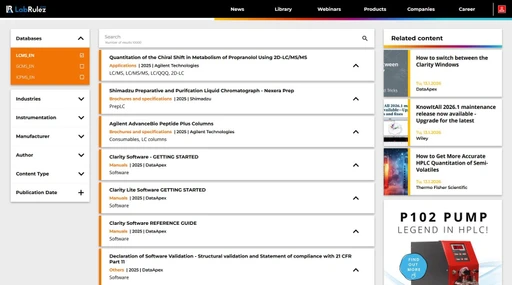
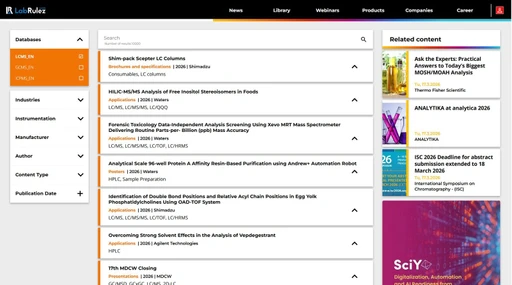
Our Library never stops expanding. What are the most recent contributions to LabRulezLCMS Library in the week of 3rd November 2025? Check out new documents from the field of liquid phase, especially HPLC and LC/MS techniques!
👉 SEARCH THE LARGEST REPOSITORY OF DOCUMENTS ABOUT LCMS AND RELATED TECHNIQUES
👉 Need info about different analytical techniques? Peek into LabRulezGCMS or LabRulezICPMS libraries.
This week we bring you application notes by Agilent Technologies, Shimadzu, Thermo Fisher Scientific and Waters Corporation!
1. Agilent Technologies: Simple and Efficient Purification of Semaglutide Using the Agilent 1290 Infinity II Preparative LC System
- Application note
- Full PDF for download
The recent surge of interest in GLP-1 receptor agonists has spurred the active development of various GLP-1 agonists for the treatment of type 2 diabetes and obesity. Among these, Semaglutide has attracted significant attention as a long‑acting peptide that requires only once-weekly administration and has demonstrated not only weight loss benefits but also cardiovascular protection.1 Currently marketed under brand names such as Ozempic and Wegovy, Semaglutide has established itself as a groundbreaking therapy for type 2 diabetes.
As the GLP-1 therapeutics market grows rapidly, pharmaceutical companies around the world are actively entering the field of generic drug development. Notably, the U.S. Food and Drug Administration recently approved a generic version of liraglutide2 , and development of Semaglutide generics is also progressing swiftly. In response, regulatory authorities are requiring robust evidence of structural and functional equivalence to reference products to ensure quality, safety, and efficacy throughout the generic development process.
This is particularly crucial for peptide-based drugs, where evaluation must go beyond primary sequence analysis to include secondary and higher-order structural assessments. The tertiary structure of peptides is directly related to their biological function and activity, making such analyses essential. Commonly employed techniques for higher-order structure analysis include circular dichroism spectroscopy, nuclear magnetic resonance, and x-ray crystallography, which require samples of high purity and concentration.3,4
Considering these challenges, this study introduces a method using an Agilent 1290 Infinity II Preparative HPLC System to efficiently isolate and fractionate Semaglutide from drug products by separating it from excipients such as sodium phosphate dibasic dihydrate, propylene glycol, and phenol. While trifluoroacetic acid (TFA) is commonly used as an acidic modifier for peptide analysis, it can lead to peptide-TFA salt formation during solvent removal in preparative workflows. To minimize this risk, a lower concentration of formic acid was used instead.5 The system's peak-based automated fractionation capability allowed straightforward collection of the main compound. Semaglutide content in the purified fractions was evaluated under dedicated analytical HPLC conditions, confirming both a high recovery rate and effective removal of excipient.6 As a result, high-purity Semaglutide suitable for structural and physicochemical characterization was obtained, offering valuable support for future generic drug development and quality control efforts.
Experimental
Instruments
The Agilent 1290 Infinity II Preparative LC System consisted of the following modules:
- Agilent 1290 Infinity II Preparative Binary Pump (G7161B) with Pump Head Kit 50 mL (G7161-60023)
- Agilent 1290 Infinity II Preparative Open-Bed Sampler/Collector (G7158B) with 5 mL Sample Loop, SST, 1/8 in (5068-0334)
- Agilent 1260 Infinity III Diode Array Detector WR (G7115A) with Preparative Flow Cell, 3 mm path length (G7115‑60001)
The Agilent 1260 Infinity III Prime Bio LC System consisted of the following modules:
- Agilent 1260 Infinity III Bio Flexible Pump (G7131C)
- Agilent 1290 Infinity III Bio Multisampler (G7137A) with Agilent InfinityLab Sample Thermostat
- Agilent 1290 Infinity III Multicolumn Thermostat (G7116B) with InfinityLab Quick Connect Heat Exchanger 1290 Bio Standard Flow and 6-Column Selector Valve (5320-0025)
- Agilent 1290 Infinity III Diode Array Detector (G7117B) with Agilent InfinityLab Bio-Inert Max-Light Cartridge Cell 60 mm (G5615-60017)
Software
- Agilent OpenLab CDS, version 2.8
Conclusion
In this study, an optimized preparative HPLC method employing a suitable acidic modifier and gradient conditions was developed to efficiently isolate semaglutide from drug products. Using formic acid as an acidic modifier minimized the risk of salt formation often associated with TFA, thus enhancing compatibility with structural analyses. Fraction collection was triggered by UV signal thresholds and slope criteria during the 2 to 4.5-minute elution window. For six replicate injections of Ozempic, the retention time and peak area of the Semaglutide peak showed excellent reproducibility, with %RSD values of 0.12 and 1.08%, respectively. Fractions were re-analyzed by analytical HPLC after adjusting injection volumes to match the original Semaglutide content. Clear separation of excipients and Semaglutide was confirmed in both fractions 1 and 2. These results demonstrate that the preparative method is effective for the simple and fast separation of Semaglutide from excipients, and suggests that isolated fractions are suitable for further structural and analytical studies.
2. Shimadzu: Automatic Optimization of Gradient Conditions by AI Algorithmand Seamless Method Transfer
- Application note
- Full PDF for download
User Benefits
- The AI algorithm of LabSolutionsTM MD can automatically optimize gradient conditions to greatly reduce labor of LC method development.
- Gradient conditions are automatically optimized at different column oven temperatures consecutively.
- UHPLC methods efficiently developed in a short time can be automatically transferred to conventional HPLC methods while maintaining the separation pattern.
In the typical LC method development, the process begins with “preparation” which includes mobile phase preparation, column installation, and creation of analysis schedules, then the analysisis started. After that, the acquired data is analyzed and “preparation” for the subsequent analysis is carried out, followed by starting the next analysis again. The method development progresses by repeating these processes, but in addition to the significant time required to repeatedly create analysis schedules, expertise in chromatography is necessary to explore optimal conditions based on data analysis. In other words, typical method development requires “human intervention”. Therefore, eliminating human involvement and automating such method development processes would be desirable to improve labor efficiency. This article introduces an approach for automatically optimizing gradient conditions at different column oven temperatures consecutively, identifying the combination of temperature and gradient conditions that meet the resolution criteria. Subsequently, a case study on the automatic adjustment of parameters for transferring an optimized UHPLC method to conventional HPLC is described.
Seamless Method Transfer Support
Transferring analytical methods between systems with differing system volumes or column dimensions while maintaining consistent separation patterns necessitates appropriate adjustment of several LC parameters. Manual adjustment can be labor-intensive and prone to input errors during parameter calculation and system entry. LabSolutions MD addresses these challenges by automatically calculating the necessary LC parameters for method transfer and generating the corresponding method files, as illustrated in steps (1) to (4) of Fig. 6. For instance, a method optimized through automatic gradient optimization using Nexera X3 system with a 100 mm × 3.0 mm I.D., 1.9 µm column was successfully transferred to conventional HPLC conditions on Nexera lite system equipped with a 150 mm × 4.6 mm I.D., 5 µm column, as depicted in Fig. 6 (analytical conditions detailed in Table 2). By selecting the target system for method transfer (Fig. 6(1)), entering the column dimensions (Fig. 6(2)), and specifying the flow rate (Fig. 6(3)), LabSolutions MD automatically adjusts the parameters required for method transfer.
Conclusion
Automatic optimization of gradient conditions using AI algorithm of LabSolutions MD was applied to a model sample (mixture of seven compounds of small molecule) at different column oven temperatures. As a result, the temperature and gradient conditions that met the resolution criteria were successfully explored. Furthermore, a case study in which an optimized method was transferred to conventional HPLC conditions while maintaining the separation pattern was also introduced, demonstrating how LabSolutions MD supports seamless method transfer by automatically adjusting the parameters across different systems and columns. In method development, human intervention, such as analysis batch creation and data analysis, is required to optimize gradient conditions. LabSolutions MD can provide significant labor savings in this area. For more information on LabSolutions MD, please refer to the Technical Report “Efficient Method Development Based on Analytical Quality by Design with LabSolutions MD Software (C190-E284)”
3. Thermo Fisher Scientific: Enhancing the efficiency and effectiveness of halogen and sulfur monitoring in challenging environmental and industrial samples
- Application note
- Full PDF for download
In industrial processes, the accurate determination of halogens and sulfur is of paramount importance due to their significant impact on product quality, equipment integrity, and environmental compliance. Halogens, such as fluorine, chlorine, bromine, iodine, and sulfur compounds are prevalent in various industries, including consumer product manufacturing, petroleum refining, and chemical manufacturing. These elements and compounds can influence corrosion rates, catalytic efficiency, and the safety of operations, making their monitoring essential for optimal process control.
Additionally, the emerging need to screen for per- and polyfluoroalkyl substances (PFAS) in various environmental and consumer product sources has heightened the importance of halogen determinations. PFAS, a group of fluorinated compounds, is increasingly recognized for their persistence in the environment and potential health risks. Accurate detection and quantification of PFAS in water, soil, and consumer products are critical for assessing the potential exposure to PFAS contaminants.
The objective of this white paper is to provide a comprehensive overview of the methodologies and best approaches for the determination of halogens and sulfur in challenging industrial and environmental samples. It aims to equip analytical lab technicians, lab managers, researchers, and other stakeholders with knowledge to assist them in implementing accurate and reliable analytical techniques. By understanding the principles, applications, and challenges associated with halogen and sulfur determinations, industry professionals can ensure compliance with regulatory standards, improve product quality, and minimize environmental impact.
Combustion-ion chromatography (C-IC)
As noted above, there are multiple methods for sample preparation and subsequent analysis, each with its advantages and drawbacks. C-IC is a hyphenated technique that uniquely integrates and automates both processes. This integration ensures consistent, accurate, and sensitive determinations while saving valuable hands-on time and minimizing exposure to hazardous chemicals and pressurized vessels. First utilized in 1980 by two groups using the Dionex Model 10, the first commercially available IC system which had been introduced just five years prior, C-IC was initially applied to analyze sulfur in fuels and halogens in ore samples24,25 —applications that remain critical in their respective industries today. Since these initial uses, C-IC has been applied to samples ranging from polyethylene,26 carbonated beverages,27 and clean room gloves.28
C-IC incorporates several key steps
- Sample introduction: Samples can be introduced manually, but automation is achieved using a liquid or solid handling autosampler. The rate of sample entry into the oven can be adjusted to ensure controlled combustion, minimizing soot production, an indicator of incomplete combustion that can lead to inaccurate results. Proper rate control also prevents liquid samples from volatilizing too quickly, another source of error.
- Pyrohydrolytic combustion: Pyrohydrolysis involves heating the sample in the presence of water vapor and oxygen to decompose nonvolatile halogens into volatile halide acids.20 Combustion occurs at temperatures up to approximately 1100 °C, with the specific temperature used varying based on the sample type. Controlling combustion can also be achieved by creating temperature gradients within the oven, progressing from cooler to warmer regions.
- Absorption: The gases produced during combustion are sparged into either water or a hydrogen peroxide solution. The hydrogen peroxide oxidizes sulfur anions to sulfate, facilitating their subsequent analysis.
- Ion chromatography: The absorption solution is injected into an IC system to determine the concentrations of halogens and/or sulfate. This is done by comparing the conductivity intensity of the sample to standard curve measurements.
In comparison to the separate sample preparation and analysis methods noted earlier, C-IC delivers time and labor savings by automating the entire process. Removing manual steps greatly enhances reproducibility, while this method provides sensitivity down to parts per billion, depending on the sample type and specific preparation method used.
Conclusion
C-IC is an innovative analytical technique that combines the processes of sample preparation and analyte determination into a single, automated system. The Cindion C-IC system exemplifies this integration, offering a comprehensive solution for the precise measurement of halogens and sulfur in various matrices. By addressing the challenges of matrix elimination and minimizing contamination risks, particularly from PFAS, the Cindion C-IC system ensures low background levels and, subsequently, high sensitivity.
This system’s compact design, industry-leading features, and single-source convenience streamline workflows, reduce hands-on time, and enhance analytical consistency. With robust support, the Cindion C-IC system leverages over 50 years of expertise in ion chromatography to meet the evolving needs of industries that include oil and gas, chemical manufacturing, mining, materials analysis, waste management, and environmental reclamation.
In summary, the Cindion C-IC system not only elevates analytical performance but also provides a seamless and efficient solution for the accurate determination of halogens and sulfur, driving advancements in analytical chemistry and supporting critical environmental and industrial applications.
4. Waters Corporation: Advancing Charge Variant Analysis with pHGradient Ion-Exchange Chromatography: Optimizing Monoclonal Antibody Characterization Using the High-pH Kit for the Alliance™ iS Bio HPLC System
- Application note
- Full PDF for download
Benefits
- The Alliance iS Bio HPLC System with a high-pH kit provides a system compatible with a pH gradient ionexchange separation for lysine variants of mAb
- The high-pH kit enabled stable performance of the Alliance iS Bio HPLC System under extreme pH conditions to ensure long-term reliability
Lysine charge variant analysis is a critical quality attribute in the characterization of mAb therapeutics, playing a pivotal role in ensuring the safety, efficacy, and consistency of drug products. Charge heterogeneity, particularly at the C-terminal lysine, can arise due to manufacturing conditions, post-translational modifications, or protein degradation, potentially impacting the drug’s biological activity and immunogenicity.1 Understanding and accurately quantifying these charge variants is essential for regulatory compliance, batch comparability, and maintaining therapeutic integrity.
Charge variant analysis serves multiple functions beyond routine quality control. It enables comparability assessments between drug product batches, helping to detect subtle manufacturing changes, and facilitates biosimilar development by evaluating structural and functional similarity to the originator biologic. Since Cterminal lysine modifications induce a slight shift in the molecule’s isoelectric point (pI), this variation can be leveraged through pH-gradient ion-exchange chromatography (IEX) to achieve separation of charge variants. As analytes traverse the chromatographic column, they elute according to the order of their pI values as determined by the overall charge state at the surface of the molecule, providing a detailed resolution of molecular heterogeneity. While pH-gradient IEX is a powerful technique for charge variant analysis, instrument compatibility remains a critical factor in ensuring reliable and reproducible results. Traditional high-performance liquid chromatography (HPLC) systems can be vulnerable to corrosion at extreme pH levels, potentially affecting performance and longevity. To mitigate these concerns, Waters has developed a high-pH kit tailored for use with the Alliance iS Bio HPLC System providing enhanced durability and analytical precision.
The high-pH kit includes a specialized sample needle cartridge assembly, extension loop, needle seal, seal port tubing, preheater, and TUV flow cell, all constructed from corrosion-resistant MP35N alloy to withstand prolonged exposure to elevated pH conditions. The Alliance iS Bio HPLC System quaternary pump also utilizes corrosion resistant materials such as PEEK, titanium, and MP35N throughout. This robust design ensures system stability while maintaining method accuracy and reproducibility. Specifically engineered for analytical workflows operating above pH 10.0 and below pH 13.0, the kit enables the reliable execution of high-pH chromatographic methods, ensuring consistent charge variant characterization without compromising instrument integrity.
In this study, a pH-gradient IEX method is employed on an Alliance iS Bio HPLC System equipped with 2 highpH kits, to assess system suitability and ensure consistency in charge variant characterization. Infliximab, a therapeutic mAb, is analyzed to quantify its lysine charge variants, demonstrating the effectiveness of this approach in monitoring biopharmaceutical quality.
Experimental
- LC system: Alliance iS Bio HPLC System with High-pH kit (p/n: 205002588)
- Detection: TUV, 280 nm @ 10 Hz
- Column(s): BioResolve SCX mAb Column, 3 µm, 4.6 x 50 mm (p/n: 186009058)
Conclusion
The Alliance iS Bio HPLC System equipped with a high-pH kit and combined with the BioResolve SCX mAb Column and BioResolve CX Concentrates demonstrated exceptional performance for a pH-gradient IEX method of mAb charge variants. To assess system suitability, two independent high-pH kits were evaluated using a Waters mAb Charge Variant Standard, ensuring consistency and reliability of the methodology. With six replicate injections, the system achieved peak area %RSDs of ≤ 0.7% for the monomer and major basic peak of the NIST mAb component, with retention times %RSDs of 0.0%, far exceeding the acceptance criteria of ≤ 5.0% for both parameters. Additionally, resolution between the monomer and major basic peak met the criteria of ≥ 2.0, with both high-pH kits averaging 3.1 across the 6 replicates, demonstrating robust separation capabilities.
Further validation of system suitability and analytical precision was confirmed in the charge variant analysis of infliximab, a widely used therapeutic mAb. Triplicate injections performed on each system showed strong agreement in average relative peak areas, with average major lysine charge variants differing by no more than 0.4% between kits, while acidic and basic isoforms exhibited variability within 0.8% relative area. These findings underscore the excellent reproducibility and repeatability of the method, reinforcing its capability for reliable determination of charge variants. Additionally, minor charge variants of both NIST mAb and infliximab were consistently detected, confirming the method’s sensitivity in resolving subtle molecular heterogeneity.
Importantly, system performance remained stable over time, despite the extreme pH fluctuations inherent to pHgradient IEX chromatography, mitigating concerns about instrument degradation and ensuring long-term reliability. These results confirm that the Alliance iS Bio HPLC System, integrated with the MP35N high-pH kit, provides excellent assay sensitivity, precision, and robustness, making it an ideal platform for charge variant analysis in biopharmaceutical development and characterization.