Automated halogen, sulfur, and PFAS screening in solid, liquid, and gas samples.
The Thermo Scientific™ Cindion™ Combustion Ion Chromatography (C-IC) System is a fully integrated platform designed for screening corrosive and toxic halogens, sulfur compounds, and PFAS in a wide range of sample matrices. Whether analyzing solids, liquids, or gases, the system delivers low background levels, high sensitivity, and robust automated workflows—all in a compact footprint.
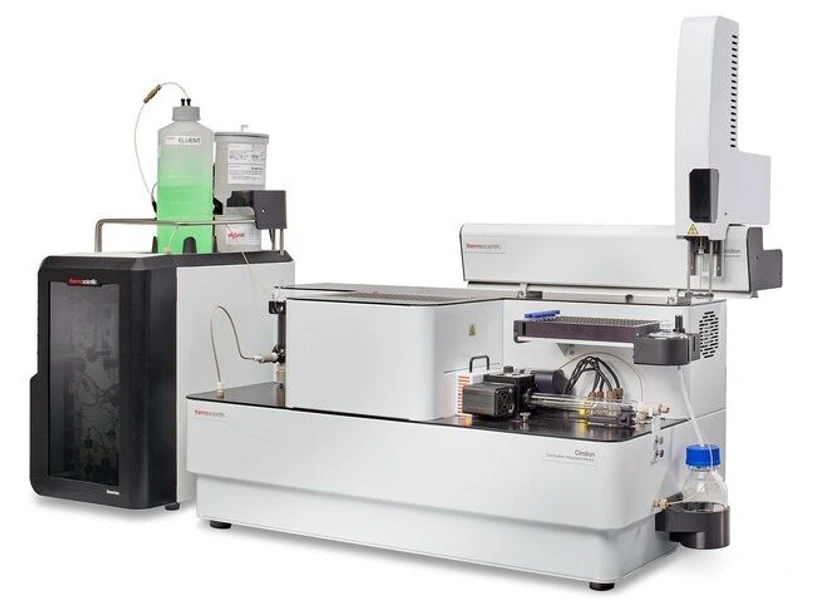 Thermo Scientific™ Cindion™ Combustion Ion Chromatography System
Key Features
- Compact system footprint: A novel combustion tube design ensures complete combustion over a shorter path, saving bench space and enhancing efficiency.
- Fully automated workflow: From sample introduction to combustion, absorption, ion chromatographic separation, and data reporting—automation minimizes user intervention.
- PFAS-free sample path: Components in the sample flow path are PFAS-free to eliminate contamination and enable ultra-sensitive PFAS detection (EPA Method 1621).
- Reagent-Free Ion Chromatography (RFIC™): Automated eluent generation—just add water. Electrolytic suppression ensures consistent results with no external pump.
- Versatile sample compatibility: Supports AOX and AOF determinations, as well as total and inorganic fluorine (TF/TIF) analysis in environmental, food, industrial, and petrochemical applications.
- Chromeleon CDS integration: A single software platform for full control of C-IC operations including sequence setup, system control, and reporting.
- High throughput: Accommodates up to 45 solid or 120 liquid samples; includes smart hydration and reduced carryover for faster cycle times.
- Application-ready: Backed by extensive application notes and 50+ years of Thermo Scientific expertise in ion chromatography.
Typical Applications
- Environmental testing: AOX/AOF screening in water and wastewater; PFAS monitoring.
- Food and packaging: Determination of organic fluorine content in food contact materials.
- Petrochemicals: Halogen and sulfur analysis in fuels and oils to prevent equipment corrosion and meet emission standards.
- Electronics and polymers: Detection of restricted brominated and fluorinated substances in plastics and E&E components.
- Mining and metallurgy: Screening for corrosive species in ores and geological samples.
System Components
- Sample delivery module: Liquid/solid autosampler or gas injector.
- Combustion/absorption unit: Integrated with autosampler and absorption tube.
- Ion chromatography system: Thermo Scientific™ Dionex™ IC with RFIC™ technology.
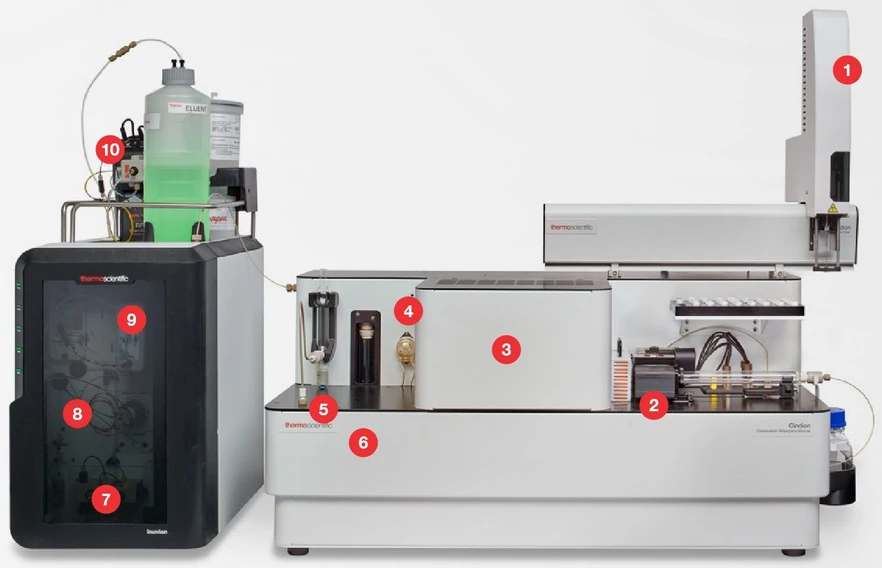 Thermo Scientific™ Cindion™ Combustion Ion Chromatography System
- Versatile autosampler. Load up to 45 (solid) or 120 (liquid) samples and easily switch between sample types without the need for tools.
- Peltier cooled sample introduction. Reduce cycle time by accelerating the cooling of the boat between samples.
- Compact combustion tube. Enhanced oxygen flow reduces time needed for complete combustion by increasing efficiency.
- Smart hydration. Peristaltic pump delivers water only during sample combustion to minimize usage and preserve tube integrity.
- Variable absorption volume. Optimize the absorption volume based on analytical need.
- Reduced sample pathway. Lower baseline contamination and low sample carryover to decrease wash time between samples.
- Advanced high-performance pump technology and electronics. Take advantage of a wider range of columns and chemistries improving speed and quality of results.
- Function driven design. Quickly and safely access everything on the instrument.
- Fast, flexible, convenient electrolytic suppression. Just connect the suppressor; no external pump or offline conditioning needed for regeneration.
- Thermo Scientific™ Dionex™ Reagent-Free™ Ion Chromatography (RFIC™). Makes eluent preparation as simple as “just add water,” while ensuring more consistent results and enabling optimized gradient separations.
Results you can count on
Getting analytes into solution is only part of the process. Being able to resolve them so that each peak can be accurately quantified is equally integral to reliable, accurate results.
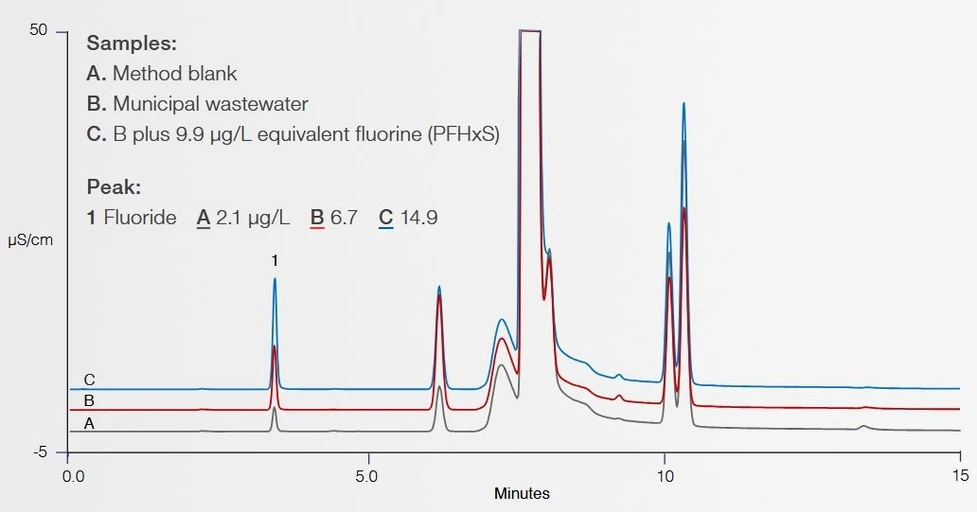 Thermo Scientific™ Cindion™ Combustion Ion Chromatography System: Figure 1. PFAS as adsorbable organic fluorine (AOF) in municipal wastewater. C-IC can be used as a screening tool for presence of PFAS compounds by adsorption onto granular activated carbon, subsequent combustion and IC analysis.
Our IC systems are paired with an unmatched portfolio of columns that are optimized to deliver the capacity, selectivity and resolution you need to get the answers you seek.
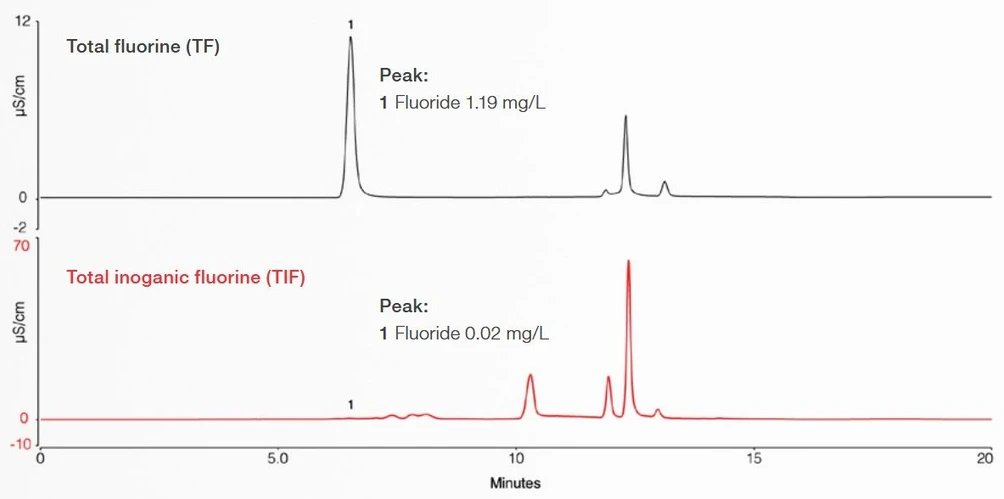 Thermo Scientific™ Cindion™ Combustion Ion Chromatography System: Figure 2. PFAS in food contact material. PFAS, as organic fluorine, can be determined by subtracting values for total inorganic fluorine (TIF) from total fluorine (TF) by IC and C-IC, respectively.