Basic analytes and the benefits of modified silica supports in reversed-phase liquid chromatography
- Photo: Phenomenex: Basic analytes and the benefits of modified silica supports in reversed-phase liquid chromatography
- Video: Phenomenex: Behind the Scenes: Kinetex Core-Shell HPLC Columns for Reversed Phase Chromatography
Silica-based stationary phases are currently the most frequently used phases in liquid chromatography. Traditional C18 columns often suffered from poor peak shape and tailing of basic analytes at low pH and limited stability due to gradual silane hydrolysis at high pH. Through cross-linking and end-capping technologies, silica‘s undesired secondary interactions and limited stability have been significantly improved.
The most recent development introduced for analysis of basic analytes at low pH levels is the production of C18 columns with a residual positive charge on the silica support. This combination allows for 100% aqueous conditions to be used, enhancing retention of basic compounds. It also minimizes (ionic) secondary interactions between positively charged bases and silanol groups due to charge repulsion at the silica surface. The result is that basic compounds can be retained and eluted with good peak shape under acidic conditions, which are generally favored. Figure 1 shows an example of enhanced peak shape of chlorpheniramine, a basic antihistamine, using a Kinetex™ PS C18 column with this technology.
 Phenomenex: Basic analytes and the benefits of modified silica supports in reversed-phase liquid chromatography: Figure 1. Improved reversed-phase retention and peak shape of chlorpheniramine with the Kinetex PS C18.
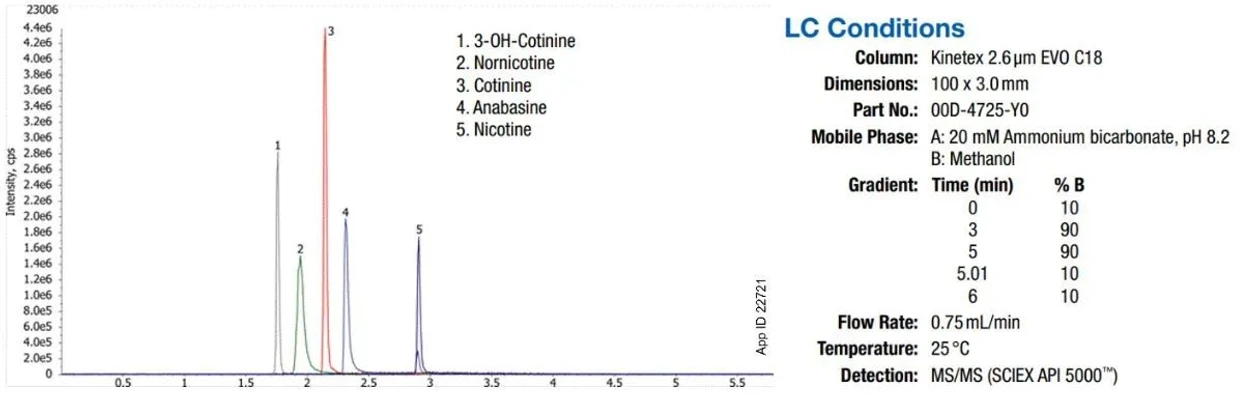 Phenomenex: Basic analytes and the benefits of modified silica supports in reversed-phase liquid chromatography: Figure 2. Analysis of nicotine and other metabolites with the Kinetex EVO C18 column.