Author
Phenomenex
Phenomenex
Phenomenex is a global technology leader committed to developing novel analytical chemistry solutions that solve the separation and purification challenges of researchers in industrial, government and academic laboratories.
Tags
Article
Academy
Product
LinkedIn Logo

The Role of End-Capping in Reversed-Phase

We, 29.10.2025
| Original article from: Phenomenex
Learn how silica end-capping improves HPLC column performance. Discover how C18, PS-C18, Polar C18, and XB-C18 chemistries enhance retention, peak shape, and selectivity for various analytes.
<p>LabRulez / AI: The Role of End-Capping in Reversed-Phase</p>

LabRulez / AI: The Role of End-Capping in Reversed-Phase

Silica used to pack HPLC columns is a polymer of silicon and oxygen with Si-OH groups (silanols) at the surface. To these silanols, functional groups are bonded using a silane reagent to functionalize the base media.

When HPLC columns are functionalized, it is impossible to ensure 100% phase coverage and react all available silanol groups (free hydroxyls on the surface of the silica) with the bonded phase. Sterically, as you begin to bond a phase you increase the hindrance to bonding making subsequent bonding stages more difficult than the previous ones.

Without end-capping, a column would be left with significant numbers of accessible, highly active residual silanols which have the potential to alter the selectivity of the stationary phase. These residual groups have the potential to form strong ionic and polar interactions (often called “secondary interactions”) with polar and basic groups on the compounds introduced to them. So, reducing the number of free silanols after bonding the stationary phase through end-capping is imperative.

Historically, end-capping was done with a small hydrophobic group, similar in nature to a trimethyl silane. In recent years several manufacturers have also introduced other groups to add a different selectivity element to the column.
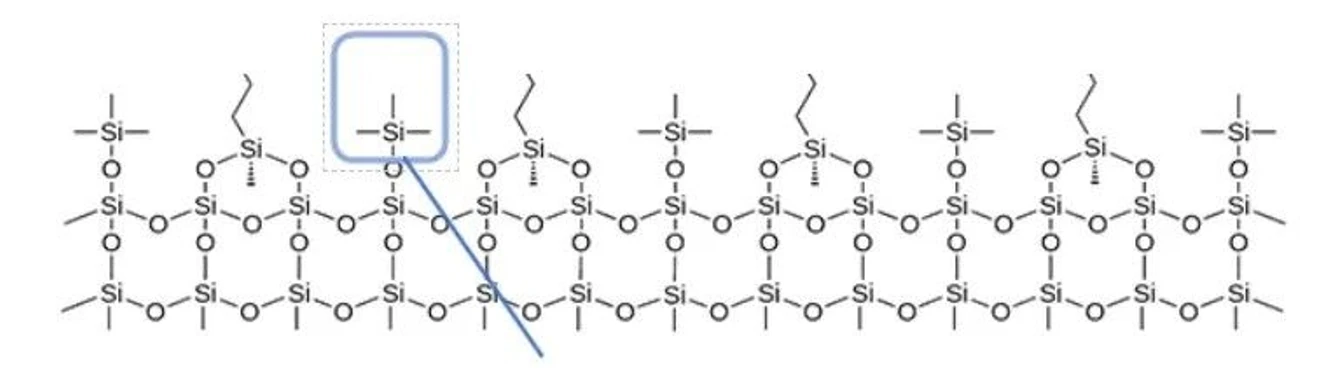
Phenomenex: TMS endcappingPhenomenex: TMS endcapping

If the reagent used for end-capping contains charged functionality, for example, this will impart ion exchange functionality to the surface and give the column ion exchange properties together with the reversed phase interactions from the C18 ligands. Likewise, a polar moiety will give polar characteristics to the surface.
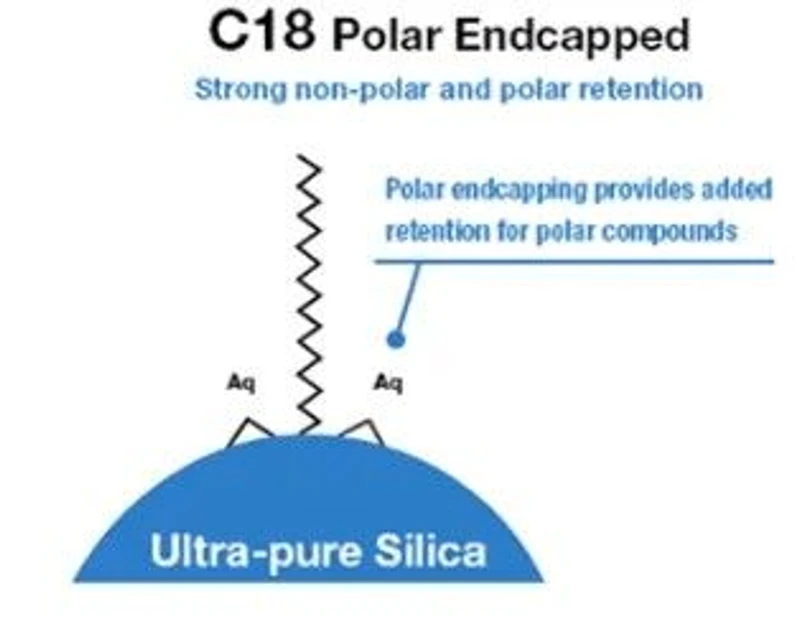
Phenomenex: C18 polar endcappingPhenomenex: C18 polar endcapping

Now that we have understood the role of end-capping, let’s review the main benefits of silica end-capping depending on the chemical groups used.

C18 – Standard Trimethylsilyl End-Capping
  • End-capping type: Trimethylsilyl group
  • Key benefits:
    • Minimizes the presence of active silanol groups.
    • Provides stable, reproducible retention for a wide range of neutral and nonpolar compounds.
PS-C18 – Positively Charged and Trimethylsilyl Groups
  • End-capping type: Positively charged group with trimethylsilyl group
  • Key benefits:
    • Combines ion-exchange secondary interactions with hydrophobic interactions.
    • Delivers excellent peak shapes for basic analytes.
    • Reduces the need for complex mobile phases or ion-pairing agents.
    • Stable under 100% aqueous conditions.
Polar C18 – Polar Group and Trimethylsilyl Group
  • End-capping type: Polar group with trimethylsilyl group
  • Key benefits:
    • Provides both polar and hydrophobic selectivity.
    • Enhances retention and resolution of polar analytes.
    • Reduces reliance on complex mobile phase compositions.
    • 100% aqueous phase stability for extended method flexibility.
XB-C18 – Sterically Protected Phase
  • End-capping type: Di-isobutyl side chains with trimethylsilyl group
  • Key benefits:
    • Bulky side chains sterically shield residual silanols, minimizing secondary interactions.
    • Produces improved peak shapes for basic compounds.
    • Offers increased retention for acidic analytes.

In summary, new end-capping technologies can significantly improve the analysis of compounds that were once considered challenging. For example, nowadays, great peak shape and shorter run times can be achieved for the analysis of basic drugs using PS-C18 columns. The Polar C18 chemistry has been proven to best retain compounds such as metabolites, and XB-C18 chemistry has shown excellent chromatography for peptide analysis, with enhanced retention of small polar peptides.

Troubleshooting LC

  • Problems with your chromatogram and Injector
  • Key problem areas and preventative maintenance
  • Leaks and Abnormal Pressure

Download HPLC Troubleshooting Guide

Phenomenex
LinkedIn Logo
 

Related content

UPLC™ Separation of Fifteen Bisphenols Using a Waters Acquity™ Biphenyl RP Column with MaxPeak™ Premier Technology and UV Detection

Applications
| 2026 | Waters
Instrumentation
Consumables, LC columns, HPLC
Manufacturer
Waters
Industries
Pharma & Biopharma

Achieving Low‑ppb Bisphenol Quantitation with the Agilent InfinityLab Pro iQ Mass Detector

Applications
| 2026 | Agilent Technologies
Instrumentation
LC/MS, LC/SQ
Manufacturer
Agilent Technologies
Industries
Materials Testing

ECL detection of fentanyl

Applications
| 2026 | Metrohm
Instrumentation
Electrochemistry
Manufacturer
Metrohm
Industries
Forensics

Early-stage drug metabolite quantitation without radiolabels

Applications
| 2026 | Thermo Fisher Scientific
Instrumentation
HPLC, LC/MS, LC/SQ
Manufacturer
Thermo Fisher Scientific
Industries
Pharma & Biopharma, Metabolomics

Oligonucleotide Analysis Using the Agilent InfinityLab Pro iQ and Altura Oligo HPH-C18 Column

Applications
| 2026 | Agilent Technologies
Instrumentation
LC/MS, LC/SQ, Consumables, LC columns
Manufacturer
Agilent Technologies
Industries
Pharma & Biopharma
 

Related articles

Advancing Fundamental Understanding of Retention Interactions in Supercritical Fluid Chromatography Using Artificial Neural Networks: Polar Stationary Phases with –OH Moieties
Article | Scientific article

Advancing Fundamental Understanding of Retention Interactions in Supercritical Fluid Chromatography Using Artificial Neural Networks: Polar Stationary Phases with –OH Moieties

The researchers used artificial neural networks to advance a fundamental understanding of retention interactions in supercritical fluid chromatography.
LabRulez
tag
share
more
News from LabRulezLCMS Library - Week 17, 2025
Article | Application

News from LabRulezLCMS Library - Week 17, 2025

This week we bring you application notes by Shimadzu and Waters Corporation, presentation by Agilent Technologies and technical notes by Knauer and Thermo Fisher Scientific!
LabRulez
tag
share
more
The Role of End-Capping in RP
Article | Academy

The Role of End-Capping in RP

New end-capping technologies can significantly improve the analysis of compounds that were once considered challenging.
Phenomenex
tag
share
more
Basic analytes and the benefits of modified silica supports in reversed-phase liquid chromatography
Article | Academy

Basic analytes and the benefits of modified silica supports in reversed-phase liquid chromatography

C18 columns with residual positive charge improve peak shape of basic analytes at low pH by reducing silanol interactions and enabling 100% aqueous mobile phases.
Phenomenex
tag
share
more
 

Related content

UPLC™ Separation of Fifteen Bisphenols Using a Waters Acquity™ Biphenyl RP Column with MaxPeak™ Premier Technology and UV Detection

Applications
| 2026 | Waters
Instrumentation
Consumables, LC columns, HPLC
Manufacturer
Waters
Industries
Pharma & Biopharma

Achieving Low‑ppb Bisphenol Quantitation with the Agilent InfinityLab Pro iQ Mass Detector

Applications
| 2026 | Agilent Technologies
Instrumentation
LC/MS, LC/SQ
Manufacturer
Agilent Technologies
Industries
Materials Testing

ECL detection of fentanyl

Applications
| 2026 | Metrohm
Instrumentation
Electrochemistry
Manufacturer
Metrohm
Industries
Forensics

Early-stage drug metabolite quantitation without radiolabels

Applications
| 2026 | Thermo Fisher Scientific
Instrumentation
HPLC, LC/MS, LC/SQ
Manufacturer
Thermo Fisher Scientific
Industries
Pharma & Biopharma, Metabolomics

Oligonucleotide Analysis Using the Agilent InfinityLab Pro iQ and Altura Oligo HPH-C18 Column

Applications
| 2026 | Agilent Technologies
Instrumentation
LC/MS, LC/SQ, Consumables, LC columns
Manufacturer
Agilent Technologies
Industries
Pharma & Biopharma
 

Related articles

Advancing Fundamental Understanding of Retention Interactions in Supercritical Fluid Chromatography Using Artificial Neural Networks: Polar Stationary Phases with –OH Moieties
Article | Scientific article

Advancing Fundamental Understanding of Retention Interactions in Supercritical Fluid Chromatography Using Artificial Neural Networks: Polar Stationary Phases with –OH Moieties

The researchers used artificial neural networks to advance a fundamental understanding of retention interactions in supercritical fluid chromatography.
LabRulez
tag
share
more
News from LabRulezLCMS Library - Week 17, 2025
Article | Application

News from LabRulezLCMS Library - Week 17, 2025

This week we bring you application notes by Shimadzu and Waters Corporation, presentation by Agilent Technologies and technical notes by Knauer and Thermo Fisher Scientific!
LabRulez
tag
share
more
The Role of End-Capping in RP
Article | Academy

The Role of End-Capping in RP

New end-capping technologies can significantly improve the analysis of compounds that were once considered challenging.
Phenomenex
tag
share
more
Basic analytes and the benefits of modified silica supports in reversed-phase liquid chromatography
Article | Academy

Basic analytes and the benefits of modified silica supports in reversed-phase liquid chromatography

C18 columns with residual positive charge improve peak shape of basic analytes at low pH by reducing silanol interactions and enabling 100% aqueous mobile phases.
Phenomenex
tag
share
more
 

Related content

UPLC™ Separation of Fifteen Bisphenols Using a Waters Acquity™ Biphenyl RP Column with MaxPeak™ Premier Technology and UV Detection

Applications
| 2026 | Waters
Instrumentation
Consumables, LC columns, HPLC
Manufacturer
Waters
Industries
Pharma & Biopharma

Achieving Low‑ppb Bisphenol Quantitation with the Agilent InfinityLab Pro iQ Mass Detector

Applications
| 2026 | Agilent Technologies
Instrumentation
LC/MS, LC/SQ
Manufacturer
Agilent Technologies
Industries
Materials Testing

ECL detection of fentanyl

Applications
| 2026 | Metrohm
Instrumentation
Electrochemistry
Manufacturer
Metrohm
Industries
Forensics

Early-stage drug metabolite quantitation without radiolabels

Applications
| 2026 | Thermo Fisher Scientific
Instrumentation
HPLC, LC/MS, LC/SQ
Manufacturer
Thermo Fisher Scientific
Industries
Pharma & Biopharma, Metabolomics

Oligonucleotide Analysis Using the Agilent InfinityLab Pro iQ and Altura Oligo HPH-C18 Column

Applications
| 2026 | Agilent Technologies
Instrumentation
LC/MS, LC/SQ, Consumables, LC columns
Manufacturer
Agilent Technologies
Industries
Pharma & Biopharma
 

Related articles

Advancing Fundamental Understanding of Retention Interactions in Supercritical Fluid Chromatography Using Artificial Neural Networks: Polar Stationary Phases with –OH Moieties
Article | Scientific article

Advancing Fundamental Understanding of Retention Interactions in Supercritical Fluid Chromatography Using Artificial Neural Networks: Polar Stationary Phases with –OH Moieties

The researchers used artificial neural networks to advance a fundamental understanding of retention interactions in supercritical fluid chromatography.
LabRulez
tag
share
more
News from LabRulezLCMS Library - Week 17, 2025
Article | Application

News from LabRulezLCMS Library - Week 17, 2025

This week we bring you application notes by Shimadzu and Waters Corporation, presentation by Agilent Technologies and technical notes by Knauer and Thermo Fisher Scientific!
LabRulez
tag
share
more
The Role of End-Capping in RP
Article | Academy

The Role of End-Capping in RP

New end-capping technologies can significantly improve the analysis of compounds that were once considered challenging.
Phenomenex
tag
share
more
Basic analytes and the benefits of modified silica supports in reversed-phase liquid chromatography
Article | Academy

Basic analytes and the benefits of modified silica supports in reversed-phase liquid chromatography

C18 columns with residual positive charge improve peak shape of basic analytes at low pH by reducing silanol interactions and enabling 100% aqueous mobile phases.
Phenomenex
tag
share
more
 

Related content

UPLC™ Separation of Fifteen Bisphenols Using a Waters Acquity™ Biphenyl RP Column with MaxPeak™ Premier Technology and UV Detection

Applications
| 2026 | Waters
Instrumentation
Consumables, LC columns, HPLC
Manufacturer
Waters
Industries
Pharma & Biopharma

Achieving Low‑ppb Bisphenol Quantitation with the Agilent InfinityLab Pro iQ Mass Detector

Applications
| 2026 | Agilent Technologies
Instrumentation
LC/MS, LC/SQ
Manufacturer
Agilent Technologies
Industries
Materials Testing

ECL detection of fentanyl

Applications
| 2026 | Metrohm
Instrumentation
Electrochemistry
Manufacturer
Metrohm
Industries
Forensics

Early-stage drug metabolite quantitation without radiolabels

Applications
| 2026 | Thermo Fisher Scientific
Instrumentation
HPLC, LC/MS, LC/SQ
Manufacturer
Thermo Fisher Scientific
Industries
Pharma & Biopharma, Metabolomics

Oligonucleotide Analysis Using the Agilent InfinityLab Pro iQ and Altura Oligo HPH-C18 Column

Applications
| 2026 | Agilent Technologies
Instrumentation
LC/MS, LC/SQ, Consumables, LC columns
Manufacturer
Agilent Technologies
Industries
Pharma & Biopharma
 

Related articles

Advancing Fundamental Understanding of Retention Interactions in Supercritical Fluid Chromatography Using Artificial Neural Networks: Polar Stationary Phases with –OH Moieties
Article | Scientific article

Advancing Fundamental Understanding of Retention Interactions in Supercritical Fluid Chromatography Using Artificial Neural Networks: Polar Stationary Phases with –OH Moieties

The researchers used artificial neural networks to advance a fundamental understanding of retention interactions in supercritical fluid chromatography.
LabRulez
tag
share
more
News from LabRulezLCMS Library - Week 17, 2025
Article | Application

News from LabRulezLCMS Library - Week 17, 2025

This week we bring you application notes by Shimadzu and Waters Corporation, presentation by Agilent Technologies and technical notes by Knauer and Thermo Fisher Scientific!
LabRulez
tag
share
more
The Role of End-Capping in RP
Article | Academy

The Role of End-Capping in RP

New end-capping technologies can significantly improve the analysis of compounds that were once considered challenging.
Phenomenex
tag
share
more
Basic analytes and the benefits of modified silica supports in reversed-phase liquid chromatography
Article | Academy

Basic analytes and the benefits of modified silica supports in reversed-phase liquid chromatography

C18 columns with residual positive charge improve peak shape of basic analytes at low pH by reducing silanol interactions and enabling 100% aqueous mobile phases.
Phenomenex
tag
share
more
Other projects
GCMS
ICPMS
Follow us
FacebookX (Twitter)LinkedInYouTube
More information
WebinarsAbout usContact usTerms of use
LabRulez s.r.o. All rights reserved. Content available under a CC BY-SA 4.0 Attribution-ShareAlike