LCMS
More information
WebinarsAbout usContact usTerms of use
LabRulez s.r.o. All rights reserved. Content available under a CC BY-SA 4.0 Attribution-ShareAlike
Author
Thermo Fisher Scientific
A unique company dedicated to serving science helping our customers drive productivity and accelerate results. Through our premier brands – Thermo Scientific, Applied Biosystems, Invitrogen, Fisher Scientific and Unity Lab Services.
Tags
Article
Academy
Product
LinkedIn Logo

Collision-Based Ion-activation and Dissociation

Tu, 23.9.2025
| Original article from: Thermo Fisher Scientific / Amanda Lee
Collision-based ion activation, developed nearly 80 years ago, remains the most widely used fragmentation method. Learn about three key techniques on Thermo Scientific MS.
<p><strong>Thermo Fisher Scientific: </strong>Collision-Based Ion-activation and Dissociation</p>

Thermo Fisher Scientific: Collision-Based Ion-activation and Dissociation

Introduced nearly 80 years ago, collision-based ion-activation and dissociation is the most commonly used type of fragmentation commercially available today. In principle, this technique is quite straightforward: apply energy to accelerate the particles of interest until they collide with an inert gas to induce fragmentation. Within these parameters, there are many different sub-categories of the technique. Here we will discuss three collision-based techniques that occur on Thermo Scientific mass spectrometers.

Thermo Fisher Scientific Freedom to Fragment IntroductionThermo Fisher Scientific Freedom to Fragment Introduction

Higher-Energy Collisional Dissociation (HCD)

  1. Process: HCD is a beam-based technique that occurs in the HCD cell or ion routing multipole, where the ion beam is directed into a potential well. Excited molecules collide with collision gas, causing fragmentation. This gas is typically nitrogen and is fast and efficient, but indiscriminate in technique. To ensure a higher energy collision, the potential energy is dropped (typically from the quadrupole into the collision cell) by many 10s of eV. This ensures the ions have high energy as they enter the cell with nitrogen and collide with enough energy for the fragmentation to occur. In peptides and proteins, HCD favors b- and y-ion formation. [Figure 1]
  2. Applications: HCD is commonly used for general proteomics and metabolomics.
  3. Considerations: When using Thermo Scientific mass spectrometers for HCD fragmentation, we generally use normalized collisional energy (NCE) instead of directly putting in the eV of potential well “drop”. The calibration routine determines the optimal voltage for a series of ions in the calibration solution.  Then the routine scales these absolute voltages to a “normalized collision energy” value of 30. As such, an NCE value of 30 should work well across a range of m/z values and charge states. To see the actual applied value, one can check the scan header of the spectrum easily in our Thermo Scientific Freestyle software.
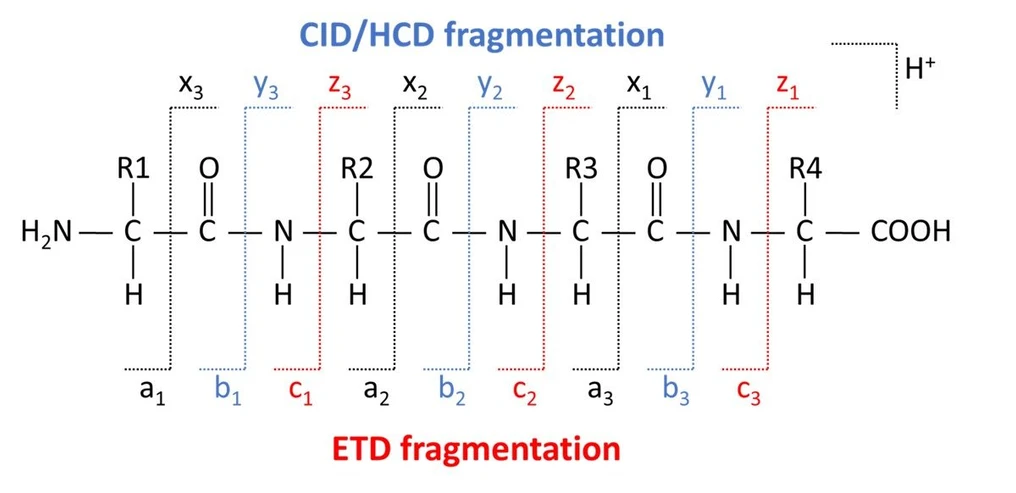
Thermo Fisher Scientific: Collision-Based Ion-activation and Dissociation: Figure 1: Location of peptide/protein backbone cleavage and its nomenclature. Representative here is a 4-amino acid peptide with side chains labeled R1-4.Thermo Fisher Scientific: Collision-Based Ion-activation and Dissociation: Figure 1: Location of peptide/protein backbone cleavage and its nomenclature. Representative here is a 4-amino acid peptide with side chains labeled R1-4.

Collision-Induced Dissociation (CID) (ion trap specific version)

  1. Process: CID, as it occurs in Thermo Fisher Scientific’s dual linear ion trap technology, is a resonance-based technique where molecules are excited by a specific frequency.  These excited molecules will start running into He molecules at a faster rate.  These collisions slowly heat the resonant molecules until they fragment. Once fragmentation occurs, the product ions at new m/z values are no longer excited by the frequency and will cool back down to the center of the trap. In peptides and proteins, CID favors b- and y-ion formation.
  2. Applications: CID is great for small molecules and peptides and helps fragment oligonucleotides, especially when the q-value is adjusted.  It also fragments with higher efficiency, which makes it well-suited for MS3 and higher workflows.
  3. Considerations: Because CID is resonance-based, there is a compromise outlined in the Matthieu equation. With certain voltages and frequencies applied, only certain m/z values can be trapped. Thus, we have something called the 1/3rd rule. This rule approximates the equation and states that any fragment created that is < 1/3 the m/z of the precursor will not be trapped. This rule makes CID less desirable as a primary fragmentation technique, thus more used as the pinch hitter when needed for alternate fragmentation after HCD is shown inefficient for a specific molecule. Furthermore, CID is a slow heating process. As such, activation/fragmentation takes a few milliseconds, whereas HCD is effectively instantaneous. 

Recent developments in oligonucleotide analysis have shown great strides in using CID for fragmentation of many types, including tRNA, snRNA and digested mRNA. To gain the most impact from these experiments, scientists can adjust the q-value applied within the CID resonance. This is usually set to 0.25; however, for oligonucleotides, lowering that value to 0.2-0.15 can help prevent unwanted fragmentation from occurring and specify backbone cleavage that can be more easily characterized.

Source Induced Dissociation (SID)

  • Process: SID is a collisional-induced activation (and if desired, dissociation) technique that is induced in the source region of mass spectrometers. By applying more voltage in the source region, ions are drawn into the mass spectrometer with more energy. Within the source region, there are still atmospheric inert gases that have been drawn in with the analytes of interest. With the additional energy, collisions with these inert gases can occur. Since SID occurs before any mass analyzer, it applies to all ions that enter the mass spectrometer.
  • Applications: SID is most commonly used as a desolvation technique for large native molecules. By applying SID energy in the source, molecules generate vibrational energy, and non-covalent, low-energy bonds will be broken only.
  • Analogy: SID could be compared to shaking off an umbrella after coming in from the rain. The jostle doesn’t cause the whole umbrella to fall apart, but it does cause the water droplets to fall off. This is a little like proteins getting desolvated from SID.
  • Considerations: SID can be a destructive, dissociative process as well, so if that is not the goal, it is important to monitor the energy applied to the analyte. For example, it has been common practice in top-down proteomics to use a small (10-15 eV) setting for SID to aid in desolvation. However, I have successfully taken pure protein (or well chromatographically separated protein) and applied much higher SID (>50 V) to induce dissociation. The resulting fragmentation pattern can yield surprisingly good results. However, this is not common practice, especially not for coeluting species, as the fragmentation would occur on all proteins eluting.

Another consideration for SID is its use in native MS. This is often vital for good detection of native proteins like antibodies. Often, we will employ a stronger SID in these cases, anywhere from 60-120 V, depending on the size and complexity of the protein/protein complex, to ensure proper desolvation and thus detection.

Learn more about collisional induced dissociation (CID) and higher energy collisional induced dissociation (HCD)

Visit us on LinkedIn: #CID #HCD #fragmentation

Amanda Lee

Amanda Lee PhD, Product Marketing Manager

Thermo Fisher Scientific
LinkedIn Logo
 

Related content

Overcoming Strong Solvent Effects in the Analysis of Vepdegestrant

Applications
| 2026 | Agilent Technologies
Instrumentation
HPLC
Manufacturer
Agilent Technologies
Industries
Pharma & Biopharma

Identification of Double Bond Positions and Relative Acyl Chain Positions in Egg Yolk Phosphatidylcholines Using OAD-TOF System

Applications
| 2026 | Shimadzu
Instrumentation
LC/MS, LC/MS/MS, LC/TOF, LC/HRMS
Manufacturer
Shimadzu
Industries
Food & Agriculture

High Molecular-Weight Polysaccharide Characterization by SEC-MALS Using GTxResolve™ 1000 and 2000 Å SEC Columns

Applications
| 2026 | Waters
Instrumentation
GPC/SEC, Consumables, LC columns
Manufacturer
Waters
Industries
Pharma & Biopharma, Food & Agriculture

Development and Optimization for a Comprehensive LC/MS/MS Method for the Detection of 74 PFAS Compounds

Applications
| 2026 | Agilent Technologies
Instrumentation
LC/MS, LC/MS/MS, LC/QQQ
Manufacturer
Agilent Technologies
Industries
Food & Agriculture

PFAS in Biota: Risk Context & Robust Analytical Solutions

Others
| 2026 | ALS Europe
Instrumentation
Laboratory analysis, LC/MS, LC/MS/MS
Manufacturer
Industries
Environmental
 

Related articles

JUNIOR STAR Grants at UCT Prague: Two talented women from abroad driving innovation in science
Article | Scientists

JUNIOR STAR Grants at UCT Prague: Two talented women from abroad driving innovation in science

Two outstanding early-career researchers at UCT Prague, Filipa Oliveira and Stella Gonsales, received prestigious GAČR JUNIOR STAR grants for innovative research in materials science and sustainable chemistry.
UCT Prague
tag
share
more
Research from IOCB Prague reveals a previously unknown mechanism of genetic transcription
Article | Science and research

Research from IOCB Prague reveals a previously unknown mechanism of genetic transcription

Scientists at IOCB Prague reveal a previously unknown mechanism that initiates gene transcription. Using cryo-EM, they uncover how alarmone molecules enable RNA synthesis under stress.
Institute of Organic Chemistry and Biochemistry of the Czech Academy of Sciences
tag
share
more
Food Adulteration and How It Is Revealed by Analytical Chemistry
Article | Food

Food Adulteration and How It Is Revealed by Analytical Chemistry

Food adulteration threatens quality and consumer trust. Discover how HPLC and modern chromatographic systems from Watrex Praha help identify oil, honey, and wine adulteration with high confidence.
Watrex Praha
tag
share
more
Affinity, Gel Filtration, Size Exclusion Chromatography: Repurposing Kinase Inhibitors for Malaria
Interview | Video

Affinity, Gel Filtration, Size Exclusion Chromatography: Repurposing Kinase Inhibitors for Malaria

This podcast explores how chromatography (FPLC/SEC) and mass spectrometry support malaria drug discovery, from protein purification and QC to interaction studies and complex sample preparation.
Organomation
tag
share
more
 

Related content

Overcoming Strong Solvent Effects in the Analysis of Vepdegestrant

Applications
| 2026 | Agilent Technologies
Instrumentation
HPLC
Manufacturer
Agilent Technologies
Industries
Pharma & Biopharma

Identification of Double Bond Positions and Relative Acyl Chain Positions in Egg Yolk Phosphatidylcholines Using OAD-TOF System

Applications
| 2026 | Shimadzu
Instrumentation
LC/MS, LC/MS/MS, LC/TOF, LC/HRMS
Manufacturer
Shimadzu
Industries
Food & Agriculture

High Molecular-Weight Polysaccharide Characterization by SEC-MALS Using GTxResolve™ 1000 and 2000 Å SEC Columns

Applications
| 2026 | Waters
Instrumentation
GPC/SEC, Consumables, LC columns
Manufacturer
Waters
Industries
Pharma & Biopharma, Food & Agriculture

Development and Optimization for a Comprehensive LC/MS/MS Method for the Detection of 74 PFAS Compounds

Applications
| 2026 | Agilent Technologies
Instrumentation
LC/MS, LC/MS/MS, LC/QQQ
Manufacturer
Agilent Technologies
Industries
Food & Agriculture

PFAS in Biota: Risk Context & Robust Analytical Solutions

Others
| 2026 | ALS Europe
Instrumentation
Laboratory analysis, LC/MS, LC/MS/MS
Manufacturer
Industries
Environmental
 

Related articles

JUNIOR STAR Grants at UCT Prague: Two talented women from abroad driving innovation in science
Article | Scientists

JUNIOR STAR Grants at UCT Prague: Two talented women from abroad driving innovation in science

Two outstanding early-career researchers at UCT Prague, Filipa Oliveira and Stella Gonsales, received prestigious GAČR JUNIOR STAR grants for innovative research in materials science and sustainable chemistry.
UCT Prague
tag
share
more
Research from IOCB Prague reveals a previously unknown mechanism of genetic transcription
Article | Science and research

Research from IOCB Prague reveals a previously unknown mechanism of genetic transcription

Scientists at IOCB Prague reveal a previously unknown mechanism that initiates gene transcription. Using cryo-EM, they uncover how alarmone molecules enable RNA synthesis under stress.
Institute of Organic Chemistry and Biochemistry of the Czech Academy of Sciences
tag
share
more
Food Adulteration and How It Is Revealed by Analytical Chemistry
Article | Food

Food Adulteration and How It Is Revealed by Analytical Chemistry

Food adulteration threatens quality and consumer trust. Discover how HPLC and modern chromatographic systems from Watrex Praha help identify oil, honey, and wine adulteration with high confidence.
Watrex Praha
tag
share
more
Affinity, Gel Filtration, Size Exclusion Chromatography: Repurposing Kinase Inhibitors for Malaria
Interview | Video

Affinity, Gel Filtration, Size Exclusion Chromatography: Repurposing Kinase Inhibitors for Malaria

This podcast explores how chromatography (FPLC/SEC) and mass spectrometry support malaria drug discovery, from protein purification and QC to interaction studies and complex sample preparation.
Organomation
tag
share
more
 

Related content

Overcoming Strong Solvent Effects in the Analysis of Vepdegestrant

Applications
| 2026 | Agilent Technologies
Instrumentation
HPLC
Manufacturer
Agilent Technologies
Industries
Pharma & Biopharma

Identification of Double Bond Positions and Relative Acyl Chain Positions in Egg Yolk Phosphatidylcholines Using OAD-TOF System

Applications
| 2026 | Shimadzu
Instrumentation
LC/MS, LC/MS/MS, LC/TOF, LC/HRMS
Manufacturer
Shimadzu
Industries
Food & Agriculture

High Molecular-Weight Polysaccharide Characterization by SEC-MALS Using GTxResolve™ 1000 and 2000 Å SEC Columns

Applications
| 2026 | Waters
Instrumentation
GPC/SEC, Consumables, LC columns
Manufacturer
Waters
Industries
Pharma & Biopharma, Food & Agriculture

Development and Optimization for a Comprehensive LC/MS/MS Method for the Detection of 74 PFAS Compounds

Applications
| 2026 | Agilent Technologies
Instrumentation
LC/MS, LC/MS/MS, LC/QQQ
Manufacturer
Agilent Technologies
Industries
Food & Agriculture

PFAS in Biota: Risk Context & Robust Analytical Solutions

Others
| 2026 | ALS Europe
Instrumentation
Laboratory analysis, LC/MS, LC/MS/MS
Manufacturer
Industries
Environmental
 

Related articles

JUNIOR STAR Grants at UCT Prague: Two talented women from abroad driving innovation in science
Article | Scientists

JUNIOR STAR Grants at UCT Prague: Two talented women from abroad driving innovation in science

Two outstanding early-career researchers at UCT Prague, Filipa Oliveira and Stella Gonsales, received prestigious GAČR JUNIOR STAR grants for innovative research in materials science and sustainable chemistry.
UCT Prague
tag
share
more
Research from IOCB Prague reveals a previously unknown mechanism of genetic transcription
Article | Science and research

Research from IOCB Prague reveals a previously unknown mechanism of genetic transcription

Scientists at IOCB Prague reveal a previously unknown mechanism that initiates gene transcription. Using cryo-EM, they uncover how alarmone molecules enable RNA synthesis under stress.
Institute of Organic Chemistry and Biochemistry of the Czech Academy of Sciences
tag
share
more
Food Adulteration and How It Is Revealed by Analytical Chemistry
Article | Food

Food Adulteration and How It Is Revealed by Analytical Chemistry

Food adulteration threatens quality and consumer trust. Discover how HPLC and modern chromatographic systems from Watrex Praha help identify oil, honey, and wine adulteration with high confidence.
Watrex Praha
tag
share
more
Affinity, Gel Filtration, Size Exclusion Chromatography: Repurposing Kinase Inhibitors for Malaria
Interview | Video

Affinity, Gel Filtration, Size Exclusion Chromatography: Repurposing Kinase Inhibitors for Malaria

This podcast explores how chromatography (FPLC/SEC) and mass spectrometry support malaria drug discovery, from protein purification and QC to interaction studies and complex sample preparation.
Organomation
tag
share
more
 

Related content

Overcoming Strong Solvent Effects in the Analysis of Vepdegestrant

Applications
| 2026 | Agilent Technologies
Instrumentation
HPLC
Manufacturer
Agilent Technologies
Industries
Pharma & Biopharma

Identification of Double Bond Positions and Relative Acyl Chain Positions in Egg Yolk Phosphatidylcholines Using OAD-TOF System

Applications
| 2026 | Shimadzu
Instrumentation
LC/MS, LC/MS/MS, LC/TOF, LC/HRMS
Manufacturer
Shimadzu
Industries
Food & Agriculture

High Molecular-Weight Polysaccharide Characterization by SEC-MALS Using GTxResolve™ 1000 and 2000 Å SEC Columns

Applications
| 2026 | Waters
Instrumentation
GPC/SEC, Consumables, LC columns
Manufacturer
Waters
Industries
Pharma & Biopharma, Food & Agriculture

Development and Optimization for a Comprehensive LC/MS/MS Method for the Detection of 74 PFAS Compounds

Applications
| 2026 | Agilent Technologies
Instrumentation
LC/MS, LC/MS/MS, LC/QQQ
Manufacturer
Agilent Technologies
Industries
Food & Agriculture

PFAS in Biota: Risk Context & Robust Analytical Solutions

Others
| 2026 | ALS Europe
Instrumentation
Laboratory analysis, LC/MS, LC/MS/MS
Manufacturer
Industries
Environmental
 

Related articles

JUNIOR STAR Grants at UCT Prague: Two talented women from abroad driving innovation in science
Article | Scientists

JUNIOR STAR Grants at UCT Prague: Two talented women from abroad driving innovation in science

Two outstanding early-career researchers at UCT Prague, Filipa Oliveira and Stella Gonsales, received prestigious GAČR JUNIOR STAR grants for innovative research in materials science and sustainable chemistry.
UCT Prague
tag
share
more
Research from IOCB Prague reveals a previously unknown mechanism of genetic transcription
Article | Science and research

Research from IOCB Prague reveals a previously unknown mechanism of genetic transcription

Scientists at IOCB Prague reveal a previously unknown mechanism that initiates gene transcription. Using cryo-EM, they uncover how alarmone molecules enable RNA synthesis under stress.
Institute of Organic Chemistry and Biochemistry of the Czech Academy of Sciences
tag
share
more
Food Adulteration and How It Is Revealed by Analytical Chemistry
Article | Food

Food Adulteration and How It Is Revealed by Analytical Chemistry

Food adulteration threatens quality and consumer trust. Discover how HPLC and modern chromatographic systems from Watrex Praha help identify oil, honey, and wine adulteration with high confidence.
Watrex Praha
tag
share
more
Affinity, Gel Filtration, Size Exclusion Chromatography: Repurposing Kinase Inhibitors for Malaria
Interview | Video

Affinity, Gel Filtration, Size Exclusion Chromatography: Repurposing Kinase Inhibitors for Malaria

This podcast explores how chromatography (FPLC/SEC) and mass spectrometry support malaria drug discovery, from protein purification and QC to interaction studies and complex sample preparation.
Organomation
tag
share
more
Other projects
GCMS
ICPMS
Follow us
More information
WebinarsAbout usContact usTerms of use
LabRulez s.r.o. All rights reserved. Content available under a CC BY-SA 4.0 Attribution-ShareAlike