LCMS
More information
WebinarsAbout usContact usTerms of use
LabRulez s.r.o. All rights reserved. Content available under a CC BY-SA 4.0 Attribution-ShareAlike
Author
DataApex
DataApex
Since 1991 DataApex develops and manufactures chromatography data stations. DataApex is constantly striving to provide users with efficient and up-to-date tools for chromatography data processing.
Tags
Article
Video
Software
Product
LinkedIn Logo

Basics of Chromatogram Integration in Clarity Chromatography Software

Tu, 6.1.2026
| Original article from: DataApex
A structured guide to chromatogram integration in Clarity software, explaining global and local integration parameters, peak detection, baseline handling, and transferring integration into analytical methods.
Video placeholder
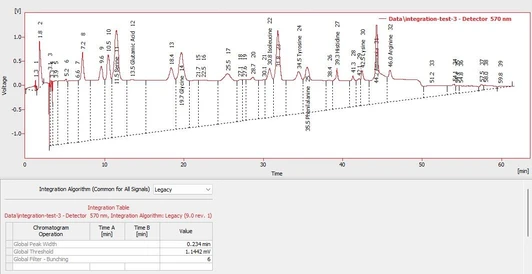
  • Photo: DataApex: Basics of Chromatogram Integration in Clarity
  • Video: DataApex: Clarity Tutorial - Peak Integration Overview 

Introduction

This article provides a structured, technical explanation of the basic chromatogram integration workflow as demonstrated in a tutorial video for Clarity Chromatography Software. The focus is on the Wave integration algorithm, although the general principles described apply equally to the Legacy algorithm available in Clarity.

Overview of Integration in Clarity

In Clarity, chromatogram integration is performed from the Chromatogram window, using the Integration tab. Integration parameters are defined through a structured table, where each row represents one integration event or operation.

Clarity offers two integration algorithms:

  • Wave algorithm – modern, adaptive peak detection method (used in this guide)
  • Legacy algorithm – traditional algorithm retained for compatibility

Although parameter names and behavior may differ slightly, the overall integration workflow remains consistent.

Typical Integration Workflow

Chromatogram integration in Clarity follows a logical, multi-step process. In most cases, the first three steps are sufficient to obtain correct and reproducible peak integration.

Step 1: Define the Integration Interval

The integration interval specifies the time range of the chromatogram that will be evaluated. Any signal outside this interval is ignored during peak detection and quantification.

Key points:

  • The interval is selected graphically in the chromatogram
  • After applying the integration function, Clarity automatically creates a new row in the integration table
  • Start and end times are taken from the graphical selection
  • All values in the integration table remain manually editable, allowing precise fine-tuning

This step ensures that irrelevant regions (e.g. solvent front, column wash, late noise) do not influence peak detection.

Step 2: Enable Detection of Negative Peaks

If the chromatogram contains negative peaks (for example, due to detector behavior, background subtraction, or specific analytical techniques), the Detect Negative Peaks option must be enabled.

Failing to activate this function will cause negative peaks to be ignored during integration, potentially leading to incomplete or incorrect quantification.

Step 3: Adjust Global Integration Parameters

Global parameters define how peaks are detected across the entire integration interval. These settings establish the fundamental sensitivity and selectivity of peak detection.

Global Peak Width
  • Represents the narrowest expected peak
  • Used internally to determine peak bunching and separation
  • Critical for distinguishing closely eluting peaks
Global Threshold
  • Defines the noise level
  • Signals below this threshold are considered noise and ignored
  • Proper adjustment prevents false peak detection
Global Baseline Slope
  • Controls how peak start and end points are determined
  • Helps adapt integration to sloping or drifting baselines

In most routine applications, correct adjustment of these global parameters is sufficient for reliable peak integration.

Advanced Integration Adjustments

When global settings alone are not adequate, Clarity provides additional tools for localized and peak-specific refinement.

Step 4: Apply Local Integration Parameters

Local parameters apply only to a selected time range within the chromatogram. This approach is useful when:

  • Peak shapes vary across the run
  • Specific regions require different sensitivity
  • Overlapping or poorly resolved peaks occur locally

Clarity assists the user by suggesting suitable parameter values, which can then be accepted or further refined.

Step 5: Peak-Specific and Baseline Operations

For final fine-tuning, Clarity allows the use of:

  • Peak-specific parameters
  • Baseline operations

These operations target individual peaks or baselines and are typically applied to:

  • Correct peak start/end points
  • Handle unusual peak shapes
  • Improve consistency for critical analytes

This step is generally reserved for complex chromatograms or validated methods requiring strict control over integration behavior.

Integration Table Logic and Execution Order

Each row in the integration table represents one integration event. The order of rows is critical:

  • Integration events are applied from top to bottom
  • Later rows can modify or override results of earlier operations
  • Careful ordering ensures predictable and reproducible results

Multi-Signal Chromatograms

In chromatograms containing multiple detector signals:

  • Each signal has its own integration table
  • Integration parameters must be adjusted independently for each signal

This ensures correct peak detection and quantification across all recorded signals.

Transferring Integration to Methods and Other Data

Once the integration setup produces satisfactory results for a representative chromatogram, the completed integration table can be:

  • Transferred into the analytical method
  • Reused for other chromatograms measured under the same conditions

This enables consistent processing, supports method validation, and improves long-term reproducibility.

Conclusion

Chromatogram integration in Clarity follows a structured and logical workflow, beginning with definition of the integration interval and global parameters, and progressing—only if necessary—to local and peak-specific adjustments.

In most routine applications:

  1. Integration interval
  2. Negative peak detection
  3. Global parameters

are sufficient for reliable quantification. Advanced operations provide flexibility for complex or demanding chromatographic scenarios.

Understanding the hierarchy and execution order of integration events is essential for building robust, transferable methods and achieving consistent analytical results.

DataApex
LinkedIn Logo
 

Related content

Analysis of Anti-Degradant Additive (6PPD) and its Transformation Product 6PPD-Quinone in Tire Rubber Using an Integrated HPLC System

Applications
| 2026 | Shimadzu
Instrumentation
HPLC
Manufacturer
Shimadzu
Industries
Energy & Chemicals

Performance Evaluation of Microbial Identification Using a Benchtop MALDI-TOF MS

Applications
| 2026 | Shimadzu
Instrumentation
MALDI, LC/MS, LC/TOF, Software
Manufacturer
Shimadzu
Industries
Pharma & Biopharma, Food & Agriculture

A Combined Method for Anionic, Cationic, and Zwitterionic PFAS using a Direct Injection UPLC™-MS/MS Method for Environmental Water Samples

Applications
| 2026 | Waters
Instrumentation
LC/MS, LC/MS/MS, LC/QQQ
Manufacturer
Waters
Industries
Environmental

Beyond the box: A ready-to-run workflow for quantitating 80 drugs of abuse in whole blood with the TSQ Certis Triple Quadrupole MS

Applications
| 2026 | Thermo Fisher Scientific
Instrumentation
LC/MS, LC/MS/MS, LC/QQQ
Manufacturer
Thermo Fisher Scientific
Industries
Forensics

Mastering Single Cell Proteomics: Daily Excellence with μPAC Neo Plus Trap-and-Elute Workflow

Presentations
| 2026 | Thermo Fisher Scientific
Instrumentation
HPLC, LC/Orbitrap, LC/MS, LC/MS/MS
Manufacturer
Thermo Fisher Scientific
Industries
Proteomics
 

Related articles

Teaching Separation Science in High School
Interview | Scientists

Teaching Separation Science in High School

This interview explores how high school students learn separation science through filtration, gravimetric analysis, and chromatography, building the foundations for future chemistry studies.
Organomation
tag
share
more
Webinars LabRulezLCMS Week 12/2026
Article | Webinars

Webinars LabRulezLCMS Week 12/2026

13 webinars: antimicrobial testing, continuous bioprocessing, glycoproteomics, GLP-1 purification, IC-MS workflows, imaging MS oncology, metabolomics design, peptide HPLC, PFAS TFA analysis
LabRulez
tag
share
more
Hop (Humulus lupulus L.) Phytochemical Profiles as a Function of Growth Region by HPLC and GC-MS Analysis
Scientific article | Science and research

Hop (Humulus lupulus L.) Phytochemical Profiles as a Function of Growth Region by HPLC and GC-MS Analysis

This study compares phytochemical profiles of Cascade hops from two U.S. regions using HPLC-DAD and HS-GC-MS, supporting evidence of hop terroir.
LabRulez
tag
share
more
Elucidating Unknown Organofluorine in Municipal Wastewater: A Mass Balance Approach including Fluorinated Pharmaceuticals
Scientific article | Science and research

Elucidating Unknown Organofluorine in Municipal Wastewater: A Mass Balance Approach including Fluorinated Pharmaceuticals

A multisorbent SPE–LC-HRMS approach shows fluorinated pharmaceuticals significantly contribute to extractable organofluorine in wastewater.
LabRulez
tag
share
more
 

Related content

Analysis of Anti-Degradant Additive (6PPD) and its Transformation Product 6PPD-Quinone in Tire Rubber Using an Integrated HPLC System

Applications
| 2026 | Shimadzu
Instrumentation
HPLC
Manufacturer
Shimadzu
Industries
Energy & Chemicals

Performance Evaluation of Microbial Identification Using a Benchtop MALDI-TOF MS

Applications
| 2026 | Shimadzu
Instrumentation
MALDI, LC/MS, LC/TOF, Software
Manufacturer
Shimadzu
Industries
Pharma & Biopharma, Food & Agriculture

A Combined Method for Anionic, Cationic, and Zwitterionic PFAS using a Direct Injection UPLC™-MS/MS Method for Environmental Water Samples

Applications
| 2026 | Waters
Instrumentation
LC/MS, LC/MS/MS, LC/QQQ
Manufacturer
Waters
Industries
Environmental

Beyond the box: A ready-to-run workflow for quantitating 80 drugs of abuse in whole blood with the TSQ Certis Triple Quadrupole MS

Applications
| 2026 | Thermo Fisher Scientific
Instrumentation
LC/MS, LC/MS/MS, LC/QQQ
Manufacturer
Thermo Fisher Scientific
Industries
Forensics

Mastering Single Cell Proteomics: Daily Excellence with μPAC Neo Plus Trap-and-Elute Workflow

Presentations
| 2026 | Thermo Fisher Scientific
Instrumentation
HPLC, LC/Orbitrap, LC/MS, LC/MS/MS
Manufacturer
Thermo Fisher Scientific
Industries
Proteomics
 

Related articles

Teaching Separation Science in High School
Interview | Scientists

Teaching Separation Science in High School

This interview explores how high school students learn separation science through filtration, gravimetric analysis, and chromatography, building the foundations for future chemistry studies.
Organomation
tag
share
more
Webinars LabRulezLCMS Week 12/2026
Article | Webinars

Webinars LabRulezLCMS Week 12/2026

13 webinars: antimicrobial testing, continuous bioprocessing, glycoproteomics, GLP-1 purification, IC-MS workflows, imaging MS oncology, metabolomics design, peptide HPLC, PFAS TFA analysis
LabRulez
tag
share
more
Hop (Humulus lupulus L.) Phytochemical Profiles as a Function of Growth Region by HPLC and GC-MS Analysis
Scientific article | Science and research

Hop (Humulus lupulus L.) Phytochemical Profiles as a Function of Growth Region by HPLC and GC-MS Analysis

This study compares phytochemical profiles of Cascade hops from two U.S. regions using HPLC-DAD and HS-GC-MS, supporting evidence of hop terroir.
LabRulez
tag
share
more
Elucidating Unknown Organofluorine in Municipal Wastewater: A Mass Balance Approach including Fluorinated Pharmaceuticals
Scientific article | Science and research

Elucidating Unknown Organofluorine in Municipal Wastewater: A Mass Balance Approach including Fluorinated Pharmaceuticals

A multisorbent SPE–LC-HRMS approach shows fluorinated pharmaceuticals significantly contribute to extractable organofluorine in wastewater.
LabRulez
tag
share
more
 

Related content

Analysis of Anti-Degradant Additive (6PPD) and its Transformation Product 6PPD-Quinone in Tire Rubber Using an Integrated HPLC System

Applications
| 2026 | Shimadzu
Instrumentation
HPLC
Manufacturer
Shimadzu
Industries
Energy & Chemicals

Performance Evaluation of Microbial Identification Using a Benchtop MALDI-TOF MS

Applications
| 2026 | Shimadzu
Instrumentation
MALDI, LC/MS, LC/TOF, Software
Manufacturer
Shimadzu
Industries
Pharma & Biopharma, Food & Agriculture

A Combined Method for Anionic, Cationic, and Zwitterionic PFAS using a Direct Injection UPLC™-MS/MS Method for Environmental Water Samples

Applications
| 2026 | Waters
Instrumentation
LC/MS, LC/MS/MS, LC/QQQ
Manufacturer
Waters
Industries
Environmental

Beyond the box: A ready-to-run workflow for quantitating 80 drugs of abuse in whole blood with the TSQ Certis Triple Quadrupole MS

Applications
| 2026 | Thermo Fisher Scientific
Instrumentation
LC/MS, LC/MS/MS, LC/QQQ
Manufacturer
Thermo Fisher Scientific
Industries
Forensics

Mastering Single Cell Proteomics: Daily Excellence with μPAC Neo Plus Trap-and-Elute Workflow

Presentations
| 2026 | Thermo Fisher Scientific
Instrumentation
HPLC, LC/Orbitrap, LC/MS, LC/MS/MS
Manufacturer
Thermo Fisher Scientific
Industries
Proteomics
 

Related articles

Teaching Separation Science in High School
Interview | Scientists

Teaching Separation Science in High School

This interview explores how high school students learn separation science through filtration, gravimetric analysis, and chromatography, building the foundations for future chemistry studies.
Organomation
tag
share
more
Webinars LabRulezLCMS Week 12/2026
Article | Webinars

Webinars LabRulezLCMS Week 12/2026

13 webinars: antimicrobial testing, continuous bioprocessing, glycoproteomics, GLP-1 purification, IC-MS workflows, imaging MS oncology, metabolomics design, peptide HPLC, PFAS TFA analysis
LabRulez
tag
share
more
Hop (Humulus lupulus L.) Phytochemical Profiles as a Function of Growth Region by HPLC and GC-MS Analysis
Scientific article | Science and research

Hop (Humulus lupulus L.) Phytochemical Profiles as a Function of Growth Region by HPLC and GC-MS Analysis

This study compares phytochemical profiles of Cascade hops from two U.S. regions using HPLC-DAD and HS-GC-MS, supporting evidence of hop terroir.
LabRulez
tag
share
more
Elucidating Unknown Organofluorine in Municipal Wastewater: A Mass Balance Approach including Fluorinated Pharmaceuticals
Scientific article | Science and research

Elucidating Unknown Organofluorine in Municipal Wastewater: A Mass Balance Approach including Fluorinated Pharmaceuticals

A multisorbent SPE–LC-HRMS approach shows fluorinated pharmaceuticals significantly contribute to extractable organofluorine in wastewater.
LabRulez
tag
share
more
 

Related content

Analysis of Anti-Degradant Additive (6PPD) and its Transformation Product 6PPD-Quinone in Tire Rubber Using an Integrated HPLC System

Applications
| 2026 | Shimadzu
Instrumentation
HPLC
Manufacturer
Shimadzu
Industries
Energy & Chemicals

Performance Evaluation of Microbial Identification Using a Benchtop MALDI-TOF MS

Applications
| 2026 | Shimadzu
Instrumentation
MALDI, LC/MS, LC/TOF, Software
Manufacturer
Shimadzu
Industries
Pharma & Biopharma, Food & Agriculture

A Combined Method for Anionic, Cationic, and Zwitterionic PFAS using a Direct Injection UPLC™-MS/MS Method for Environmental Water Samples

Applications
| 2026 | Waters
Instrumentation
LC/MS, LC/MS/MS, LC/QQQ
Manufacturer
Waters
Industries
Environmental

Beyond the box: A ready-to-run workflow for quantitating 80 drugs of abuse in whole blood with the TSQ Certis Triple Quadrupole MS

Applications
| 2026 | Thermo Fisher Scientific
Instrumentation
LC/MS, LC/MS/MS, LC/QQQ
Manufacturer
Thermo Fisher Scientific
Industries
Forensics

Mastering Single Cell Proteomics: Daily Excellence with μPAC Neo Plus Trap-and-Elute Workflow

Presentations
| 2026 | Thermo Fisher Scientific
Instrumentation
HPLC, LC/Orbitrap, LC/MS, LC/MS/MS
Manufacturer
Thermo Fisher Scientific
Industries
Proteomics
 

Related articles

Teaching Separation Science in High School
Interview | Scientists

Teaching Separation Science in High School

This interview explores how high school students learn separation science through filtration, gravimetric analysis, and chromatography, building the foundations for future chemistry studies.
Organomation
tag
share
more
Webinars LabRulezLCMS Week 12/2026
Article | Webinars

Webinars LabRulezLCMS Week 12/2026

13 webinars: antimicrobial testing, continuous bioprocessing, glycoproteomics, GLP-1 purification, IC-MS workflows, imaging MS oncology, metabolomics design, peptide HPLC, PFAS TFA analysis
LabRulez
tag
share
more
Hop (Humulus lupulus L.) Phytochemical Profiles as a Function of Growth Region by HPLC and GC-MS Analysis
Scientific article | Science and research

Hop (Humulus lupulus L.) Phytochemical Profiles as a Function of Growth Region by HPLC and GC-MS Analysis

This study compares phytochemical profiles of Cascade hops from two U.S. regions using HPLC-DAD and HS-GC-MS, supporting evidence of hop terroir.
LabRulez
tag
share
more
Elucidating Unknown Organofluorine in Municipal Wastewater: A Mass Balance Approach including Fluorinated Pharmaceuticals
Scientific article | Science and research

Elucidating Unknown Organofluorine in Municipal Wastewater: A Mass Balance Approach including Fluorinated Pharmaceuticals

A multisorbent SPE–LC-HRMS approach shows fluorinated pharmaceuticals significantly contribute to extractable organofluorine in wastewater.
LabRulez
tag
share
more
Other projects
GCMS
ICPMS
Follow us
FacebookX (Twitter)LinkedInYouTube
More information
WebinarsAbout usContact usTerms of use
LabRulez s.r.o. All rights reserved. Content available under a CC BY-SA 4.0 Attribution-ShareAlike