LCMS
More information
WebinarsAbout usContact usTerms of use
LabRulez s.r.o. All rights reserved. Content available under a CC BY-SA 4.0 Attribution-ShareAlike
Author
RECETOX - Centrum pro výzkum toxických látek v prostředí
RECETOX (Research Centre for Toxic Compounds in the Environment) is an independent department of the Faculty of Science of Masaryk University in Brno, which has been established in 1983. RECETOX is focused on the research and education in cross-cutting area of Environment and Health. It addresses interactions among chemicals, environment, and biological systems, including consequences at local, regional, and global levels.
Tags
Article
Science and research
Environment
LinkedIn Logo

Long-Term Air Monitoring Shows Pesticides Aren’t Gone—They’re Coming Back
Th, 8.1.2026
| Original article from: RECETOX MUNI
A decade-long study from the Czech National Atmospheric Observatory shows that banned pesticides persist in the air decades later, driven by soil re-emission and slow environmental degradation.
<p>RECETOX MUNI: Long-Term Air Monitoring Shows Pesticides Aren’t Gone—They’re Coming Back</p>

RECETOX MUNI: Long-Term Air Monitoring Shows Pesticides Aren’t Gone—They’re Coming Back

Persistent pesticides continue to pollute our air decades after their ban, a new long-term study at the Czech National Atmospheric Observatory reveals. Researchers found that concentrations of legacy organochlorine pesticides (OCPs) have stopped declining and remain in the environment due to secondary sources like soil, while some current-use pesticides (CUPs) linger in the atmosphere years after prohibition. These findings underscore the urgent need for continuous monitoring and stricter measures to protect human health and ecosystems.  

We looked into the atmospheric levels of legacy organochlorine pesticides (OCPs) and current-use pesticides (CUPs) over the years, at an agricultural site in the Czech Republic. A few things stood out, for instance, concentrations of some OCPs declines over time, we found that concentrations of key pollutants like β- and γ-HCH, DDT , α-chlordane, and mirex are leveling off, which means that secondary sources, such as soil and bodies, are enhanced and release these pollutant s back to the environment over time, especially in the summer,” says main author of the publication Ludovic Mayer.

The researchers also observed that CUPs atmospheric levels mostly decreased or showed no significant changes over time, but critically, banned substances like chlorpyrifos and fenpropimorph remained detectable in the atmosphere even years after their bans took effect, highlighting their persistence.

Our research is vital because it challenges the assumption that highly persistent banned substances disappear naturally over time; the leveling off of OCPs  concentrations proves that decades-old pollution sources continue to contaminate our air, posing ongoing risks to human and environmental health. We established that environmental loads of these semivolatilecompounds persist because they degrade much slower in soils and have the capacity to revolatilise over time,” adds Ludovic Mayer.

Moreover, tracking current-use pesticides provides immediate feedback on the effectiveness of recent bans, showing that compounds like chlorpyrifos and fenpropimorph persist in the atmosphere years after they were prohibited, indicating a need for continued vigilance regarding environmental clearance and human exposure to these toxic substances. The study highlights the importance of continued long-term monitoring for CUPs, which is currently lacking, but would provide sufficient insights into their atmospheric fate and to develop accurate models to predict key environmental processes like transport and deposition.

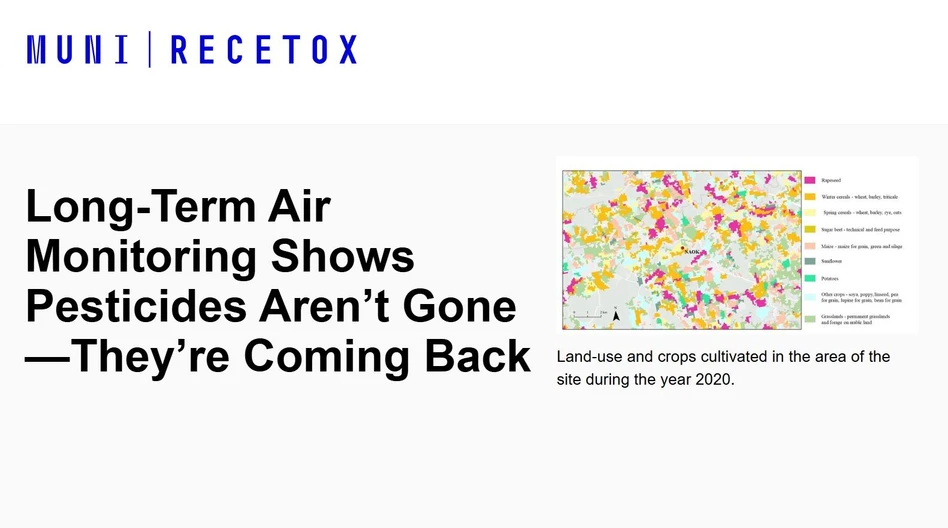
The conclusions were reached by performing continuous biweekly air sampling at the National Atmospheric Observatory Košetice (NAOK), a rural-agricultural site in the Czech Republic, spanning 10 years for OCPs and three years for CUPs.  

We collected air samples with large air pumps that pull outdoor air through special filters, allowing us to capture both airborne particles and the pesticides that exist as gases. In the lab, we used sensitive instruments to identify and measure these pesticides very precisely. We then applied statistical methods to see how pesticide levels changed over the years and how factors like temperature affected their release back into the air from surfaces such as soil.

These findings help us better understand how pesticides behave in the environment, and they show why long-term monitoring is essential. In the future, we hope to study a wider range of chemicals and also look at the interaction, not just with air, but in soil, water, and rain/snowfall. That way we can get a clearer picture of the cycling of those compounds in the environment,” concludes Ludovic Mayer. 

The original article

Current-use and legacy pesticides' multi-annual trends in air in central Europe: primary and unidentified secondary sources

Ludovic Mayer, Lisa Melymuk, Adela Holubová Šmejkalová, Jiři Kalina, Petr Kukučka, Jakub Martiník, Petra Přibylová, Petr Šenk, Pourya Shahpoury, and Gerhard Lammel

Atmos. Chem. Phys., 25, 12467–12482

 https://doi.org/10.5194/acp-25-12467-2025

licensed under CC-BY 4.0

Abstract

This study investigated 48 current-use pesticides (CUPs) and 30 organochlorine pesticides (OCPs) in ambient air at a rural-agricultural site in the Czech Republic, with biweekly sampling over three and 10 years, respectively. Despite being banned decades ago, OCPs persist in the atmosphere, with revolatilisation from surfaces apparent in summer. Temporal trend analysis revealed decreasing atmospheric concentrations for several OCPs, which indicate long-term diminishing reservoirs in environmental compartments, especially soil. For β- and γ-HCH, - and -DDE, -DDD, - and -DDT, α-chlordane, and mirex, levelling off is observed, which points to recently enhanced secondary sources in the region or beyond, related to reversal of the direction of air-surface exchange in response to historic atmospheric depositions or recent mobilisation from ground compartments, such as water bodies, the cryosphere, or soils heated by wildfires.

CUP concentrations peaked during application seasons, with multi-annual trends either insignificant or declining. For compounds like chlorpyrifos and fenpropimorph, declining trends aligned with regulatory bans, though their presence in the atmosphere was evident one-year after the bans, suggesting persistence.

2 Methodology

2.4 Sample preparation and analysis 

Air samples were first spiked with isotopically-labelled standards (Table S3) and then underwent extraction using an automated extractor (E-800, Büchi Extraction System, Flawil, Switzerland), with 150 mL of methanol and 5 mM of ammonium acetate for CUPs and 150 mL of dichloromethane for OCPs. CUPs extract clean-up was done by filtration through a 0.22 µm pore size cellulose acetate membrane (Corning Costar Spin-X, United States) and concentrated under a gentle stream of nitrogen to a final volume of 500 µL. 100 µL of MilliQ water were then added to a 100 µL aliquot of the extract which was then used for analysis. After extraction, OCPs extracts were transferred to a glass column (30 mm i.d.) filled with 0.5 g of activated silica, 30 g of H2SO4 modified activated silica and 1 g of non-activated silica and were eluted with 40 mL of DCM:hexane (1:1). 50 µL of n-nonane was added as a keeper solvent, and the extract was then concentrated under a gentle stream of nitrogen to a final volume of 100 µL.

CUPs were analysed using a high-performance liquid chromatograph (HPLC, Agilent 1290, Agilent, Santa Clara, USA) coupled to a mass spectrometer (QTRAP 5500, AB Sciex, Framingham, USA) using four different methods previously developed and described (Mayer et al., 2024). The precursor to product ions were monitored in scheduled multiple reaction monitoring mode (MRM) (Table S4). The identification of individual pesticides was based on the comparison of intensity ratios of ions and retention times with standards and quantification was done using internal calibration with isotopically labelled standards (Table S4).

OCPs were analysed by gas chromatography-mass spectrometry (GC-MS/MS). Analysis realised with 7890A GC coupled to a triple quadrupole 7000B MS for 2015-2017 samples then 8890 GC coupled to a triple quadrupole 7000D MS for 2018-2022 samples.

RECETOX - Centrum pro výzkum toxických látek v prostředí
LinkedIn Logo
 

Related content

Overcoming Strong Solvent Effects in the Analysis of Vepdegestrant

Applications
| 2026 | Agilent Technologies
Instrumentation
HPLC
Manufacturer
Agilent Technologies
Industries
Pharma & Biopharma

Identification of Double Bond Positions and Relative Acyl Chain Positions in Egg Yolk Phosphatidylcholines Using OAD-TOF System

Applications
| 2026 | Shimadzu
Instrumentation
LC/MS, LC/MS/MS, LC/TOF, LC/HRMS
Manufacturer
Shimadzu
Industries
Food & Agriculture

High Molecular-Weight Polysaccharide Characterization by SEC-MALS Using GTxResolve™ 1000 and 2000 Å SEC Columns

Applications
| 2026 | Waters
Instrumentation
GPC/SEC, Consumables, LC columns
Manufacturer
Waters
Industries
Pharma & Biopharma, Food & Agriculture

Development and Optimization for a Comprehensive LC/MS/MS Method for the Detection of 74 PFAS Compounds

Applications
| 2026 | Agilent Technologies
Instrumentation
LC/MS, LC/MS/MS, LC/QQQ
Manufacturer
Agilent Technologies
Industries
Food & Agriculture

PFAS in Biota: Risk Context & Robust Analytical Solutions

Others
| 2026 | ALS Europe
Instrumentation
Laboratory analysis, LC/MS, LC/MS/MS
Manufacturer
Industries
Environmental
 

Related articles

JUNIOR STAR Grants at UCT Prague: Two talented women from abroad driving innovation in science
Article | Scientists

JUNIOR STAR Grants at UCT Prague: Two talented women from abroad driving innovation in science

Two outstanding early-career researchers at UCT Prague, Filipa Oliveira and Stella Gonsales, received prestigious GAČR JUNIOR STAR grants for innovative research in materials science and sustainable chemistry.
UCT Prague
tag
share
more
Research from IOCB Prague reveals a previously unknown mechanism of genetic transcription
Article | Science and research

Research from IOCB Prague reveals a previously unknown mechanism of genetic transcription

Scientists at IOCB Prague reveal a previously unknown mechanism that initiates gene transcription. Using cryo-EM, they uncover how alarmone molecules enable RNA synthesis under stress.
Institute of Organic Chemistry and Biochemistry of the Czech Academy of Sciences
tag
share
more
Food Adulteration and How It Is Revealed by Analytical Chemistry
Article | Food

Food Adulteration and How It Is Revealed by Analytical Chemistry

Food adulteration threatens quality and consumer trust. Discover how HPLC and modern chromatographic systems from Watrex Praha help identify oil, honey, and wine adulteration with high confidence.
Watrex Praha
tag
share
more
Affinity, Gel Filtration, Size Exclusion Chromatography: Repurposing Kinase Inhibitors for Malaria
Interview | Video

Affinity, Gel Filtration, Size Exclusion Chromatography: Repurposing Kinase Inhibitors for Malaria

This podcast explores how chromatography (FPLC/SEC) and mass spectrometry support malaria drug discovery, from protein purification and QC to interaction studies and complex sample preparation.
Organomation
tag
share
more
 

Related content

Overcoming Strong Solvent Effects in the Analysis of Vepdegestrant

Applications
| 2026 | Agilent Technologies
Instrumentation
HPLC
Manufacturer
Agilent Technologies
Industries
Pharma & Biopharma

Identification of Double Bond Positions and Relative Acyl Chain Positions in Egg Yolk Phosphatidylcholines Using OAD-TOF System

Applications
| 2026 | Shimadzu
Instrumentation
LC/MS, LC/MS/MS, LC/TOF, LC/HRMS
Manufacturer
Shimadzu
Industries
Food & Agriculture

High Molecular-Weight Polysaccharide Characterization by SEC-MALS Using GTxResolve™ 1000 and 2000 Å SEC Columns

Applications
| 2026 | Waters
Instrumentation
GPC/SEC, Consumables, LC columns
Manufacturer
Waters
Industries
Pharma & Biopharma, Food & Agriculture

Development and Optimization for a Comprehensive LC/MS/MS Method for the Detection of 74 PFAS Compounds

Applications
| 2026 | Agilent Technologies
Instrumentation
LC/MS, LC/MS/MS, LC/QQQ
Manufacturer
Agilent Technologies
Industries
Food & Agriculture

PFAS in Biota: Risk Context & Robust Analytical Solutions

Others
| 2026 | ALS Europe
Instrumentation
Laboratory analysis, LC/MS, LC/MS/MS
Manufacturer
Industries
Environmental
 

Related articles

JUNIOR STAR Grants at UCT Prague: Two talented women from abroad driving innovation in science
Article | Scientists

JUNIOR STAR Grants at UCT Prague: Two talented women from abroad driving innovation in science

Two outstanding early-career researchers at UCT Prague, Filipa Oliveira and Stella Gonsales, received prestigious GAČR JUNIOR STAR grants for innovative research in materials science and sustainable chemistry.
UCT Prague
tag
share
more
Research from IOCB Prague reveals a previously unknown mechanism of genetic transcription
Article | Science and research

Research from IOCB Prague reveals a previously unknown mechanism of genetic transcription

Scientists at IOCB Prague reveal a previously unknown mechanism that initiates gene transcription. Using cryo-EM, they uncover how alarmone molecules enable RNA synthesis under stress.
Institute of Organic Chemistry and Biochemistry of the Czech Academy of Sciences
tag
share
more
Food Adulteration and How It Is Revealed by Analytical Chemistry
Article | Food

Food Adulteration and How It Is Revealed by Analytical Chemistry

Food adulteration threatens quality and consumer trust. Discover how HPLC and modern chromatographic systems from Watrex Praha help identify oil, honey, and wine adulteration with high confidence.
Watrex Praha
tag
share
more
Affinity, Gel Filtration, Size Exclusion Chromatography: Repurposing Kinase Inhibitors for Malaria
Interview | Video

Affinity, Gel Filtration, Size Exclusion Chromatography: Repurposing Kinase Inhibitors for Malaria

This podcast explores how chromatography (FPLC/SEC) and mass spectrometry support malaria drug discovery, from protein purification and QC to interaction studies and complex sample preparation.
Organomation
tag
share
more
 

Related content

Overcoming Strong Solvent Effects in the Analysis of Vepdegestrant

Applications
| 2026 | Agilent Technologies
Instrumentation
HPLC
Manufacturer
Agilent Technologies
Industries
Pharma & Biopharma

Identification of Double Bond Positions and Relative Acyl Chain Positions in Egg Yolk Phosphatidylcholines Using OAD-TOF System

Applications
| 2026 | Shimadzu
Instrumentation
LC/MS, LC/MS/MS, LC/TOF, LC/HRMS
Manufacturer
Shimadzu
Industries
Food & Agriculture

High Molecular-Weight Polysaccharide Characterization by SEC-MALS Using GTxResolve™ 1000 and 2000 Å SEC Columns

Applications
| 2026 | Waters
Instrumentation
GPC/SEC, Consumables, LC columns
Manufacturer
Waters
Industries
Pharma & Biopharma, Food & Agriculture

Development and Optimization for a Comprehensive LC/MS/MS Method for the Detection of 74 PFAS Compounds

Applications
| 2026 | Agilent Technologies
Instrumentation
LC/MS, LC/MS/MS, LC/QQQ
Manufacturer
Agilent Technologies
Industries
Food & Agriculture

PFAS in Biota: Risk Context & Robust Analytical Solutions

Others
| 2026 | ALS Europe
Instrumentation
Laboratory analysis, LC/MS, LC/MS/MS
Manufacturer
Industries
Environmental
 

Related articles

JUNIOR STAR Grants at UCT Prague: Two talented women from abroad driving innovation in science
Article | Scientists

JUNIOR STAR Grants at UCT Prague: Two talented women from abroad driving innovation in science

Two outstanding early-career researchers at UCT Prague, Filipa Oliveira and Stella Gonsales, received prestigious GAČR JUNIOR STAR grants for innovative research in materials science and sustainable chemistry.
UCT Prague
tag
share
more
Research from IOCB Prague reveals a previously unknown mechanism of genetic transcription
Article | Science and research

Research from IOCB Prague reveals a previously unknown mechanism of genetic transcription

Scientists at IOCB Prague reveal a previously unknown mechanism that initiates gene transcription. Using cryo-EM, they uncover how alarmone molecules enable RNA synthesis under stress.
Institute of Organic Chemistry and Biochemistry of the Czech Academy of Sciences
tag
share
more
Food Adulteration and How It Is Revealed by Analytical Chemistry
Article | Food

Food Adulteration and How It Is Revealed by Analytical Chemistry

Food adulteration threatens quality and consumer trust. Discover how HPLC and modern chromatographic systems from Watrex Praha help identify oil, honey, and wine adulteration with high confidence.
Watrex Praha
tag
share
more
Affinity, Gel Filtration, Size Exclusion Chromatography: Repurposing Kinase Inhibitors for Malaria
Interview | Video

Affinity, Gel Filtration, Size Exclusion Chromatography: Repurposing Kinase Inhibitors for Malaria

This podcast explores how chromatography (FPLC/SEC) and mass spectrometry support malaria drug discovery, from protein purification and QC to interaction studies and complex sample preparation.
Organomation
tag
share
more
 

Related content

Overcoming Strong Solvent Effects in the Analysis of Vepdegestrant

Applications
| 2026 | Agilent Technologies
Instrumentation
HPLC
Manufacturer
Agilent Technologies
Industries
Pharma & Biopharma

Identification of Double Bond Positions and Relative Acyl Chain Positions in Egg Yolk Phosphatidylcholines Using OAD-TOF System

Applications
| 2026 | Shimadzu
Instrumentation
LC/MS, LC/MS/MS, LC/TOF, LC/HRMS
Manufacturer
Shimadzu
Industries
Food & Agriculture

High Molecular-Weight Polysaccharide Characterization by SEC-MALS Using GTxResolve™ 1000 and 2000 Å SEC Columns

Applications
| 2026 | Waters
Instrumentation
GPC/SEC, Consumables, LC columns
Manufacturer
Waters
Industries
Pharma & Biopharma, Food & Agriculture

Development and Optimization for a Comprehensive LC/MS/MS Method for the Detection of 74 PFAS Compounds

Applications
| 2026 | Agilent Technologies
Instrumentation
LC/MS, LC/MS/MS, LC/QQQ
Manufacturer
Agilent Technologies
Industries
Food & Agriculture

PFAS in Biota: Risk Context & Robust Analytical Solutions

Others
| 2026 | ALS Europe
Instrumentation
Laboratory analysis, LC/MS, LC/MS/MS
Manufacturer
Industries
Environmental
 

Related articles

JUNIOR STAR Grants at UCT Prague: Two talented women from abroad driving innovation in science
Article | Scientists

JUNIOR STAR Grants at UCT Prague: Two talented women from abroad driving innovation in science

Two outstanding early-career researchers at UCT Prague, Filipa Oliveira and Stella Gonsales, received prestigious GAČR JUNIOR STAR grants for innovative research in materials science and sustainable chemistry.
UCT Prague
tag
share
more
Research from IOCB Prague reveals a previously unknown mechanism of genetic transcription
Article | Science and research

Research from IOCB Prague reveals a previously unknown mechanism of genetic transcription

Scientists at IOCB Prague reveal a previously unknown mechanism that initiates gene transcription. Using cryo-EM, they uncover how alarmone molecules enable RNA synthesis under stress.
Institute of Organic Chemistry and Biochemistry of the Czech Academy of Sciences
tag
share
more
Food Adulteration and How It Is Revealed by Analytical Chemistry
Article | Food

Food Adulteration and How It Is Revealed by Analytical Chemistry

Food adulteration threatens quality and consumer trust. Discover how HPLC and modern chromatographic systems from Watrex Praha help identify oil, honey, and wine adulteration with high confidence.
Watrex Praha
tag
share
more
Affinity, Gel Filtration, Size Exclusion Chromatography: Repurposing Kinase Inhibitors for Malaria
Interview | Video

Affinity, Gel Filtration, Size Exclusion Chromatography: Repurposing Kinase Inhibitors for Malaria

This podcast explores how chromatography (FPLC/SEC) and mass spectrometry support malaria drug discovery, from protein purification and QC to interaction studies and complex sample preparation.
Organomation
tag
share
more
Other projects
GCMS
ICPMS
Follow us
More information
WebinarsAbout usContact usTerms of use
LabRulez s.r.o. All rights reserved. Content available under a CC BY-SA 4.0 Attribution-ShareAlike