Pesticides in House Dust: An Overlooked Pathway of Human Exposure
RECETOX: Pesticides in House Dust: An Overlooked Pathway of Human Exposure
Pesticides and biocides are widely used in agriculture, building materials, and urban gardening to control pests and protect crops and public health. While much attention has been paid to pesticide residues in food, water, and outdoor environments, far less is known about their presence inside homes, where people spend the majority of their time. A new RECETOX study published in Indoor Environments addresses this gap by examining pesticides detected in house dust and their relevance for human exposure.
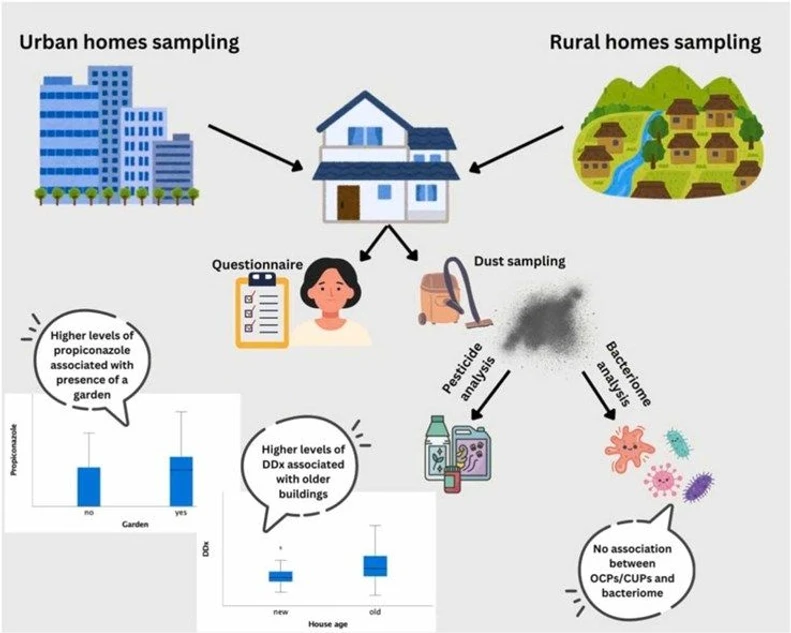
The study reveals that Czech household dust commonly contains multiple pesticide residues, highlighting the persistence of both historic and current chemical use indoors. Modern pesticides were detected in 93% of homes, with two fungicides (carbendazim and propiconazole) most frequently found, while compounds related to the long‑banned pesticide DDT were present in dust from all homes, and were at higher levels in homes over 40 years old. Homes located closer to agricultural areas showed higher levels of current‑use pesticides in spring, indicating an influence of nearby farming activities.
House dust acts as a sink for chemicals transported indoors from outdoor sources as well as from indoor use. Many pesticides can persist in dust for long periods, leading to continuous exposure in indoor spaces. This is particularly important for young children, who have higher exposure to dust from playing on the floor and mouthing toys and objects. The research underscores that indoor environments are not isolated from their surroundings. Understanding what ends up in house dust is a crucial step toward protecting public health and developing more comprehensive approaches to managing chemical risks in everyday life.
RECETOX: Pesticides in House Dust: An Overlooked Pathway of Human Exposure
Original Article
Legacy and current-use pesticides in indoor settled dust and association with building age and seasonality
Paula Marcinekova, Ondřej Mikeš, Simona Rozárka Jílková, Petr Šenk, Jakub Martiník, Jan Böhm, Petra Borilova Linhartova, Lenka Andrýsková, Jana Klánová, Lisa Melymuk
Indoor Environ., 2026, 3, 100169
https://doi.org/10.1016/j.indenv.2026.100169
licensed under CC-BY 4.0
Abstract
Indoor pesticide exposure is increasingly recognized as a significant contributor to pollutant exposure in residential spaces. This study investigates concentrations of legacy organochlorine pesticides (OCPs) and current-use pesticides (CUPs) in settled dust from 116 homes in the Czech Republic, in the context of their seasonal variability, relationships with building characteristics, geospatial factors, and indoor dust bacteriome diversity and composition. CUPs were detected in dust in 93% of homes, with carbendazim (84.5%), propiconazole (49.1%), atrazine (24.1%), and tebuconazole (11.2%) detected most frequently. OCPs were found in all homes. Propiconazole concentrations were significantly higher in homes with adjacent gardens, potentially reflecting its use as a biocide in outdoor building materials. CUP concentrations had clear seasonal trends, with peak levels in spring and summer, corresponding to pesticide application periods, particularly in rural environments. OCP concentrations were substantially higher in houses over 40 years old, indicating the persistence of residues from past indoor uses. While pesticide presence was ubiquitous, exposure estimates for children, under both average and high-exposure scenarios, were well below U.S. EPA reference doses (RfDs) for individual compounds; however, most homes had 3–11 pesticides in dust, raising the possibility of mixture effects. No significant associations, using a Spearman rank correlation matrix, were observed between pesticide concentrations and indoor dust bacteriome diversity and composition. These findings highlight the presence of pesticides in homes, including those in urban areas, driven by both current and historical sources, and reinforce the importance of monitoring to better understand potential exposure pathways.
Instrumentation
1. LC–MS/MS analysis of CUPs
- Agilent 1290 Series Gradient HPLC
- Columns:
- SCIEX QTrap 5500+ (triple quadrupole MS, ESI+)
2. GC–MS/MS analysis of OCPs