Revealing hidden chemicals at sea
RECETOX: Revealing hidden chemicals at sea
Flame retardant chemicals help prevent fires and save lives. They are widely used in indoor spaces—from homes and offices to airplanes and cars. However, one environment has largely escaped scientific attention: the inside of cruise ships. These floating cities are packed with furniture, electronics, and synthetic materials, yet little is known about the chemicals passengers and crew may be exposed to during long voyages.
In the largest study of its kind, researchers from RECETOX and the Norwegian Institute of Water Research (NIVA) examined indoor dust from three expedition cruise ships in the North Atlantic Ocean. The ships differed in age and renovation history. Dust samples were collected from a range of locations on each vessel, including cabins, common areas, and workspaces. Scientists analyzed dozens of flame retardants, including older chemicals that are now restricted in many countries and newer replacements that are still widely used.
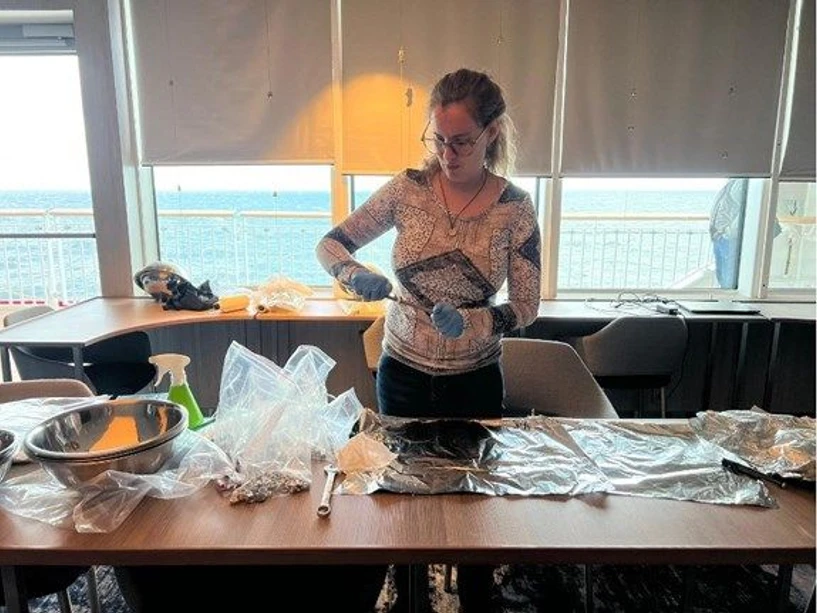
RECETOX: Revealing hidden chemicals at sea: A makeshift laboratory onboard to assemble passive air samplers.
The results revealed that flame retardants were present everywhere - but not evenly distributed. Some areas contained levels up to ten times higher than others, particularly spaces filled with electronics or soft furnishings. The most abundant chemicals were organophosphate flame retardants, especially one called TCIPP, which reached extremely high concentrations in some samples.
“Older ships had overall higher levels of flame retardants than the newer vessels, which likely reflects the types of materials used in the past and earlier fire‑safety standards. Using exposure models, we also estimated how much of these chemicals people on board may be ingesting or absorbing each day. The estimates suggest that crew members, who spend many months living and working on the ships, may experience higher exposure during routine activities - for example through contact with surfaces or the unintentional ingestion of dust,” says the study’s lead author, Veronica van der Schyff.
 RECETOX: Revealing hidden chemicals at sea: Outdoor air sampler setup.
While strict fire-safety standards are mandatory for ships, there are currently no rules limiting which flame retardant chemicals can be used or how much is allowed. This study highlights an important gap in maritime safety regulations and raises questions about long-term chemical exposure in enclosed ship environments.
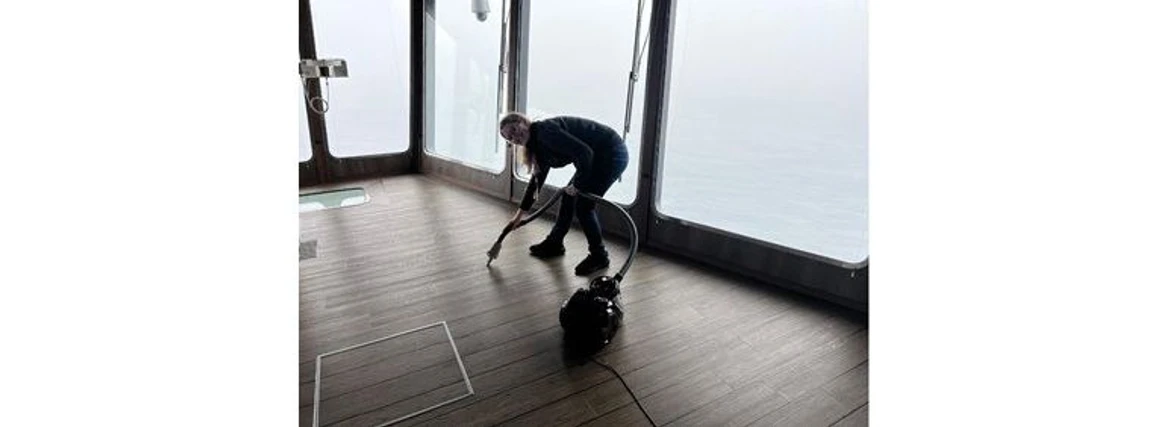 RECETOX: Revealing hidden chemicals at sea: Dust collection with a vacuum cleaner.
As cruise tourism, and the maritime industry, continues to grow, the findings underscore the need for closer monitoring and smarter regulation; ensuring that protecting ships from fire does not come at the cost of crew and passenger health.
The original article
Flame retardants in dust from the indoor environments of expedition cruise ships
Veronica van der Schyff, Verena Meraldi, Andrew Luke King, Simona Rozárka Jílková, Ondřej Audy, Petr Kukučka, Jiří Kohoutek, Lisa Melymuk
Environ. Sci.: Adv., 2026,5, 86-97
https://doi.org/10.1039/D5VA00257E
licensed under CC-BY 3.0
Abstract
Flame retardants (FRs) are widely used in indoor environments to meet fire safety requirements. One understudied environment with respect to indoor chemical exposure to FRs is the maritime environment, particularly the indoor environments of cruise ships. This study presents the first comprehensive assessment of FRs in indoor dust collected from three expedition cruise ships of varying ages and refitting histories. Ten polybrominated diphenyl ethers (PBDEs), 23 alternative halogenated flame retardants (AHFRs), and 16 organophosphate esters (OPEs) were analyzed in dust from 12–16 locations per ship. OPEs, especially tris(1-chloro-2-propyl)phosphate (TCIPP), dominated the chemical profile, with concentrations reaching up to 1786 µg g−1. Concentrations of FRs in different areas on the same ships differed greatly, sometimes by an order of magnitude. Older ships exhibited significantly higher FR levels compared to the newer vessel. Estimated daily intake (EDI) modeling indicated that ship crew members—particularly those working in heavily furnished or electronic-rich areas—may experience elevated exposures through ingestion and dermal contact. Strict performance-based fire test procedures are mandatory for all products onboard ships, but no regulations exist concerning the type of FR used or the concentrations thereof. These findings underscore the need for targeted regulation and further monitoring of chemical exposures in maritime environments, especially given the extended periods that crew members spend onboard.
Instrumental analyses
Out of 16 OPEs that were analyzed for (Table S1), 15 were detected in the samples at least once: TDCIPP, TCIPP, CDP, EHDPP, oTMPP, ip-TPP, m/p TMPP, TBOEP, TCEP, TEHP, TEP, TiBP, TnBP, TnPP, TPHP. The full list of target OPEs with compound names and identifiers is given in Table S1. OPEs were quantified using an Agilent 1290 Infinity high-performance liquid chromatograph (HPLC) coupled to an Agilent 6495 triple quadrupole mass spectrometer operating in positive electrospray ionization mode (ESI+). Chromatographic separation was achieved on an ACQUITY BEH C18 column (2.1 mm × 100 mm, 1.7 µm) with a mobile phase gradient of 0.1% formic acid in water and methanol at a flow rate of 0.2 mL min−1. Quantification was performed in multiple reaction monitoring (MRM) mode using isotope dilution with 13C- or deuterium-labeled standards for TPHP, TnBP, TDCIPP, and TnPP.
Ten PBDE congeners were detected (BDEs-28, 47, 66, 99, 100, 153, 154, 183, and 209) and 16 out of 23 AHFRs (HBB, BEH-TEBP, PBBZ, PBT, PBEB, TBP-DBPE, EH-TBB, DBDPE, TBP-AE, aDBE-DBCH, bDBE-DBCH, gdDBE-DBCH, BTBPE, sDP and aDP) were detected in the samples. The full list of PBDEs and AHFRs is given in Table S1. PBDEs and AHFRs were analyzed using an Agilent 7890A gas chromatograph equipped with an RTX-1614 column (15 m × 0.25 mm, 0.10 µm) and coupled to a Waters AutoSpec Premier high-resolution mass spectrometer operated in electron impact ionization (EI+) and selected ion monitoring (SIM) mode with a resolving power greater than 10 000. BDE-209 was analyzed at a reduced resolution of >5000 to improve sensitivity. While PBDEs and AHFRs were measured using the same instrumental setup, distinct GC oven temperature programs and injection conditions were applied for each compound group. Full analytical parameters are provided in the SI (Text S3; Tables S4–S8) and example chromatographs presented in Fig. S3–S7.