News from LabRulezLCMS Library - Week 12, 2026

LabRulez: News from LabRulezLCMS Library - Week 12, 2026
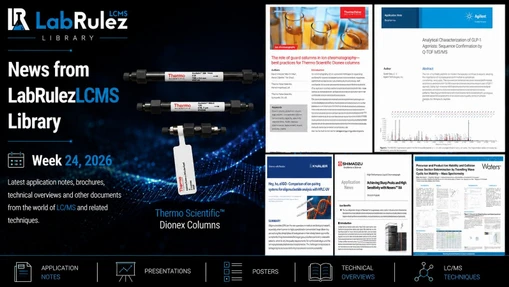
Our Library never stops expanding. What are the most recent contributions to LabRulezLCMS Library in the week of 16th March 2026? Check out new documents from the field of liquid phase, especially HPLC and LC/MS techniques!
👉 SEARCH THE LARGEST REPOSITORY OF DOCUMENTS ABOUT LCMS AND RELATED TECHNIQUES
👉 Need info about different analytical techniques? Peek into LabRulezGCMS or LabRulezICPMS libraries.
This week we bring you application notes by Agilent Technologies, Metrohm and Waters Corporation, technical note by Shimadzu and presentation by Thermo Fisher Scientific!
1. Agilent Technologies: Therapeutic Peptide Analysis of GLP‑1 Agonists
Using an Agilent Altura Peptide Plus column and an Agilent InfinityLab Pro iQ Plus
- Application note
- Full PDF for download
The integrity of synthetic peptide therapeutics is critical in the biopharmaceutical industry, demanding strict analytical control to ensure the safety and effectiveness of the final product. Confirming peptide identity through molecular weight analysis and assessing purity to detect impurities are basic to this process. For consistent manufacture, regulatory approval, and predictable biological performance, these analyses ensure molecular structure and the absence of impurities resulting from synthesis or degradation.¹ Liquid chromatography coupled with mass spectrometry (LC/MS) is an indispensable technique for this analysis, providing simultaneous high-resolution separation and precise mass identification.
When obtaining peptides from several contract manufacturers, each with different synthesis and purification procedures, thorough examination becomes even more crucial. Therapeutic peptides such as Glucagon-Like Peptide-1 (GLP-1) analogs are often produced by various CMOs or suppliers, each employing distinct solid-phase synthesis methods, protecting group strategies, and purification processes. These variations can lead to a diverse set of product-related impurities, including truncated species and postsynthetic modifications. Therefore, a comparative analysis of peptides from different suppliers is a basic requirement. It ensures uniform quality and confirms that every batch meets the standard specifications for identity, purity, and stability while facilitating supplier qualification.
This study demonstrates the suitability of the Agilent Altura Peptide Plus column for characterizing therapeutic peptides like GLP-1 from various suppliers, with emphasis on identity confirmation and impurity analysis. The column provided high-resolution separations of the main peptide API from its impurities and excellent mass spectrometry compatibility for accurate molecular weight confirmation.
Experimental
Analytical equipment
- Agilent 1290 Infinity II bio LC system, including:
- Agilent 1290 Infinity II bio high-speed pump (G7120A)
- Agilent 1290 Infinity II bio multisampler (G7167B)
- Agilent 1290 Infinity II thermostatted column compartment (G7116B)
- Agilent InfinityLab Pro iQ Plus (G6170A)
- Software Agilent OpenLab CDS (version 2.8)
Results and discussion
Molecular weight and purity
The analysis uses the Altura Peptide Plus column and Pro iQ Plus to confirm the molecular weight and assess the purity profile of four GLP-1 agonists: semaglutide, liraglutide, tirzepatide, and retatrutide. The primary goal is to verify the identity of the target peptide and identify any impurity-related peaks. Figure 1 shows the total ion chromatogram (TIC) and deconvoluted spectra for each of the GLP-1 agonists. The analysis shows a distinct purity profile for each GLP-1 agonist. Semaglutide shows a single, distinct peak in the TIC and deconvoluted spectrum, confirming the identity and indicating a high degree of purity with no significant impurities detected. The TIC for liraglutide is more complex, showing the main liraglutide peak along with five small impurity peaks. While the main compound is confirmed, the sample contains several low-level impurities that separate chromatographically. Tirzepatide presents a single, distinct peak in the TIC, but is accompanied by three coeluting impurities visible in the deconvoluted spectrum. Retatrutide shows a single, distinct peak in the TIC, similar to semaglutide and tirzepatide, but the deconvoluted spectrum reveals two coeluting impurities. The results demonstrate that the Altura Peptide Plus column is well suited for impurity analysis.
Conclusion
The study demonstrates that the Agilent Altura Peptide Plus column coupled with the Agilent InfinityLab Pro iQ Plus provides a robust platform for the analysis of GLP-1 agonists. The workflow effectively confirms molecular weight and identifies distinct impurity profiles for different peptides, highlighting variations in purity levels. Furthermore, the method successfully differentiates impurity patterns across multiple suppliers of liraglutide and tirzepatide, highlighting its value for supplier qualification and quality consistency assessments. This approach supports the rapid assessment of peptide therapeutics, contributing to the development and manufacture of safer and more effective biopharmaceuticals
2. Metrohm: Standardization of cationic surfactants by argentometric titration
- Application note
- Full PDF for download
Accurate assay determination of TEGO®trant with silver nitrate including near-infrared (NIR) quantification model
There are no primary or secondary standard methods for titrating or determining the active substance content of anionic and cationic surfactants. A cationic titrant is standardized using an anionic titrant, and vice versa. In short, the result of this titration is a sum parameter usually specified as «total surfactant content». This value is then used to determine the content in the actual sample. The major weakness of this type of standardization is the significant margin of error one must accept. Because the exact concentration of the titrant is unknown, conclusions about the analyzed sample can only be made with limited accuracy.
EXPERIMENTAL
The determination is carried out using an OMNIS Sample Robot S – WSM, an OMNIS Professional Titrator equipped with OMNIS Dosing Modules, as well as a dAg Titrode along with an OMNIS NIR Analyzer Solid.
CONCLUSION
Potentiometric titration is an accurate and precise method that can be used to standardize the cationic surfactant TEGOtrant. The OMNIS system used in this study is fully automated and enables fast and reliable cationic surfactant titration standardization. The argentometric determination with the digital Ag Titrode is highly accurate. Furthermore, the Ag2 Scoated silver ring increases sensitivity, delivering even better results. When used with the corresponding OMNIS NIR Analyzer Solid, OMNIS Software can easily create a quantification model on a single platform, offering users real added value for the TEGOtrant standardization.
3. Shimadzu: High-Throughput Analysis Enabled by Ultra-Fast Gradient with Nexera X4 × LCMS-8060 Series
- Technical note
- Full PDF for download
Speeding up LC-MS/MS drug concentration measurements in biological samples is critical for pharmaceutical and clinical fields. In particular, drug discovery and pharmacokinetic studies, which handle extremely large numbers of samples, faster analysis directly increases productivity. Faster LC-MS analysis requires shorter frontend LC times. Achieving this also demands multiple instrument capabilities simultaneously, including high gradient responsiveness and reduced system volume.
Nexera X4 Features
Nexera X4 is a next-generation ultra high performance liquid chromatograph (UHPLC) system that builds on technologies developed for previous Shimadzu Nexera series models. In addition, cutting-edge fluid control technology, which enables exceptional solvent delivery consistency for fast analysis under ultra-high pressure conditions, provides highly reliable results.
Low-Capacity Design Enables Fast Gradients
Including the LC-40B X4 solvent delivery unit in the Nexera X4 successfully reduced the pump’s internal volume and enabled a smaller gradient mixer. Consequently, the time required to restore gradients during ultra-fast gradient analysis can be reduced to an absolute minimum.
Conclusions
- Due to the four independently actuated plungers and a pressure feedback mechanism, the LC-40B X4 offers consistent solvent delivery and a stable baseline under ultra-high pressure conditions.
- The Nexera X4 reduces gradient delay during ultra-fast gradient analysis by reducing the system volume.
- Combining Nexera X4’s superior fast gradient capability with UFswitching of the triple quadrupole mass spectrometer delivers a next-generation LC-MS solution offering speed and reliability.
4. Thermo Fisher Scientific: Mastering Single Cell Proteomics: Daily Excellence with μPAC Neo Plus Trap-and-Elute Workflow
- Presentation
- Full PDF for download
Single-cell proteomics has evolved rapidly in recent years, driven by advances in sample preparation, chromatography, and high-resolution mass spectrometry. Modern workflows now enable the identification of thousands of proteins from individual cells, making it possible to investigate biological heterogeneity with unprecedented depth. Central to this progress is the optimization of each analytical step to minimize sample loss and maximize sensitivity, as illustrated by the integrated workflow combining nanoLC separation, advanced MS acquisition strategies, and robust data processing approaches.
The presentation highlights the role of µPAC Neo Plus pillar-array LC columns in enhancing separation efficiency for low-input proteomics. Their perfectly ordered microfabricated structure improves peak sharpness and sensitivity at nano-flow rates, enabling deeper proteome coverage even from highly dilute samples. Coupled with optimized flow-rate strategies and trap-and-elute workflows, these columns help balance sensitivity and instrument productivity—critical factors in routine single-cell studies.
Comparative experiments demonstrate that miniaturized LC-MS conditions significantly increase ionization efficiency and signal intensity, while optimized injection and gradient strategies can maintain throughput without compromising analytical performance. In practical applications, workflows combining variable flow rates, optimized trapping, and Orbitrap-based detection systems allow comprehensive characterization of biological processes, reaching approximately 2,000 protein groups per cell in routine experiments.
Overall, the work emphasizes that successful single-cell proteomics requires a holistic approach—integrating optimized hardware, chromatographic strategies, and data-analysis tools. With continued improvements in instrumentation and workflow design, these methods are expected to play an increasingly important role in biopharmaceutical research, clinical biomarker discovery, and systems biology studies.
5. Waters Corporation: Analytical Quality by Design Method Development and Optimization of an Impurity Profiling Method for GLP-1 Receptor Agonist Exenatide
- Application note
- Full PDF for download
Benefits
- Systematic identification and control of critical method parameters impacting separation of exenatide impurities using a structured, ICH Q14 aligned AQbD workflow.
- Improved accuracy of peak tracking during extensive screening and optimization studies using the ACQUITY QDa™ II Mass Detector with complementary UV detection.
- Accelerated method development by leveraging the ACQUITY Premier UPLC System for rapid screening, followed by method scaling to the Alliance iS Bio HPLC System to support routine quality control applications.
The control and characterization of process- and product-related impurities are critical components of pharmaceutical development. Impurities can originate from raw materials, manufacturing processes, degradation pathways, or storage conditions, and their presence may impact product safety, efficacy, and stability. Consequently, regulatory agencies require robust, well-understood analytical methods capable of reliably detecting and monitoring impurities throughout product development and routine quality control. For peptidebased therapeutics such as exenatide, impurity analysis is particularly challenging due to the presence of structurally similar degradants and closely eluting species under RPLC conditions.
To address these challenges, an AQbD approach, as described in ICH Q14, was applied to provide a structured, science-based framework for analytical procedure development.1 Unlike traditional one-factor-at-a-time approaches, AQbD integrates risk assessment and DoE to systematically evaluate the impact of key method parameters on analytical performance. Within this framework, method development is guided by the establishment of method goals, identification of CMPs, and the application of DoE to understand parameters effects and interactions. The ultimate objective is to establish a MODR within which the analytical method consistently meets its intended performance criteria.
In this application note, an AQbD workflow is demonstrated for the development and optimization of an impurity profiling method for exenatide. As shown in Figure 1, research-grade exenatide contained several process-related impurities. To further characterize potential degradation pathways, exenatide was thermally stressed at 50 °C for 7 days to generate a more complete impurity profile.2,3 Method development was initially performed on an ACQUITY Premier UPLC System, leveraging small particle size columns to achieve higher separation efficiency and shorter run times. For long-term routine use in regulated laboratories, the method was scaled to an HPLC column to be compatible with the Alliance iS Bio HPLC System, enabling the use of several error reducing tools designed to improve efficiency in quality control environments. This study integrates risk assessment, DoE driven method screening and optimization, complementary UV and mass-based detection for impurity tracking, and scaling from UPLC to HPLC systems. Together, these elements enabled the development of a method capable of reliably separating process and product related impurities suitable for routine impurity monitoring.
Experimental
Method Development Conditions
- LC system: ACQUITY Premier System
- Detection: TUV Detector λ = 220 nm and ACQUITY QDa II Mass Detector 400-1,500 m/z
- Columns: ACQUITY Premier Peptide BEH™ C18 Column, 130A, 1.7µm, 2.1 x 100 mm (p/n: 186009482) ACQUITY Premier Peptide CSH™ C18 Column, 130A, 1.7µm, 2.1 x 100 mm (p/n: 186009488)
Final Method Conditions
- LC system: Alliance iS Bio HPLC System
- Detection: TUV Detector, λ = 220 nm
- Column: XSelect™ Premier Peptide CSH C18 Column, 130A, 2.5µm, 4.6 x 150 mm (p/n: 186009909)
Software
- Chromatography data system: Empower™ 3.8.1 Software
- Method development software: Fusion QbD™ Software (S-Matrix Corporation, Version 9.9.2 SR3.b)
Conclusion
This study demonstrates the effective application of an AQbD-based approach, consistent with the major principles outlined in ICH Q14, to systematically develop and optimize an impurity profiling method for exenatide. Through a structured screening and optimization strategy, key chromatographic variables influencing impurity detectability and separation were identified, enabling the detection of 20 process- and product-related impurities. The combined use of complementary UV and mass-based detection for impurity tracking, together with Fusion QbD Software for multivariate modeling, Pareto ranking, and resolution visualization maps, enabled data-driven decision making and establishment of a MODR. Evaluation of multiple system suitability metrics such as USP resolution and peak-to-valley ratio improved discrimination between partially resolved impurities and strengthened method understanding during optimization. Experimental verification of multiple MODR points demonstrated comparable method performance across the defined operating space. Overall, the developed method provides reliable separation of the majority of relevant exenatide impurities and is suitable for routine impurity monitoring on the Alliance iS Bio HPLC System.