News from LabRulezLCMS Library - Week 19, 2026
LabRulez: News from LabRulezLCMS Library - Week 19, 2026
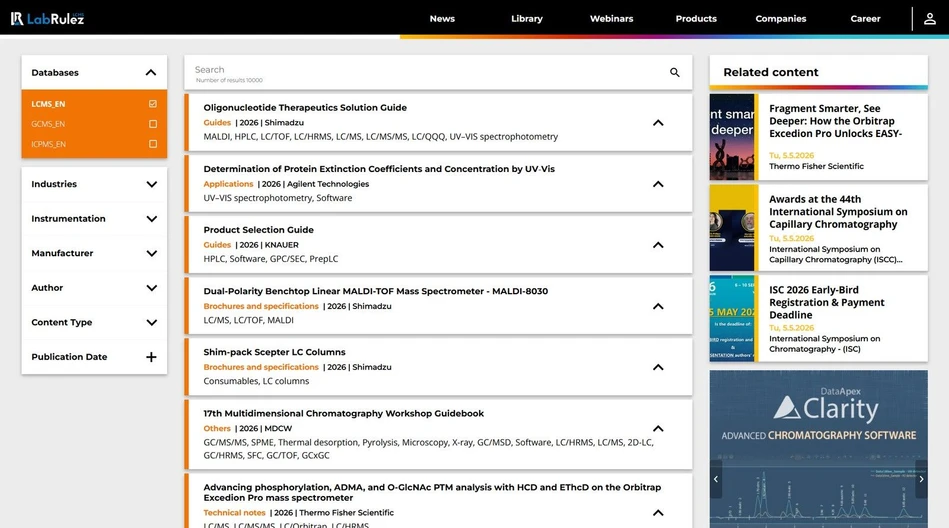
Our Library never stops expanding. What are the most recent contributions to LabRulezLCMS Library in the week of 4th May 2026? Check out new documents from the field of liquid phase, especially HPLC and LC/MS techniques!
👉 SEARCH THE LARGEST REPOSITORY OF DOCUMENTS ABOUT LCMS AND RELATED TECHNIQUES
👉 Need info about different analytical techniques? Peek into LabRulezGCMS or LabRulezICPMS libraries.
This week we bring you application notes by Agilent Technologies, Metrohm and Thermo Fisher Scientific, technical note by Shimadzu and poster by Waters Corporation / AAPS!
1. Agilent Technologies: Authenticity Evaluation of Insect Protein-Containing Food Products
- Application note
- Full PDF for download
The increasing demand for sustainable and alternative protein sources has led to the rise of novel foods, of which insect-based products are gaining traction.1 Among edible insects, Acheta domesticus (house cricket) stands out due to its favorable nutritional profile, ease of farming, and regulatory acceptance.2,3 Cricket-derived ingredients are now incorporated into various consumer products, such as protein bars, offering high protein content with a lower environmental footprint compared to traditional animal proteins.2,4
However, incorporating insect proteins into the food chain raises questions related to species authentication, product labeling (both when insect proteins are present and when they are absent), compliance with evolving regulatory frameworks, and the management of potential allergenic risks. To address these challenges, advanced analytical techniques such as liquid chromatography/mass spectrometry (LC/MS) are required. This approach enables comprehensive protein profiling and the identification of species-specific peptide markers, even in highly processed food matrices. In the current application note, the Agilent 1290 Infinity III Bio LC and Agilent 6545XT AdvanceBio LC/Q-TOF were used to support the identification of insect-derived proteins in processed food matrices.
Results and discussion
LC/MS was employed for the taxonomic authentication of insect-derived ingredients in a selection of commercially available cricket-based protein bars. Prior to protein extraction, samples were cryogenically ground and delipidated using hexane to remove interfering lipids and improve extraction efficiency. Isolated proteins were subsequently reduced, alkylated, and digested with trypsin before LC/MS analysis. Peptides were separated on an octadecyl reversed‑phase column over a 90-minute acetonitrile gradient, and MS/MS data were collected in data‑dependent acquisition mode. Total ion chromatograms (TICs) of the tryptic digests are displayed in Figure 1.
Chromatographic profiles varied substantially across the different protein bars. The resulting MS/MS data were subsequently subjected to protein database searching. On average, over 78,600 MS/MS spectra (n = 3) were submitted, and over 8750 MS/MS spectra could be confidently assigned to peptides. This corresponds to an average identification rate of approximately 11%, which is typical for high-complexity food matrices such as protein bars (Table 4).
Conclusion
This application note highlights the power of LC/MS for authenticating A. domesticus in commercial protein bars. The combination of the Agilent 1290 Infinity III Bio LC and Agilent 6545XT AdvanceBio LC/Q-TOF offers a robust, precise, and biocompatible front-end with a high-resolving, accurate, and sensitive backend incorporating smart data‑dependent acquisition. Species-specific peptides from Apolipophorin-III and Tropomyosins were confidently identified using curated databases and taxonomic tools. The consistent detection of five peptides supports their role as robust markers for A. domesticus, with particular attention to peptides LQEASEAADEAQKR and ALQTAEGEIAALNR, which may be relevant for allergen monitoring. Beyond species authentication, the workflow also enables verification of major ingredients, supporting label compliance and demonstrating the method's value for food transparency and safety in complex matrices.
2. Metrohm: Photometric titration of acid value in biodiesel according to EN 14104
Fast and reliable determination of acid value in fatty acid methyl ester (FAME) with the Optrode following EN 14104
- Application note
- Full PDF for download
FAME (biodiesel) is a type of fuel produced by transesterification of glycerides present in vegetable or animal fats and oils, as well as in organic waste with monohydric alcohols like methanol or ethanol. In simplified terms, the production process is based on the following reaction: Oils/Fats + Alcohol → Biodiesel + Glycerine
Compared to petroleum-based diesel, biodiesel produces fewer emissions and is considered sustainable and climate-friendly. It is primarily made from renewable resources, is biodegradable, and has good lubricating properties. The acid value in biodiesel should be determined as a quality control measure. Low values are associated with good quality biodiesel, while high values indicate poor quality and a higher likelihood of corrosion from the fuel.
EXPERIMENTAL
The determinations are carried out on an OMNIS Professional Titrator equipped with OMNIS Dosing Modules (Figure 1) as well as an Optrode M2. An appropriate amount of sample is weighed into the titration beaker, and pre-neutralized 2-propanol as well as phenolphthalein solution are added. The solution is titrated until after the first break point with standardized potassium hydroxide in 2-propanol.
CONCLUSION
Photometric titration is a fast and reliable test method for determining the acid value of fatty acid methyl ester (FAME). The glass coating of the Optrode is insensitive to chemicals and raw materials (e.g., biodiesel itself), making it ideal for this purpose. Thanks to the individually adjustable wavelength of the Optrode and the reliable OMNIS Software, acid value determination according to EN 14104 can be achieved even in very low measuring ranges.
3. Shimadzu: Retention Time Repeatability in Peptide Mapping under Shallow Gradient Conditions Using Nexera X4
- Technical note
- Full PDF for download
Typically, when checking the quality of proteins used in biopharmaceuticals, the proteins are digested with enzymes and then peptide mapping is used to analyze the resulting peptide fragments. Because peptide mapping requires separating and analyzing such a wide diversity of peptide types at once, the analysis time becomes long and shallow gradient conditions are typically used. Under such shallow gradient conditions, the solvent delivery unit must provide extremely accurate and stable solvent delivery performance to ensure retention time repeatability.
Nexera X4 Features
The Nexera X4 is Shimadzu’s next-generation ultra high performance liquid chromatograph (UHPLC) system based on technologies cultivated for previous Nexera series models. Due to its cutting-edge fluid control technology, the Nexera X4 offers outstanding solvent delivery stability even for analyses that require especially accurate delivery, such as shallow gradient analysis.
Advanced Solvent Delivery Algorithm Reduces Pulsation
The LC-40B X4 is a binary gradient pump with 4 independently actuated plungers and a new pressure feedback mechanism. By actuating each plunger independently to optimize the timing of mobile phase suctioning/discharging actions, the pump significantly reduces pulsation originating from the pump. In general, retention times tend to fluctuate especially when the solvent B concentration is extremely low or the gradient is shallow, but the LC-40B X4 pump achieves outstanding repeatability.
Conclusions
- The LC-40B X4 solvent delivery unit achieves stable solvent delivery and baseline stability even under ultra-high pressure conditions, thanks to its 4 independently actuated plungers and pressure feedback mechanism.
- SPD-M40 X4 detector features a newly designed capillary cell and optical system that reduce the refractive index effect during gradient analysis.
- Nexera X4 include superior gradient control technology that achieves excellent retention time repeatability for peptide mapping with a shallow gradient.
4. Thermo Fisher Scientific: Early-stage drug metabolite quantitation without radiolabels
- Application note
- Full PDF for download
Application benefits
- Method allows quantitation of metabolites without radiolabeling.
- Method is ideal for quantitation of metabolites early in the drug development process, without the need for reference standards for each component.
- Quantitation of the parent compound and all nonvolatile metabolites down to nanogram levels is achieved due to the wide dynamic range of the Thermo Scientific™ Vanquish™ Charged Aerosol Detector P series.
- The diverter valve allows the user to switch between CAD and the MS for comparison purposes.
Early prediction of drug metabolism by cytochrome P-450 in the liver is key to the drug development process. Significant formation of toxic metabolites will force any promising candidate out of the development pipeline. The key step is quantitation to determine if a substance is present at levels above a certain threshold of concern. Any peak greater than the threshold must be identified in extensive tests with mass spectrometry (MS) and sometimes even tested for toxicity in animal models. The critical quantitation step is complicated by the fact that standards do not usually exist for new, unexpected metabolites.
The gold standard for metabolite quantitation is the use of radiolabeled substrates, such that the metabolites are radioactive and can be quantified using a radiometric detector. When labs choose to forgo the time-consuming synthesis of expensive radioactive substrates and the preparation of the lab space to handle radioactive substances, several options for quantification exist. Quantitation by high performance liquid chromatography (HPLC) with MS without standards for each peak is complicated because ionization efficiency, and therefore MS response, depends on chemical structure.
Quantitation by ultraviolet (UV) detection without standards can also yield inconsistent results because detector responses vary based on the structure of the chromophore. Quantitation by evaporative light scattering detection (ELSD) is possible without a standard, but the methods are often insufficiently sensitive, and response depends on chemical properties such as refractive index. Quantitation by charged aerosol detector (CAD) provides the most consistent response across all nonvolatile and some semivolatile analytes of all HPLC detection techniques. The detector works by evaporating the solvent, charging the remaining analyte particles in proportion to their mass, and measuring the resulting electrical signal, providing a nearuniversal response that is independent of light scattering (unlike ELSD).
An inverse gradient compensation (IGC) was implemented to ensure a constant mobile phase composition at the detector, despite the gradient, and to maximize the CAD quantitation performance. The performance of the method presented here was evaluated using clozapine, whose metabolites retain the UV chromophore and for which both the UV and CAD estimations are quite accurate. This analysis can easily be transferred to a substance for which the metabolites have no good UV chromophore and for which the chromophore-independent CAD quantitation shows advantages over UV. During the study, the application was optimized to take advantage of improvements in the Vanquish Charged Aerosol Detector P series (CAD P). The changes made included use of the diverter valve to switch the salt-rich matrix to waste to protect the detector from contamination, collection of data simultaneously on four channels with different power values (PVs) to optimize the system for a linear response, use of coupling mode to bring the temperature of the charging-detection module down to 5 °C above the evaporation tube temperature, and use of the diverter valve to switch between the CAD and the MS.
Experimental
Instrumentation Vanquish Flex UHPLC system consisting of:
- Thermo Scientific™ Vanquish™ System Base (Cat. No. VF-S01-A)
- Thermo Scientific™ Vanquish™ Dual Gradient Pump F (Cat. No. VF-P32-A)
- Thermo Scientific™ Vanquish™ Split Sampler F (Cat. No. VF-A10-A)
- Thermo Scientific™ Vanquish™ Column Compartment H (Cat. No. VH-C10-A)
- Thermo Scientific™ Vanquish™ Diode Array Detector F (Cat. No. VF-D11-A)
- Thermo Scientific™ Vanquish™ Standard Flow Cell, 13 μL, path length 10 mm, SST (Cat. No. 6083.0510)
- Thermo Scientific™ Vanquish™ Charged Aerosol Detector HP (Cat. No. VH-D21-A)
- Thermo Scientific™ ISQ™ EM mass spectrometer (Cat. No. ISQEM-ESI)
- Thermo Scientific™ Viper™ TQ Capillary Kit for Vanquish Inverse Gradient Systems (Cat. No. 6036.2010A)
Conclusion
The presented method advances early-stage drug metabolite quantitation by eliminating the need for radiolabeling and metabolite reference standards. The integrated diverter valve enhances flexibility by enabling automatic switching between CAD for quantitative analysis and MS for qualitative metabolite confirmation without user interaction. While UV detection can be applied using a single calibrant, differences in chromophoric response may result in over- or underestimation. MS provides compound confirmation but is not suitable for single-calibrant quantitation due to variable ionization efficiency. Overall, the CAD offers the most uniform quantitation compared to UV and MS for these kind of applications.
The study yielded the following results for the CAD method:
- Optimal results were achieved at incubation time of 180 min, EvapT of 25 °C, and PV of 1.5.
- Limit of quantitation is 0.67 ng/µL or 3.4 ng on column, based on the lowest calibration standard measured.
- Recovery for total peak area of target compounds was 93%.
- Metabolite quantitation results ranged from < LOQ to 1.52 ng/µL
5. Waters Corporation / AAPS: Understanding how UHPLC System Characteristics Effect Going Green with Regulated Methods
- Poster
- Full PDF for download
This study focuses on how UHPLC system characteristics influence the environmental impact (“going green”) of regulated liquid chromatography methods, particularly in pharmaceutical analysis. Traditional HPLC with optical detection is associated with high solvent consumption, making it less environmentally friendly, especially in high-throughput laboratories. The study highlights that switching to ultra-high-performance liquid chromatography (UHPLC) can significantly reduce solvent usage due to shorter columns, lower flow rates, and faster analysis times. However, successful method transfer requires a thorough understanding of system-specific parameters such as dwell volume and dispersion .
The experimental work is based on a USP method for amlodipine besylate and its organic impurities, using a Waters ACQUITY BEH C18 (2.1 × 50 mm, 1.7 µm) column and multiple LC platforms, including ACQUITY UPLC I-Class and H-Class systems, other UHPLC systems, and an Alliance iS HPLC system . The method employs gradient elution with aqueous phosphate buffer and methanol, a flow rate of 0.5 mL/min, and UV detection. The study compares system suitability and chromatographic performance across instruments with varying dwell volumes, demonstrating how these differences directly affect retention times and peak shapes.
Results show that UHPLC systems generally meet system suitability requirements without modification, delivering fast and efficient separations. In contrast, systems with larger dwell volumes (e.g., up to ~1000 µL and beyond) exhibited chromatographic issues such as delayed elution, distorted peaks, and insufficient re-equilibration between injections. As illustrated in the chromatograms and overlays on the poster (e.g., Figures 2–4), retention time is inversely correlated with dwell volume, and improper equilibration can lead to peak distortion or loss . These issues were successfully mitigated through method adjustments such as extending gradient hold times or applying “next injection delay” and “gradient start” features to compensate for system delay volume.
In conclusion, the study demonstrates that UHPLC offers clear advantages in speed, efficiency, and sustainability, but method transfer between LC systems requires careful optimization of system-dependent parameters. Importantly, modern high-pressure HPLC systems (e.g., Alliance iS) can also run methods with sub-2 µm particles, enabling greener operation without full UHPLC upgrades. The key takeaway is that understanding and compensating for dwell volume differences is essential to maintain chromatographic performance and ensure reliable, transferable analytical results across different LC platforms.