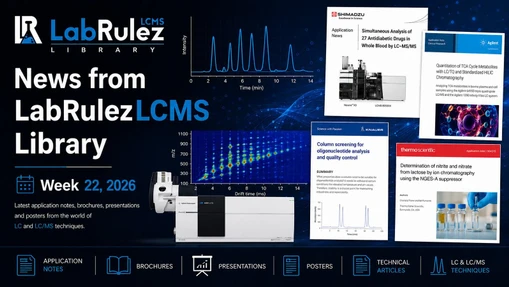
News from LabRulezLCMS Library - Week 17, 2026
LabRulez: News from LabRulezLCMS Library - Week 17, 2026
Our Library never stops expanding. What are the most recent contributions to LabRulezLCMS Library in the week of 20th April 2026? Check out new documents from the field of liquid phase, especially HPLC and LC/MS techniques!
👉 SEARCH THE LARGEST REPOSITORY OF DOCUMENTS ABOUT LCMS AND RELATED TECHNIQUES
👉 Need info about different analytical techniques? Peek into LabRulezGCMS or LabRulezICPMS libraries.
This week we bring you application notes by Agilent Technologies, KNAUER, Shimadzu and Waters Corporation and technical note by Thermo Fisher Scientific!
1. Agilent Technologies: Sensitive and Repeatable Analysis of InstantPC-labeled N-Glycans from Human Immunoglobulin G
Enabling confident detection and quantification of low-abundance IgG glycans with UHPLC peak fidelity and excellent run-to-run precision
- Application note
- Full PDF for download
Many biopharmaceuticals are glycosylated proteins such as monoclonal antibodies, Fc fusion proteins, and other antibody-based proteins These proteins are a powerful class of biopharmceuticals.1,2
A key characteristic of these proteins is their glycosylation, whereby a carbohydrate structure is bound to a specific asparagine residue within the amino acid sequence of the antibody. The resultant glycosylation is referred to as N-glycan. Glycosylation, a fundamental post-translational modification, exerts a substantial influence on stability, solubility, immunogenicity, pharmacokinetics, and effector functions of biopharmaceuticals, thereby rendering glycosylation a critical quality attribute. Therefore, it is essential to understand and control the glycosylation patterns to ensure product quality and consistency during manufacturing.1,2,3
To achieve these goals, a suitable analytical method for a protein glycosylation pattern analysis is required. However, this task is often quite challenging, because many glycan analytes occur only in low abundance in complex biological samples. To overcome this challenge, a sensitive and repeatable analytical method is needed.4
This application note demonstrates the high sensitivity for lowest limits of detection (LODs) and lowest quantification limits (LOQs), as well as repeatability, that can be achieved with an Agilent 1290 Infinity III Fluorescence Detector (FLD) within an Agilent 1290 Infinity III Bio LC System for N-glycan analysis—delivering UHPLC peak fidelity with minimal dispersion and high-confidence quantification of low‑abundance glycoforms. This method requires derivatization of released N-glycans with a tag to allow detection by fluorescence. In this instance, N-glycans of human immunoglobulin G (HuIgG) derivatized with InstantPC (IPC) were used.
To assign glycans, glycan symbol structures were used according to the Consortium for Functional Glycomics (CFG) (see Figure 1). The Oxford glycan nomenclature and the biopharma mAb style were used for the assigned glycans.
Equipment
The Agilent 1290 Infinity III BioLC comprised the following modules:
- Agilent 1290 Infinity III Bio High-Speed Pump (G7132A)
- Agilent 1290 Infinity III Bio Multisampler (G7137A)
- Agilent 1290 Infinity III Multicolumn Thermostat (G7116B) equipped with an Agilent Quick Connect Bio Heat Exchanger Standard Flow (G7116-60071)
- Agilent 1290 Infinity III Fluorescence Detector (FLD) (G7123B), equipped with a 2 µL FLD cell (G7123-60500)
Software
- Agilent OpenLab CDS version 2.8 or later versions.
Columns
- Agilent AdvanceBio Amide HILIC, Rapid Resolution HD, 2.1 × 150 mm, 1.8 Micron (part number 859750-913).
Conclusion
The Agilent 1290 Infinity III Bio LC System, equipped with an Agilent 1290 Infinity III FLD, has been demonstrated to exhibit excellent overall performance in terms of repeatability, sensitivity, and low peak dispersion for the analysis of IPC‑labeled N-glycans. These results are substantiated by the low retention time and peak area relative standard deviations, as well as the low LOD and LOQ values. The 1290 Infinity III FLD is distinguished by its high linear dynamic range, enabling accurate quantification across a wide concentration range and supporting both abundant and low-level glycoforms in a single method. By combining UHPLC peak fidelity with high sensitivity and repeatability, the system reduces reruns and troubleshooting, lowers the cost per compliant result, and recovers analytical capacity. Importantly, the achieved LOD/LOQ and precision provide the confidence needed for defensible decisions at the limit—positioning the 1290 Infinity III FLD as a fluorescence detector of choice for UHPLC N-glycan characterization workflows.
2. KNAUER: Sandwiches for all – benefits and injection principles of the KNAUER Liquid Handler LH 8.1
- Application note
- Full PDF for download
The KNAUER LH 8.1 is an analytical, modular and customizable XYZ autosampler (Fig. 1). It combines the main functions of an autosampler, sample storage and sample injection, with additional options for high sample capacity, customizability, liquid handling and sample preparation.
Using sandwich mode means that only the amount of sample that will be injected is aspired by the syringe. The sample is trapped between air gaps and transport solvent plugs (Fig. 2), preventing peak broadening already during the injection process. This injection mode provides very high precision and none of your sample gets lost.
LH 8.1 supports also “Full Loop” injection mode. Here, the sample loop is filled completely with the sample and maximum injection precision is achieved.
CONCLUSION
The liquid handler LH 8.1 combines the benefits of a “traditional” liquid handler and an autosampler. Modular design, high sample capacity as well as outstanding analytical performance are only some of the customers’ benefits. The sandwich injection mode provides the same values for repeatability as a full loop injection but without any sample loss. Finally, we were able to show that sandwiches are a good choice, also in HPLC.
3. Shimadzu: Rapid and Simple Analysis of LNP-Encapsulated mRNA Using a Microchip Electrophoresis System
- Application note
- Full PDF for download
User Benefits
- Automates gel preparation, sample application, and data acquisition for nucleic acid electrophoresis.
- Enables rapid and simple measurement of LNP-encapsulated mRNA samples without purification.
- Provides highly sensitive mRNA analysis.
Recently, medical technology utilizing mRNA has advanced rapidly. In addition to infectious disease vaccines, mRNA is gaining attention in fields such as cancer vaccines and gene therapy. Since mRNA is a large, negatively charged molecule with poor cell membrane permeability, delivery technology is essential for efficient transport into cells. Currently, Lipid Nanoparticles (LNPs) are primarily used as Drug Delivery Systems (DDS). This technology protects mRNA from extracellular degradation and enables efficient intracellular transport.
LNP-encapsulated mRNA (mRNA-LNP) formulations are expected to serve as treatments for various diseases; however, quality control in their manufacturing and storage has become a critical challenge. The quality of mRNA-LNP formulations directly impacts their safety, efficacy, and stability. Therefore, establishing appropriate analytical methods for quality evaluation is essential for improving product reliability and ensuring compliance with regulatory standards.
Methods for confirming mRNA purity include agarose gel electrophoresis and capillary electrophoresis; however, these can be disadvantageous due to the time required for preparation and analysis, or insufficient resolution. In contrast, the Microchip Electrophoresis System MultiNATM II (Fig. 1) automates the entire processfrom gel preparation to sample loading and data analysis. It enables rapid analysis with a migration time of approximately 100 seconds per sample. This application presents an example of simple and rapid analysis of mRNA-LNP using the MultiNA II without the need for pretreatment.
Conclusion
This application demonstrates the simple and rapid analysis of mRNA-LNP size, concentration, and purity using the Microchip Electrophoresis System MultiNA II. The MultiNA II automates the entire process from gel preparation to sample loading and data analysis for mRNA sample evaluation. In accordance with the USP draft guidelines, it was confirmed that mRNA-LNP detection is possible by adding Triton X-100 as a surfactant and applying heat treatment, without the need for lipid removal. This method enables the simple and rapid evaluation of mRNA-LNP, which is expected to contribute to improving the efficiency of mRNA pharmaceutical development.
4. Thermo Fisher Scientific: Unlocking biological insights with the Stellar mass spectrometer for Adaptive RT-enhanced quantitative proteomics for plasma biomarker analysis
- Technical note
- Full PDF for download
The development of targeted assays to monitor biomedically relevant proteins is crucial for translating discovery experiments into large-scale clinical studies. However, current targeted assays struggle to scale up to hundreds or thousands of targets. To address this challenge, the Thermo Scientific™ Stellar™ Mass Spectrometer, combined with Skyline Software, was employed to successfully generate large-scale assays.
With hyper-fast acquisition speeds, the Stellar mass spectrometer handles shifting retention times typically observed over the course of large longitudinal studies through a real-time retention time alignment mode called Adaptive RT. This feature automatically adjusts the retention time window for targeted analytes, so an eluting peak is never missed. This enables the acquisition of the target at the sensitivity and speed required while also allowing for the management of numerous concurrent targets that are typically possible without Adaptive RT. Without Adaptive RT, the acquisition window for a peak is typically 2 minutes wide to reliably capture the peak despite day-to-day variations in chromatography. With Adaptive RT, this acquisition window can be reduced to 0.6 minutes or less, allowing more targets to be added to the method.
Another key feature of the Stellar mass spectrometer is the option to perform MS3 fragmentation. This enables additional fragmentation of the MS2 product ions of interest, which improves the signal-to-noise ratio (S/N) by reducing interferences. This results in improved sensitivity that is not achievable with typical triple-stage quadrupole mass spectrometers and is only possible with an ion trap mass analyzer made available on the Stellar mass spectrometer.
Leveraging the advanced features of the Stellar mass spectrometer, we developed a cutting-edge multiplex targeted proteomics method with Adaptive RT functionality in two to three days, using peptides from the Biognosys PQ500™ Reference Peptides Kit as heavy standards. This innovative method was then applied to the quantification of potential protein biomarkers in plasma samples from patients with lung cancer, Alzheimer’s disease (AD), and colorectal cancer (CRC).
Experimental approach
Instrumentation
- Thermo Scientific™ Vanquish™ Neo™ UHPLC System
- Stellar mass spectrometer
- Thermo Scientific™ Easy-Spray™ Source
Conclusions
The Stellar mass spectrometer platform represents a significant advancement in mass spectrometry-based proteomics, offering exceptional precision, linearity, and sensitivity. This technology facilitates the analysis of over 1,600 peptide precursors using MS2 and MS3 assays within a 30-minute gradient, enabling the identification of 322 endogenous proteins and 507 peptides in total in both disease and healthy plasma, including 57 FDAapproved biomarkers. The MS3 assay significantly enhances the S/N for low-abundant peptides or those with interference, resulting in the identification of 10.3% more proteins. The Adaptive RT function and a 0.65-minute scheduled RT window ensure the successful capture of all 804 peptides without the need for rescheduling retention time windows during analysis.
The Stellar mass spectrometer platform’s advanced linear ion trap analyzer allows for extremely rapid and sensitive PRM and MS3 targeting, achieving high reproducibility and low coefficients of variation. This capability is crucial for clinical applications, as it enables the accurate quantification of multiple biomarkers, from hundreds of micrograms per milliliter to picograms per milliliter in a single run. The platform’s high sensitivity and specificity make it ideal for longitudinal studies and real-time monitoring of disease progression, bridging the gap between proteomics discovery and routine clinical testing.
Significantly altered proteins influencing CRC progression were identified, with proteins such as CO9 and A2GL significantly increased in the plasma of CRC patients compared to healthy controls. This underscores the platform’s potential in identifying clinically relevant biomarkers. The Stellar mass spectrometer platform’s advanced capabilities make it an indispensable tool for clinical laboratories aiming to enhance their diagnostic and prognostic capabilities, ultimately driving the future of precision medicine.
Key takeaways
- Innovative PRM methods on the Stellar mass spectrometer: Developed large-scale targeted PRM methods on the Stellar mass spectrometer, showcasing exceptional precision, linearity, and sensitivity.
- Comprehensive peptide analysis: Analyzed over 1,600 peptide precursors using MS2 and MS3 assays within a swift 30-minute gradient.
- Extensive protein identification: Identified 322 endogenous proteins and 507 peptides in both disease and healthy plasma using MS2 and MS3 methods, including 57 FDAapproved biomarkers.
- Enhanced detection with MS3 assay: The MS3 assay significantly improved the S/N for low-abundant peptides or those with interference, resulting in the identification of 10.3% more proteins.
- Efficient peptide capture: Successfully captured all 804 peptides using an Adaptive RT function and a 0.65-minute scheduled RT window, eliminating the need for rescheduling retention time windows during analysis.
- CRC biomarker discovery: Identified significantly altered proteins influencing CRC progression, with notable increases in proteins such as CO9 and A2GL in the plasma of CRC patients compared to healthy controls, highlighting their potential as biomarkers for CRC.
5. Waters Corporation: Automating Charged Aerosol Detection (CAD) Analysis with Empower™ CDS Using a Single-Vendor Integrated LC Platform
- Application note
- Full PDF for download
Benefits
- Single vendor CAD-based workflow facilitates evaluation and processing of CAD data within the Empower CDS as compliant-ready solution.
- Simultaneous acquisition of CAD power function values enables rapid method optimization for increased productivity.
- Objective data review in a semi-automated fashion using CDS software processing/reporting functionality to expedite data interpretation and method development.
Waters CAD was engineered to deliver robust performance, ease of deployment, and simplified serviceability while maintaining compatibility with existing LC methods. Fully integrated and controlled within the Empower CDS, Waters CAD can be seamlessly combined with optical detectors and mass detection to support flexible, information rich workflows in the analysis of biotherapeutics (Figure 1).
In this study, an integrated, Empower CDS based orthogonal detection platform incorporating Waters CAD is introduced using lipid nanoparticles as a case study. This data‑driven workflow enables rapid review of results and calibration modeling to efficiently identify optimal power‑function settings for increased accuracy and robustness in CAD-based analyses. By supporting objective data assessment within a compliant‑ready CDS, the workflow improves analytical efficiency and decision‑making, making it well-suited for manufacturing environments where speed, reliability, and data integrity are critical.
Experimental
All lipids in this study were used for research and demonstration purposes and were purchased from the following vendors: cholesterol and DSPC from Sigma-Aldrich; DMG-PEG 2000 and SM-102 from Cayman Chemical. Stocks of each lipid were prepared in methanol at 5 mg/mL and diluted to the appropriate concentration at 90/10 methanol/water (v/v). Samples were separated with the ACQUITY™ Premier UPLC™ System using a prototype RP 230 Å Pheny-hexyl+, 1.6 um, 2.1 x 50 mm MaxPeak™ Premier Column at 50 °C over a 6-minute gradient. Optical data were acquired with UV detection. Data acquisition and analysis were performed in Empower CDS.
Conclusion
The ability to evaluate and linearize multiple analyte response curves within the Empower CDS provides several practical benefits for analytical method development, including simplified calibration strategies, improved quantitative robustness, and enhanced suitability for regulated environments. With the proposed structured approach for CAD-based workflows, Empower CDS enables a complete, compliant workflow for CAD method optimization and quantitation featuring rapid analysis, statistical rigor, and full traceability. This framework not only accelerates development of robust quantitative methods for LNP analysis but also reduces reliance on subjective judgment and manual intervention.