

News from LabRulezLCMS Library - Week 03, 2026
LabRulez: News from LabRulezLCMS Library - Week 03, 2026
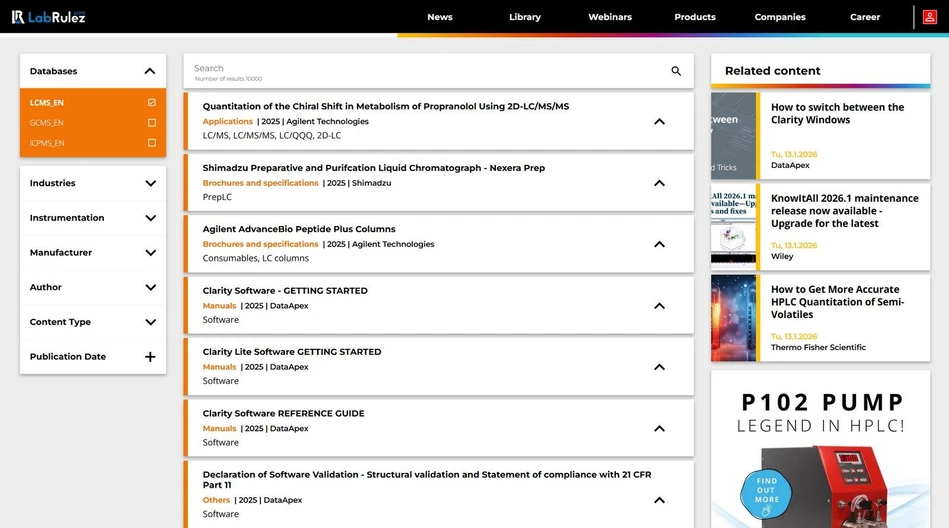
Our Library never stops expanding. What are the most recent contributions to LabRulezLCMS Library in the week of 12th January 2026? Check out new documents from the field of liquid phase, especially HPLC and LC/MS techniques!
👉 SEARCH THE LARGEST REPOSITORY OF DOCUMENTS ABOUT LCMS AND RELATED TECHNIQUES
👉 Need info about different analytical techniques? Peek into LabRulezGCMS or LabRulezICPMS libraries.
This week we bring you application notes by Agilent Technologies, Shimadzu, Waters Corporation and poster by Thermo Fisher Scientific / HPLC!
1. Agilent Technologies: B Vitamin Analysis in Dietary Supplements on the Agilent 1290 Infinity III LC System
Using ion-pairing reagent and supported by time‑saving automation of routine tasks using the Agilent InfinityLab Assist
- Application note
- Full PDF for download
There is a huge variety of (multi)vitamin supplements on the market, with different vitamin combinations and different concentrations available. To ensure that the claimed vitamin contents are met, analysis of those supplements is necessary.
To ensure constant and good analytical performance, preparation of the analytical system is fundamental. There are different approaches to preparing the system for analysis. Purging the solvent lines from bottle to pump removes possible air bubbles, especially after longer breaks between instrument usage or changing eluent to the ion-pairing and buffer-containing eluent after the weekend. Equilibration can either be done by a calculated time (10–20 column volumes)1 , set as a fixed experimentally determined value, or manually monitored. Using a fixed time for equilibration can lead to unnecessary high solvent consumption, as equilibration may already be established and no monitoring was previously done. In contrast, manual monitoring of equilibration can be time-consuming and error-prone. For example, if there are no written rules regarding key points for equilibration of the column, its determination can be subjective (constant pressure and baseline of e.g. UV absorption).
As vitamins are grouped according to their water solubility and not their chemical structure, separation behavior can greatly differ as they have different charges at physiological pH. In such cases, ion-pairing reagents such as hexane sulfonic acid can enable the separation of those vitamins while using a reversed phase column. As ion-pairing LC depends on good equilibration to ensure the presence of ion‑pairing reagent within the system, the process of preparing the instrument is an inevitable step. This is essential for good and reproducible analytical results.
With the Agilent InfinityLab Assist, making your instrument ready is no longer a time-consuming and unpleasant procedure.1 This application note demonstrates the separation of multiple B vitamins in multivitamin tablets and effervescent tablets using an Agilent 1290 Infinity III LC System. Furthermore, it is shown how the InfinityLab Assist can help users ensure good chromatographic results, save time, and reduce errors by replacing manual tasks with InfinityLab Assist tasks.
Experimental
Equipment
- Agilent 1290 Infinity III High-Speed Pump (G7120A)
- Agilent 1290 Infinity III Multisampler (G7167B) with Agilent InfinityLab Sample Thermostat (G4761A)
- Agilent 1290 Infinity III Multicolumn Thermostat (G7116B) with Agilent InfinityLab Quick Connect Heat Exchanger (G7116-60015)
- Agilent InfinityLab Level Sensing (G7175A)
- Agilent InfinityLab Assist (G7180A) with Agilent InfinityLab Assist Control Software, version 2.0
- Agilent 1290 Infinity III Diode Array Detector (G7117B) with Agilent InfinityLab Max-Light Cartridge Cell (10 mm, 1.0 µL, G4212-60008)
Software
- Agilent OpenLab CDS, version 2.8, update 7 (or later versions)
Column
- Agilent InfinityLab Poroshell 120 EC-C18, 2.1 mm × 100 mm, 2.7 µm column (p/n 695775-902).
Results and discussion
Separation of vitamin B1, B2, B5, B9, and B12
To analyze vitamin B1, B2, B5, B6, B7, B9, and B12 in vitamin supplements, different columns, mobile phases, and gradients were evaluated. The selected chromatographic conditions (Table 1) showed the best separation from peak to peak and additional matrix peaks. Hexane sulfonate was needed as an ion-pairing reagent to ensure good peak shapes, as all vitamins investigated, except vitamin B12, are expected to be charged based on their pKa values.3 The method detects the B vitamins investigated in vitamin tablets and effervescent tablets as demonstrated in Figure 1, showing chromatograms of aqueous standards and real samples. As some vitamins are present at higher doses, such as the 12 mg tablet (vitamin B5) compared to the 2.5 µg tablet (B12) in supplement 3 (Figure 1), parallel analysis is rather difficult, and not all vitamins present were detectable in each supplement.
Conclusion
Using the Agilent 1290 Infinity III LC System setup detection of vitamins B1, B2, B5, B6, B7, B9, and B12 in effervescent tablets and multivitamin supplement matrix, good separation was achieved. Using the Agilent InfinityLab Assist "Make Ready" task, the system was prepared for B vitamin analysis using only one automated task and no manual monitoring. Running this task automatically by scheduling saved more than 20 minutes of working time. Additionally, the time required for medium equilibration monitoring sensitivity was reduced by approximately six minutes, compared to manual equilibration. Furthermore, using the schedulable InfinityLab Assist "Standby" task, the risk of errors regarding instrument standby can be drastically reduced. User-defined settings enable adjustment for different purposes, such as switching of all modules except the sampler thermostat.2 The ability to remove the used buffer and ion-pairing reagent from the flow path for longer storage by scheduling a standby task also greatly helps to prevent salt precipitation in the system without additional effort. Also, the InfinityLab Assist can clearly help to accelerate checking the instrument status while preparing the instrument, as well as during running samples.2
2. Shimadzu: Analysis of Ammonia as an Impurity in Fuel Cell Grade Hydrogen According to ISO 14687 Grade D Using a Gas Generator
- Application note
- Full PDF for download
Hydrogen is expected to be a new power and heat source to reduce greenhouse gas emissions. Hydrogen is an easily available substance that can be produced from the electrolysis of water in our daily lives. However, when used in fuel cells, it is necessary to control impurities in hydrogen gas because certain impurities introduced during the manufacturing process deteriorate the electrode and electrolyte membrane, reducing the performance of the fuel cell or shortening its life. When ammonia is used as a carrier of hydrogen gas due to its distribution as a chemical, there is a possibility that ammonia may be introduced into hydrogen. This article presents an example of analysis of ammonia in hydrogen using an ion chromatograph (IC) based on the standard values described in ISO 14687 Grade D.1)
Analysis of Ammonium Ion by IC
A non-suppressor IC (HIC-NS) was used to analyze NH4. Since the IC can selectively measure ions dissolved in the sample, it is less affected by contaminants than other methods and can measure NH4 with high accuracy. In addition, by using the same device together with a suppressor IC, it is possible to measure inorganic halogens and formic acid, which are other impurities listed in ISO 14687. Table 1 shows the analytical conditions for NH4, Fig. 2 shows the chromatogram of a standard sample at a concentration near the specified value (25 μg/L), and Fig. 3 shows the calibration curve in the range from 2.5 μg/L to 200 μg/L. As shown in Fig. 3, the linearity was greater than 0.9999. Table 2 shows the reproducibility of the sample at 10 μg/L, which is around 1/2 of the specified concentration, repeated 7 times.
Conclusion
Ammonia, an impurity in hydrogen, was analyzed using a nonsuppressor IC, and it was confirmed that the method met the standard value specified by ISO 14687 Grade D. In addition, when ammonia standard gas near the standard value was mixed into hydrogen using a gas generator, a good recovery rate was obtained, which confirmed the validity of the method including the collection flow of pretreatment.
3. Thermo Fisher Scientific / HPLC: High-sensitive multi-attribute analysis of ADCs under native conditions by using an online multiple heart-cut 2D-LC-HRAM mass spectrometry system
- Poster
- Full PDF for download
ADCs are a rapidly expanding class of biotherapeutics for cancer treatment. Critical quality attributes such as charge heterogeneity, DAR, and drug distribution are essential for ensuring the safety, stability, and efficacy of ADCs. Strong cation exchange (SCX) and hydrophobic interaction chromatography (HIC) are conventional methods employed for charge variant analysis and DAR determination of ADCs1. However, these methods frequently utilize MS-incompatible salts, limiting their use for MS characterization. Online 2D-LC addresses this by enabling desalting in the second dimension(2D) and offering multi-attribute analysis in one method. Here, multiple heart-cut 2D-LC-HRAM MS methods were developed to achieve high sensitivity for the multi-attribute analysis of polatuzumab vedotin under native conditions.
Methods
A Thermo Scientific Vanquish 2D UHPLC system, coupled with a Thermo Scientific Orbitrap Exploris 240 mass spectrometer with Biopharma option, were utilized to configure the multiple heart-cut 2D-LC-HRAM MS system. HIC-SEC and SCXSEC methods were developed and optimized for the charge variants, drug-to-antibody ratio (DAR) and drug load distribution (DLD) characterization of ADCs under native conditions.
Conclusions
In this study, an online multiple heart-cut 2D-LC-HRAM MS system was configured and optimized for the multi-attribute analysis of polatuzumab vedotin. This approach provides detailed and comprehensive insights into the charge heterogeneity analysis, DAR, and DLD analysis of polatuzumab vedotin under native conditions.
- The online multiple heart-cut 2D-LC system enables the direct transfer of SCX and HIC fractions to mass spectrometry analysis by utilizing SEC as a desalting step, thereby overcoming the MS-incompatibility buffer in the LC separation.
- The backflush transfer of fractions was employed to enhance peak shape and sensitivity in the 2D SEC separation.
- The 2D SEC-MS analysis enables the characterization of ADCs under native conditions.
- The high sensitivity of the Orbitrap Exploris 240 MS allows for the identification of fractions with low abundance in the 1D chromatography
4. Waters Corporation: Automated Multiple Reaction Monitoring (MRM) Method Development for Peptide Drugs Using waters_connect for Quantitation Software
- Application note
- Full PDF for download
Benefits
- Rapid evaluation and optimization of MRM conditions freeing up bioanalysts to perform other valuable tasks
- Interactive graphical review of results facilitating informed decision making.
- Elimination of transcription errors via direct transfer of MRM results to the LC-MS method editor.
LC-MS/MS is the technology of choice for the quantification of drugs, metabolites, and biomarkers in biofluids, typically employing tandem quadrupole mass spectrometry (MS) with detection via MRM. MRM method development for classic small molecule drugs involves the selection of the best precursor and product ion followed by optimization of cone voltages and collision energies. This is achieved by infusion or LC injection of the analyte(s) of interest. For small molecule drug compounds, this process is usually straightforward and lends itself to automation as they largely generate singly charged ions. However, in electrospray mass spectrometry, biomolecules such as peptides, oligonucleotides, and proteins normally form several multiply charged precursor ions, e.g., M+3H3+, M+4H4+. This significantly complicates MRM method development, as each charge state can generate multiple fragment ions, all of which need to be compared both within and across each charge state to choose the best transition or transitions for analyte measurement.
The MRM Optimization tool with the waters_connect for Quantification Software has been specifically designed to address the challenge of MRM method development for multiply charged biomolecules. The Optimization tool facilitates the automatic acquisition of data from multiple precursor and product ion and collision energy combinations across several charge states, with the results reviewed via an interactive graphical interface. Here, the use of this optimization is illustrated, using the GLP-1 peptide, semaglutide, as an example.
Experimental
Mass Spectrometry
Mass spectrometry was performed on a Waters Xevo™ TQ Absolute XR Mass Spectrometer, operated in positive ion electrospray ionization mode (ESI). Nitrogen was used as the nebulizer gas and argon as the collision gas. The cone voltage, collision energy, and MS/MS transitions were adjusted and evaluated using the waters_connect MRM Optimization tool.
Informatics
The mass spectrometer was controlled and resulting data evaluated using waters_connect for Quantitation Application Manager version 1.9.
Conclusion
The number of candidate biomolecule drugs, peptides, oligonucleotides, and proteins in pharmaceutical discovery and development is steadily increasing. These biomolecules require the development of quantitative LC-MS/MS assays to support discovery, preclinical, and human DMPK studies. Unlike small molecules, these biomolecules form multiply charged ions in the MS source, making MRM method development more challenging, as multiple charge state–product ion combinations must be evaluated and compared. The Optimization tool in waters_connect for Quantitation Software provides an automated, fast platform for the optimization and evaluation of the precursor ion → product ion pairs formed at each charge state, simplifying the process of LCMS/MS method development for biomolecules.


