News from LabRulezLCMS Library - Week 46, 2025
LabRulez: News from LabRulezLCMS Library - Week 46, 2025
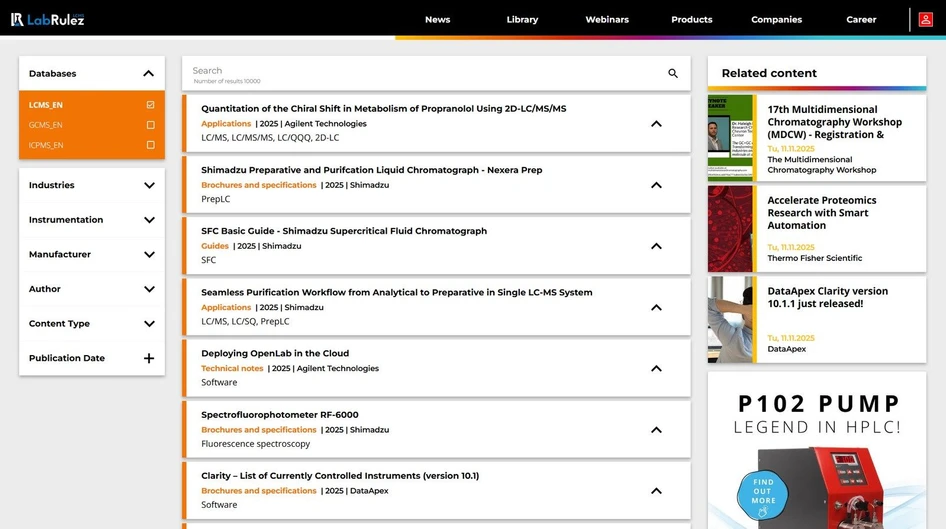
Our Library never stops expanding. What are the most recent contributions to LabRulezLCMS Library in the week of 10th November 2025? Check out new documents from the field of liquid phase, especially HPLC and LC/MS techniques!
👉 SEARCH THE LARGEST REPOSITORY OF DOCUMENTS ABOUT LCMS AND RELATED TECHNIQUES
👉 Need info about different analytical techniques? Peek into LabRulezGCMS or LabRulezICPMS libraries.
This week we bring you application notes by Agilent Technologies, Shimadzu and Waters Corporation and poster by Thermo Fisher Scientific!
1. Agilent Technologies: Feed Injection at Elevated Pressure Using the Agilent 1290 Infinity III Hybrid Multisampler
Optimization of a multipesticide method for the highest sensitivity through feed injection
- Application note
- Full PDF for download
Modern analytical methods for the determination of pesticide residues are based on multipesticide methods capable of determining hundreds of pesticides in a sample in one analytical LC/MS/MS run. For chromatographic separation of these pesticides, modern separation columns are used. Their dimensions are typically 2.1 × 150 mm, filled with 1.9 µm particle size material. This requires that the LC can work at high pressures up to 1300 bar. The Agilent 1290 Infinity III Hybrid Multisampler can operate within this pressure range. In addition, the Hybrid Multisampler can work in two different modes, the classic flow through mode and the Agilent Feed Injection mode. Feed Injection mode helps to prevent peak broadening and splitting effects as they can occur with the classic flow through mode for injection of samples in solvents with high elution strength and higher injection volumes.
Experimental
Instrumentation
- Agilent 1290 Infinity III High-Speed Pump (G7120A)
- Agilent 1290 Infinity III Hybrid Multisampler (G7137B)
- Agilent 1290 Infinity III MCT (G7116B)
- Agilent Ultivo Triple Quadrupole LC/MS with Agilent Jet Stream source
Software
- Agilent MassHunter Acquisition Software (v. 12.2)
- Agilent MassHunter Qualitative Analysis Software (v. 12.0)
- Agilent MassHunter Quantitative Analysis Software (v. 12.1)
Column
- Agilent InfinityLab Poroshell 120 Phenyl-Hexyl, 2.1 × 150 mm, 1.9 µm (part number 699675-912)
Results and discussion
Calibration curves for a multipesticide method were acquired to demonstrate the possible improvement of peak shape and the lower limits of quantification (LOQ) using Agilent Feed Injection mode in comparison to classical flow through injection mode. This method comprised approximately 120 pesticide compounds measured by dynamic MRM. The separation was performed on a 150 mm length column. With the chosen solvents and flow rate, a pressure range above 1000 bar was necessary. The calibration curves were acquired for concentrations down to 0.02 ppb (20 ppt), and each calibration point was measured three-fold. The concentrations of the calibration solutions were prepared by dilution using the strong-eluting solvent acetonitrile and injected directly by both injection modes with different injection volumes. An example chromatogram showing the elution pattern for the MRM transitions is displayed in Figure 1.
Conclusion
This technical overview demonstrates the use of the Agilent Feed Injection mode available with the Agilent 1290 Infinity III Hybrid Multisampler in comparison to the classical flow through injection mode for the analysis of pesticides by a multipesticide method. We demonstrated that the use of Agilent Feed Injection mode improves the obtained peak shape for injection of samples dissolved in high elution strength solvent compared to classical flow through mode. With the improved peak shape obtained by Feed Injection mode, signal to noise ratios were improved, resulting in higher sensitivity. Due to retained peak shape, no manual interaction for peak integration was necessary when using feed injection.
2. Shimadzu: Automatic Optimization of Sample Solvent Composition for Achieving Sharp Peak Shapes
- Application note
- Full PDF for download
User Benefits
- The automatic pretreatment function integrated into the autosampler enables efficient optimization of sample solvent composition, which can be automatically adjusted during analysis.
- The desired composition of sample solvent can be easily specified via the LabSolutionsTM MD interface.
In LC analysis, the composition of the sample solvent is critical for achieving proper peak shape. If the sample solvent is a stronger eluting solvent than the mobile phase, sample band condensation at the column inlet may be insufficient, leading to sample band broadening. For instance, increasing the organic solvent ratio in the sample solvent to dissolve low-polar compounds may deteriorate the peak shapes of early-eluting compounds in reversed-phase chromatography. Therefore, determining the optimal ratio of organic solvent in the sample solvent is essential. However, manually preparing multiple solvent compositions is extremely time-consuming. The automatic pretreatment function of the autosamplers (Nexera series), in combination with the method development support software LabSolutions MD, enables consecutive analyses using different sample solvent compositions without manual intervention. This allows evaluation of the effect of sample solvent composition on peak shape while significantly reducing the labor involved in optimization. In this study, we demonstrate the automated determination of the optimal sample solvent composition using metoclopramide, a small-molecule drug, as a model compound.
Automatic Pretreatment Function
The automatic pretreatment function integrated into the autosampler enables drawing and ejecting specified volumes of reagents and solvents from any vial, as well as mixing them within the needle. As an example, Fig. 1 illustrates the procedure for automatically adjusting the water-to-methanol ratio in the sample solvent using this function. The autosamplers (Nexera series) supports up to three rinsing solvents via the multi-rinse function, and in this procedure, methanol and water were supplied from these rinsing lines. By modifying the "methanol eject volume" (2) and “water eject volume” (3) in Fig. 1, sample solvents with desired methanol-to-water ratios can be automatically prepared. In addition, adjusting the “sample drawing volume” (1) allows for not only changing the sample solvent composition but also diluting the sample solution to a specified concentration.
Analytical Conditions and Target Compounds
A 1000 mg/L solution of metoclopramide, a small-molecule drug, was prepared in 100% methanol as a model sample. The water content in the sample solvent was then varied from 0% to 90% in 10% increments (A 10-fold dilution was applied during automatic sample solvent preparation), and its effect on peak shape was evaluated under the analytical conditions shown in Table 1. By simply specifying the desired water content on the LabSolutions MD interface (red frame in Fig. 2), the autosampler’s automatic pretreatment function adjusts the sample solvent composition during consecutive analyses. This eliminates the need for manual preparation of multiple solvent mixtures, significantly reducing the workload involved in optimizing sample solvent composition for ideal peak shapes.
Conclusion
Optimizing the composition of the sample solvent is essential for achieving appropriate peak shapes. However, manual preparation of multiple solvent compositions is time-consuming. The automatic pretreatment function of the autosampler, in combination with LabSolutions MD, enables consecutive analyses with automatic variation of the sample solvent composition. This significantly reduces the effort required for optimization. Since the optimal sample solvent composition depends on both the physicochemical properties of the analyte and the mobile phase conditions, optimization is necessary for each sample. These tasks, however, can be greatly reduced by utilizing the automatic pretreatment function.
3. Thermo Fisher Scientific: Improving selectivity and sensitivity of lipid mediator analyses by coupling nano-flow chromatography with the Stellar mass spectrometer
- Poster
- Full PDF for download
Lipid mediators play crucial roles in regulating inflammation and maintaining tissue homeostasis. However, their quantification in biological samples is difficult due to low concentrations (ppt–ppb range), chemical instability, and structural similarity. Conventional LC-MS/MS methods using high-flow UHPLC and triple quadrupole mass spectrometers require extensive optimization of SRM transitions for each analyte. This study introduces a nano-flow LC-MS workflow combining the Thermo Scientific Vanquish Neo UHPLC system with the Thermo Scientific Stellar mass spectrometer, aiming to improve analytical sensitivity and selectivity while reducing solvent and sample consumption.
Experimental
Lipid mediator standards (from Cayman Chemical) were analyzed using two chromatographic configurations: a nano-flow method (500 nL/min) with the Vanquish Neo UHPLC and a high-flow method (300 µL/min) using the Vanquish Horizon UHPLC. Both setups were coupled either to the Stellar MS or the TSQ Altis Plus triple quadrupole MS. The Stellar instrument features a dual-pressure linear ion trap and ion routing multipole, enabling both HCD (higher-energy collisional dissociation) and CID (collision-induced dissociation) fragmentation. Parallel reaction monitoring (PRM) was employed instead of SRM, allowing simultaneous detection of multiple transitions. Data were processed using Thermo Scientific TraceFinder software with internal standards and calibration curves ranging from 0.0001 ppb to 100 ppb.
Results
The nano-flow Stellar method achieved superior sensitivity and selectivity compared with the high-flow methods on both Stellar and TSQ Altis Plus systems. Limits of quantitation (LOQ) reached the low-ppt range, while maintaining fast analysis times (< 30 min) and requiring less than 20 µL of solvent per sample. Chromatograms of key eicosanoids such as 15(S)-HETE, 12(S)-HETE, and 5(S)-HETE demonstrated higher signal intensity and improved peak shapes under nano-flow conditions. Calibration curve reproducibility and scan density (> 10 scans per peak) confirmed reliable quantitative performance.
Conclusion
Coupling nano-flow chromatography with the Stellar mass spectrometer provides a powerful workflow for targeted lipid mediator analysis, significantly enhancing both selectivity and sensitivity compared with conventional high-flow LC-MS/MS. The system’s PRM capability, dual-fragmentation flexibility, and low-volume solvent use make it a robust and cost-effective solution for biological and clinical lipidomics, capable of quantifying trace-level lipid mediators efficiently and reproducibly.
4. Waters Corporation: Investigating Drug Metabolism of Methapyrilene Within a Rat Model Using a Data Dependent Acquisition Workflow with the Xevo MRT Mass Spectrometer
- Application note
- Full PDF for download
Benefits
- Demonstration of the Waters™ Xevo™ MRT Mass Spectrometer (MS) workflow for the analysis of urine extracts from a drug dosed study, involving methapyrilene.
- Data dependent acquisition (DDA) has been used for data collection, providing highly informative fragmentation data to confidently identify drug metabolites of interest.
- Combining a DDA approach with high-throughput chromatography is shown to consistently yield high quality spectra, providing highly confident compound identifications.
- A seamless workflow allowing drug metabolites to be confidently identified is demonstrated with the UNIFI™ Application within the waters_connect™ Software Platform
The introduction of the Xevo MRT Mass Spectrometer allows for comprehensive drug metabolite identification (Met ID) at high acquisition speed. Using urine samples collected over a time course of six days, the excellent mass accuracy, high mass resolution, and sensitivity are highlighted, which can be achieved for drug metabolism studies. DDA provides highly specific MS/MS information, which assists with structural elucidation. The speed at which DDA data can be acquired with the Xevo MRT Mass Spectrometer can be as fast as 50 and 100 Hz, MS, and MS/MS respectively. Combined with fast chromatographic methods, this fast data acquisition rate allows for highly informative, confident data in a high-throughput fashion
Experimental
LC-MS Data Acquisition LC-MS data were collected using an ACQUITY™ Premier UPLC™ System coupled to a Xevo MRT Mass Spectrometer. The reversed-phase (RP) chromatographic separation consisted of a 5.0 minute method (injection to injection) using a CORTECS™ C18, 1.6 µm, 2.1 x 50 mm analytical Column (p/n: 186007114). The LC solvents were comprised of mobile phase A (0.1% formic acid containing 1 mMol ammonium formate) and mobile phase B (95:5 ACN:Water (v/v), 0.1% formic acid, 1 mMol ammonium formate) being ramped from 50% to 99% over 5 minutes using a flow rate of 0.6 mL/minute. The gradient started from 0.1% to 15% (mobile phase B) over 1.5 minutes, 50% at 3 minutes and 99% at 4 minutes. The solvent composition was held at 99% (mobile phase B) for 0.5 minutes and re-equilibration at initial conditions by 5 minutes, ready for the subsequent injection.
The Xevo MRT Mass Spectrometer was configured with the source settings as outlined in Table 1. MS data were collected using DDA mode of operation, which consisted of scan rates of 20 Hz (MS) and 50 Hz (MS/MS). The number of components selected for MS/MS were eight with a dynamic exclude applied of 10 mDa with a 10 second retention time tolerance.
Data Processing
The acquired data were processed using the UNIFI Application within the waters_connect Software Platform. Data were peak picked and screened against a compound database containing MP metabolites and their associated fragments. A mass tolerance of 1 ppm for both MS and MS/MS were applied.
Conclusion
LC-MS analysis of urine collected over a time course following administration of the drug methapyrilene, has been demonstrated using a DDA approach with the Xevo MRT Mass Spectrometer. MP undergoes complex biotransformation to provide a variety of metabolites. Utilizing a DDA workflow provides detailed, clean fragment ion spectra for confident structural elucidation. The additional benefit of sub ppm mass accuracy provides definitive identification(s). Integrating fast chromatography allows for high-throughput analyses while maintaining high resolution and mass accuracy.