Webinars LabRulezLCMS Week 15/2026
LabRulez: Webinars LabRulezLCMS Week 15/2026
In the week of April 6, the following webinars await you in the field of liquid phase and especially HPLC and LC/MS.
👉 DETAILS AND REGISTRATION IN THE WEBINARS SECTION
👉 Search and filter in the largest global database with over 5 500 GC, LC, MS and spectroscopy webinars.
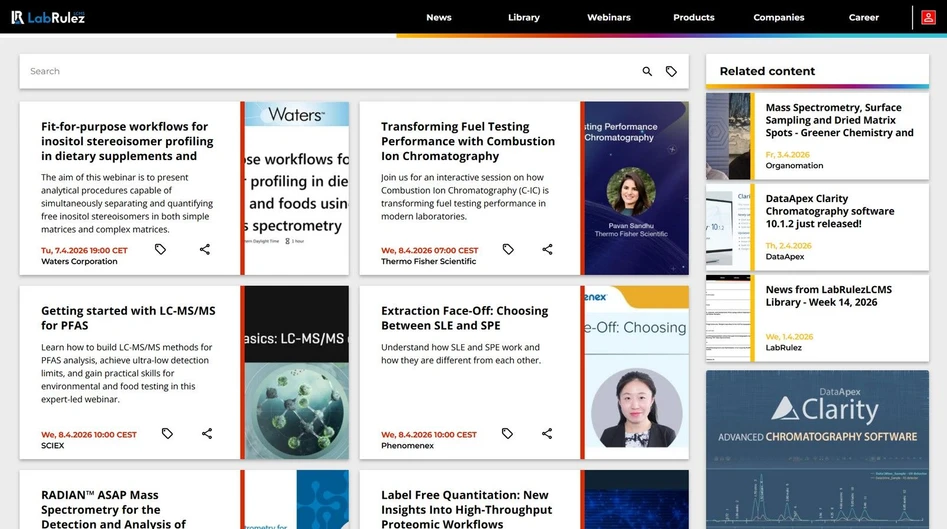
1. Waters Corporation: Fit-for-purpose workflows for inositol stereoisomer profiling in dietary supplements and foods using single and tandem mass spectrometry
- Tu, 7.4.2026 19:00 CET
- Registration
The aim of this webinar is to present analytical procedures capable of simultaneously separating and quantifying free inositol stereoisomers in both simple matrices and complex matrices.
2. Thermo Fisher Scientific: Transforming Fuel Testing Performance with Combustion Ion Chromatography
- We, 8.4.2026 07:00 CEST
- Registration
Join us for an interactive session on how Combustion Ion Chromatography (C-IC) is transforming fuel testing performance in modern laboratories.
3. SCIEX: Getting started with LC-MS/MS for PFAS
- We, 8.4.2026 10:00 CEST
- Registration
Learn how to build LC-MS/MS methods for PFAS analysis, achieve ultra-low detection limits, and gain practical skills for environmental and food testing in this expert-led webinar.
4. Phenomenex: Extraction Face-Off: Choosing Between SLE and SPE
- We, 8.4.2026 10:00 CEST
- Registration
Understand how SLE and SPE work and how they are different from each other.
5. Waters Corporation: RADIAN™ ASAP Mass Spectrometry for the Detection and Analysis of Explosive Traces
- We, 8.4.2026 16:00 CET
- Registration
Explore how mass spectrometry enables rapid detection of trace explosives. Learn how RADIAN™ ASAP extends forensic and security workflows, supporting future screening technologies and ion-mobility innovation.
6. Technology Networks: Label Free Quantitation: New Insights Into High-Throughput Proteomic Workflows
- Th, 9.4.2026 16:00 CET
- Registration
Discover how next-generation LC–MS and the ZenoTOF 8600 enable robust, high-throughput LFQ proteomics, backed by insights from a large multi-laboratory benchmark study.