Two-Dimensional Liquid Chromatography Isolation and Quantitation of IgG and Exosomes from Cell Culture Media (Chris Topper, MDCW 2026)
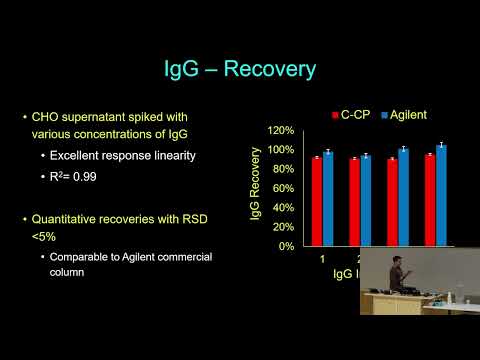
- Photo: MDCW: Two-Dimensional Liquid Chromatography Isolation and Quantitation of IgG and Exosomes from Cell Culture Media (Chris Topper, MDCW 2026)
- Video: LabRulez: Chris Topper: 2DLC quantification of immunoglobulin G and exosomes using polymer columns (MDCW 2026)
🎤 Presenter: Chris Topper (Clemson University)
Abstract
Extracellular vesicles (EVs) are small membrane-bound particles that are naturally released by cells into the extracellular environment. Exosomes constitute a subset of EVs with a characteristic size range of 30 – 150 nm. Exosomes are produced by nearly every cell type in the body and can be found in virtually all biological fluids. They share the same integral membrane proteins as their originating cell and thus can be used as biomarkers to identify and monitor disease.
Monoclonal antibodies (mAbs) such as IgG are primarily produced by culturing Chinese hamster ovary (CHO) cells and then passing the culture media through a Protein A (ProA) affinity chromatography column to isolate the antibodies. The waste effluent from this process, however, contains valuable EVs that are ultimately discarded. Therefore, the isolation of exosomes from CHO cell waste streams presents an opportunity for by-product valorization.
We describe a two-dimensional liquid chromatography platform employing columns packed with capillary-channeled polymer (C-CP) fibers to isolate both IgG and exosomes from CHO cell supernatant. The first dimension utilizes ProA to isolate and quantify IgG, while hydrophobic interaction chromatography (HIC) is used in the second dimension to isolate and quantify exosomes from the 1D effluent. Thus, we demonstrate a convenient framework for characterizing any CHO cell culture into both its IgG and exosome production traits, providing practical insights into the co-production of these two, disparate biotherapeutics, as well as a means for extracting valuable EVs during the production of mAbs, converting waste into dollars.
-Workshop-LOGO_s.webp)