How to Select the Right SEC Column for the Analysis of Biologics
We, 22.4.2026
| Original article from: Phenomenex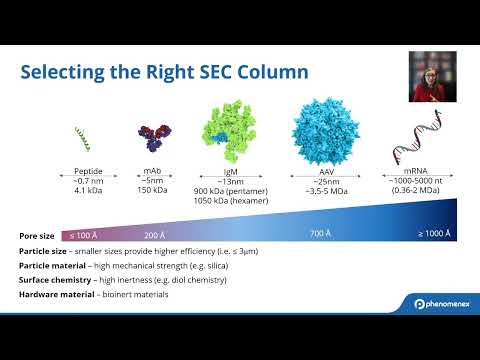
- Photo: Phenomenex: How to Select the Right SEC Column for the Analysis of Biologics
- Video: Phenomenex: How to Choose the Right SEC Column | Size Exclusion Chromatography Guide
This guide explains how to select an appropriate size exclusion chromatography (SEC) column for the analysis of biologics. SEC separates molecules based on their hydrodynamic radius, reflecting their size and shape rather than molecular weight.
- Molecules penetrate the pores of the stationary phase
- There are no chemical interactions with the stationary phase
- Larger molecules elute faster
- Smaller molecules elute later
Principle of SEC Separation
The separation mechanism is based on molecular size:
Large molecules
→ do not enter the pores
→ travel through the interstitial spaces between particles
→ elute earlier
Small molecules
→ enter the pores
→ follow a longer path
→ elute later
Key Parameters for Column Selection
1. Molecule Nature
Start by evaluating:
- hydrodynamic radius
- molecular shape
Examples:
- Peptides: ~0.7 nm
- Large biomolecules (e.g., AAVs): ~25 nm
- mRNA: elongated, non-globular structure
2. Pore Size Selection
The pore size of the stationary phase should be:
- 3–4 times larger than the hydrodynamic radius of the target molecule
3. Particle Size
- ≤ 3 µm
- ensures high separation efficiency
4. Stationary Phase Material
- Prefer mechanically robust media, such as silica
- Capable of withstanding high back pressure
5. Surface Chemistry
- Chemical surface inertness is critical
- Diol chemistry is preferred, because:
- it minimizes interactions
- it provides a highly hydrophilic surface
6. Column Hardware
- Use bio-inert hardware
- ensures:
- minimal analyte loss
- high reproducibility
Available SEC Column Options (BioZen dSEC Family)
1. 90 Å (9 nm)
- peptides
- small proteins
- aggregates up to ~50 kDa
2. 200 Å
- antibodies
- antibody–drug conjugates
- short oligonucleotides
3. 700 Å (70 nm)
- AAVs
- mRNA
- large protein complexes (e.g., IgM)
Column Characteristics
- silica-based particles
- diol surface chemistry (hydrophilic, inert)
- bio-inert hardware
- designed for:
- high recovery
- high reproducibility
Performance and Calibration
Proteins and AAVs
- 90 Å → low molecular weight (up to ~50 kDa)
- 200 Å → medium range (up to ~450–500 kDa)
- 700 Å → large molecules (including AAVs)
RNA and DNA
- separation of molecules with non-globular shapes
- 200 Å → smaller oligonucleotides
- 700 Å → larger nucleic acid chains (up to ~3000–4000 nucleotides)
Conclusion
Selecting the correct SEC column requires:
- understanding molecule size and shape
- choosing an appropriate pore size
- selecting suitable particle size
- ensuring inert surface chemistry and bio-inert hardware
This enables optimal separation of a wide range of biologics.

Phenomenex