Author
KNAUER
KNAUER
Based in Berlin, KNAUER is a medium-sized, owner-managed company that has been serving the sciences since 1962. We develop and manufacture scientific instruments of superior quality for liquid chromatography, including: Analytical HPLC/UHPLC, Preparative HPLC, Fast protein liquid chromatography (FPLC), Multi-column chromatography/Simulated moving bed (SMB) chromatography. High pressure dosing, in-line detection systems, and osmometry are additional business areas.
Tags
Article
Product
Academy
LinkedIn Logo

A comprehensive guide for selecting the appropriate HPLC detector
We, 13.5.2026
| Original article from: KNAUER
Learn how to select the right HPLC detector by comparing sensitivity, selectivity, compatibility, and performance across common detection technologies.
<p>KNAUER: A comprehensive guide for selecting the appropriate HPLC detector</p>

KNAUER: A comprehensive guide for selecting the appropriate HPLC detector

High-performance liquid chromatography (HPLC) remains one of the most widely used analytical techniques for separating, identifying, and quantifying compounds in complex mixtures. Successful HPLC method development depends not only on selecting the correct column and optimizing the mobile phase composition, but also on choosing the appropriate detector. Even a perfectly optimized chromatographic separation provides little value if the detection system cannot properly capture and interpret the analytes of interest.

In many ways, the detector acts as the “vision system” of the chromatograph. It converts separated compounds into measurable electronic signals, allowing analysts to identify components and determine their concentrations. The choice of detector therefore has a major impact on sensitivity, selectivity, robustness, and the overall quality of analytical data.

This article provides an overview of the most common HPLC detection techniques, discusses their strengths and limitations, and outlines the most important criteria to consider when selecting a detector for a specific analytical task.

HPLC Detection Technologies

HPLC detectors are typically divided into two major categories:

  1. Specific detectors (solute-property detectors)
  2. Bulk property detectors

Specific detectors respond to a particular chemical or physical property of the analyte. Ideally, their signal is largely unaffected by changes in mobile phase composition. Common examples include UV/Vis detectors, fluorescence detectors, and mass spectrometers.

Bulk property detectors, on the other hand, measure differences between the pure mobile phase and the mobile phase containing analytes. These detectors are considered more universal because they respond to properties shared by many compounds. Refractive index detectors are among the best-known examples, alongside conductivity and light-scattering detectors.

Both detector categories have important advantages depending on the application, sample type, and analytical goals.

Common Detector Types Used in HPLC

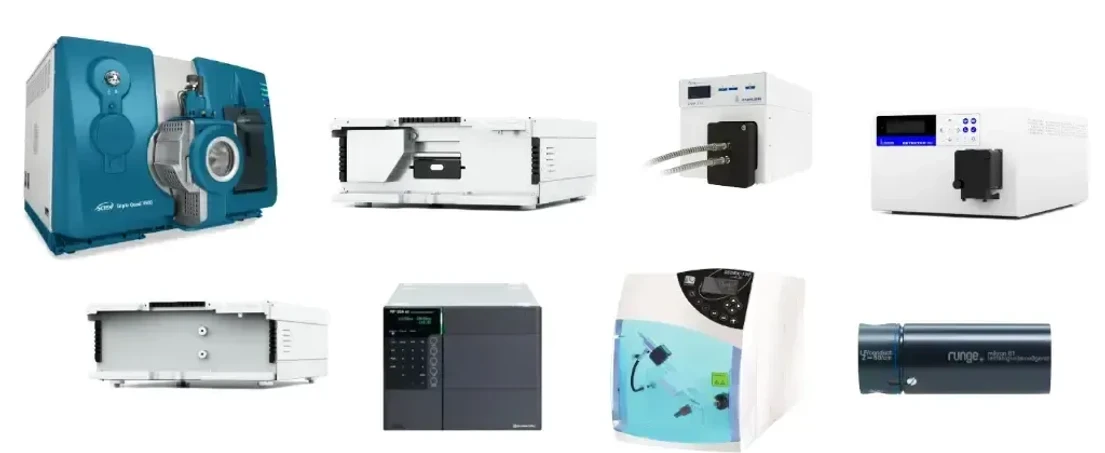
A wide variety of detectors are available for HPLC systems, ranging from highly universal devices to extremely selective and sensitive technologies.

Common detector options include:

  • UV/Vis detectors
  • Diode array detectors (DAD/PDA)
  • Fluorescence detectors
  • Refractive index detectors (RID)
  • Conductivity detectors
  • Evaporative light scattering detectors (ELSD)
  • Charged aerosol detectors (CAD)
  • Mass spectrometry detectors (MS)

Each technology offers a different balance of sensitivity, selectivity, robustness, operational complexity, and cost.
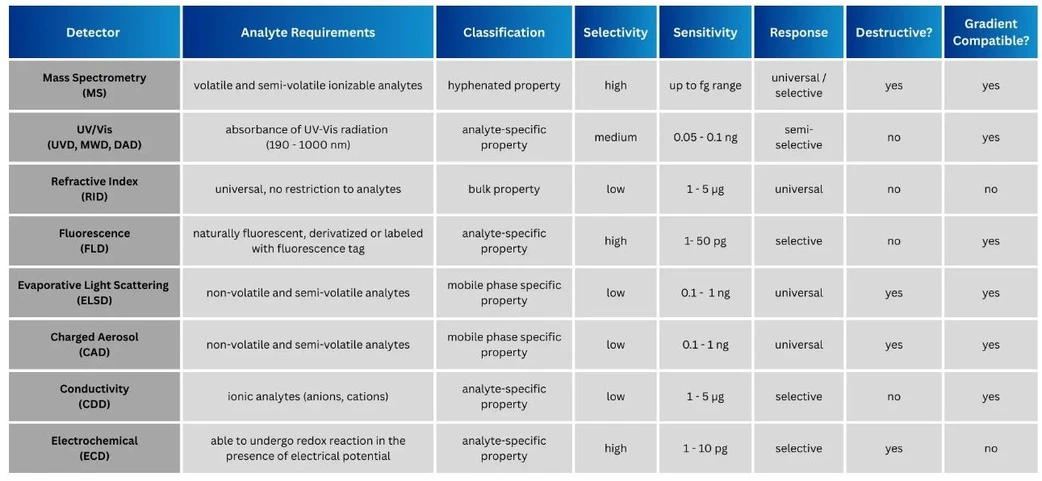
KNAUER: Detector overview with characteristics. Graphic by KNAUER.KNAUER: Detector overview with characteristics. Graphic by KNAUER.

Selecting the Right HPLC Detector

There is no universally ideal detector for all HPLC applications. The best choice depends on several factors, including analyte chemistry, matrix complexity, required detection limits, and instrument compatibility.

Careful detector selection is essential for obtaining reliable and meaningful analytical results.

The following considerations can help guide the selection process.

1. Chemical and Physical Properties of the Analytes

The chemical nature of the compounds being analyzed is one of the most important selection criteria.

Questions to consider include:

  • Do the analytes contain chromophores?
  • Are the compounds naturally fluorescent?
  • What is their polarity?
  • What is their molecular weight?
  • Are they volatile or non-volatile?

Compounds containing UV-active groups are often well suited for UV/Vis detection, while fluorescent molecules can benefit from the high sensitivity of fluorescence detectors. Non-UV-active compounds may require universal detection approaches such as CAD, ELSD, or mass spectrometry.

2. Required Sensitivity

Detector sensitivity determines the minimum concentration that can be reliably detected and quantified.

Routine quality control analyses often rely on UV/Vis detectors because they provide sufficient sensitivity for many applications while remaining relatively simple and cost-effective. However, trace-level analysis or highly complex matrices may require more advanced technologies such as:

  • Fluorescence detection
  • Charged aerosol detection
  • Mass spectrometry

These techniques offer significantly lower detection limits and greater analytical specificity.

3. Detector Linearity

Linearity describes how well detector response correlates with analyte concentration across a defined range.

A detector with strong linearity ensures accurate quantification and simplifies calibration procedures. Poor linearity can introduce quantification errors, especially when analyzing samples across broad concentration ranges.

4. Dynamic Range

Dynamic range refers to the concentration interval over which the detector can reliably measure analytes.

Applications involving samples with highly variable concentrations require detectors capable of maintaining accurate response over a broad range. A wide dynamic range reduces the need for repeated dilutions or multiple analytical runs.

5. Selectivity

Selectivity defines the detector’s ability to distinguish target analytes from other matrix components.

This factor becomes particularly important for complex samples containing many interfering substances. Highly selective detectors reduce the risk of overlapping signals and false positives.

Mass spectrometry is often advantageous when dealing with unknown compounds or highly complicated sample matrices because it provides structural information in addition to quantitative data.

6. Budget Considerations

Detector cost is another practical factor that laboratories must evaluate.

UV/Vis and refractive index detectors are generally among the more economical choices, making them attractive for routine analyses and standard applications.

More sophisticated technologies such as fluorescence detection, CAD, or mass spectrometry typically require:

  • Higher initial investment
  • Additional maintenance
  • More complex infrastructure
  • Greater operational expertise

However, the overall value of the detector should always be considered in relation to analytical performance requirements and long-term application needs.

7. Instrument and Mobile Phase Compatibility

The selected detector must be compatible with the operational conditions of the HPLC system.

Important parameters include:

  • Flow rate range
  • Pressure limitations
  • Mobile phase composition
  • Solvent compatibility

Some detectors are highly sensitive to mobile phase composition or gradient changes, while others tolerate a broader range of operating conditions.

Ensuring proper compatibility helps prevent baseline instability, signal interference, and reduced detector performance.

8. Destructive vs. Non-Destructive Detection

Another important consideration is whether the analytical workflow involves only detection or also preparative purification.

Non-destructive detectors allow collected fractions to remain intact after detection, which is highly beneficial for preparative chromatography and purification workflows.

Destructive detectors, by contrast, consume or alter the sample during measurement and are therefore more suitable for analytical applications where sample recovery is not required.

9. Reliability and Ease of Operation

Practical usability is often just as important as analytical performance.

Some detectors are designed for straightforward plug-and-play operation, while others require:

  • Frequent calibration
  • Specialized maintenance
  • Dedicated gas supplies
  • Vacuum systems
  • Advanced operator expertise

Laboratories should evaluate the available technical support, user experience, and maintenance capabilities before implementing more sophisticated detection technologies.

Reliable operation and manageable maintenance requirements can significantly improve laboratory productivity and reduce downtime.

Choosing the correct HPLC detector starts with understanding both the sample and the analytical objective. Rather than selecting a detector simply because it is available, laboratories should ensure that the technology aligns with the chemistry of the analytes, required performance characteristics, and workflow demands.

In many cases, combining multiple detectors within a single HPLC system can provide even greater analytical insight by delivering complementary information from the same chromatographic separation.
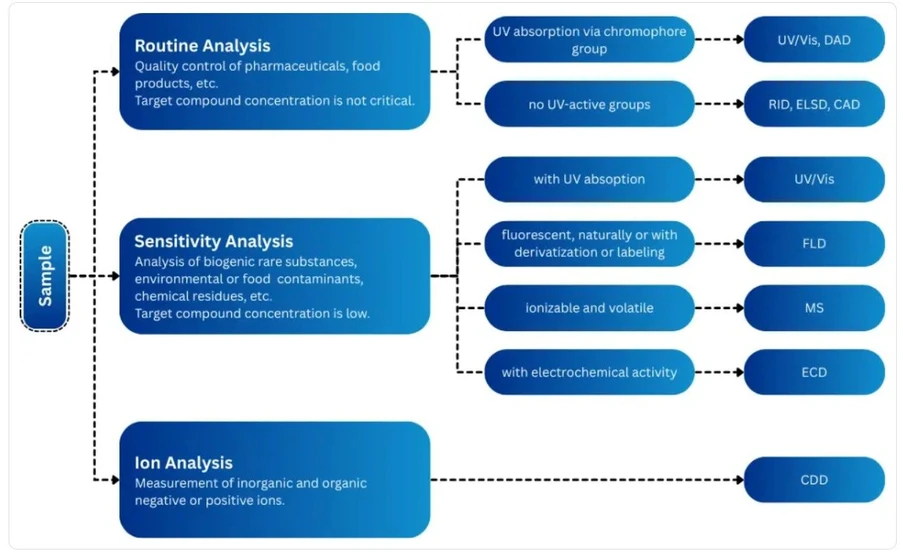
KNAUER: Flow scheme for detector selection. Graphic by KNAUER.KNAUER: Flow scheme for detector selection. Graphic by KNAUER.

Interested in learning more? Future articles will explore individual HPLC detection techniques in greater detail, including their operating principles, application areas, and practical advantages for different analytical workflows.

This version of the article was adapted from the original text using AI-assisted rewriting and editorial review.
KNAUER
LinkedIn Logo
 

Related content

Suppressed Cation Analysis of Wastewater Using Ion Chromatograph Nexera IC, Conforming to ASTM D6919-17

Applications
| 2026 | Shimadzu
Instrumentation
Ion chromatography
Manufacturer
Shimadzu
Industries
Environmental, Food & Agriculture

Comprehensive and Robust Analysis of Ultrashort- to Long-Chain PFAS, PAE, OPE, and PAH

Applications
| 2026 | Agilent Technologies
Instrumentation
LC/MS, LC/MS/MS, LC/TOF, LC/HRMS
Manufacturer
Agilent Technologies, Plasmion
Industries
Environmental

UPLC™ Separation of Fifteen Bisphenols Using a Waters Acquity™ Biphenyl RP Column with MaxPeak™ Premier Technology and UV Detection

Applications
| 2026 | Waters
Instrumentation
Consumables, LC columns, HPLC
Manufacturer
Waters
Industries
Pharma & Biopharma

Achieving Low‑ppb Bisphenol Quantitation with the Agilent InfinityLab Pro iQ Mass Detector

Applications
| 2026 | Agilent Technologies
Instrumentation
LC/MS, LC/SQ
Manufacturer
Agilent Technologies
Industries
Materials Testing

ECL detection of fentanyl

Applications
| 2026 | Metrohm
Instrumentation
Electrochemistry
Manufacturer
Metrohm
Industries
Forensics
 

Related articles

Episode 1: The Benefits of Charged Aerosol Detection (CAD) in High-Performance Liquid Chromatography (HPLC)
Article | Product

Episode 1: The Benefits of Charged Aerosol Detection (CAD) in High-Performance Liquid Chromatography (HPLC)

In this post, we’ll explore the principles of CAD, its advantages, and how it’s transforming the landscape of analytical chemistry.
Thermo Fisher Scientific
tag
share
more
News from LabRulezLCMS Library - Week 20, 2025
Article | Application

News from LabRulezLCMS Library - Week 20, 2025

This week we bring you technical note by Agilent Technologies, application notes by Metrohm, Shimadzu and Waters Corporation and other document by Thermo Fisher Scientific!
LabRulez
tag
share
more
Food Adulteration and How It Is Revealed by Analytical Chemistry
Article | Food

Food Adulteration and How It Is Revealed by Analytical Chemistry

Food adulteration threatens quality and consumer trust. Discover how HPLC and modern chromatographic systems from Watrex Praha help identify oil, honey, and wine adulteration with high confidence.
Watrex Praha
tag
share
more
News from LabRulezLCMS Library - Week 13, 2026
Article | Application

News from LabRulezLCMS Library - Week 13, 2026

This week we bring you application notes by Agilent Technologies, KNAUER and Shimadzu, brochure by Thermo Fisher Scientific and poster by Waters Corporation!
LabRulez
tag
share
more
 

Related content

Suppressed Cation Analysis of Wastewater Using Ion Chromatograph Nexera IC, Conforming to ASTM D6919-17

Applications
| 2026 | Shimadzu
Instrumentation
Ion chromatography
Manufacturer
Shimadzu
Industries
Environmental, Food & Agriculture

Comprehensive and Robust Analysis of Ultrashort- to Long-Chain PFAS, PAE, OPE, and PAH

Applications
| 2026 | Agilent Technologies
Instrumentation
LC/MS, LC/MS/MS, LC/TOF, LC/HRMS
Manufacturer
Agilent Technologies, Plasmion
Industries
Environmental

UPLC™ Separation of Fifteen Bisphenols Using a Waters Acquity™ Biphenyl RP Column with MaxPeak™ Premier Technology and UV Detection

Applications
| 2026 | Waters
Instrumentation
Consumables, LC columns, HPLC
Manufacturer
Waters
Industries
Pharma & Biopharma

Achieving Low‑ppb Bisphenol Quantitation with the Agilent InfinityLab Pro iQ Mass Detector

Applications
| 2026 | Agilent Technologies
Instrumentation
LC/MS, LC/SQ
Manufacturer
Agilent Technologies
Industries
Materials Testing

ECL detection of fentanyl

Applications
| 2026 | Metrohm
Instrumentation
Electrochemistry
Manufacturer
Metrohm
Industries
Forensics
 

Related articles

Episode 1: The Benefits of Charged Aerosol Detection (CAD) in High-Performance Liquid Chromatography (HPLC)
Article | Product

Episode 1: The Benefits of Charged Aerosol Detection (CAD) in High-Performance Liquid Chromatography (HPLC)

In this post, we’ll explore the principles of CAD, its advantages, and how it’s transforming the landscape of analytical chemistry.
Thermo Fisher Scientific
tag
share
more
News from LabRulezLCMS Library - Week 20, 2025
Article | Application

News from LabRulezLCMS Library - Week 20, 2025

This week we bring you technical note by Agilent Technologies, application notes by Metrohm, Shimadzu and Waters Corporation and other document by Thermo Fisher Scientific!
LabRulez
tag
share
more
Food Adulteration and How It Is Revealed by Analytical Chemistry
Article | Food

Food Adulteration and How It Is Revealed by Analytical Chemistry

Food adulteration threatens quality and consumer trust. Discover how HPLC and modern chromatographic systems from Watrex Praha help identify oil, honey, and wine adulteration with high confidence.
Watrex Praha
tag
share
more
News from LabRulezLCMS Library - Week 13, 2026
Article | Application

News from LabRulezLCMS Library - Week 13, 2026

This week we bring you application notes by Agilent Technologies, KNAUER and Shimadzu, brochure by Thermo Fisher Scientific and poster by Waters Corporation!
LabRulez
tag
share
more
 

Related content

Suppressed Cation Analysis of Wastewater Using Ion Chromatograph Nexera IC, Conforming to ASTM D6919-17

Applications
| 2026 | Shimadzu
Instrumentation
Ion chromatography
Manufacturer
Shimadzu
Industries
Environmental, Food & Agriculture

Comprehensive and Robust Analysis of Ultrashort- to Long-Chain PFAS, PAE, OPE, and PAH

Applications
| 2026 | Agilent Technologies
Instrumentation
LC/MS, LC/MS/MS, LC/TOF, LC/HRMS
Manufacturer
Agilent Technologies, Plasmion
Industries
Environmental

UPLC™ Separation of Fifteen Bisphenols Using a Waters Acquity™ Biphenyl RP Column with MaxPeak™ Premier Technology and UV Detection

Applications
| 2026 | Waters
Instrumentation
Consumables, LC columns, HPLC
Manufacturer
Waters
Industries
Pharma & Biopharma

Achieving Low‑ppb Bisphenol Quantitation with the Agilent InfinityLab Pro iQ Mass Detector

Applications
| 2026 | Agilent Technologies
Instrumentation
LC/MS, LC/SQ
Manufacturer
Agilent Technologies
Industries
Materials Testing

ECL detection of fentanyl

Applications
| 2026 | Metrohm
Instrumentation
Electrochemistry
Manufacturer
Metrohm
Industries
Forensics
 

Related articles

Episode 1: The Benefits of Charged Aerosol Detection (CAD) in High-Performance Liquid Chromatography (HPLC)
Article | Product

Episode 1: The Benefits of Charged Aerosol Detection (CAD) in High-Performance Liquid Chromatography (HPLC)

In this post, we’ll explore the principles of CAD, its advantages, and how it’s transforming the landscape of analytical chemistry.
Thermo Fisher Scientific
tag
share
more
News from LabRulezLCMS Library - Week 20, 2025
Article | Application

News from LabRulezLCMS Library - Week 20, 2025

This week we bring you technical note by Agilent Technologies, application notes by Metrohm, Shimadzu and Waters Corporation and other document by Thermo Fisher Scientific!
LabRulez
tag
share
more
Food Adulteration and How It Is Revealed by Analytical Chemistry
Article | Food

Food Adulteration and How It Is Revealed by Analytical Chemistry

Food adulteration threatens quality and consumer trust. Discover how HPLC and modern chromatographic systems from Watrex Praha help identify oil, honey, and wine adulteration with high confidence.
Watrex Praha
tag
share
more
News from LabRulezLCMS Library - Week 13, 2026
Article | Application

News from LabRulezLCMS Library - Week 13, 2026

This week we bring you application notes by Agilent Technologies, KNAUER and Shimadzu, brochure by Thermo Fisher Scientific and poster by Waters Corporation!
LabRulez
tag
share
more
 

Related content

Suppressed Cation Analysis of Wastewater Using Ion Chromatograph Nexera IC, Conforming to ASTM D6919-17

Applications
| 2026 | Shimadzu
Instrumentation
Ion chromatography
Manufacturer
Shimadzu
Industries
Environmental, Food & Agriculture

Comprehensive and Robust Analysis of Ultrashort- to Long-Chain PFAS, PAE, OPE, and PAH

Applications
| 2026 | Agilent Technologies
Instrumentation
LC/MS, LC/MS/MS, LC/TOF, LC/HRMS
Manufacturer
Agilent Technologies, Plasmion
Industries
Environmental

UPLC™ Separation of Fifteen Bisphenols Using a Waters Acquity™ Biphenyl RP Column with MaxPeak™ Premier Technology and UV Detection

Applications
| 2026 | Waters
Instrumentation
Consumables, LC columns, HPLC
Manufacturer
Waters
Industries
Pharma & Biopharma

Achieving Low‑ppb Bisphenol Quantitation with the Agilent InfinityLab Pro iQ Mass Detector

Applications
| 2026 | Agilent Technologies
Instrumentation
LC/MS, LC/SQ
Manufacturer
Agilent Technologies
Industries
Materials Testing

ECL detection of fentanyl

Applications
| 2026 | Metrohm
Instrumentation
Electrochemistry
Manufacturer
Metrohm
Industries
Forensics
 

Related articles

Episode 1: The Benefits of Charged Aerosol Detection (CAD) in High-Performance Liquid Chromatography (HPLC)
Article | Product

Episode 1: The Benefits of Charged Aerosol Detection (CAD) in High-Performance Liquid Chromatography (HPLC)

In this post, we’ll explore the principles of CAD, its advantages, and how it’s transforming the landscape of analytical chemistry.
Thermo Fisher Scientific
tag
share
more
News from LabRulezLCMS Library - Week 20, 2025
Article | Application

News from LabRulezLCMS Library - Week 20, 2025

This week we bring you technical note by Agilent Technologies, application notes by Metrohm, Shimadzu and Waters Corporation and other document by Thermo Fisher Scientific!
LabRulez
tag
share
more
Food Adulteration and How It Is Revealed by Analytical Chemistry
Article | Food

Food Adulteration and How It Is Revealed by Analytical Chemistry

Food adulteration threatens quality and consumer trust. Discover how HPLC and modern chromatographic systems from Watrex Praha help identify oil, honey, and wine adulteration with high confidence.
Watrex Praha
tag
share
more
News from LabRulezLCMS Library - Week 13, 2026
Article | Application

News from LabRulezLCMS Library - Week 13, 2026

This week we bring you application notes by Agilent Technologies, KNAUER and Shimadzu, brochure by Thermo Fisher Scientific and poster by Waters Corporation!
LabRulez
tag
share
more
Other projects
GCMS
ICPMS
Follow us
FacebookX (Twitter)LinkedInYouTube
More information
WebinarsAbout usContact usTerms of use
LabRulez s.r.o. All rights reserved. Content available under a CC BY-SA 4.0 Attribution-ShareAlike