Seeing is Believing – Detection Made Easy Part 1: Detector Overview

KNAUER: Seeing is Believing – Detection Made Easy Part 1: Detector Overview
HPLC Detection Technologies: A Practical Overview
High-performance liquid chromatography is a cornerstone of modern analytical chemistry. It is routinely applied in pharmaceutical quality control, biopharmaceutical development, environmental monitoring, food analysis, and polymer characterization. However, separating the components of a sample is only one part of the analytical process. The compounds leaving the column must also be recognized and converted into a signal that can be evaluated.
This is the task of the HPLC detector. Its selection can strongly influence the sensitivity, selectivity, reliability, and overall usefulness of a chromatographic method.
In the first article of our HPLC detector series, we introduce the principal detection technologies, explain how they differ, and outline the factors that should be considered when selecting a detector for a particular application.
What Does an HPLC Detector Do?
After compounds have been separated inside the chromatographic column, they enter the detector one after another. The detector continuously monitors the column effluent and responds to a physical or chemical property of each analyte.
This response is converted into an electrical signal and displayed as a chromatogram. The position of a peak provides information related to retention time, while its height or area can be used to determine the amount of the corresponding compound.
A detector must therefore provide more than a visible signal. It should generate data that are sufficiently sensitive, stable, reproducible, and suitable for the purpose of the analytical method.
Several characteristics are particularly important when comparing detector technologies:
- Sensitivity: The lowest amount or concentration that can be detected or reliably quantified.
- Selectivity: The ability to respond preferentially to certain compounds while minimizing signals from other sample components.
- Linearity and working range: The concentration interval over which detector response remains proportional to analyte concentration.
- Mobile-phase compatibility: The detector must function correctly with the selected solvents, additives, gradients, flow rates, and temperatures.
- Information content: Some detectors provide only a quantitative response, while others also deliver spectral or structural information.
- Practical requirements: Instrument cost, maintenance, method complexity, and operator experience must also be considered.
There is consequently no single detector that is ideal for every separation. The most suitable choice depends on the analyte, sample matrix, expected concentration, mobile phase, and type of information required.
 KNAUER: Figure 1 - Typical HPLC system configuration with two detectors.
How HPLC Detector Responses Can Be Classified
HPLC detection principles can be viewed from three broad perspectives.
Analyte-property detection
These detectors respond to a characteristic of the individual compound, such as UV absorption, fluorescence, optical activity, or electrochemical behavior. Their response may therefore be highly selective, but only analytes possessing the relevant property can be measured.
Bulk-property detection
Bulk-property detectors monitor a change in a general physical property of the mobile phase as an analyte passes through the detector. Refractive index is a common example. Because many compounds can produce such a change, these detectors offer broad applicability, although they are often less sensitive and more dependent on stable operating conditions.
Hyphenated detection techniques
In hyphenated systems, HPLC is connected to another analytical technology capable of generating additional information. Liquid chromatography–mass spectrometry is the best-known example. These combinations extend detection beyond a simple chromatographic response and can provide molecular-mass or structural data.
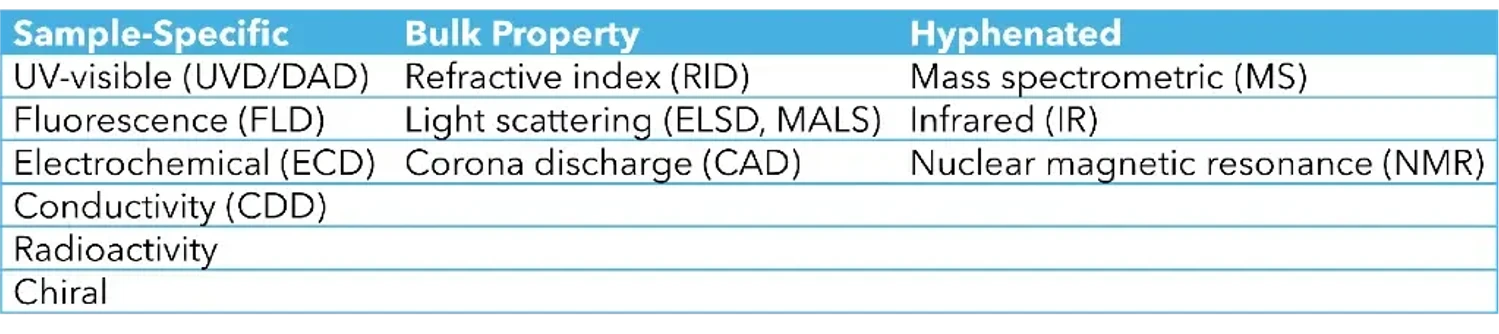 KNAUER: Table 1 - Common HPLC Detectors.
1. Optical Detectors
Optical detection is the most established and widely used approach in routine liquid chromatography. These detectors evaluate how an analyte absorbs, emits, rotates, or otherwise interacts with light.
UV/VIS, DAD, and PDA detectors
UV/VIS absorbance detectors measure the reduction in light intensity caused by an analyte at a selected wavelength. They are especially suitable for compounds containing chromophores, which are molecular structures capable of absorbing ultraviolet or visible light.
Diode-array and photodiode-array detectors record absorbance across a broader wavelength range. In addition to quantitative detection, they can provide spectral information that assists with wavelength selection, peak comparison, and the assessment of chromatographic purity.
UV-based detectors are popular because they are robust, relatively easy to operate, and compatible with a wide range of routine HPLC applications.
Fluorescence detectors
Fluorescence detection measures light emitted by a compound after excitation at a specific wavelength. It can provide excellent sensitivity and selectivity when an analyte is naturally fluorescent.
Compounds without native fluorescence may sometimes be converted into fluorescent derivatives before or after separation. This extends the range of applications but introduces an additional sample-preparation or reaction step.
Fluorescence detection is frequently used for pharmaceutical compounds, environmental contaminants, biological molecules, and other analytes requiring sensitive measurement in complex samples.
Optical rotation and circular dichroism detectors
These detectors evaluate the interaction of optically active compounds with polarized light. They are particularly valuable in chiral separations, where the objective is to distinguish between enantiomers and evaluate enantiomeric purity.
Their application is more specialized than conventional UV detection, but they can provide information that cannot be obtained from a standard absorbance signal alone.
2. Aerosol and Light-Scattering Detectors
Some analytes do not absorb UV light strongly enough for reliable absorbance detection. Aerosol-based and light-scattering technologies provide alternatives for many nonvolatile compounds.
Evaporative light-scattering detection
In an evaporative light-scattering detector, the column effluent is nebulized and the volatile mobile phase is removed. The remaining analyte particles pass through a light beam, and the scattered light is measured.
ELSD can therefore detect many compounds that lack chromophores, including certain lipids, carbohydrates, surfactants, and polymers. The analyte must generally be less volatile than the mobile phase.
Charged aerosol detection
Charged aerosol detection also begins with nebulization and evaporation of the mobile phase. The resulting analyte particles are then electrically charged, and the charge is measured to generate the detector response.
CAD offers broad applicability for nonvolatile and semi-volatile analytes and is frequently considered when UV detection is unavailable or produces an insufficient response.
Multi-angle light scattering
Multi-angle light-scattering detectors measure light scattered at several angles. When combined with suitable chromatographic and concentration data, MALS can support the characterization of molecular size and absolute molar mass.
This capability is particularly valuable in polymer analysis, protein characterization, and size-exclusion chromatography.
3. Mass Spectrometric Detection
Mass spectrometry is among the most informative detection technologies available for liquid chromatography. Instead of responding only to absorbance or another general property, an MS detector measures ions according to their mass-to-charge ratio.
LC–MS can provide:
- High sensitivity for trace-level analysis
- Strong selectivity in complex sample matrices
- Molecular-mass information
- Fragmentation data supporting compound identification
- Qualitative and quantitative results within a single workflow
Mass spectrometry is not universal in the strictest sense because the analyte must be successfully ionized. The mobile phase and its additives must also be compatible with the ion source.
Despite these requirements, LC–MS has become indispensable in pharmaceutical research, clinical and bioanalytical testing, food safety, environmental analysis, metabolomics, and many other fields. Its main disadvantages are higher acquisition costs, greater method complexity, and more demanding maintenance and data interpretation.
4. Electrochemical Detectors
Electrochemical detectors measure electrical changes associated with oxidation or reduction reactions at an electrode surface. They are suitable for compounds that are electrochemically active under the selected conditions.
Typical applications include the analysis of:
- Neurotransmitters
- Catecholamines
- Vitamins
- Phenolic compounds
- Redox-active pharmaceutical substances
For suitable analytes, electrochemical detection can achieve very high sensitivity and selectivity. At the same time, reliable operation requires carefully controlled mobile-phase composition, clean solvents, stable electrode conditions, and thorough method optimization.
The technique is therefore extremely powerful for targeted applications but less broadly applicable than UV or mass spectrometric detection.
5. Bulk-Property and Specialized Detectors
Refractive index detectors
A refractive index detector compares the refractive index of the mobile phase with that of the mobile phase containing an eluting analyte. Because many compounds alter this property, RID can be used for substances that do not absorb UV light.
Common applications include sugars, alcohols, lipids, and polymers. Refractive index detection is relatively straightforward, but it generally provides lower sensitivity than UV or fluorescence detection. It is also highly sensitive to changes in temperature and mobile-phase composition, making it poorly suited to gradient elution.
Viscosity and pH detectors
Viscosity detectors monitor changes in the flow characteristics of the mobile phase, while pH detectors respond to changes in acidity or alkalinity. These technologies are less common in general-purpose HPLC but can be useful in specific analytical or characterization workflows.
Radioactivity detectors
Radioactivity detectors are used when compounds contain radioactive labels. They are particularly important in tracer studies, metabolism research, drug development, and nuclear medicine.
Their selectivity is determined by the radioactive signal, allowing labelled compounds and their products to be followed even in complex matrices.
Selecting the Most Appropriate Detector
The detector should be selected according to the analytical question rather than according to a single performance specification.
For routine analysis of compounds with suitable chromophores, UV or diode-array detection is often the most practical solution. Fluorescence or electrochemical detection may be preferable when very high sensitivity is required for compounds with the appropriate chemical properties.
ELSD and CAD are useful for nonvolatile analytes that exhibit weak or no UV absorption. Refractive index detection remains valuable for relatively concentrated samples analyzed under isocratic conditions. When molecular identification, structural confirmation, or highly selective trace analysis is required, mass spectrometry is usually the strongest option.
In more complex workflows, several detectors may be connected in sequence. This makes it possible to obtain complementary information from the same chromatographic separation.
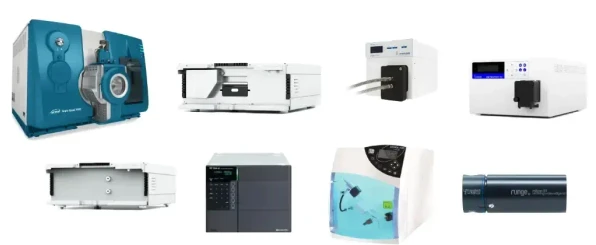
 KNAUER: Figure 2 Detector types used in HPLC.
Conclusion
A successful chromatographic separation must be paired with a detector capable of revealing the compounds of interest. Detector selection directly affects what can be measured, at what concentration, and with what degree of confidence.
Understanding the underlying detection principles makes it easier to balance sensitivity, selectivity, compatibility, information content, and practical laboratory requirements. Rather than searching for a universally superior technology, analysts should choose the detector whose response best matches the properties of the analyte and the objective of the method.
The next article in this series will examine detector performance in greater detail, including the specifications and evaluation criteria that make it possible to compare different technologies more fairly.
- L. R. Snyder, J. J. Kirkland, J. W. Dolan, Introduction to Modern Liquid Chromatography, 3rd Edition, John Wiley & Sons, Inc., Hoboken, New Jersey, 2010.
- D. A. Skoog, F. J. Holler, S. R. Crouch, Principles of Instrumental Analysis, 7th Edition, Cengage Learning, Boston, 2018.
- R. P. W. Scott, Liquid Chromatography Detectors. In J. Chromatogr. Library, Vol. 11, Elsevier Scientific Publishing Company, Amsterdam, 1977, pp. iii-ix, 1-248.
- V. R. Meyer, Praxis der Hochleistungs-Flüssigchromatographie, 10., vollst. überarb. u. erw. Auflage, Wiley-VCH, Weinheim, 2009.
- G. Aced, H. J. Möckel, Liquidchromatographie, Apparative, theoretische und methodische Grundlagen der HPLC, VCH Verlagsgesellschaft mbH, Weinheim, 1991.