

Characterisation of small RNA-based therapeutics and their process impurities by fast and sensitive liquid chromatography high resolution mass spectrometry
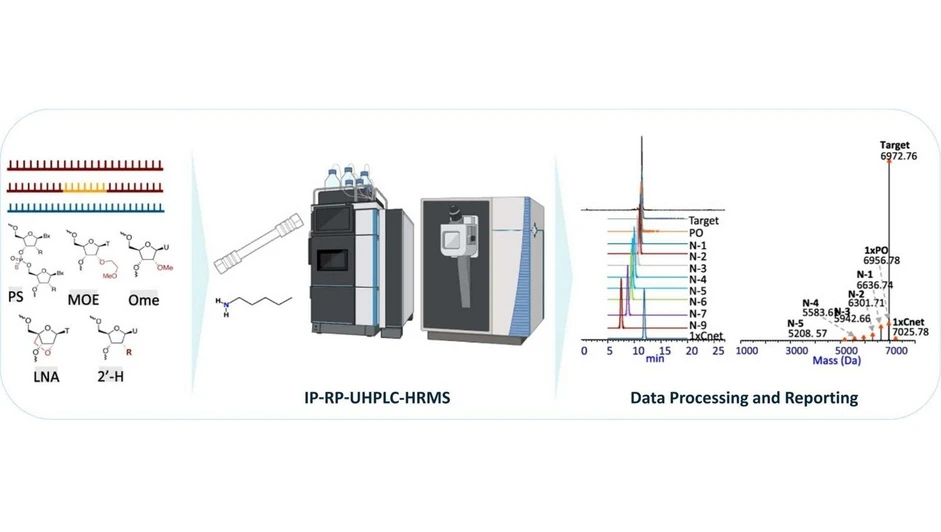
Pharm Biomed Anal. 2026,15:268:117097: Graphical abstract
This study describes a fast and sensitive LC-HRMS/MS method for characterizing small RNA-based therapeutics, including chemically modified antisense oligonucleotides. Using an amine-based ion-pair reversed-phase LC approach and optimized electrospray conditions, the method minimizes ion-pair adduct formation and in-source artifacts.
The workflow enables accurate sequence confirmation, terminal and site-specific modification analysis, and detection of low-abundance impurities and degradants. High sensitivity and mass accuracy allowed identification of common process-related impurities, including phosphodiester conversions and truncated sequences, supporting quality control of RNA therapeutics.
The original article
Characterisation of small RNA-based therapeutics and their process impurities by fast and sensitive liquid chromatography high resolution mass spectrometry
Silvia Millán-Martín, Felipe Guapo, Sara Carillo, Ulrik H. Mistarz, Ken Cook, Jonathan Bones
Pharm Biomed Anal. 2026,15:268:117097
https://doi.org/10.1016/j.jpba.2025.117097
licensed under CC-BY 4.0
Selected sections from the article follow. Formats and hyperlinks were adapted from the original.
To date, IP-RP-HPLC, in combination with mass spectrometry (MS) is the most widely used hyphenated technique providing high sensitivity and resolution [25], [26], [27]. The use of tandem MS can provide detailed information about the structure and sequence of oligonucleotides [28]. C18 stationary phases have been predominantly used, and the addition of cationic ion pairing agent, is needed to increase the interaction between the oligonucleotides and the stationary phase. Based on the classical ion-pairing mechanism, the ion pairing agent interacts with the negatively charged phosphate groups by electrostatic interactions and the hydrophobic moieties on the ion pairing agent eventually drive the interaction with the non-polar stationary phase. Other proposed mechanism is based on the adsorption of the ion-pair agent on the stationary phase (dynamic ion-exchange). The impact of ion pairing agents on the selectivity and sensitivity in the analysis of modified oligonucleotides has been extensively studied and it was demonstrated that the retention mechanism strongly depends on alkyl chain branching in the structure of ion pairing agent [27], [28]. The concentration of ion pairing agent also influences the oligonucleotide separation, regardless of utilised stationary phase. Finally, it was also shown that the ion pairing agents influence the MS sensitivity in significant way. The combination of alkylamines ion pairing agents with fluoroalcohols as counter ions such as hexafluoro-2-isopropanol (HFIP) are the most common mobile phases used to improve mass spectrometry sensitivity [29]. The choice of fluoroalcohols in IP-RP-LC/MS analysis of oligonucleotides depends on the type of ion-pairing reagents used in the mobile phase [30], [31]. Various types of amines are commonly used for oligonucleotide analysis, such as triethylamine acetate (TEAA), tributylamine acetate (TBAA), triethylamine (TEA), hexylamine (HA), dibutylamine (DBA), N,N-dimethylbutylamine (DMBA), N,N-diisopropylethylamine (DIPEA), or tripropylamine (TPA), between others [27], [30], [32]. Over the last decade efforts have focused on improving chromatographic resolution and improving MS sensitivity. IP-RP-LC-MS separation of oligonucleotides is strongly influenced by the sequence of the oligonucleotide under investigation. The MS sensitivity depends on hydrophobicity of oligonucleotides bases [32], alkylamine/HIFP concentrations [31] and adduct formation [33]. Optimal MS signal has been observed when using low concentration (5–30 mM) of alkylamines buffered with 50–100 mM HIFP [27].
In 2022, Rentel et al. [19] published the first QC method based on IP-HPLC-UV-MS for rapid, detailed and sensitive monitoring of assay, purity and impurity profile of oligonucleotides across their antisense platform which provided insights into batch-to-batch variability, stability, and degradation from stress testing.
This study highlights the use of IP-RP coupled to a high-resolution MS and MS/MS method (HRMS) for both intact and oligo sequencing analysis of RNA-based ss-ASOs of different lengths (14mer-20mer) and with different types of chemical modifications and their associated process related impurities using a 27-minute gradient. Most abundant species were identified as the target molecules, with purity values ranged from 93.6 % to 73.2 %, while most common impurity found was the presence of the PO in PS oligonucleotides followed by N-x impurities. Pentylamine was used as an alternative ion pairing agent with moderate hydrophobicity, for the characterisation of RNA-based ss-ASOs. This ion pair on its own is not enough to suppress the stereo isomer separation caused by the inclusion of the sulphur on the phosphate backbone [34], which can result in broad peaks and poor resolution. The combined use with HFIP makes the eluent more hydrophilic and encourages the pentylamine ion pair to interact with the stationary phase to mask the hydrophobic interactions involved in diastereoisomer separation of ASO RNA. Pentylamine is a primary amine which has a moderate hydrophobicity due to its five-carbon chain with an amine group attached to the first carbon. Existing literature has not yet reported the use of this IP reagent for oligonucleotide analysis by IP-RP-HRMS, however some studies suggested the use of propylamine, butylamine, hexylamine or octylamine, between others [32]. Although strong IP alkylamines offer improved chromatography, they also generate a decrease in MS signal intensity due to the formation of ion-pair adducts. Pentylamine is less hydrophobic than the commonly used TBAA or HA, and easier to remove as an adduct, whilst enabling high resolution chromatography when used in combination with HFIP. The high pH of the eluent system generated higher charge states that yielded improved MS/MS fragmentation for sequence analysis. The multiple charge states observed facilitate isotopic deconvolution. Isotopic deconvolution requires the identification of the smallest isotope which can be performed on the higher charge states and allows the lowest charge states, which may still contain amine adducts, to be ignored in the deconvolution results. The developed method allowed for target molecule sequence verification and identification of low abundant impurities with high sensitivity and high mass accuracy. Full sequence coverage obtained by MS/MS enabled confirmation of the identified impurities and in some cases, the location of the modifications. Finally, it is also important to highlight, that highly hydrophobic agents are non-environmentally or health friendly, being deadly when ingested or inhaled, toxic to aquatic life, and have long-lasting environmental impacts, something that is also considered for the present study, in accordance with the principles of green chemistry.
2. Materials and methods
2.2. Equipment
A Thermo Scientific Vanquish Flex UHPLC system equipped with a column compartment, a binary pump F and a UV detector was used for analysis. For MS detection, the Vanquish Flex was hyphenated to an Orbitrap Exploris 480 Mass Spectrometer (MS) through a standard flow Ion MAX Source containing a heated electrospray ionisation (H-ESI) probe (Thermo Scientific, Bremen, Germany). All data were acquired using Thermo Scientific Chromeleon Chromatography Data System software 7.3.2 (Thermo Scientific, Germering, Germany).
2.4. Data processing
For intact analysis data deconvolution and annotation was performed in Thermo Scientific BioPharma Finder 5.2. (Thermo Scientific, San Jose, CA, USA) using sliding windows and the Xtract deconvolution algorithm for isotopically resolved spectra. Data deconvolution and analysis parameters are outlined in Table S1 in the Supporting Information. For oligonucleotide sequencing analysis, BioPharma Finder 5.2 was also used, and data processing parameters are summarised in Table S2 in the Supporting Information. For GLP compliance the intact deconvolution can be performed within Chromeleon as both software options use the same deconvolution engine and parameters. For both data processing approaches, oligonucleotide sequence editor was used to assign maximum number of modifications to 1, terminal truncation search for both 5’ and 3’ end by creating 2 different sequences and default and custom created variable modifications (Tables S1 and S2).
3. Results and discussion
3.1. Optimisation of chromatographic and MS parameters
The multistep synthesis and purification processes of therapeutic oligonucleotides, although optimised and well-controlled, can generate low-level impurities and degradation products, which may impact on the quality of the target oligonucleotide by shortening shelf-life or leading to unexpected side-effects. Extensive work has been performed to identify the different types of impurities and degradation products from oligonucleotides formed during their synthesis or from different degradation pathways. The most common impurities are shortmer failure sequences. Shortmer molecules (N-1, N-2, etc.) may be formed due to failure sequences resulting from coupling inefficiency, incomplete capping or detritylation. Similarly, longmer molecules may be formed as (N + 1) owing to further coupling or as (N + x) due to inefficiency of the final cleavage and deprotection phase. Other impurity products may be produced by depurination, deamination, thermal stress, sulphur loss, adduct formation as chloral and acrylonitrile adducts or other reactions.
We first evaluated chromatographic retention and resolution for different types of RNA-based ss-ASOs of different lengths, with molecular masses between 4732 Da (14mer) to 7122 Da (20mer) and the presence of commonly observed modified backbone or bases, as described for second and third generation ASOs (Table 1). The chromatographic gradient was optimised for a rapid analysis of the different molecules in less than 30 min while maintaining adequate chromatographic resolution. Fig. 2 outlines the UV chromatograms for 5 different RNA-based ss-ASOs over a 22-minute gradient. All the chromatographic profiles show a main peak which corresponds to the target molecules, eluting at different retention times (Rt) and with different peaks shapes. It can be observed that smaller oligonucleotides elute earlier in the chromatogram i.e., cobomarsen, miravirsen, and the use of pentylamine as ion pairing agent enabled achievement of good retention and resolution for the studied molecules with different types of modifications in their molecular structures. Zoomed areas show low abundant impurities mainly before the main peak, with some signals also noticeable after the main peak corresponding to other potential impurities. Generally, it is not possible to resolve all oligonucleotide-related impurities by traditional chromatographic methods, and the combination with mass spectrometry is key to improve the identification and quantification of process-related impurities, as it is highlighted by regulatory guidelines on the development and manufacture of oligonucleotides [35].
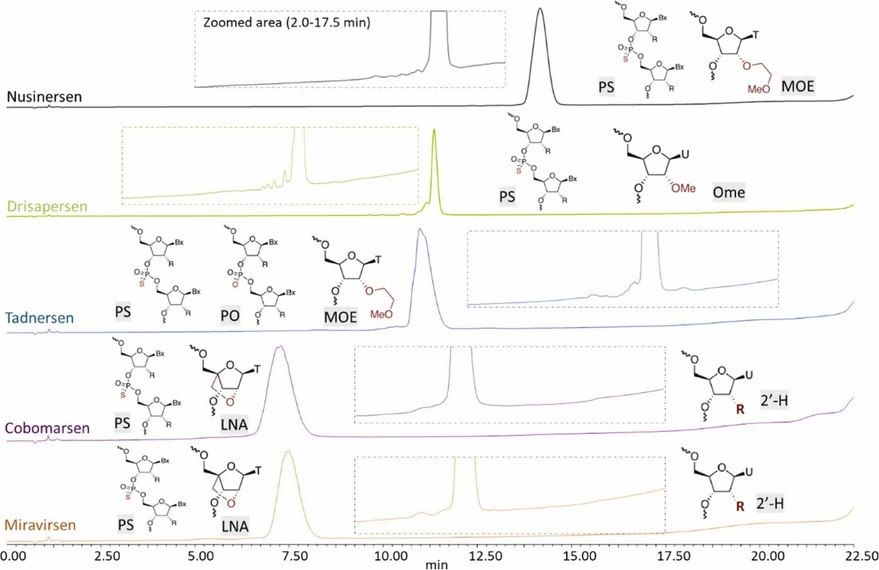 Pharm Biomed Anal. 2026,15:268:117097: Fig. 2. Comparison of UV (260 nm) chromatograms for 0.8 µg injection of the studied RNA-based ss-ASOs where corresponding structural modifications are indicated. PS: phosphorothioate linkage; PO: phosphodiester linkage; MOE: 2’-O-methoxy ethyl; Ome: 2’-methoxy, 2’-H: 2’-deoxy; LNA: locked nucleic acid.
3.3. Oligo sequencing analysis of RNA-based ss-ASOs with different types of chemical modifications
Detailed RNA-based ss-ASOs characterisation was next complemented with tandem mass spectrometry analysis for the determination of their sequences. MS/MS analysis were performed using a stepped higher-energy collisional dissociation (HCD) at 17, 19, 21 %. Fragmentation was typically observed around the phosphate backbone. McLuckey et al. [42] introduced a general nomenclature for those ions, which is based on the nomenclature used for the fragmentation of peptide ions and it has been adopted by the MS community as the standard approach to annotate oligonucleotide MS/MS data. In general, a-B and w ions are obtained for DNA-based molecules, following different pathways [43], while c and y ions for RNA-based molecules with reduced loss of base due to the presence of -OH, which stabilises the N-glycosidic bond on the nucleobase. Conversely, c and y ions in RNA-based molecules are formed via an intermolecular-cyclic transition state between the 2’-hydroxyl hydrogen atom and the oxygen of 5’-phosphate, with two mechanisms proposed [44] (Figure S9).
Using the oligonucleotide analysis workflow within BioPharma Finder (Table S2) allowed for automated MS/MS annotation facilitating comprehensive interpretation and data visualisation. A default list of variable modifications for oligonucleotide sequences are provided by the application, but it also allows to add user-defined custom modifications. Results are filtered using a confidence score of ≥ 95 and best average structural resolution (ASR) values of < 1.4. Confidence score is assigned by matching the predicted MS2 spectra to experimental results for each detected component. Best ASR of 1.0 means every single nucleotide residue bond has been broken and resulting fragment ions matched the predicted MS/MS spectra. High confidence score with low delta ppm and low ASR provides accurate and confident sequence identification and confirmation. Obtained results for all the studied RNA-based ss-ASO molecules are summarised in Supplementary Data 1, which lists all the detected species confirmed by MS/MS data for the analysed molecules, with corresponding extracted ion chromatograms where Rt elution is shown, oligonucleotide sequence, fragment coverage map and component results table.
As an example, Fig. 5 shows the fragment coverage map for two most abundant species detected for nusinersen, a fully modified RNA-based ss-ASO with PS and 2’MOE modifications, which correspond to the full-length product with 93.6 % purity value, in terms of fractional abundance (Table 2), and the PO impurity detected at 2.25 %, where most abundant fragments are c and y ions. Predicted and experimental MS2 spectra are also shown for both species in Fig. 5b and d, where the top spectrum corresponds to the predicted and the bottom spectrum to the experimental. Although some observed fragment ions are common for both full length and PO impurity (i.e. y ions), it is possible to observe some predictive fragments which confirm the unique identity of the two species with a −15.98 Da of mass difference for the PO impurity as denoted by c ions.
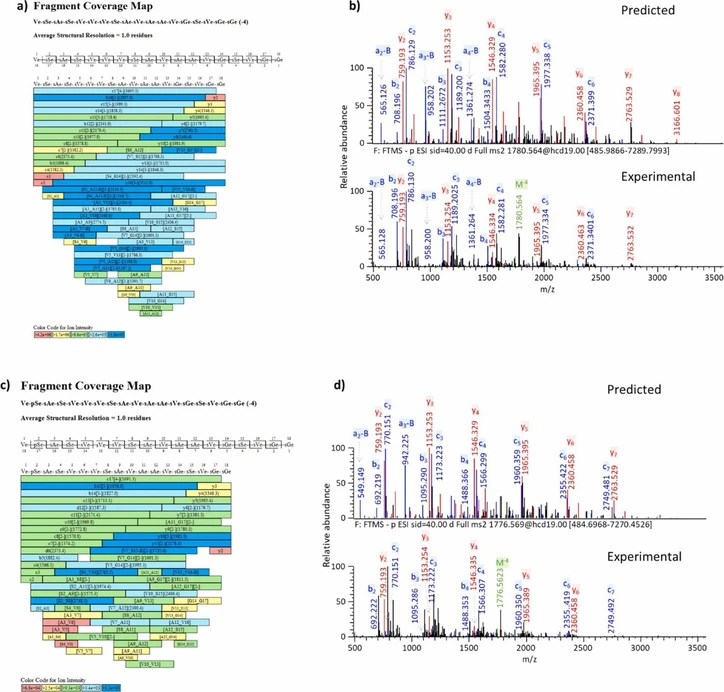 Pharm Biomed Anal. 2026,15:268:117097: Fig. 5. Fragment coverage maps (a) and (c) for nusinersen full length product and PO impurity, respectively. Annotated predicted (top) and experimental (bottom) MS2 spectra (b) and (d) acquired at stepped NCEs of 17–19–21. Most abundant ions are highlighted, which correspond to c and y fragment ions.
4. Conclusion
Over the last few years, the number of therapeutic oligonucleotides approved by regulatory agencies has increased considerably and is likely to continue to grow exponentially in the coming years considering the number of new molecules that are currently at advanced clinical trial stages. Hence, there is an increasing demand for rapid, reliable, high-throughput analytical methods to facilitate process development and product characterisation to support the entry of these molecules into the market and to ensure access by patients suffering from different types of diseases.
Here, an IP-RP-UHPLC-HRMS method was described suitable for MS identification and quantification of target molecule and impurities. A combination of pentylamine and fluorinated alcohol was used as ion pairing agents, which allowed for sequence verification and confident identification of low abundant impurities, with high sensitivity and high mass accuracy, at the intact and sequencing level.
Different categories of RNA-based ss-ASOs, from second and third generation, were studied with the aim to understand the behaviour of the different types of molecules bearing different modifications such as PS, 2’-MOE, 2’-Ome, LNA and 2’-H. Intact analysis allowed for the detection and quantification of full length products with different sizes and purity values, and also the detection of multiple impurities and degradants, even without being fully chromatographically resolved, with high sensitivity. MS parameters must be studied for each specific molecule to avoid adduct formation or in-source produced impurities, together with the MS response in each case.
The use of tandem MS provided detailed complementary information about the structure and sequence of oligonucleotides and their main impurities. The MS/MS method not only allowed rapid confirmation of oligonucleotide sequence and localisation of modifications, but it can also confidently identify very low abundant impurities that are not discernible in the chromatogram.
The described method works for all varieties of ASO RNA samples tested and is both fast and reliable. Data handling for impurity analysis can be automated and placed within a compliant Chromeleon environment. The analysis, including data handling and reporting can be achieved in under 30 min making it ideal for rapid analysis in product development, in addition to a general quality control environment.
The use of HRMS provides significant advantages over single quadrupole methodology. Sensitivity is much improved along with impurity mass identification and quantitation. The elimination of adducts and in-source impurities also enables much easier quantitation. HRMS has started to be adopted in quality control environments with applications such as nitrosamine analysis and the multi-attribute method (MAM) for monoclonal antibodies, where the advantages in HRMS outweigh the difficulties in attempting to run the analysis without it. It is already accepted that the impurities under the full-length product of an ASO RNA require the use of mass spectrometry. Herein, we utilised HRMS for the total analysis rather than just the impurities under the main peak. This simplifies the quantitation aspect of the analysis and gives more informative data.


