Author
Phenomenex
Phenomenex
Phenomenex is a global technology leader committed to developing novel analytical chemistry solutions that solve the separation and purification challenges of researchers in industrial, government and academic laboratories.
Tags
Article
Academy
Product
Video
LinkedIn Logo

SPE Troubleshooting: Why Won't My Sample Flow Through the SPE Cartridge?
We, 10.6.2026
| Original article from: Phenomenex
Learn the most common causes of SPE cartridge flow problems and how to troubleshoot them. Identify issues related to samples, solvents, manifold pressure, and precipitation.
Video placeholder
  • Photo: Phenomenex: SPE Troubleshooting: Why Won't My Sample Flow Through the SPE Cartridge?
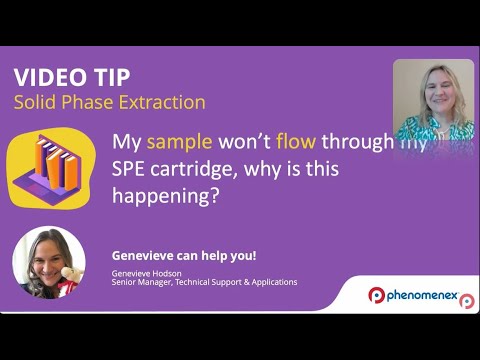
  • Video: Phenomenex: Why Your Sample Won’t Flow Through an SPE Cartridge | SPE Tip

In this troubleshooting tip, Genevie Hodson, Senior Manager of Technical Support and Applications at Phenomenex, addresses a common solid phase extraction (SPE) question:

"My sample won't flow through my SPE cartridge. Why is this happening?"

Several factors can contribute to flow problems during SPE. A systematic troubleshooting approach can help identify the root cause and restore proper cartridge performance.

Identifying When the Flow Problem Occurs

The first step in troubleshooting is determining when the flow issue appears.

Ask the following question:

  • Does the problem occur during the sample loading step?
  • Or does it occur before sample loading, during cartridge conditioning or when running blanks?

The timing of the problem can help identify its underlying cause.

Cause 1: Viscous or Cloudy Samples

Description

Samples that are thick, highly viscous, or contain large amounts of particulate matter can restrict flow through the SPE sorbent.

Recommended Actions

Before SPE, the sample should be:

  • Diluted
  • Centrifuged
  • Filtered

Another option is selecting a sorbent with a larger particle size.

Example

  • Strata-X – 33 µm particle size
  • Strata XL – 100 µm particle size

The larger particle size of Strata XL is better suited for viscous samples and can improve flow performance.

When This Problem Appears

If sample viscosity or particulate content is the cause, the flow issue will typically occur during the sample loading step.

Cause 2: Insufficient Manifold Pressure

Description

  • Flow problems may originate from the SPE manifold or instrumentation.
  • The applied pressure must be sufficient to generate proper flow through the cartridge.

Recommended Actions

Check:

  • The SPE manifold
  • Associated instrumentation
  • Individual manifold positions

In some cases, a specific position within the manifold may be responsible for the problem.

When This Problem Appears

If manifold pressure is the issue, poor flow will typically be observed during:

  • Conditioning steps
  • Blank runs

Cause 3: Immiscible Solvents

Description

Using solvents that are not mutually miscible can interfere with flow through the SPE cartridge.

Recommended Actions

Always use solvents that are miscible with each other.

Example

  • Hexane
  • Water

These solvents are immiscible and may cause flow problems if used together.

When This Problem Appears

Flow issues caused by solvent incompatibility are generally observed during:

  • Conditioning steps
  • Blank runs

Cause 4: Precipitation and Protein Build-Up

Description

  • Sample constituents or proteins may precipitate and clog the sorbent bed.
  • This blockage can significantly restrict or stop flow through the cartridge.

Recommended Actions

Possible corrective actions include:

  • Diluting the sample
  • Reducing sample volume
  • Avoiding denaturing solvents
  • Washing the sorbent with a low ionic strength buffer before the regular wash step

When This Problem Appears

If protein precipitation or sample-derived precipitates are responsible, the flow problem will typically occur after the sample has been loaded.

Systematic Troubleshooting Approach

When investigating SPE flow issues, use a systematic elimination strategy.

Key Principle

  • Evaluate one variable at a time and isolate potential causes individually.
  • This approach helps identify the true root cause rather than changing multiple parameters simultaneously.

Summary of Common SPE Flow Problems

Cause   /   Typical Observation Point   /   Suggested Solution
  • Viscous or cloudy sample: During sample loading - Dilute, centrifuge, filter, or use larger particle size sorbent
  • Insufficient manifold pressure: Conditioning or blanks - Check manifold and instrumentation
  • Immiscible solvents: Conditioning or blanks - Use only miscible solvents
  • Precipitation or proteins: After sample loading - Dilute sample, reduce volume, avoid denaturing solvents, use low ionic strength buffer wash

Conclusion

Flow problems in SPE can arise from several common sources, including viscous samples, insufficient manifold pressure, incompatible solvents, and precipitation of sample components or proteins. Determining exactly when the problem occurs during the SPE workflow is a critical first step in troubleshooting. A systematic, one-variable-at-a-time approach allows the root cause to be identified efficiently and corrective actions to be implemented.

Phenomenex
LinkedIn Logo
 

Related content

Large-Volume Dilute-and-Shoot Analysis of PFAS in Drinking Water Using the Altura PFAS Column

Applications
| 2026 | Agilent Technologies
Instrumentation
Consumables, LC columns, LC/MS, LC/MS/MS, LC/QQQ
Manufacturer
Agilent Technologies
Industries
Environmental

Hey, ho, oliGO – Comparison of ion-pairing systems for oligonucleotide analysis with HPLC-UV

Applications
| 2026 | KNAUER
Instrumentation
Consumables, LC columns, HPLC
Manufacturer
KNAUER
Industries
Pharma & Biopharma

Suppressed Cation Analysis of Wastewater Using Ion Chromatograph Nexera IC, Conforming to ASTM D6919-17

Applications
| 2026 | Shimadzu
Instrumentation
Ion chromatography
Manufacturer
Shimadzu
Industries
Environmental, Food & Agriculture

Comprehensive and Robust Analysis of Ultrashort- to Long-Chain PFAS, PAE, OPE, and PAH

Applications
| 2026 | Agilent Technologies
Instrumentation
LC/MS, LC/MS/MS, LC/TOF, LC/HRMS
Manufacturer
Agilent Technologies, Plasmion
Industries
Environmental

UPLC™ Separation of Fifteen Bisphenols Using a Waters Acquity™ Biphenyl RP Column with MaxPeak™ Premier Technology and UV Detection

Applications
| 2026 | Waters
Instrumentation
Consumables, LC columns, HPLC
Manufacturer
Waters
Industries
Pharma & Biopharma
 

Related articles

Troubleshooting SPE
Article | Academy

Troubleshooting SPE

A technical guide to troubleshooting low analyte recovery in SPE. Explains relative vs. absolute recovery and provides practical solutions for conditioning, loading, and sorbent selection.
Phenomenex
tag
share
more
Why Is It Necessary to Dry the SPE Sorbent Before Elution?
Article | Academy

Why Is It Necessary to Dry the SPE Sorbent Before Elution?

Proper drying of the SPE sorbent is a critical step to achieve high sensitivity, good reproducibility, and maximum analyte recovery, especially for complex sample matrices.
Phenomenex
tag
share
more
SPE Troubleshooting: Understanding and Resolving Low Recovery in Solid Phase Extraction
Article | Academy

SPE Troubleshooting: Understanding and Resolving Low Recovery in Solid Phase Extraction

Low SPE recovery does not have to mean method failure. Learn how fraction collection and analysis can identify analyte losses and guide effective troubleshooting steps.
Phenomenex
tag
share
more
Solvent Switching in Liquid Chromatography Columns: How to Change Column Solvents Safely
Article | Academy

Solvent Switching in Liquid Chromatography Columns: How to Change Column Solvents Safely

Learn how to safely switch solvents in an LC column, verify solvent miscibility, use IPA between immiscible systems, and prevent irreversible column damage.
Phenomenex
tag
share
more
 

Related content

Large-Volume Dilute-and-Shoot Analysis of PFAS in Drinking Water Using the Altura PFAS Column

Applications
| 2026 | Agilent Technologies
Instrumentation
Consumables, LC columns, LC/MS, LC/MS/MS, LC/QQQ
Manufacturer
Agilent Technologies
Industries
Environmental

Hey, ho, oliGO – Comparison of ion-pairing systems for oligonucleotide analysis with HPLC-UV

Applications
| 2026 | KNAUER
Instrumentation
Consumables, LC columns, HPLC
Manufacturer
KNAUER
Industries
Pharma & Biopharma

Suppressed Cation Analysis of Wastewater Using Ion Chromatograph Nexera IC, Conforming to ASTM D6919-17

Applications
| 2026 | Shimadzu
Instrumentation
Ion chromatography
Manufacturer
Shimadzu
Industries
Environmental, Food & Agriculture

Comprehensive and Robust Analysis of Ultrashort- to Long-Chain PFAS, PAE, OPE, and PAH

Applications
| 2026 | Agilent Technologies
Instrumentation
LC/MS, LC/MS/MS, LC/TOF, LC/HRMS
Manufacturer
Agilent Technologies, Plasmion
Industries
Environmental

UPLC™ Separation of Fifteen Bisphenols Using a Waters Acquity™ Biphenyl RP Column with MaxPeak™ Premier Technology and UV Detection

Applications
| 2026 | Waters
Instrumentation
Consumables, LC columns, HPLC
Manufacturer
Waters
Industries
Pharma & Biopharma
 

Related articles

Troubleshooting SPE
Article | Academy

Troubleshooting SPE

A technical guide to troubleshooting low analyte recovery in SPE. Explains relative vs. absolute recovery and provides practical solutions for conditioning, loading, and sorbent selection.
Phenomenex
tag
share
more
Why Is It Necessary to Dry the SPE Sorbent Before Elution?
Article | Academy

Why Is It Necessary to Dry the SPE Sorbent Before Elution?

Proper drying of the SPE sorbent is a critical step to achieve high sensitivity, good reproducibility, and maximum analyte recovery, especially for complex sample matrices.
Phenomenex
tag
share
more
SPE Troubleshooting: Understanding and Resolving Low Recovery in Solid Phase Extraction
Article | Academy

SPE Troubleshooting: Understanding and Resolving Low Recovery in Solid Phase Extraction

Low SPE recovery does not have to mean method failure. Learn how fraction collection and analysis can identify analyte losses and guide effective troubleshooting steps.
Phenomenex
tag
share
more
Solvent Switching in Liquid Chromatography Columns: How to Change Column Solvents Safely
Article | Academy

Solvent Switching in Liquid Chromatography Columns: How to Change Column Solvents Safely

Learn how to safely switch solvents in an LC column, verify solvent miscibility, use IPA between immiscible systems, and prevent irreversible column damage.
Phenomenex
tag
share
more
 

Related content

Large-Volume Dilute-and-Shoot Analysis of PFAS in Drinking Water Using the Altura PFAS Column

Applications
| 2026 | Agilent Technologies
Instrumentation
Consumables, LC columns, LC/MS, LC/MS/MS, LC/QQQ
Manufacturer
Agilent Technologies
Industries
Environmental

Hey, ho, oliGO – Comparison of ion-pairing systems for oligonucleotide analysis with HPLC-UV

Applications
| 2026 | KNAUER
Instrumentation
Consumables, LC columns, HPLC
Manufacturer
KNAUER
Industries
Pharma & Biopharma

Suppressed Cation Analysis of Wastewater Using Ion Chromatograph Nexera IC, Conforming to ASTM D6919-17

Applications
| 2026 | Shimadzu
Instrumentation
Ion chromatography
Manufacturer
Shimadzu
Industries
Environmental, Food & Agriculture

Comprehensive and Robust Analysis of Ultrashort- to Long-Chain PFAS, PAE, OPE, and PAH

Applications
| 2026 | Agilent Technologies
Instrumentation
LC/MS, LC/MS/MS, LC/TOF, LC/HRMS
Manufacturer
Agilent Technologies, Plasmion
Industries
Environmental

UPLC™ Separation of Fifteen Bisphenols Using a Waters Acquity™ Biphenyl RP Column with MaxPeak™ Premier Technology and UV Detection

Applications
| 2026 | Waters
Instrumentation
Consumables, LC columns, HPLC
Manufacturer
Waters
Industries
Pharma & Biopharma
 

Related articles

Troubleshooting SPE
Article | Academy

Troubleshooting SPE

A technical guide to troubleshooting low analyte recovery in SPE. Explains relative vs. absolute recovery and provides practical solutions for conditioning, loading, and sorbent selection.
Phenomenex
tag
share
more
Why Is It Necessary to Dry the SPE Sorbent Before Elution?
Article | Academy

Why Is It Necessary to Dry the SPE Sorbent Before Elution?

Proper drying of the SPE sorbent is a critical step to achieve high sensitivity, good reproducibility, and maximum analyte recovery, especially for complex sample matrices.
Phenomenex
tag
share
more
SPE Troubleshooting: Understanding and Resolving Low Recovery in Solid Phase Extraction
Article | Academy

SPE Troubleshooting: Understanding and Resolving Low Recovery in Solid Phase Extraction

Low SPE recovery does not have to mean method failure. Learn how fraction collection and analysis can identify analyte losses and guide effective troubleshooting steps.
Phenomenex
tag
share
more
Solvent Switching in Liquid Chromatography Columns: How to Change Column Solvents Safely
Article | Academy

Solvent Switching in Liquid Chromatography Columns: How to Change Column Solvents Safely

Learn how to safely switch solvents in an LC column, verify solvent miscibility, use IPA between immiscible systems, and prevent irreversible column damage.
Phenomenex
tag
share
more
 

Related content

Large-Volume Dilute-and-Shoot Analysis of PFAS in Drinking Water Using the Altura PFAS Column

Applications
| 2026 | Agilent Technologies
Instrumentation
Consumables, LC columns, LC/MS, LC/MS/MS, LC/QQQ
Manufacturer
Agilent Technologies
Industries
Environmental

Hey, ho, oliGO – Comparison of ion-pairing systems for oligonucleotide analysis with HPLC-UV

Applications
| 2026 | KNAUER
Instrumentation
Consumables, LC columns, HPLC
Manufacturer
KNAUER
Industries
Pharma & Biopharma

Suppressed Cation Analysis of Wastewater Using Ion Chromatograph Nexera IC, Conforming to ASTM D6919-17

Applications
| 2026 | Shimadzu
Instrumentation
Ion chromatography
Manufacturer
Shimadzu
Industries
Environmental, Food & Agriculture

Comprehensive and Robust Analysis of Ultrashort- to Long-Chain PFAS, PAE, OPE, and PAH

Applications
| 2026 | Agilent Technologies
Instrumentation
LC/MS, LC/MS/MS, LC/TOF, LC/HRMS
Manufacturer
Agilent Technologies, Plasmion
Industries
Environmental

UPLC™ Separation of Fifteen Bisphenols Using a Waters Acquity™ Biphenyl RP Column with MaxPeak™ Premier Technology and UV Detection

Applications
| 2026 | Waters
Instrumentation
Consumables, LC columns, HPLC
Manufacturer
Waters
Industries
Pharma & Biopharma
 

Related articles

Troubleshooting SPE
Article | Academy

Troubleshooting SPE

A technical guide to troubleshooting low analyte recovery in SPE. Explains relative vs. absolute recovery and provides practical solutions for conditioning, loading, and sorbent selection.
Phenomenex
tag
share
more
Why Is It Necessary to Dry the SPE Sorbent Before Elution?
Article | Academy

Why Is It Necessary to Dry the SPE Sorbent Before Elution?

Proper drying of the SPE sorbent is a critical step to achieve high sensitivity, good reproducibility, and maximum analyte recovery, especially for complex sample matrices.
Phenomenex
tag
share
more
SPE Troubleshooting: Understanding and Resolving Low Recovery in Solid Phase Extraction
Article | Academy

SPE Troubleshooting: Understanding and Resolving Low Recovery in Solid Phase Extraction

Low SPE recovery does not have to mean method failure. Learn how fraction collection and analysis can identify analyte losses and guide effective troubleshooting steps.
Phenomenex
tag
share
more
Solvent Switching in Liquid Chromatography Columns: How to Change Column Solvents Safely
Article | Academy

Solvent Switching in Liquid Chromatography Columns: How to Change Column Solvents Safely

Learn how to safely switch solvents in an LC column, verify solvent miscibility, use IPA between immiscible systems, and prevent irreversible column damage.
Phenomenex
tag
share
more
Other projects
GCMS
ICPMS
Follow us
FacebookX (Twitter)LinkedInYouTube
More information
WebinarsAbout usContact usTerms of use
LabRulez s.r.o. All rights reserved. Content available under a CC BY-SA 4.0 Attribution-ShareAlike