Computer simulations shed light on how unusual tRNAs change the rules of reading the genetic code

VŠCHT Prague: Computer simulations shed light on how unusual tRNAs change the rules of reading the genetic code
Scientists from UCT Prague contributed to a large-scale study showing that a small change in the so-called anticodon stem of transfer RNAs can expand their decoding capabilities – not only in eukaryotes but also in bacteria.
Scientists from UCT Prague contributed to a large-scale study showing that even a small change in transfer RNA (tRNA) can fundamentally affect how a cell reads its genetic information. Computer simulations explained why certain tRNAs are able to ignore a signal that under normal circumstances marks the end of protein synthesis. Such tRNAs were previously known in higher organisms. The study, however, mapped how common these unusual tRNAs are in bacteria.
The genetic code is a set of rules by which cells translate genetic information during protein synthesis. Transfer RNAs (tRNAs) play a key role in this process, recognising short stretches of mRNA known as codons through their anticodon. In addition to amino acid codons, there is one start codon and several termination (stop) codons. Stop codons are not recognised by transfer RNAs but by specialised enzymes that terminate protein synthesis. Standard tRNAs have five nucleobase pairs in their so-called anticodon stem. Recently, however, it has emerged that some organisms carry functional tRNAs with only four pairs. These "shortened" variants can recognise even codons that, according to the classical rules, should not correspond to them.
An international team led by the Biology Centre of the Czech Academy of Sciences in České Budějovice analysed over 42,000 bacterial genomes and found that tRNAs with a four-pair stem occur in bacteria surprisingly often. In some cases, these variants likely enable the reading of the stop codon UGA as the amino acid tryptophan, a phenomenon previously associated mainly with unicellular eukaryotes.
The Kolář group at the Department of Physical Chemistry, UCT Prague, focused on the question of why a four-pair stem alters the decoding properties of tRNA. To address this, they employed atomistic molecular dynamics simulations, which make it possible to track the movement of every atom in a tRNA molecule over time.
Jakub Žváček, a student on the Master's programme in Data Engineering in Chemistry, prepared a total of nine variants derived from the tryptophan tRNA of the bacterium Escherichia coli: the wild type with a five-pair stem, six mutants with a disrupted top base pair, and two previously described variants that promote reading of the stop codon UGA (the G24A and A9C mutations). The simulation results showed that disrupting the top base pair does not cause the overall three-dimensional structure of the tRNA to collapse. It remains stabilised by stacking interactions of neighbouring bases and non-canonical hydrogen bonds. The key finding, however, concerns a region at the interface of the D-arm and the stem – kind of hinge within the tRNA. In some mutants, the simulations revealed destabilisation of this region and increased flexibility of the anticodon stem, reminiscent of the behaviour of known mutations that promote stop codon readthrough. The simulations thus provided a structural explanation for the experimental observations and helped formulate predictions about which nucleotide combinations in the disrupted pair are functionally relevant.
The study proposed an extension of the so-called superwobble hypothesis to include non-canonical C:A pairing at the third codon position. If this hypothesis is confirmed for other types of tRNA as well, it will have profound implications for our understanding of how the genetic code — shared by all known organisms — has been shaped by evolution.
The results were published in the Nucleic Acids Research (2026, 54, gkag327).
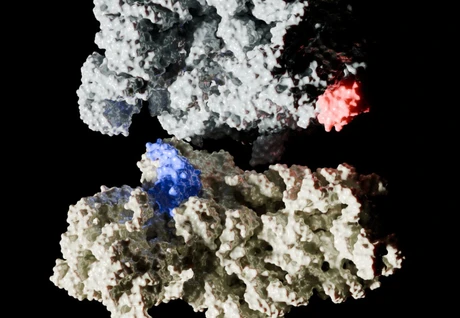
VŠCHT Prague: Computer simulations shed light on how unusual tRNAs change the rules of reading the genetic code: Molecular architecture of the transfer RNA with the 5th anticodon-stem base pair labelled. This base pair affects the decoding ability of the tRNA anticodon.
 VŠCHT Prague: Computer simulations shed light on how unusual tRNAs change the rules of reading the genetic code: Analysis of anticodon stem flexibility showed that the mutation of the 5th nucleobase pair (C27A), which enables stop-codon readthrough, loosens the anticodon stem in a manner similar to the previously known Hirsh mutation G24A. Conversely, the C27U mutation does not loosen the stem, which correlates with the absence of this mutation in the genomes of bacteria containing tRNAs with 4bp stems.
Original article
Frequent occurrence and predicted functions of tRNAs with 4-base-pair anticodon stems in bacteria: extended superwobble hypothesis
Fadel Fakih, Satish Nandipati, Ambar Kachale, Jiří Heller, Jakub Žváček, Filip Brázdovič, Nawal Al-Chamy, Pragya Tripathi, Zdeněk Paris, Leoš Shivaya Valášek, Michal H Kolář, Vyacheslav Yurchenko, Marek Eliáš, Eugene V Koonin, Julius Lukeš, Anzhelika Butenko
Nucleic Acids Research, Volume 54, Issue 7, 24 April 2026, gkag327
https://doi.org/10.1093/nar/gkag327
licenced by CC-BY 4.0
Abstract
Recently, a tRNATrpCCA with a 4-base-pair (bp) anticodon stem (AS) was shown to efficiently recognize a near-cognate UGA codon in unicellular eukaryotes, such as some trypanosomatids and ciliates, thereby representing a novel codon reassignment mechanism. To determine whether this mechanism also evolved in bacteria, we analysed a dataset of 42 109 genomes, including previously reported cases of stop-to-tryptophan UGA reassignment and a newly identified instance in the phylum Patescibacteriota. We show that the 4-bp AS tRNATrp species are present across diverse bacteria and in some cases likely function in decoding in-frame UGA codons. Most notable is the endosymbiotic bacterium Candidatus Zinderia insecticola, which contains only the near-cognate 4-bp AS tRNATrpCCA, while lacking both canonical 5-bp AS tRNATrpCCA and a tRNATrpUCA. The secondary structure of this 4-bp AS tRNATrp resembles that of its eukaryotic counterpart, suggesting convergent evolution. We experimentally confirmed the UGA readthrough capacity of 4-bp AS tRNATrpCCA in Escherichia coli, and applied molecular dynamics simulations to suggest the underlying mechanism. Furthermore, we tested several predictions based on accepting the previously excluded possibility of C:A base pairing at the 3rd codon position. These findings provide new insights into the structural diversity of transfer RNAs (tRNAs) and expand our understanding of genetic code evolution.