New technology streamlines the development of aptamers, synthetic alternatives to antibodies
- Photo: IOCHB Prague: New technology streamlines the development of aptamers, synthetic alternatives to antibodies
- Video: IOCB Prague: New technology streamlines the development of aptamers, synthetic alternatives to antibodies
Scientists at IOCB Prague have developed a breakthrough technology that streamlines aptamer development. The new method integrates several biochemical and bioinformatics steps and paves the way for new diagnostic and therapeutic applications. Ongoing applications include wearable sensors that monitor selected biomarkers in real time and provide early warnings of impending health complications. The findings were published in Nature Communications.
Aptamers are short DNA or RNA strands that can recognize and bind to a specific target molecule with high precision. Similar to antibodies, they can be used to detect these molecules or modulate their activity. Unlike antibodies, they are much more stable, can be produced synthetically, and can be chemically modified to achieve the desired properties. As a result, they can offer capabilities that cannot be achieved with antibodies.
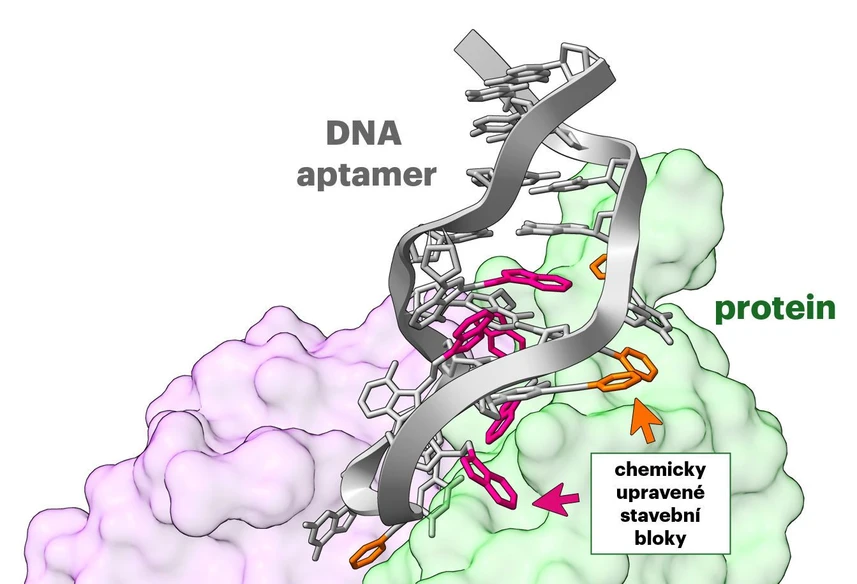 IOCHB Prague: New technology streamlines the development of aptamers, synthetic alternatives to antibodies: Chemically modified DNA aptamer bound to the target protein.
As demand grows for accurate and rapid diagnostic tools, aptamers are often better suited to these applications than antibodies. However, developing aptamers is both experimentally demanding and time-consuming. A team of scientists from IOCB Prague, led by Dr. Marek Ondruš and Prof. Michal Hocek, has now developed a technology that significantly shortens the development process.
“Developing an aptamer is often like looking for a needle in a haystack. Among trillions of different DNA sequences, we search for the one that binds strongly and specifically to a target molecule. Our new approach first screen for ‘aptamer families’ – hundreds of related sequences – and then identify the best-performing member of the family. This approach can reduce development time from several months to only a few days,” says Marek Ondruš.
Video: New technology streamlines the development of aptamers, synthetic alternatives to antibodies
The team has also expanded the potential applications of aptamers by chemically modifying their building blocks. For example, introducing functional groups similar to those found naturally in amino acids allows the resulting molecules to combine the advantages of both DNA and antibodies: Their sequence is encoded by the order of nucleotides in DNA, while the attached chemical modifications greatly expand their ability to recognize biologically relevant targets and mimic interactions between proteins that are underlying many biological processes.
The researchers demonstrated the potential of this new method using the human insulin receptor, a key protein that regulates blood sugar levels. They developed an aptamer that specifically binds to the receptor and elucidated the molecular basis of this interaction using cryo-electron microscopy. “We have shown that chemically introduced functional groups play a crucial role not only in target recognition and formation of the aptamer–protein complex, but also in stabilizing the DNA aptamer’s structure. Our findings provide new insights into how chemically modified nucleic acids can mimic key properties of proteins,” says Marek Ondruš.
In the future, the technology could complement – or, in some applications, even replace – antibody-based diagnostic tools. Researchers are collaborating with IOCB Tech on its further development, as the company helps to bring discoveries from IOCB Prague into practical applications.
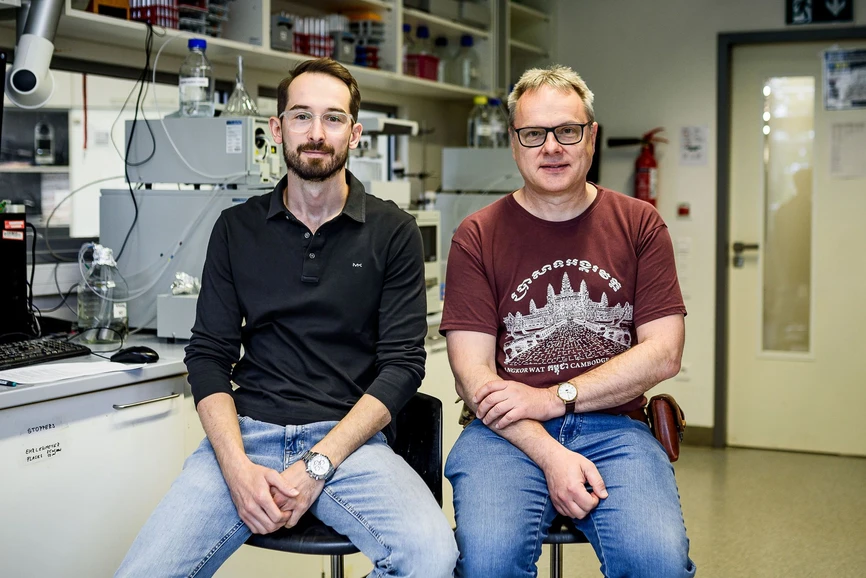 IOCHB Prague/Tomáš Belloň: New technology streamlines the development of aptamers, synthetic alternatives to antibodies: Dr. Marek Ondruš, first author of the study, and Prof. Michal Hocek, head of the Bioorganic and Medicinal Chemistry of Nucleic Acids research group at IOCB Prague.
Original article
Expedient single-round selection of hyper-modified aptamer targeting insulin receptor from over-represented dually nucleobase-modified DNA libraries
ablo Alberto Franco-Urquijo, Marek Ondruš, Jaroslav Kurfürst, Jana Škerlová, Irena Selicharová, Lucie Mužíková Čechová, Hana Šváchová, Alena Semerádtová, Anatolij Filimoněnko, Adéla Fejfarová, Jiří Homola, Tomáš Kouba & Michal Hocek
Nat. Commun., 2026
https://doi.org/10.1038/s41467-026-73676-y
licenced under CC-BY 4.0
Abstract
Discovery of functional nucleic acids from randomized libraries typically relies on multiple, time-consuming iterative rounds of in vitro selection with low success rate. Here, we present a single-round selection strategy for rapid screening of multiple over-represented nucleobase-modified DNA libraries and various selection conditions, capable of identifying high-affinity modified aptamers. Double partition followed by amplification of eluted sequences, NGS analysis and clustering provides fast identification of aptamer candidates. Screening of modified DNA libraries containing modified adenine and uracil nucleotides bearing hydrophobic aromatic phenyl and indole moieties results in development of an aptamer binding human insulin receptor with sub-nanomolar affinity and exquisite specificity. Cryo-EM structure reveals the importance of each aromatic modification, either in stabilizing the secondary structure or facilitating interactions with the protein surface. This approach addresses the main drawbacks of aptamer selection and has potential for high-throughput screening and accelerating the development of next-generation aptamers for diagnostics or therapeutics.