Highly Sensitive
A highly sensitive, on-line differential viscometer used in conjunction with SEC-MALS-IV to determine the size and conformation of all types of biopolymers, synthetic polymers and even proteins and peptides.
Multiple Novel Technologies
The ViscoStar incorporates multiple novel technologies to provide the highest sensitivity, stability and solvent compatibility of any available viscometer for GPC. Its ease-of-use and serviceability make it the perfect companion for Wyatt's DAWN™ light scattering and Optilab™ refractive index detectors.
Another path to polymer and protein characterization: SEC-MALS-IV
When coupled with size-exclusion chromatography and a concentration detector such as the Optilab™ , the ViscoStar derives the intrinsic viscosity (IV) of polymers. An inherently valuable physico-chemical property in itself, IV is best utilized together with molar mass information from multi-angle light scattering (SEC-MALS-IV) to derive the hydrodynamic radius, conformation, and branching ratio of a macromolecule in solution.
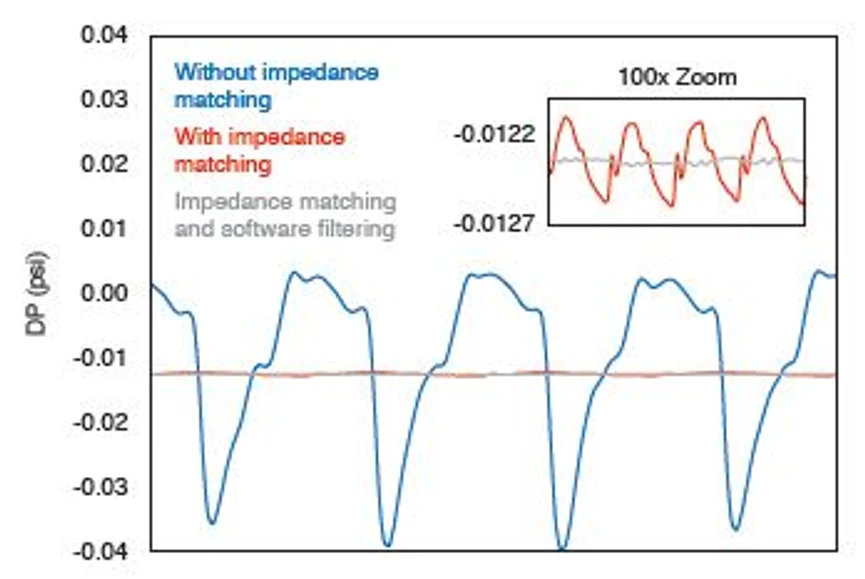 Waters ViscoStar: Patented pulse compensation technology in the ViscoStar eliminates pump fluctuations. At the hardware level, the bridge is impedance matched for dynamic balance, greatly reducing the effect of pump pulses. An additional layer of software filtering eliminates residual pump pulses.
Key benefits of the ViscoStar
- High sensitivity, equivalent to 100 ng of 100 kDa polystyrene in THF at 1.0 mL/min injected onto a standard GPC column
- High dynamic range of over 135,000:1. The full measurement range corresponds to over 13 mg/mL of 100 kDa polystyrene in THF
- Extended solvent compatibility with all-316 stainless steel transducers
- Temperature range from 4 °C to 70 °C for polymers or proteins that require a range of temperatures
- Minimal band broadening thanks to fast pressure transducers
- Pump pulse suppression to below 4 Pa (hardware alone) or 1 Pa (hardware + software) without loss of chromatographic resolution
- Automated capillary bridge tuning with no moving parts, to guarantee a perfectly balanced bridge, every run
- Enhanced thermal stability with drift of <2.5 Pa/hour
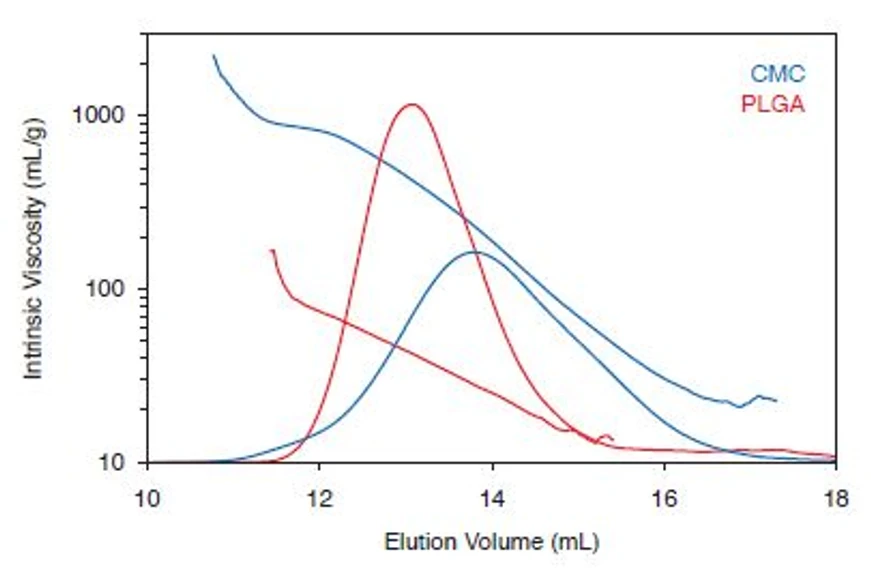 Waters ViscoStar: The ViscoStar provides the highest available dynamic range and sensitivity in online viscometry. This graph shows the intrinsic viscosities of 1) poly(lactic co-glycolic acid), or PLGA, in THF and 2) carboxymethyl cellulose, or CMC, in aqueous mobile phase, both measured with a ViscoStar and Optilab, spanning a range from tens to thousands of mL/g. The same instruments readily measure intrinsic viscosity values in the low single digits with excellent signal-to-noise, even at very low concentrations.
SEC-IV without MALS?
Yes, as much as we love MALS for optimal polymer analysis, it's true that there are occasions when it just won't fit the bill.
Universal calibration is a parallel technique to SEC-MALS for determining molecular weight, commonly used to characterize linear polymers. While universal calibration overcomes some of the problematic issues associated with column calibration by reference molecules, it does not account for non-ideal column behavior caused by chemical solute-column interactions or hyperbranching.
Universal calibration is particularly-well suited to replace MALS for:
- Strongly fluorescent polymers, in particular those not adequately addressed by a DAWN™ with long-wavelength (785 nm) laser or a standard DAWN (685 nm) with fluorescence-blocking filters.
- Weakly-scattering polymer/solvent systems with very low dn/dc values
The Mark-Houwink-Sakurada relationship makes use of empirical relationships between intrinsic viscosity and molar mass, specific to each polymer and solvent, to estimate molar mass from SEC-IV measurements. Of course, the best way to determine MHS coefficients is to measure them using SEC-MALS-IV and ASTRA™!
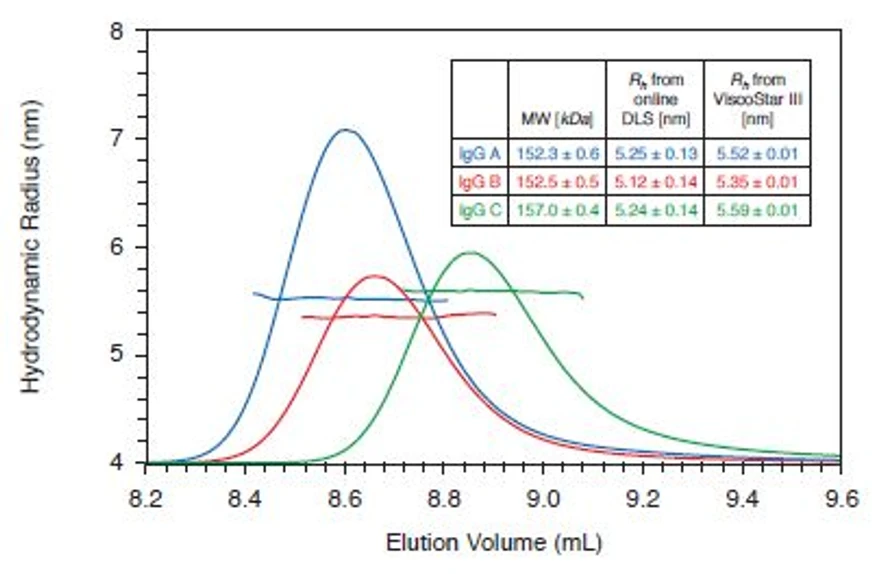 Waters ViscoStar: Three IgG proteins with similar MWs eluted at different elution volumes. To understand their different elution properties, online DLS is typically used to measure the hydrodynamic radius, R h , of a protein. However, online DLS did not provide reliable insights, in this case due to the relatively high experimental uncertainty of the DLS. The precise Rh values obtained with a MALS detector and the ViscoStar III, on the other hand, clearly revealed the causes. IgG B eluted later than IgG A due to its more compact structure; IgG C had a slight interaction with the SEC column.
Specifications
Measurement Capabilities – Differential Viscosity
- Sensitivity:
Detects as little as 0.1 µg of 100 kDa polystyrene in THF at 1 mL/min under typical GPC conditions. - Differential Pressure Performance:
- Noise: < 0.05 Pa
- Range: 6.9 kPa, with built-in overpressure protection
- Drift: < 2.5 Pa/hr
- Linearity: Within 0.5% of full scale
- Dynamic Range: 135,000:1
- Capillary Bridge Autobalance:
Thermally regulated, leak-free mechanism ensures stable baseline and precision. - Sample Shear Rate:
Up to 5000 Hz with water at 1 mL/min
Fluidics and Flow Compatibility
- Maximum Flow Rate:
- Aqueous: 1.5 mL/min
- THF: 3 mL/min
- Delay Volume Options:
Configurable at 16.2, 10.8, or 5.4 mL; optional factory-installed upgrade to 32.4 mL
(Note: actual column fluid volume is approx. half the listed value) - Maximum Inlet-to-Outlet Pressure:
690 kPa - Wetted Materials:
316 stainless steel, PTFE, zirconium silicate, Kalrez, Inconel, and 26-1 stainless steel – all selected for chemical resistance and long-term durability
Temperature Control
- Operating Range:
4 °C to 70 °C - Stability:
Maintains temperature within < 0.005 °C for precise measurements - Ambient Conditions:
0 °C to 40 °C; relative humidity 20% to 70%
Electronics and Connectivity
- Digital Output:
20-bit resolution at 10 Hz for high-fidelity data - Auxiliary I/O:
- Inputs: Autoinject contact closure, Alarm In, and 2 analog inputs (18-bit, ±10 V)
- Outputs: Autoinject retransmit, Alarm Out, Recycle Out
- Communication Interface:
Ethernet for seamless integration into lab networks and data systems
User Interface
- Front Panel Display:
7” (178 mm) high-resolution capacitive touchscreen for monitoring signals, diagnostics, and adjusting settings with ease
Instrument Dimensions
- Size: 58 cm (L) × 36 cm (W) × 18 cm (H)
Other Viscometers
- microViscoStar™ - Similar to the ViscoStar but designed specifically for use with UHPLC/APC.



