Launch of the book: Modern HPLC separations in theory and practice

Czech Chromatographic School: Launch of the book: Modern HPLC separations in theory and practice
- Price: 155 € + VAT
- 840 Pages
- ISBN 978-80-11-04472-5
- Language: English
- Published in June 2024 by Czech Chromatographic School
- Authors: Lucie Nováková, Michal Douša, Petr Česla, Jiří Urban, and collective
- Reviewers: Davy Guillarme, Deirdre Cabooter
How to buy the book
To order the book, please fill in the order form and send it back to [email protected]. Based on this information, we will issue an invoice including shipping. Once the payment is received, we will ship the book to you.
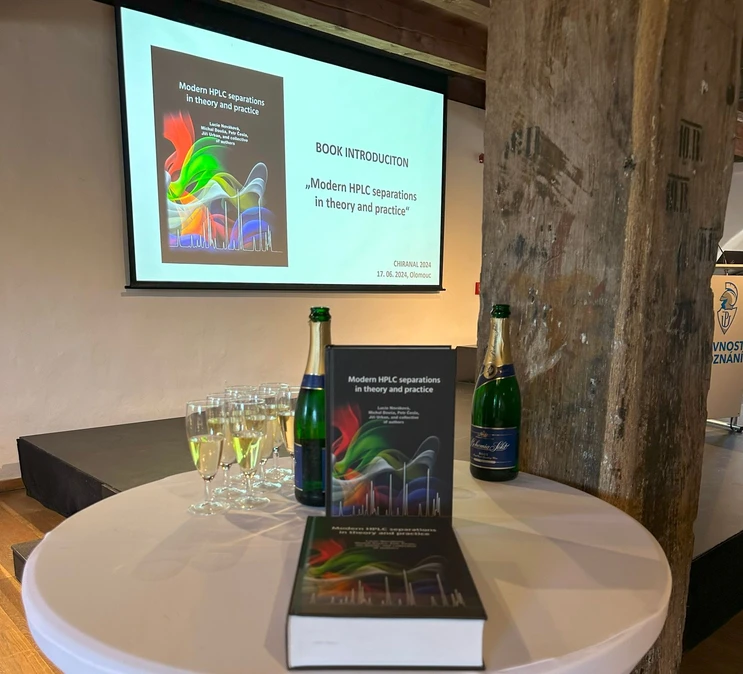 Czech Chromatographic School: Launch of the book: Modern HPLC separations in theory and practice
Book Content
1 HISTORY AND DEVELOPMENT OF LIQUID CHROMATOGRAPHY
- 1.1 FROM THE FIRST CHROMATOGRAPHIC SEPARATIONS TO HIGH-PERFORMANCE LIQUID CHROMATOGRAPHY
- 1.2 DEVELOPMENT OF HIGH-PERFORMANCE LIQUID CHROMATOGRAPHY IN THE NEW MILLENNIUM
2 BASIC CONCEPTS OF CHROMATOGRAPHIC SEPARATION
- 2.1 DESCRIPTION OF RETENTION IN THE CHROMATOGRAPHIC SYSTEM
- 2.2 DESCRIPTION OF SELECTIVITY IN THE CHROMATOGRAPHIC SYSTEM
- 2.3 DESCRIPTION OF EFFICIENCY IN THE CHROMATOGRAPHIC SYSTEM
- 2.4 DESCRIPTION OF RESOLUTION
- 2.5 SEPARATIONS USING GRADIENT ELUTION
3 HPLC INSTRUMENTATION
- 3.1 BASIC DESCRIPTION OF A LIQUID CHROMATOGRAPH
- 3.2 MOBILE PHASE TRANSPORT
- 3.3 SAMPLE INJECTION
- 3.4 CHROMATOGRAPHIC COLUMNS FOR HPLC
- 3.5 DETECTION IN HPLC
- 3.6 DERIVATIZATION IN HPLC
4 STATIONARY PHASES
- 4.1 PARAMETERS CHARACTERIZING STATIONARY PHASES
- 4.2 SILICA GEL
- 4.3 CHEMICALLY BONDED SILICA GEL BASED STATIONARY PHASES
- 4.4 METAL OXIDE-BASED STATIONARY PHASES
- 4.5 STATIONARY PHASES BASED ON ORGANIC POLYMERS
- 4.6 STATIONARY PHASES FOR ION-EXCHANGE CHROMATOGRAPHY
- 4.7 HYBRID STATIONARY PHASES
- 4.8 POROUS GRAPHITIC CARBON-BASED STATIONARY PHASES
- 4.9 MIXED-MODE STATIONARY PHASES
 Czech Chromatographic School: Launch of the book: Modern HPLC separations in theory and practice in action
5 CHROMATOGRAPHIC MODES
- 5.1 NORMAL-PHASE CHROMATOGRAPHY (NP-HPLC)
- 5.2 REVERSED-PHASE CHROMATOGRAPHY (RP-HPLC)
- 5.3 ION-EXCHANGE CHROMATOGRAPHY (IEC)
- 5.4 HYDROPHILIC INTERACTION LIQUID CHROMATOGRAPHY (HILIC)
- 5.5 HYDROPHOBIC INTERACTION CHROMATOGRAPHY (HIC)
- 5.6 MIXED-MODE CHROMATOGRAPHY
- 5.7 ION-PAIR CHROMATOGRAPHY
- 5.8 AFFINITY CHROMATOGRAPHY
- 5.9 SIZE-EXCLUSION CHROMATOGRAPHY (SEC)
- 5.10 CHIRAL CHROMATOGRAPHY
6 CURRENT TRENDS IN HIGH-PERFORMANCE LIQUID CHROMATOGRAPHY
- 6.1 ULTRA-HIGH-PERFORMANCE LIQUID CHROMATOGRAPHY (UHPLC)
- 6.2 POROUS SHELL PARTICLES
- 6.3 MONOLITHIC COLUMNS
- 6.4 HIGH-TEMPERATURE LIQUID CHROMATOGRAPHY (HTLC)
- 6.5 SUPERCRITICAL FLUID CHROMATOGRAPHY
- 6.6 TWO-DIMENSIONAL LIQUID CHROMATOGRAPHY
- 6.7 MINIATURIZATION IN LIQUID CHROMATOGRAPHY
7 MODERN HPLC PRACTICE
- 7.1 MOBILE PHASE PREPARATION AND USE
- 7.2 CHROMATOGRAPHIC COLUMN – CARE AND USE
- 7.3 REGULAR MAINTENANCE OF HPLC SYSTEM
8 HPLC METHOD DEVELOPMENT AND OPTIMIZATION
- 8.1 PHYSICOCHEMICAL PROPERTIES OF THE ANALYTES AND METHOD OBJECTIVE
- 8.2 SELECTION OF DETECTION APPROACH
- 8.3 SELECTION OF CHROMATOGRAPHIC MODE
- 8.4 SELECTION OF STATIONARY AND MOBILE PHASES
- 8.5 PRELIMINARY EXPERIMENTS
- 8.6 METHOD OPTIMIZATION
- 8.7 SOLVING SEPARATION PROBLEMS IN METHOD DEVELOPMENT
- 8.8 SPECIFIC OPTIMIZATION APPROACHES
 Czech Chromatographic School: Launch of the book: Modern HPLC separations in theory and practice, Authors (Lucie Nováková, Michal Douša, Petr Česla, Jiří Urban, and collective)
9 SAMPLE PREPARATION FOR CHROMATOGRAPHIC ANALYSIS
- 9.1 CONVENTIONAL TECHNIQUES FOR SAMPLE PREPARATION
- 9.2 MODERN TRENDS IN SAMPLE PREPARATION TECHNIQUES
10 PREPARATIVE CHROMATOGRAPHY
- 10.1 PREPARATIVE HPLC
- 10.2 PREPARATIVE SFC
11 DATA ANALYSIS IN HPLC
- 11.1 QUALITATIVE ANALYSIS
- 11.2 QUANTITATIVE ANALYSIS
- 11.3 METABOLOMICS APPROACHES
12 METHOD VALIDATION IN HPLC
- 12.1 DEFINITIONS OF METROLOGICAL TERMS
- 12.2 VALIDATION PARAMETERS
- 12.3 PRACTICAL IMPLEMENTATION OF VALIDATION
- 12.4 PHARMACOPEIAL METHODS
- 12.5 SYSTEM SUITABILITY TEST
- 12.6 HPLC SYSTEM QUALIFICATION
 Czech Chromatographic School: Launch of the book: Modern HPLC separations in theory and practice, Author (Lucie Nováková) and Reviewers: Davy Guillarme, Deirdre Cabooter
13 HPLC TROUBLESHOOTING
- 13.1 BACK PRESSURE ISSUES
- 13.2 BASELINE ISSUES
- 13.3 RETENTION TIME ISSUES
- 13.4 PEAK SHAPE AND PEAK AREA PROBLEMS
- 13.5 CHROMATOGRAM PROBLEMS
14 LITERATURE REFERENCES
15 TABLES USEFUL IN HPLC DAILY PRACTICE
- 15.1 DYNAMIC VISCOSITY η OF ACETONITRILE/WATER AND METHANOL/WATER MIXTURES
- 15.2 MISCIBILITY OF ORGANIC SOLVENTS USED IN HPLC
- 15.3 ABSORPTION MAXIMA AND MOLAR EXTINCTION COEFFICIENTS
16 LIST OF ABBREVIATIONS
17 LIST OF SYMBOLS
CHROMATOGRAPHIC VENDORS’ PRESENTATION
 Czech Chromatographic School: Modern HPLC separations in theory and practice - Book Partners
Authors’ short biographies
Lucie Nováková is a Full Professor at the Charles University, Faculty of Pharmacy in Hradec Králové, Department of Analytical Chemistry, the Czech Republic. Her research is focused on separation techniques, in liquid and supercritical phase, and their coupling to mass spectrometry. She is involved in a broad scope of research projects focused on pharmaceutical analysis, doping control, plant analysis, and bioanalytical methods. She extended her scientific experience during the fellowships at world-recognized universities, such as the University of Geneva and Vrije Universiteit Brussel, beyond others. She published over 155 peer-reviewed scientific articles with H-index of 41 and more than 5500 citations, one book, and nine book chapters. She is also widely involved in teaching and education activities, such as HPLC and SFC training courses, seminars, but also conference lectures and organization. Recently, she has become also a Vice-dean for External and International Relationships.
 Czech Chromatographic School: Lucie Nováková (Charles University) and Michal Douša (Zentiva)
Michal Douša has been working in the pharmaceutical company Zentiva since 2007 as a head of the separation methods department. His research is focused on separation techniques, especially hydrophilic interaction liquid chromatography and chiral separation. He gained previous work experience at various workplaces in the field of HPLC analysis of water, soil, food,
and feed. He is the author of a book on HPLC theory and practice and one book chapter. He published over 65 peer-reviewed scientific articles withmore than 850 citations and H-index of 18. He is also involved in teaching and education activities, such as HPLC and validation training courses and seminars.
Petr Česla is an Associate professor of analytical chemistry, Head of the Department of analytical chemistry, and Vice-dean for Research and Creative Activities of the Faculty of Chemical Technology, University of Pardubice. In his research work, he focuses on the development of separation techniques in liquid phase, mainly liquid chromatography and capillary electrophoresis, with the special attention to the two-dimensional separations, optimization procedures, data processing, and coupling of LC and CE to mass spectrometry. He has been engaged in many research projects and acts as principal investigator of several projects of Czech Science Foundation. He is author of more than 60 papers in scientific journals with H-index of 18 and more than 1070 citations, co-author of one book and two book chapters.
 Czech Chromatographic School: Petr Česla (University of Pardubice) and Jiří Urban (Masaryk University)
Jiří Urban received a Ph.D. in 2007 in the group of Pavel Jandera at the University of Pardubice, the Czech Republic, where he worked until 2016. During 2009 – 2011, he followed post-doctoral research at the University of California, Berkeley, USA, in the František Švec and Jean M. J. Fréchet group. In 2017 he moved to the Department of Chemistry, Masaryk University, Brno, Czech Republic, where he became an Associate Professor in 2018. In his research, he utilizes multifunctional polymer monoliths to develop new analytical methods applicable to metabolomics and proteomics. He also focuses on the design of new instrumental setups for two-dimensional liquid chromatography. He published over 51 peer-reviewed scientific articles with more than 1400 citations and H-index of 22.
Reviewers’ feedback
“It was an honor to serve as a reviewer for this comprehensive book on liquid chromatography, and I am grateful to the authors for the opportunity to contribute to such a valuable resource. The book provides an excellent balance of content for those new to the field and those with advanced expertise, making it a versatile and accessible guide for chromato- graphers at all levels. The clarity of the explanations, the quality of the figures (I cannot imagine the time it takes to draw all the figures contained within the book), coupled with the in-depth discussions, allow me to further expand my understanding of liquid chromatography in some points. This book, with its well-structured content and broad appeal, is sure to become a bestseller and make a significant contribution to the chromatography community. I am confident that readers, whether novice or experienced, will find immense value in its pages.”
Davy Guillarme
 Czech Chromatographic School: Davy Guillarme (University of Geneva) and Deirdre Cabooter (KU Leuven)
“This book presents a very comprehensive overview of modern HPLC theory and practice that will be of great interest to anyone looking to immerse themselves into the technique. The book gives an overview of all aspects of liquid chromatography, from basic concepts of chromatography, covering all chromatographic modes, to novel trends in HPLC, such as 2D-LC and micro-pillar array columns, and a very useful chapter on troubleshooting. The many clear and informative illustrations make the book very practical and applicable. This is a must-have for anyone who is teaching or learning HPLC.”
Deirdre Cabooter


_s.webp)