Ultrahigh-Performance Supercritical Fluid Chromatography–Multimodal Ionization–Tandem Mass Spectrometry as a Universal Tool for the Analysis of Small Molecules in Complex Plant Extracts
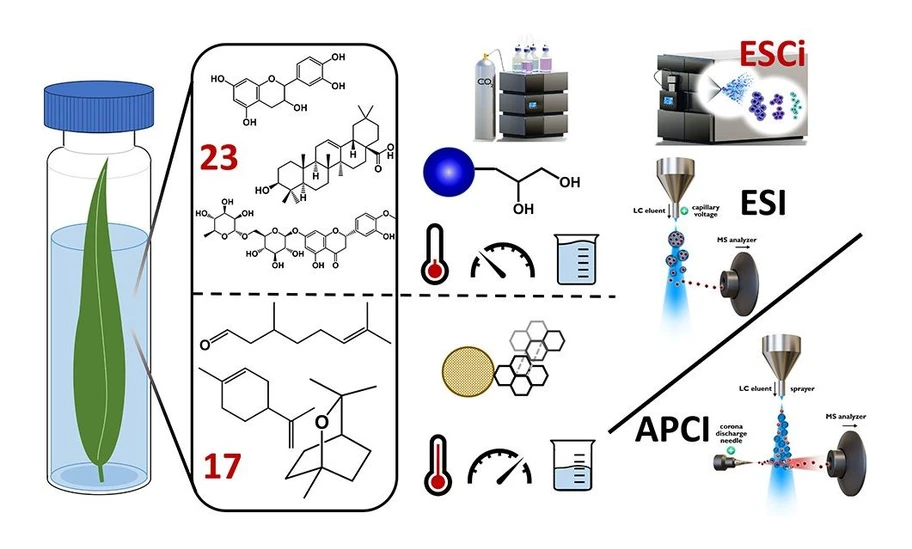
- Photo: Analytical Chemistry 2024 96 (7), 2840-2848: graphical abstract
In the research article recently published in ACS Analytical Chemistry journal the researchers led by Lucie Nováková from the Department of Analytical Chemistry, Faculty of Pharmacy in Hradec Králové, Charles University, present a novel analytical approach for mixtures of natural products.
This study addresses the complexity of plant extract analysis by developing a holistic two-injection method that integrates ultrahigh-performance supercritical fluid chromatography (UHPSFC) with multimodal ionization tandem mass spectrometry (MS/MS). This method, which does not require manual intervention, significantly improves the efficiency and accuracy of analyzing various small molecules, such as terpenes, flavonoids, and phenolic acids, in plant extracts. The authors applied this method to Eucalyptus sp. extracts, demonstrating its potential as a robust tool for comprehensive plant metabolite analysis.
The original article
Ultrahigh-Performance Supercritical Fluid Chromatography–Multimodal Ionization–Tandem Mass Spectrometry as a Universal Tool for the Analysis of Small Molecules in Complex Plant Extracts
Kateřina Plachká, Veronika Pilařová, Štefan Kosturko, Jan Škop, Frantisek Svec, and Lucie Nováková
Analytical Chemistry 2024 96 (7), 2840-2848
DOI: 10.1021/acs.analchem.3c03599
licensed under CC-BY 4.0
Selected sections from the article follow.
Abstract
Complex analysis of plant extracts usually requires a combination of several analytical approaches. Therefore, in this study, we developed a holistic two-injection approach for plant extract analysis, which is carried out within one instrument without the need for any manual intervention during the analysis. Ultrahigh-performance supercritical fluid chromatography (UHPSFC) was employed for the analysis of 17 volatile terpenes on a porous graphitic carbon column within 7.5 min, followed by analysis on short diol column where flavonoids, phenolic acids, and terpenoic acids were analyzed within 15.5 min. A multimodal ionization source combining electrospray and atmospheric pressure chemical ionization (ESCi) was selected for mass spectrometry detection as a simultaneous ionization of both lipophilic and polar compounds was required. The quantitative aspects of the final UHPSFC-ESI/ESCi-MS/MS two-injection approach were determined, and it was applied to the analysis of Eucalyptus sp. extracts prepared by supercritical fluid extraction. Current methods reported in the literature typically require a labor-intensive combination of liquid and gas chromatography for the complex analysis of plant extracts. We present for the first time a new UHPSFC approach requiring only a single instrument that provides an alternative approach to the analysis of complex plant extracts.
Analytical Chemistry 2024 96 (7), 2840-2848: graphical abstract.
Subjects
Experimental Section
Chromatographic Conditions
All experiments were carried out using the supercritical fluid chromatography system Acquity UPC2 (Waters, Milford, MA, USA) equipped with a binary pump, an autosampler, a column thermostat, a back pressure regulator (BPR), and a PDA detector. The system was coupled to a triple quadrupole mass spectrometer Xevo TQ-XS (Waters) via a commercially available SFC-MS dedicated pre-BPR splitter device with an additional isocratic or binary pump for makeup solvent delivery (Waters).
Several stationary phases were tested during optimization including Viridis BEH (hybrid silica), Viridis BEH 2-ethylpyridine (2-EP), Torus 2-picolylamine (2-PIC), Viridis HSS C18 SB (C18), Torus 1-amino anthracene (1-AA), all in 3.0 × 100 mm, 1.7 μm, Torus Diol (diol) (3.0 × 50 mm and 100 mm, 1.7 μm), BEH HILIC (2.1 × 100 mm, 1.7 μm), CORTECS HILIC (silica) (3.0 × 100 mm, 1.6 μm), all from Waters, YMC Carotenoid C30 (4.6 × 100 mm, 5 μm) from YMC (Dinslaken, Germany, and porous graphitic carbon (PGC) columns Hypercarb (3.0 × 50 mm and 100 mm, 3.0 μm, Thermo Fisher Scientific Inc., Waltham, MA, USA) and Supel Carbon LC (3.0 × 150 mm, 2.7 μm, Merck KGaA, Darmstadt, Germany). Analyses were carried out using methanolic organic modifiers with or without an additive that included 10 mmol/L ammonia, 5% water, and 10 mmol/L formic acid. Final chromatographic conditions were as follows: Method 1: 150 mm Supel Carbon LC column at 60 °C, BPR pressure at 3300 psi (22.75 MPa), flow rate 1.5 mL/min, MeOH as organic modifier in gradient elution: 0% for 1.5 min, 0–40% in 1.5–4.0 min, 40–41% in 4.0–6.0 min, followed by 1.5 min equilibration at starting conditions. Method 2: 50 mm Torus Diol column at 20 °C and 5% water in MeOH as organic modifier with specific gradient conditions listed in Table 1. The partial loop with needle overfill injection mode was used to inject 2 and 10 μL samples for methods 1 and 2, respectively. The autosampler was cooled to 5 °C to reduce the evaporation of volatile compounds.
MS Conditions
The four ionization sources, ESI, APCI, multimodal ESCi, and US, all from Waters were tested. MassLynx Software 4.1 was used for MS control, data acquisition, and processing. Optimization of the ionization sources conditions was carried out using a design of experiment (DoE) approach, followed by the optimization of the makeup solvent composition and flow rate. The makeup solvents tested included pure MeOH and MeOH with various additives, such as water, ammonia, formic acid, and their combinations in different concentrations. The makeup solvent flow rate was tested in the range of 0.0–0.6 mL/min. Selected reaction monitoring (SRM) transitions were determined for each analyte (Supporting Information S2), and their selectivity was verified. MODDE Software 13.0.1 was used to design the experiments for the ion source optimization and subsequent data evaluation. The parameters tested and their respective ranges for each ionization source are listed in Table 2. The DoE were selected as a compromise between the number of experiments required and the power of the study. Three replicates were always included to test the repeatability of the model. The data evaluation included its logarithmic transformation when necessary and the exclusion of outliers to achieve the highest possible linearity (R2), model validity, predictability (Q2), and reproducibility. The limits for the applicable model were set according to the MODDE software: R2 showing model fit >0.5, Q2 estimating future prediction precision >0.1 for significant model and >0.5 for a good model, reproducibility >0.5. Model validity tests diverse model problems and should be >0.25. However, model validity can be lost for very good models with Q2 > 0.9 due to high sensitivity in the test or extremely good replicates (>0.9). Therefore, model validity was always carefully checked manually. The critical factors (marked with “!“ in Table 2) were identified as having a significant effect on the model, i.e., contributing more than 50% to the final response. Therefore, these factors were optimized separately, and a second DoE was run.
Results and Discussion
The aim of this study was to develop a holistic method for the simultaneous analysis of compounds typically found in plant extracts, namely, flavonoids, terpenoic and phenolic acids, and terpenes. These compounds include molecules with a wide range of physicochemical properties, from small lipophilic terpenes to polar flavonoids, as listed in Table S1.
First, a stationary phase had to be selected that would allow the retention of all of the target compounds. We expected that the retention and elution of hydrophilic flavonoids, and especially their glycosylated forms, i.e., rutin, hirsutrin, and hesperidin, would be the main challenge of the UHPSFC-MS method due to the low polarity of the CO₂-based mobile phase. On the other hand, less polar terpenes should be easily retained and eluted. A systematic column screening was carried out on a set of selected stationary phases, including hybrid silica, 2-EP, C18, 2-PIC, and diol with preferred H-bonding and π–π interactions. A generic gradient from 0 to 45% of organic modifier, i.e., MeOH, 10 mmol/L ammonia in MeOH, 10 mmol/L formic acid in MeOH, and 2% water in MeOH, was tested on all five columns. As expected, the addition of water to the organic modifier had a beneficial effect on the elution of polar flavonoids. However, it was necessary to increase the percentage of organic modifiers up to 58% to enable the elution of all target analytes. Unfortunately, these stationary phases were not able to retain most of the lipophilic terpenes, especially those without hydroxy groups. That was surprising as more lipophilic compounds are commonly analyzed by SFC. However, cymene, limonene, pinene, caryophyllene, and citronellal eluted in the dead volume even when using pure CO₂. Volatiles containing hydroxy groups were retained on C18, diol, silica, and 2-EP stationary phases but still coeluted in 1 peak near to the dead volume. Therefore, the retention and separation of terpenes became the main challenge. Accordingly, the 1-AA column with dominant π–π interactions was tested, where the higher retention of nonpolar compounds was expected. This hypothesis was confirmed. However, flavonoids were retained to such an extent that they could not be eluted within a reasonable analysis time under any conditions tested.
Thus, a holistic approach to the analysis of a plant extract consisting of two UHPSFC methods carried out on two columns and the same system without any manual intervention was developed and tested as a proof of concept. Indeed, most commercially available SFC instruments use a column manager that allows two or more columns to be connected simultaneously. Thus, it is still possible to analyze a complex sample in just two injections, taking advantage of the two stationary phases with different selectivity.
Application of UHPSFC-ESI/ESCi-MS/MS Method on Eucalyptus Extracts
 Analytical Chemistry 2024 96 (7), 2840-2848: Figure 4. Comparison of the percentage abundance of targeted analytes, i.e., (A) terpenes, (B) terpenoic acids, (C).jpg
Conclusions
UHPSFC-MS/MS is an interesting alternative to LC and GC methods, permitting the analysis of a wide range of compounds with a single instrument. Unfortunately, a single holistic method for the simultaneous analysis of terpenes and polar flavonoids remains unattainable due to two main challenges. No tested stationary phase enabled the retention and elution of both groups of analytes. However, new stationary phases are being introduced to the market every year, which is promising. Second, a universal ionization source combining GC and LC approaches is required for the simultaneous analysis of small lipophilic terpenes and polar glycosylated flavonoids.
Despite these challenges, we were able to develop a two-injection approach for complex plant analysis as a proof-of-concept based on the ability of the UHPSFC to cover supercritical, subcritical, enhanced-liquid, and liquid conditions within one instrument. Here, volatile terpenes are measured using a PGC stationary phase within supercritical to subcritical conditions achieved by adding up to 40% of MeOH to CO₂. More polar phenolic and terpenoic acids and flavonoids are then analyzed on short diol column with gradient from 0 to 90% MeOH with addition of 5% water.
The APCI source proved to be beneficial in the case of lipophilic volatiles when compared to ESI, but it was not possible to detect flavonoids using APCI. Conversely, US resulted in higher sensitivity for flavonoids, but similar to ESI, it was not possible to detect terpenes without hydroxy groups. The finally selected multimodal ESCi source was able to detect all targeted volatiles although the sensitivity was significantly lower than in the case of APCI. However, it was possible to switch from ESCi to ESI without any need for manual intervention, which was crucial for the applicability of the developed approach.
Finally, the quantitative aspects of the two developed UHPSFC-ESI/ESCi-MS/MS methods were determined, and the approach was successfully applied for the analysis of SFE extract from Eucalyptus sp. The novel approach can be beneficial for analysis of complex samples containing analytes with a wide range of physicochemical properties.
- Ultrahigh-Performance Supercritical Fluid Chromatography–Multimodal Ionization–Tandem Mass Spectrometry as a Universal Tool for the Analysis of Small Molecules in Complex Plant Extracts Kateřina Plachká, Veronika Pilařová, Štefan Kosturko, Jan Škop, Frantisek Svec, Lucie Nováková. Analytical Chemistry 2024 96 (7), 2840-2848. DOI: 10.1021/acs.analchem.3c03599