Cumulative Neutral Loss Model for Fragment Deconvolution in Electrospray Ionization High-Resolution Mass Spectrometry Data
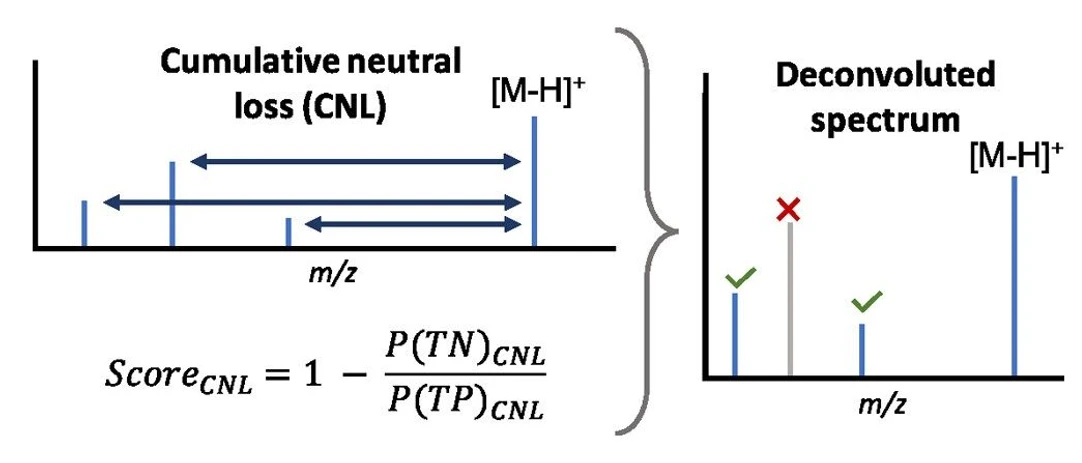
- Photo: Anal. Chem. 2023, 95, 33, 12247-12255: graphical abstract.
In the research article published in ACS Analytical Chemistry journal the researchers from Van ’t Hoff Institute for Molecular Sciences (HIMS) of the University of Amsterdam, Queensland Alliance for Environmental Health Sciences (QAEHS) of The University of Queensland, and Agilent Technologies Deutschland GmbH presented a new algorithm for improving spectral cleanup in nontarget analysis.
This study presents an algorithm for improving spectral cleanup in nontarget analysis (NTA) workflows by integrating both time and mass domain information. The algorithm uses a probability-based cumulative neutral loss (CNL) model to achieve efficient fragment deconvolution. When optimized, the model demonstrated a high true positive rate (TPr) of 95.0% and was tested on real samples, consistently achieving a TPr above 88.8% across various conditions. Compared to other methods, a combination of correlation analysis and the CNL model was most effective, providing robust results with an 84.7% TPr and significant reduction in spectral noise.
The original article
Cumulative Neutral Loss Model for Fragment Deconvolution in Electrospray Ionization High-Resolution Mass Spectrometry Data
Denice van Herwerden, Jake W. O’Brien, Sascha Lege, Bob W. J. Pirok, Kevin V. Thomas, and Saer Samanipour
Analytical Chemistry 2023 95 (33), 12247-12255
DOI: 10.1021/acs.analchem.3c00896
licensed under CC-BY 4.0
Selected sections from the article follow.
Abstract
Clean high-resolution mass spectra (HRMS) are essential to a successful structural elucidation of an unknown feature during nontarget analysis (NTA) workflows. This is a crucial step, particularly for the spectra generated during data-independent acquisition or during direct infusion experiments. The most commonly available tools only take advantage of the time domain for spectral cleanup. Here, we present an algorithm that combines the time domain and mass domain information to perform spectral deconvolution. The algorithm employs a probability-based cumulative neutral loss (CNL) model for fragment deconvolution. The optimized model, with a mass tolerance of 0.005 Da and a scoreCNL threshold of 0.00, was able to achieve a true positive rate (TPr) of 95.0%, a false discovery rate (FDr) of 20.6%, and a reduction rate of 35.4%. Additionally, the CNL model was extensively tested on real samples containing predominantly pesticides at different concentration levels and with matrix effects. Overall, the model was able to obtain a TPr above 88.8% with FD rates between 33 and 79% and reduction rates between 9 and 45%. Finally, the CNL model was compared with the retention time difference method and peak shape correlation analysis, showing that a combination of correlation analysis and the CNL model was the most effective for fragment deconvolution, obtaining a TPr of 84.7%, an FDr of 54.4%, and a reduction rate of 51.0%.
Experimental Section
LC-ESI-Q-TOF Analysis
Chromatographic separation of analytes was performed using a 1290 Infinity II LC system (Agilent Technologies, Germany), consisting of a binary pump (G7120A), an autosampler (G7129B), and a column oven (G7116B). Samples were kept in the autosampler at room temperature (ca. 20 °C) and the injection volume was usually 1 μL. Analytes were separated on a Poroshell EC-C18 column (2.1 mm × 150 mm, 2.7 μm, Agilent Technologies) at a constant flow rate of 0.5 mL/min and a column temperature of 40 °C. The mobile phases were water + 0.1% formic acid (A) and acetonitrile + 0.1% formic acid (B). The following gradient program was used for the separation of analytes: at 0 min, 95% A; at 1 min, 95% A; at 21 min, 5% A; at 23 min, 5% A; at 23.1 min, 95% A; and at 28 min, 95% A. The HPLC system was connected to a G6546A quadrupole time-of-flight (Q-TOF) mass spectrometer (Agilent Technologies), equipped with an electrospray ionization (ESI) source using the Dual Spray Agilent Jet Stream technology. The Q-TOF was operated in the high-resolution mode for the low (m/z 1700) mass range. The acquisition rate was set to 6 Hz performing all ion full scan measurements at alternating collision energies of 0, 20, and 40 eV. Data were always recorded for a mass range of m/z 50–1200 in profile storage mode. Ionization was performed in the positive mode and the ESI source was operated under the following conditions: a drying gas temperature of 225 °C, a drying gas flow of 12 L/min, a sheath gas temperature of 350 °C, a sheath gas flow of 11 L/min, and a nebulizer pressure of 35 psi. The capillary and nozzle voltages were kept at 3500 and 500 V, respectively. A reference solution, containing purine and hexakis(1H,1H,3H-tetrafluoropropoxy)phosphazine (HP-0921), was continuously supplied to the second sprayer of the ESI source using an isocratic pump (G7110B, Agilent Technologies, Germany).
Cumulative Neutral Loss Model
The CNL model was built based on the MassBank EU, MoNA, and NIST20 database entries that were obtained using electrospray ionization in positive mode with a mass resolution ≥5000, including any type of mass analyzer (i.e., Q-TOF and Orbitrap) and collision energy. (37−39) Where multiple entries for a single chemical were found, the spectra were merged to ensure that the CNLs for each compound would have equal contribution to the model, using a 0.001 Da mass window. It should be noted that 0.001 Da was not assumed to be the inherent uncertainty of the data and was used as bin width for generation of average spectra. To obtain the CNLs for each compound, the fragment m/z values from the merged spectra were subtracted from the precursor ion mass. This resulted in reducing the 360,750 individual spectra to 24,487 merged CNL spectra for unique chemical constituents. The CNLs were used in place of the fragments to better capture the structural information implicitly present in the spectra. For example, while a high-frequency fragment may not contain much structural information, a highly frequent CNL provides information on the parts of the structure that are detached during fragmentation. (40) For the CNL model building, a Bayesian (i.e., probabilistic) approach was employed to overcome the issues related to limited database and potential data leakage. (41)
These CNL spectra were used to build the true positive (TP) and true negative (TN) probability distributions that were required for the Bayesian CNL model. To calculate these, the CNL spectra were converted to binary vectors for a CNL range of 0–1000 Da with 0.001 Da steps (i.e., 1,000,001 CNL values). The TP binary vector, for each chemical, contains ones for CNLs found in the spectra and zeros for the remaining bits, while the TN binary vector contains ones for the CNLs that were not found in a spectrum (Figure 1A). The CNL masses that were larger than the precursor ion were set to zero for the TN binary vector. The TP and TN CNL occurrence distributions were calculated by summing the binary vectors obtained for all 24,487 CNL spectra and adding 1 to each CNL bin to avoid obtaining probabilities equal to 0. Finally, the TP and TN probability distributions were obtained by dividing each CNL occurrence by the total number of TP and TN CNL occurrences, respectively. Overall, building the CNL model took about 1–2 h and depended on the number of spectra and unique chemicals in the databases.
 Anal. Chem. 2023, 95, 33, 12247-12255: Figure 1. Workflow figure for construction of the CNL model (A) and an example calculation for using the CNL model with a mass tolerance of 0.005 Da and a scoreCNL threshold of 0.00 (B). The abbreviations are listed in (C).
These calculated TP and TN CNL probabilities were used as the conditional probability (i.e., P(B|A)) in the Bayes theorem (eq 1). Additionally, to be able to calculate the TP or TN probability of a precursor ion having a specific CNL (i.e., posterior probability or P(A|B)), a flat prior (P(A)) is assumed, and since the marginal probability (P(B)) is a constant normalizing factor, the Bayes theorem can be reduced to eq 2, meaning that the TP and TN probabilities given a certain CNL are proportional to the probability of a CNL given that it is a TP or TN.
(1) 𝑃(𝐴|𝐵)=𝑃(𝐵|𝐴)×𝑃(𝐴)𝑃(𝐵)
(2) 𝑃(𝐴|𝐵)∝𝑃(𝐵|𝐴)
Through eq 2, the TP and TN probabilities for a CNL can be obtained, which were used to calculate scoreCNL (eq 3). This score is used to evaluate whether a CNL belongs to a specific precursor ion mass. To calculate scoreCNL, the TP and TN sums of probability (i.e., ∑P(TP|CNL) and ∑P(TN|CNL), respectively) are obtained for specified CNL ± mass tolerance. For example, if the mass tolerance is set to 0.010 Da and a CNL mass of 18 has been found, then ∑P(TP) corresponds to the summed TP probabilities of the CNL masses of 17.99 to 18.01. After similarly calculating ∑P(TN), scoreCNL can be used to assess if the CNL in question relates to a true fragment mass of the precursor ion mass or not, corresponding to above or below the scoreCNL threshold, respectively. An example of calculating scoreCNL is depicted in Figure 1B.
(3) scoreCNL=1−∑𝑃(TN|CNL)/∑𝑃(TP|CNL)
Results and Discussion
Exploring the CNL Model
When building the CNL model, the TP and TN counts for each CNL were calculated. At first sight, a general trend of a decrease in the total number of CNL counts after a CNL of 125 Da was found (Figure S1). This was expected, since the median of all precursor ions is ±300 Da and the higher CNLs are not possible (i.e., precursor ion mass < CNLs) for more and more compounds. Additionally, a distribution of the fragment m/z counts was also generated for comparison (Figure S2). Here, it can be seen that the fragment m/z counts are less clearly defined than the CNL distribution (Figure 3). Finally, the CNL counts were converted to probabilities, and still, the same trend was observed (Figure 3). However, the probabilities in the TN distribution are much smaller than the TP probability distribution due to the larger number of TN cases than TPs. Therefore, scoreCNL is calculated that evaluates the relationship between P(TP) and P(TN).
 Anal. Chem. 2023, 95, 33, 12247-12255: Figure 3. TP and TN CNL probability distributions that are implemented in the CNL model. (A) Full probability distribution, (B) a zoomed-in fraction of the TP probability distribution, and (C, D) the TN probability distribution zoomed-in on the probability range and CNL range, respectively.
To provide an idea of what these probabilities mean in terms of chemical information, an overview of a few CNL masses with high TP probability can be found in Table S2 with the potential CHNO compositions of these CNL masses. The most prominent CNL has been found at a mass of 18.01, which corresponds to a commonly known neutral loss of water or H₂O. Other frequently occurring losses such as ammonia (NH₃), methanol (CH4O), and, when looking at larger CNLs, C₂H₄O₂ correspond to CNLs of 17.03, 32.03, and 60.02, respectively. These examples show that the CNL masses contain valuable information related to the neutral losses of the precursor ion, meaning that a fragment mass might not have the same m/z value for multiple precursor ions, while their CNL mass with that fragment is actually the same. Moreover, the CNL occurrence probabilities could potentially be used to assist fragmentation pattern prediction tools, by, for example, ranking the fragments based on their CNL occurrence probability.
Conclusions
In this paper, we showed a fragment deconvolution technique that is able to clean up LC-HRMS information, using only the information of the mass domain. For the measurements used to evaluate the performance, the CNL model, with the optimized parameters of a mass tolerance of 0.005 Da and a scoreCNL of 0.00, was able to maintain a TPr above 95%, and depending on the sample or aspect evaluated, FD rates between 33 and 79% and reduction rates between 9 and 45% have been found. Moreover, when time domain methods were combined with the CNL model, an optimal combination of correlation analysis with the CNL model was found, using a correlation threshold of 0.57 and the optimized CNL parameters. This combination was able to achieve a 51.0% reduction in the total number of fragments with a TPr of 84.7% and an FDr of 54.4%.
However, when evaluating the CNL range influence, the model performed best for the lower-range CNLs, which could be related to the higher number of TP and TN counts in this range. Therefore, it would be good if a larger number of spectra with an exact mass above 200 could be collected and included in the model. As the databases (i.e., MassBank EU, MoNA, and NIST) grow over time, the model can be easily rebuilt and optimized for the same data with the provided CNL model package. Additionally, the current model is built based on positive mode spectra. Since different fragments were found for the same chemical depending on the ionization mode, this paper focuses on the positive-mode CNL model due to the lower number of database spectra measured in negative mode. However, the developed CNLforFragments package could also be used to generate a negative-mode CNL model. Finally, when there are sufficient data available for all of the precursor ions, the potential to expand the model to obtain the likelihood of a CNL depending on the precursor ion mass could be investigated. However, there are currently too little data to implement this in the CNL model.
Overall, we showed the potential of a mass domain approach for the cleanup of fragments. The CNL model can be used when there is no time domain (e.g., for DDA) and assist existing methods when a time domain is present. Additionally, a score is calculated for each potential CNL mass, which could potentially be used as a prioritization technique to order the fragments based on true fragment likelihood. The developed algorithm is able to clean up MS2 spectra that can be fed to the structural elucidation workflows, ultimately resulting in highly confident identifications, independently from the workflow and the database. The incorporation of this model into the CompCreate.jl package for use with ULSA or other library search algorithms is an ongoing project in our group.
- Cumulative Neutral Loss Model for Fragment Deconvolution in Electrospray Ionization High-Resolution Mass Spectrometry Data Denice van Herwerden, Jake W. O’Brien, Sascha Lege, Bob W. J. Pirok, Kevin V. Thomas, and Saer Samanipour. Analytical Chemistry 2023 95 (33), 12247-12255. DOI: 10.1021/acs.analchem.3c00896